Architectural Record
search
cart
facebook twitter linkedin youtube
  • Sign In
  • Subscribe
  • Sign Out
  • My Account
Architectural Record
  • NEWS
    • Latest News
    • Awards
    • Interviews
    • Obituaries
    • Podcasts
      • Design:Ed Podcast
      • Sponsored Podcasts
  • OPINION
    • Book Reviews / Excerpts
    • Exhibition Reviews
    • Forum
  • EXCLUSIVES
    • Videos
    • Design Vanguard
    • Top 300 Firms
    • Sponsored Content
    • Sponsored eBooks
    • From the Archives
  • CONTINUING ED
    • Editorial Continuing Ed
    • CE Center
    • CE Academies
  • PROJECTS
    • Buildings By Type
    • Reuse & Renovation
    • Museums & Arts Centers
    • Colleges & Universities
    • Multifamily Housing
    • Interiors
    • Lighting
    • Kitchen & Bath
  • HOUSES
    • Record Houses
    • House of the Month
    • Featured Houses
  • PRODUCTS
    • Products by Category
    • Record Products of the Year
    • Latest Products
  • EVENTS
    • Dates & Events
    • Record on the Road
    • Innovation Conference
    • Sustainability in Practice
    • Women In Architecture
    • Webinars
    • Ad Excellence Awards
    • Submit an Event
  • CONNECT
    • Ask RECORD AI
    • Newsletters
    • Contact
    • Advertise
    • Editorial Calendar
    • Store
    • Customer Service
  • SUBMIT
    • Submission Guidelines
    • RECORD Competitions
  • MAGAZINE
    • Subscribe
    • My Account
    • Digital Edition
    • Current Issue
    • Firm Pass
    • Historic Archive
ProjectsLighting Design

Church at Worth Abbey

By Linda C. Lentz
Church at Worth Abbey
Designed to be built over time, Francis Pollen's church at Worth Abbey was erected between 1964 and 1974 but ultimately completed in 2011 by Thomas Heatherwick and a team that included DPA Lighting Design. Driven by programmable controls, the flexible lighting system allows the monks to create atmospheric scenes that illuminate the lantern and ceiling singly or in tandem, highlight the altar with an overhead pendant and perimeter spots, and use light and shadow for function or meditative effects.
 
Photo © James Newton
Church at Worth Abbey
Designed to be built over time, Francis Pollen's church at Worth Abbey was erected between 1964 and 1974 but ultimately completed in 2011 by Thomas Heatherwick and a team that included DPA Lighting Design. Driven by programmable controls, the flexible lighting system allows the monks to create atmospheric scenes that illuminate the lantern and ceiling singly or in tandem, highlight the altar with an overhead pendant and perimeter spots, and use light and shadow for function or meditative effects.
 
Photo © James Newton
Church at Worth Abbey
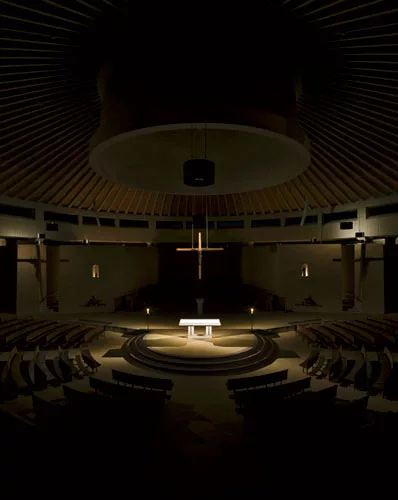
Designed to be built over time, Francis Pollen's church at Worth Abbey was erected between 1964 and 1974 but ultimately completed in 2011 by Thomas Heatherwick and a team that included DPA Lighting Design. Driven by programmable controls, the flexible lighting system allows the monks to create atmospheric scenes that illuminate the lantern and ceiling singly or in tandem, highlight the altar with an overhead pendant and perimeter spots, and use light and shadow for function or meditative effects.
 
Photo © James Newton
Church at Worth Abbey
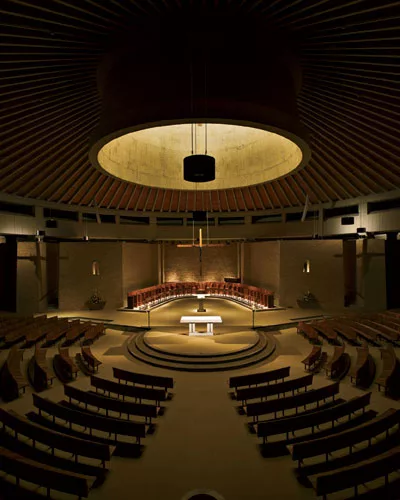
Designed to be built over time, Francis Pollen's church at Worth Abbey was erected between 1964 and 1974 but ultimately completed in 2011 by Thomas Heatherwick and a team that included DPA Lighting Design. Driven by programmable controls, the flexible lighting system allows the monks to create atmospheric scenes that illuminate the lantern and ceiling singly or in tandem, highlight the altar with an overhead pendant and perimeter spots, and use light and shadow for function or meditative effects.
 
Photo © James Newton
Church at Worth Abbey
Designed to be built over time, Francis Pollen's church at Worth Abbey was erected between 1964 and 1974 but ultimately completed in 2011 by Thomas Heatherwick and a team that included DPA Lighting Design. Driven by programmable controls, the flexible lighting system allows the monks to create atmospheric scenes that illuminate the lantern and ceiling singly or in tandem, highlight the altar with an overhead pendant and perimeter spots, and use light and shadow for function or meditative effects.
 
Photo © James Newton
Church at Worth Abbey
Designed to be built over time, Francis Pollen's church at Worth Abbey was erected between 1964 and 1974 but ultimately completed in 2011 by Thomas Heatherwick and a team that included DPA Lighting Design. Driven by programmable controls, the flexible lighting system allows the monks to create atmospheric scenes that illuminate the lantern and ceiling singly or in tandem, highlight the altar with an overhead pendant and perimeter spots, and use light and shadow for function or meditative effects.
 
Photo © James Newton
Church at Worth Abbey
November 15, 2012

Architects & Firms

Heatherwick Studio

Crawley, U.K.

People/Products

As if sparked by divine intervention, a design team led by Thomas Heatherwick completed and revitalized an important Modernist church by Francis Pollen (1926'87) for a historic Benedictine abbey, illuminating the late British architect's vision with craft and 21st-century technology.

Nestled in the bucolic West Sussex village of Crawley some 42 miles southeast of London, the Church of Our Lady, Help of Christians at Worth Abbey, built between 1964 and 1974, is one of the finest examples of that era's ecclesiastical architecture and listed as a Grade II* (or “particularly important”) building by England's Historic Buildings and Monuments Commission. It is also one of the region's largest churches, at approximately 17,000 square feet, seating up to 900 people in a vast volume that Pollen devised by incorporating bridge-building techniques into his scheme. But the striking sanctuary was never finished, and such essential details as permanent seating integral to the original circular plan were omitted. The lighting, too, was inadequate for the needs of the abbey's active community of 25 monks, the 550 students of the school they run, and the thriving congregation they serve.

Thanks to the recent contributions of generous benefactors, the design-savvy monks—including one former architect—were able to tap Heatherwick to renew and furnish the interior of their church in the round. The British designer and his studio restored the building's reinforced-concrete surfaces, replaced the windows, and improved the acoustics. They surrounded the central altar with exquisitely curved, fixed seating and choir stalls custom-made out of solid black walnut striped with ash. Then they created a distinctive portland-stone pulpit and holy-water stoups informed by Pollen's existing altar and baptismal font.

As improved lighting was crucial to the success of the project, Heatherwick engaged DPA Lighting Design to develop a strategy that would be invisible yet supply multiple layers of illumination. Most would have to be electric, because the only sunlight entering the room filters in through bands of clerestories encircling the perimeter walls and a 40-foot-wide lantern that pierces the conical timber-and-concrete roof above the altar. According to DPA's Gary Campbell, the light was very beautiful, but weak. The challenge, he explains, was to get an ample amount of well-controlled, nonglaring light down to the floor from the substantial height, which would improve light levels for reading. The monastery also requested a flexible, easy-to-use control system that would allow it to create appropriate settings for various services and events.

The first step was to refurbish Pollen's existing single-lamp fixtures—a series of cylindrical pendants and up/down sconces in rustic metal—retrofitting them with dimmable AR111 low-voltage halogen lamps. The DPA team rearranged the pendants over the clergy's seats to give them a focused beam, and supplemented the originals with four-lamp replicas suspended over the congregation to provide ambient, task, and emergency lighting (the last supplied by an auxiliary battery-powered LED). Then the team developed a robust 10-lamp version, motorized for maintenance, that hangs from the lantern's core and highlights the lectern and altar—also spotlighted for additional drama from the tops of four perimeter columns. Finally, the lighting designers tucked powerful LEDs on top of the lantern's crossbeams to brighten its walls indirectly, and rimmed its outer base with cold-cathode tubular lamping to wash the ceiling with an even glow. Everything is dimmable, and split up into zones and tasks.

The overall effect is theatrical, due in part to the preset scenes. “The architecture is stunning,” says Campbell. “And when you light that, it is incredible—like a stage set.”


People

Architect:
Heatherwick Studio — Thomas Heatherwick, principal; Peter Ayres, Fred Manson, project architects

Lighting Designer:
DPA Lighting Design — Gary Campbell, partner in charge

Engineer:
BLR Associates

Client:
Worth Abbey Monastery

Consultants:
Swift Horsman (furniture fabrication); Arup (acoustics)

General Contractor:
CMS Building Services

Size:
17,000 square feet

Completion Date:
August 2011


Products

Lighting Controls:
Lutron

Lighting:
Mike Stoane Lighting (pendants, sconces, spotlights); AC/DC (cold cathode); Philips Color Kinetics (LEDs)

Electric Hoist:
Raising & Lowering Systems

 
KEYWORDS: United Kingdom

Share This Story

Looking for a reprint of this article?
From high-res PDFs to custom plaques, order your copy today!

Linda Lentz is a former editor at Architectural Record.

Post a comment to this article

Report Abusive Comment

Subscription Center
  • Create an Account
  • Start a Subscription
  • Manage My Account
  • Sign Up for Newsletters
  • Visit Customer Service
  • Update Preferences

More Videos

Sponsored Content

Sponsored Content is a special paid section where industry companies provide high quality, objective, non-commercial content around topics of interest to the Architectural Record audience. All Sponsored Content is supplied by the advertising company and any opinions expressed in this article are those of the author and not necessarily reflect the views of Architectural Record or its parent company, BNP Media. Interested in participating in our Sponsored Content section? Contact your local rep!

close
  • cold storage facility
    Sponsored byCarlisle SynTec Systems

    How Architects Can Design More Continuous Cold Storage Envelopes

  • TAMLYN XtremeTrim Exterior Trim
    Sponsored byTamlyn

    Designing Cleaner Panel Facades: Why Exterior Trim Details Matter

  • Building with Vapor Barriers
    Sponsored byReef Industries, Inc.

    Vapor Barriers Help Control Moisture in Tighter Building Designs

DESIGN:ED Podcast
Listen to Architectural Record’s DESIGN:ED Podcast

Events

June 18, 2026

Rebooting the Aging Office Building

Credits: 1 AIA LU/HSW; 1 AIBD P-CE; 0.1 ICC CEU; 1 PDH

Explore façade retrofit strategies and award-winning design concepts that can transform aging office buildings into healthier, higher-performing workplaces for today’s hybrid workforce.

June 23, 2026

Enhancing Fire Resistance with Advanced PVC Solutions

Credits: 1 AIA LU/HSW; 1 AIBD P-CE; 0.1 ICC CEU; 1 IIBEC CEH

Evaluate advanced PVC solutions that improve fire resistance, support WUI compliance, and enhance resilience in residential and commercial building design.

View All Submit An Event

Products

2026 Architect's Square Foot Costbook

2026 Architect's Square Foot Costbook

See More Products

Popular Stories

SanDiegoAirport

Top 300 Architecture Firms of 2026

Lorcan O' Herilhy

California Architect Lorcan O’Herlihy Has Died, Age 66

Coronado Bridge

The Architect’s Guide to San Diego

CCA, Studio Gang

The Winners of the AIA’s 2026 Architecture Award Range from Collegiate Rowing Hubs to Housing for the Homeless

Dusk House

Design Vanguard 2026: ONO

Rebooting the Aging Office Building - Free Webinar - June 18, 2026

Related Articles

  • St. Nicholas Greek Orthodox_result2.jpg

    Calatrava’s New St. Nicholas Church Opens at Ground Zero

    See More
  • Val Notre-Dame Abbey by Atelier Pierre Thibault

    See More
  • Abby Kortrijk

    A Flemish Abbey Turned Museum Gets a Stark New Pavilion by Barozzi Veiga

    See More

Related Products

See More Products
  • bim design firms.jpg

    BIM for Design Firms: Data Rich Architecture at Small and Medium Scales

  • Architectural Record - October 2025

    Architectural Record October 2025 Issue

See More Products
×

The latest news and information

#1 Source for Architectural Design, News and Products

SUBSCRIBE
  • RESOURCES
    • Advertise
    • Contact Us
    • Submit
    • Store
  • ACCOUNT CENTER
    • Create an Account
    • Start a Subscription
    • Manage My Account
    • Sign Up for Newsletters
    • Visit Customer Service
    • Update Preferences
  • PRIVACY
    • PRIVACY POLICY
    • TERMS & CONDITIONS
    • DO NOT SELL MY PERSONAL INFORMATION
    • PRIVACY REQUEST
    • ACCESSIBILITY
  • SERVICES
    • Marketing Services
    • Reprints
    • Market Research
    • List Rental
    • Survey/Respondent Access
  • STAY CONNECTED
    • Linkedin
    • Facebook
    • Instagram
    • YouTube
    • X (Twitter)

Copyright ©2026. All Rights Reserved BNP Media, Inc. and BNP Media II, LLC.

Design, CMS, Hosting & Web Development :: ePublishing