Architectural Record
search
cart
facebook twitter linkedin youtube
  • Sign In
  • Subscribe
  • Sign Out
  • My Account
Architectural Record
  • NEWS
    • Latest News
    • Awards
    • Interviews
    • Obituaries
    • Podcasts
      • Design:Ed Podcast
      • Sponsored Podcasts
  • OPINION
    • Book Reviews / Excerpts
    • Exhibition Reviews
    • Forum
  • EXCLUSIVES
    • Videos
    • Design Vanguard
    • Top 300 Firms
    • Sponsored Content
    • Sponsored eBooks
    • From the Archives
  • CONTINUING ED
    • Editorial Continuing Ed
    • CE Center
    • CE Academies
  • PROJECTS
    • Buildings By Type
    • Reuse & Renovation
    • Museums & Arts Centers
    • Colleges & Universities
    • Multifamily Housing
    • Interiors
    • Lighting
    • Kitchen & Bath
  • HOUSES
    • Record Houses
    • House of the Month
    • Featured Houses
  • PRODUCTS
    • Products by Category
    • Record Products of the Year
    • Latest Products
  • EVENTS
    • Dates & Events
    • Record on the Road
    • Innovation Conference
    • Sustainability in Practice
    • Women In Architecture
    • Webinars
    • Ad Excellence Awards
    • Submit an Event
  • CONNECT
    • Ask RECORD AI
    • Newsletters
    • Contact
    • Advertise
    • Editorial Calendar
    • Store
    • Customer Service
  • SUBMIT
    • Submission Guidelines
    • RECORD Competitions
  • MAGAZINE
    • Subscribe
    • My Account
    • Digital Edition
    • Current Issue
    • Firm Pass
    • Historic Archive
Projects

National Stadium

Herzog & de Meuron creates an icon that reaches beyond the Olympics.

By Alex Pasternack
July 19, 2008

Architects & Firms

Herzog & de Meuron

Beijing, China

National Stadium lies beyond Beijing’s Fourth Ring Road, at the northern end of the imperial axis that cuts through Tiananmen Square and the Forbidden City. But it can be seen almost everywhere in the capital. Billboards, magazines, television ads, soda cans, clothes, hats, and ashtrays bear the likeness of Herzog & de Meuron’s woven-steel building, reflecting the propaganda, marketeering, and pure fascination that surround the city’s Olympic centerpiece. In a place where architectural feats tend to attract puzzlement, if not ridicule (locals use “The Egg” with a derisive tone when referring to Paul Andreu’s National Performing Arts Center), the $423 million stadium has become a rare architectural celebrity. Everyone calls it the “Bird’s Nest,” which in China means it is something much prized, an expensive delicacy eaten on special occasions.
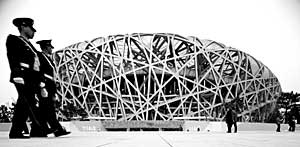
 

National Stadium
Photo ' Iwan Baan


Jacques Herzog and Pierre de Meuron, along with their project architect Stefan Marbach, developed the stadium’s distinctive design in close collaboration with a number of key Chinese players. Artist Ai Weiwei, a provocateur who famously shattered a pair of ancient Han Dynasty vases in one work, showed the architects how he manipulates old and new, and contributed ideas throughout the design process. “We learned how radical Chinese art has become,” recalled Herzog at a lecture at Columbia University in May.

Another important guide was Li Xinggang, the chief architect of China Architecture Design and Research Group (CADG), the local design institute with which Herzog & de Meuron worked. At their first design meeting in Basel in 2003, Li suggested that the Swiss architects move away from the delicate facades for which they had first become known. “Until then, the entire architectural discipline had the impression of Herzog & de Meuron as the ‘skin’ architects,” said Li. “In my opinion, if they had submitted this kind of design for the competition, they would have been denied by the Chinese people,” he said. “China wanted to have something new for this very important stadium.” The architects weren’t interested in repeating the past either. “We don’t want to be typecast,” stated Herzog, “so we are always trying to escape our biography.”

The design team began by studying Chinese ceramics. “We wanted the stadium to be a collective building, a public vessel,” explained Herzog. But they also wanted it to be “porous,” open to its surroundings. So they explored the idea of a bowl with no skin, which eventually led them to the nest scheme. At the time, Herzog & de Meuron was starting to build Allianz Arena [record, June, 2006, page 238], a soccer stadium in Munich with a translucent ETFE (ethylene tetrafluoroethylene) envelope that wraps around an elliptical frame. For the Olympic stadium, the architects went in the opposite direction, using an exposed structure, rather than a dramatic skin, to define the building’s form.

Although the stadium’s curving steel nest grabs the most attention, the building actually combines a pair of structures: a bright-red concrete bowl for seating and the iconic steel frame around it. Sight lines from the seats to the playing field helped determine the form and dimensions of the concrete bowl, while the need to include a heavy retractable roof (a requirement in the competition brief) informed the giant crisscrossing steel members on the outside of the building. Because the architects disliked the massive parallel beams necessary to support the retractable roof, they developed a lacy pattern for the other steel elements to disguise them. In the process, they created a structure that seems random and nonrepetitive. “We’re interested in complexity and ornamentation,” said Herzog, “but of the kind you would find on a Gothic cathedral, where structure and ornamentation are the same.” For Michael Kwok, the director at Arup in charge of the project, the design was gratifying. The structure may seem complicated, but it “expresses the engineering beneath it,” explained Kwok.

KEYWORDS: Beijing

Share This Story

Looking for a reprint of this article?
From high-res PDFs to custom plaques, order your copy today!
Post a comment to this article

Report Abusive Comment

Subscription Center
  • Create an Account
  • Start a Subscription
  • Manage My Account
  • Sign Up for Newsletters
  • Visit Customer Service
  • Update Preferences

More Videos

Sponsored Content

Sponsored Content is a special paid section where industry companies provide high quality, objective, non-commercial content around topics of interest to the Architectural Record audience. All Sponsored Content is supplied by the advertising company and any opinions expressed in this article are those of the author and not necessarily reflect the views of Architectural Record or its parent company, BNP Media. Interested in participating in our Sponsored Content section? Contact your local rep!

close
  • TAMLYN XtremeTrim Exterior Trim
    Sponsored byTamlyn

    Designing Cleaner Panel Facades: Why Exterior Trim Details Matter

  • Building with Vapor Barriers
    Sponsored byReef Industries, Inc.

    Vapor Barriers Help Control Moisture in Tighter Building Designs

  • Duct Interior with Prodeq System
    Sponsored byHenry, a Carlisle Company

    Designing Resilient Water Containment Systems

DESIGN:ED Podcast
Listen to Architectural Record’s DESIGN:ED Podcast

Events

June 10, 2026

Rethinking Stormwater – The Power of Porous Paving

Credits: 1 AIA LU/HSW; 1 AIBD P-CE; 0.1 ICC CEU

Learn how porous paving systems support stormwater management, reduce heat island effects, and enhance sustainable site design performance.

June 11, 2026

Very Early Warning Fire Detection for Mission-Critical Facilities

Credits: 1 AIA LU/HSW; 1 AIBD P-CE; 0.1 ICC CEU

Examine advanced fire detection strategies that support uptime and enhance safety in data centers and other mission-critical facilities.

View All Submit An Event

Products

2026 Architect's Square Foot Costbook

2026 Architect's Square Foot Costbook

See More Products

Popular Stories

Practice Matters illustration

What’s in a (Firm’s) Name? Thinking About Succession and Legacy

Practice Matters illustration

By the Numbers: Counting America's Architects

Riverdale House by Studio Lau

Riverdale House by Studio Lau

House on a Hill

Design Vanguard 2026: Forma

Crane Cove, ONO

Design Vanguard 2026 Winners

Broader Sustainability of CMU - Free Webinar - May 21, 2026

Related Articles

  • National Stadium Project Portfolio

    See More
  • Toyo Ito & Associates National Stadium of Sports Affairs Council Project Portfolio

    See More
  • National Stadium of Sports Affairs Council

    See More

Related Products

See More Products
  • manual

    2026 National Building Cost Manual

  • const estimator

    2026 National Construction Estimator

See More Products
×

The latest news and information

#1 Source for Architectural Design, News and Products

SUBSCRIBE
  • RESOURCES
    • Advertise
    • Contact Us
    • Submit
    • Store
  • ACCOUNT CENTER
    • Create an Account
    • Start a Subscription
    • Manage My Account
    • Sign Up for Newsletters
    • Visit Customer Service
    • Update Preferences
  • PRIVACY
    • PRIVACY POLICY
    • TERMS & CONDITIONS
    • DO NOT SELL MY PERSONAL INFORMATION
    • PRIVACY REQUEST
    • ACCESSIBILITY
  • SERVICES
    • Marketing Services
    • Reprints
    • Market Research
    • List Rental
    • Survey/Respondent Access
  • STAY CONNECTED
    • Linkedin
    • Facebook
    • Instagram
    • YouTube
    • X (Twitter)

Copyright ©2026. All Rights Reserved BNP Media, Inc. and BNP Media II, LLC.

Design, CMS, Hosting & Web Development :: ePublishing