The Wild Men of Paris
Gelett Burgess' influential essay from May 1910 introduced French modern art to the United States.
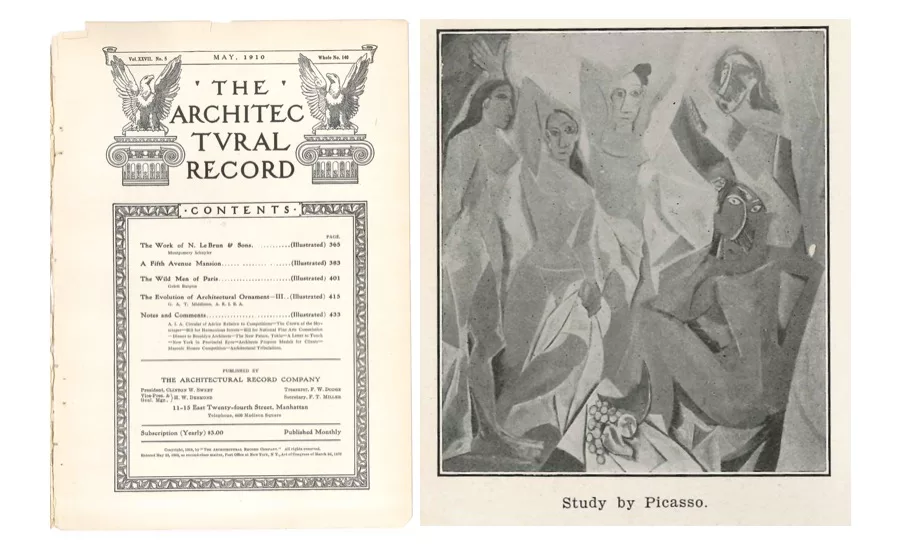
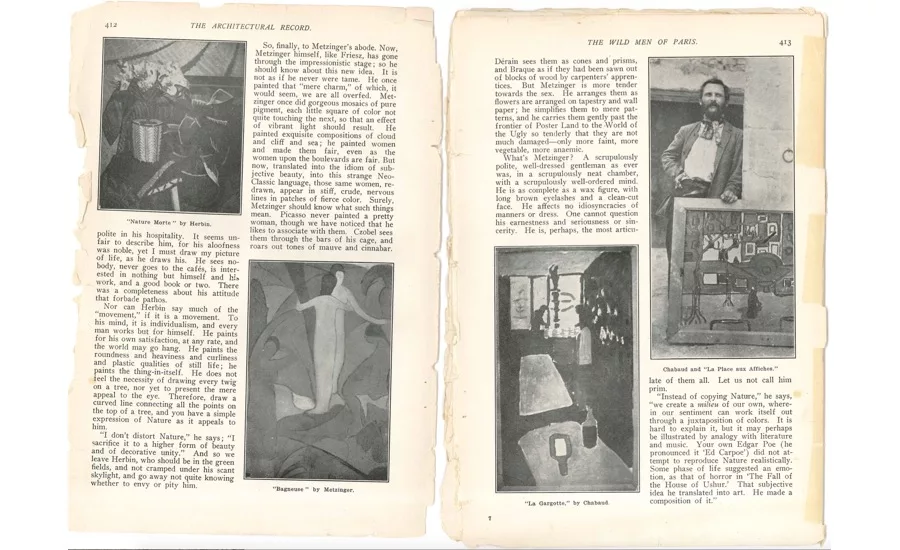
The May 1910 issue contained Gelett Burgess' article and a study for Picasso's Les Demoiselles d'Avignon.
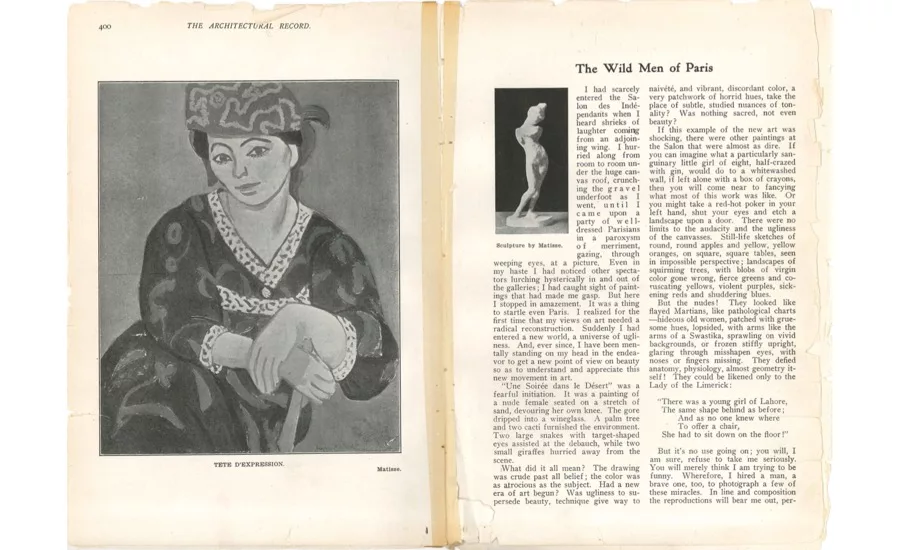
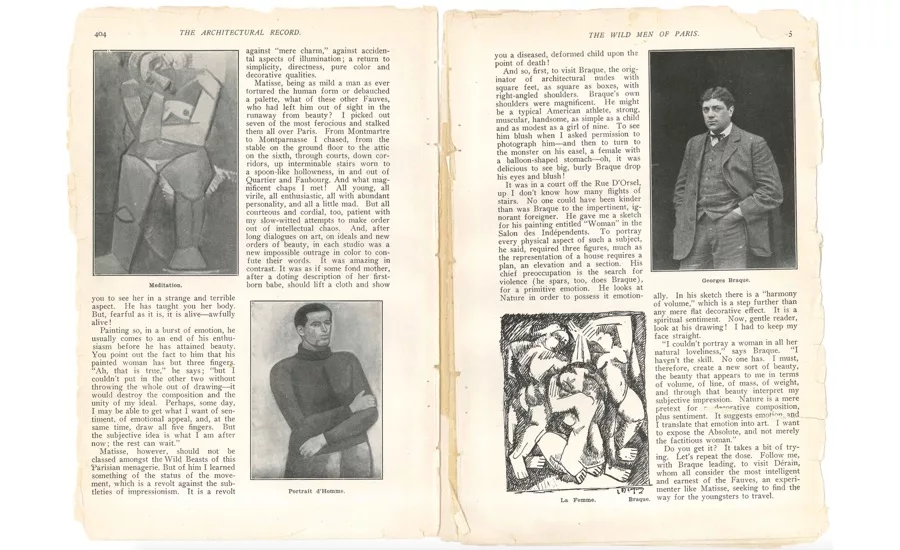
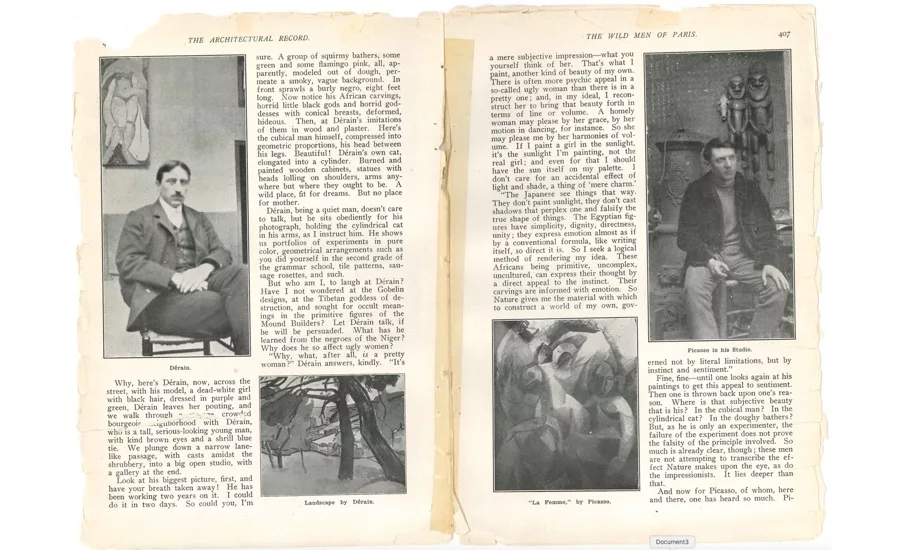
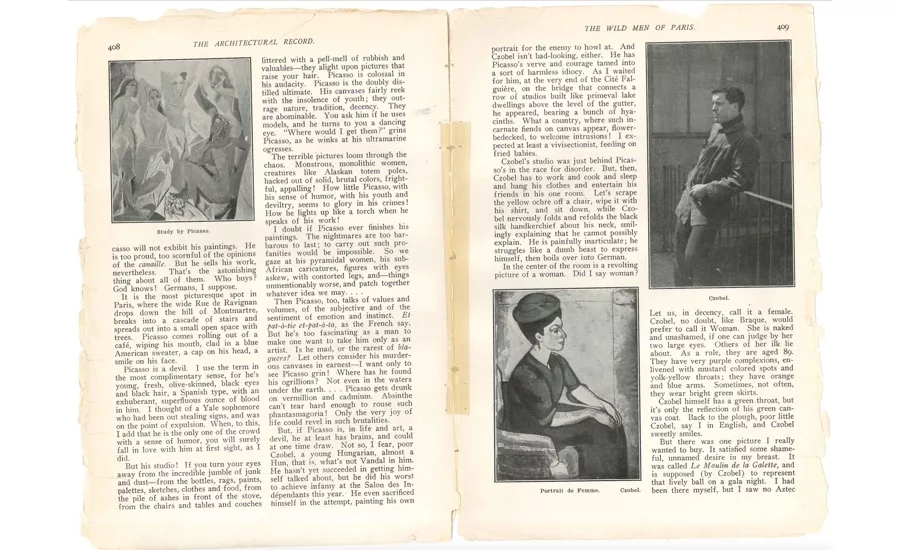
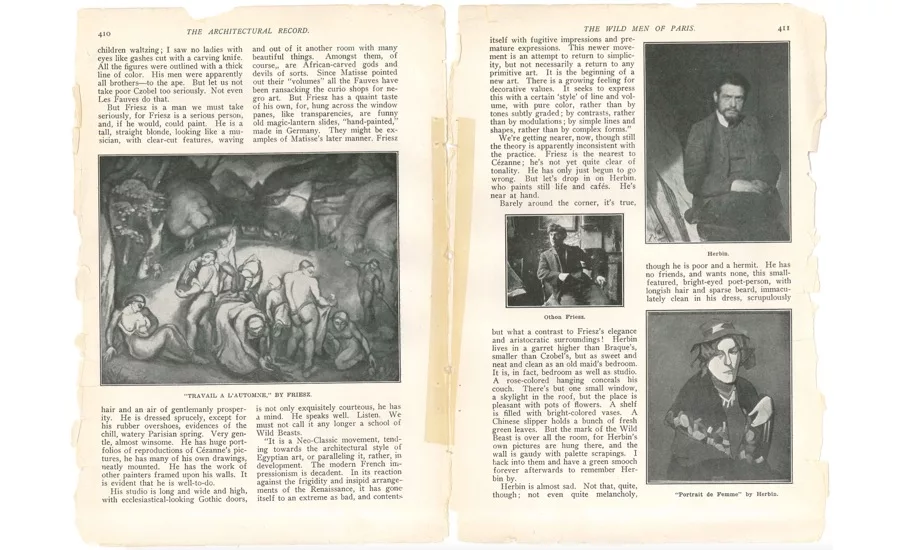
Gelett Burgess, a draftsman and illustrator by trade, is probably best known for the poetry he left behind. Though even this is somewhat lost to history, perhaps because his most famous books are volumes of nonsense poetry. Take, for example, this, probably his most famous single poem:
I never saw a Purple Cow,
I never hope to see one,
But I can tell you, anyhow,
I'd rather see than be one!
It is probably safe to say that the above is less than pure genius, coming from a man who was a contemporary of T.S. Eliot. But Burgess’s writing came from his experience working as an illustrator for magazines, and he was always more of a humorist than a philosopher.
Less well known than "The Purple Cow" is an essay Burgess wrote in 1910, after his visit to the Salon des Indépendants, the by then well-established anti-establishment exhibition of art in Paris. In 1910, Cubism was beginning to make itself known, though some of the artists that Burgess writes of, such as Picasso, had already made something of a mark (the "Blue Period" was several years in the past). But this essay, which Burgess shopped around before having it purchased by Architectural Record, has become known as a seminal work on this group, even though it is not taken entirely seriously. Burgess’s aim, after all, was as much comic as anything (he even manages to slip in a Limerick). But it marked the first time that many of these paintings, such as a study for Les Démoiselles d’Avignon, appeared in print, and even if Burgess’s art criticism isn’t up to par, his writing is hilarious.
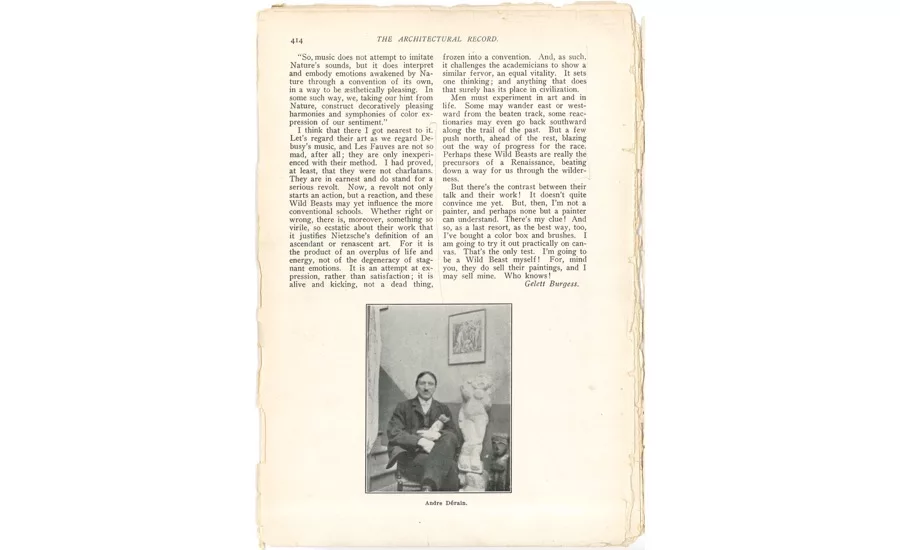
"The Wild Men of Paris" is reproduced here exactly as it appeared in RECORD, with archaic spellings and strange copyediting mistakes (Debusy instead of Debussy?) intact. View the original pages here.
The Wild Men of Paris
I had scarcely entered the Salon des Indépendants when I heard shrieks of laughter coming from an adjoining wing. I hurried along from room to room under the huge canvas roof, crunching the gravel underfoot as I went, until I came upon a party of well-dressed Parisians in a paroxysm of merriment, gazing, through weeping eyes, at a picture. Even in my haste I had noticed other spectators lurching in and out of the galleries; I had caught sight of paintings that made me gasp. But here I stopped in amazement. It was a thing to startle even Paris. I realized for the first time that my views on art needed a radical reconstruction. Suddenly I had entered a new world, a universe of ugliness. And, ever since, I have been mentally standing on my head in the endeavor to get a new point of view on beauty so as to understand and appreciate this new movement in art.
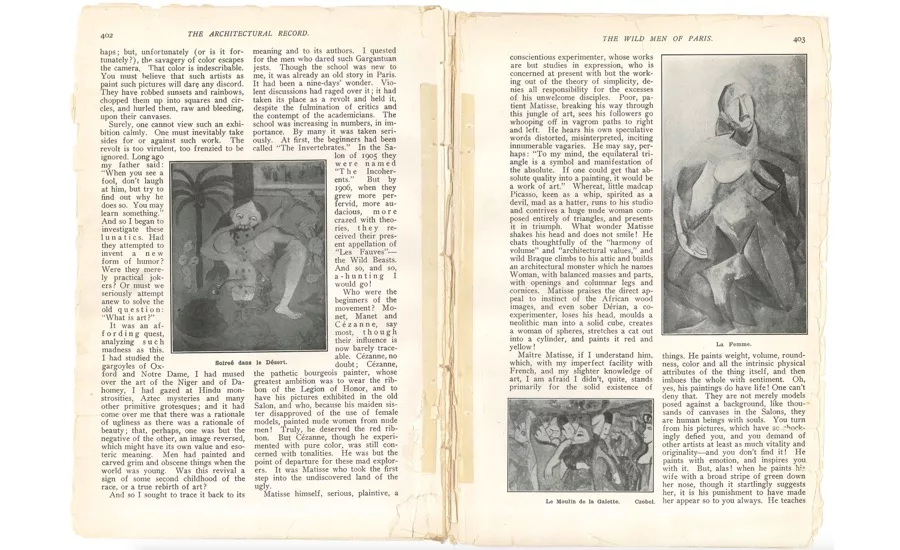
"Une Soirée dans le Désert" was a fearful initiation. It was a painting of a nude female seated on a stretch of sand, devouring her own knee. The gore dripped into a wineglass. A palm tree and two cacti furnished the environment. Two large snakes with target-shaped eyes assisted at the debauch, while two small giraffes hurried away from the scene.
What did it all mean? The drawing was crude past all belief; the color was as atrocious as the subject. Had a new era of art begun? Was ugliness to supersede beauty, technique to give way to naivété, and vibrant, discordant color, a very patchwork of horrid hues, take the place of subtle, studied nuances of tonality? Was nothing sacred, not even beauty?
Looking for quick answers on architecture and design topics?
Try Ask RECORD, our new smart AI search tool.
Ask RECORD →
If this example of the new art was shocking, there were other paintings at the Salon that were almost as dire. If you can imagine what a particularly sanguinary little girl of eight, half-crazed with gin, would do to a whitewashed wall, if left alone with a box of crayons, then you will come near to fancying what most of this work was like. Or you might take a red-hot poker in your left hand, shut your eyes and etch a landscape upon a door. There were no limits to the audacity and the ugliness of the canvasses. Still-life sketches of round, round apples and yellow, yellow oranges, on square, square tables, seen in impossible perspective; landscapes of squirming trees, with blobs of virgin color gone wrong, fierce greens and coruscating yellows, violent purples, sickening reds and shuddering blues.
But the nudes! They looked like flayed Martians, like pathological charts—hideous old women, patched with gruesome hues, lopsided, with arms like the arms of a Swastika, sprawling on vivid backgrounds, or frozen stiffly upright, glaring through misshapen eyes, with noses or fingers missing. They defied anatomy, physiology, almost geometry itself! They could be likened only to the Lady of the Limerick:
"There was a young girl of Lahore,
The same shape behind as before;
And as no one knew where
To offer a chair,
She had to sit down on the floor!"
But it’s no use going on; you will, I am sure, refuse to take me seriously. You will merely think I am trying to be funny. Wherefore, I hired a man, a brave one too, to photograph a few of these miracles. In line and composition the reproductions will bear me out, perhaps; but unfortunately (or is it fortunately?), the savagery of color escapes the camera. That color is indescribable. You must believe that such artists as paint such pictures will dare any discord. They have robbed sunsets and rainbows, chopped them up into squares and circles, and hurled them, raw and bleeding, upon their canvases.
Surely, one cannot view such an exhibition calmly. One must inevitably take sides for or against such work. The revolt is too virulent, too frenzied to be ignored. Long ago my father said: "When you see a fool, don’t laugh at him, but try to find out why he does so. You may learn something." And so I began to investigate these lunatics. Had they attempted to invent a new form of humor? Were they merely practical jokers? Or must we attempt anew to solve the old question: "What is art?"
It was an affording quest, analyzing such madness as this. I had studied the gargoyles of Oxford and Notre Dame, I had mused over the art of the Niger and of Dahomey, I had gazed at Hindu monstrosities, Aztec mysteries and many other primitive grotesques; and it had come over me that there was a rationale of ugliness as there was a rationale of beauty; that, perhaps, one was but the negative of the other, an image reversed, which might have its own value and esoteric meaning. Men had painted and carved grim and obscene things when the world was young. Was this revival a sign of some second childhood of the race, or a true rebirth of art?
And so I sought to trace it back to its meaning and to its authors. I quested for the men who dared such Gargantuan jests. Though the school was new to me, it was already an old story in Paris. It had been a nine-days’ wonder. Violent discussions had raged over it; it had taken its place as a revolt and held it, despite the fulmination of critics and the contempt of academicians. The school was increasing in numbers, in importance. By many it was taken seriously. At first, the beginners had been called "The Invertebrates." In the Salon of 1905 they were named "The Incoherents." But by 1906, when they grew more perfervid, more audacious, more crazed with theories, they received their present appellation of "Les Fauves"—the Wild Beasts. And so, and so, a-hunting I would go!
Who were the beginners of the movement? Monet, Manet and Cézanne, say most, though their influence is now barely traceable. Cézanne, no doubt; Cézanne the pathetic bourgeois painter, whose greatest ambition was to wear the ribbon of the Legion of Honor, and to have his pictures exhibited in the old Salon, and who, because his maiden sister disapproved of the use of female models, painted nude women from nude men! Truly, he deserved the red ribbon. But Cézanne, though he experimented with pure color, was still concerned with tonalities. He was but the point of departure for these mad explorers. It was Matisse who took the first step into the undiscovered land of the ugly.
Matisse himself, serious, plaintive, a conscientious experimenter, whose works are but studies in expression, who is concerned at present with but the working out of the theory of simplicity, denies all responsibility for the excesses of his unwelcome disciples. Poor, patient Matisse, breaking his way through this jungle of art, sees his followers go whooping off in vagrom paths to right and left. He hears his own speculative words distorted, misinterpreted, inciting innumerable vagaries. He may say, perhaps: "To my mind, the equilateral triangle is a symbol and manifestation of the absolute. If one could get that absolute quality into a painting, it would be a work of art." Whereat, little madcap Picasso, keen as a whip, spirited as a devil, mad as a hatter, runs to his studio and contrives a huge nude woman composed entirely of triangles, and presents it in triumph. What wonder Matisse shakes his head and does not smile! He chats thoughtfully of the "Harmony and volume" and "architectural values," and wild Braque climbs to his attic and builds an architectural monster which he names Woman, with balanced masses and parts, with openings and columnar legs and cornices. Matisse praises the direct appeal to instinct of the African wood images, and even a sober Dérain, a co-experimenter, loses his head, moulds a neolithic man into a solid cube, creates a woman of spheres, stretches a cat out into a cylinder, and paints it red and yellow!
Maître Matisse, if I understand him, which, with my imperfect facility with French, and my slighter knowledge of art, I am afraid I didn’t, quite, stands primarily for the solid existence of things. He paints weight, volume, roundness, color, and all the intrinsic physical attributes of the thing itself, and then imbues the whole with sentiment. Oh, yes, his paintings do have life! One can’t deny that. They are not merely models posed against a background, like thousands of canvases in the Salons, they are human beings with souls. You turn from his pictures, which have so shockingly defied you, and you demand of other artists at least as much vitality and originality—and you don’t find it! He paints with emotion, and inspires you with it. But, alas! When he paints his wife with a broad stripe of green down her nose, though it startlingly suggests her, it is his punishment to have made her appear so to you always. He teaches you to see her in a strange and terrible aspect. He has taught you her body. But, fearful as it is, it is alive—awfully alive!
Looking for a reprint of this article?
From high-res PDFs to custom plaques, order your copy today!