Architectural Record
search
cart
facebook twitter linkedin youtube
  • Sign In
  • Subscribe
  • Sign Out
  • My Account
Architectural Record
  • NEWS
    • Latest News
    • Awards
    • Interviews
    • Obituaries
    • Podcasts
      • Design:Ed Podcast
      • Sponsored Podcasts
  • OPINION
    • Book Reviews / Excerpts
    • Exhibition Reviews
    • Forum
  • EXCLUSIVES
    • Videos
    • Design Vanguard
    • Top 300 Firms
    • Sponsored Content
    • Sponsored eBooks
    • From the Archives
  • CONTINUING ED
    • Editorial Continuing Ed
    • CE Center
    • CE Academies
  • PROJECTS
    • Buildings By Type
    • Reuse & Renovation
    • Museums & Arts Centers
    • Colleges & Universities
    • Multifamily Housing
    • Interiors
    • Lighting
    • Kitchen & Bath
  • HOUSES
    • Record Houses
    • House of the Month
    • Featured Houses
  • PRODUCTS
    • Products by Category
    • Record Products of the Year
    • Latest Products
  • EVENTS
    • Dates & Events
    • Record on the Road
    • Innovation Conference
    • Sustainability in Practice
    • Women In Architecture
    • Webinars
    • Ad Excellence Awards
    • Submit an Event
  • CONNECT
    • Ask RECORD AI
    • Newsletters
    • Contact
    • Advertise
    • Editorial Calendar
    • Store
    • Customer Service
  • SUBMIT
    • Submission Guidelines
    • RECORD Competitions
  • MAGAZINE
    • Subscribe
    • My Account
    • Digital Edition
    • Current Issue
    • Firm Pass
    • Historic Archive

Investments in Public Architecture Pay Off for the City
By James Murdock
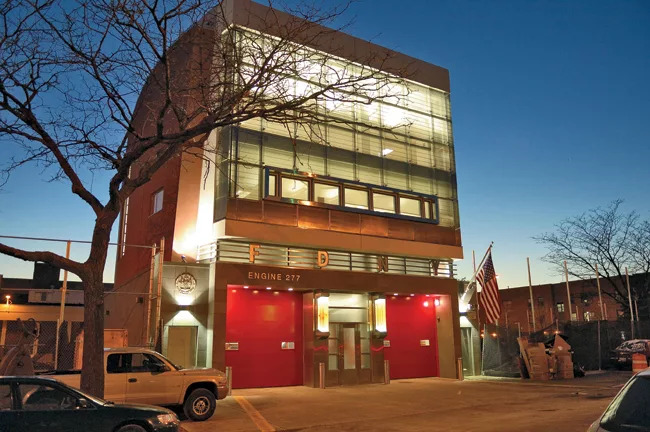
The architects enclosed the upper two floors of this Brooklyn station in glass, while red doors open on the ground floor, creating a street-facing facade that reads as both a contemporary facility and
Engine Company 27
STV GROUP
New York
The architects enclosed the upper two floors of this Brooklyn station in glass, while red doors open on the ground floor, creating a street-facing facade that reads as both a contemporary facility and a traditional firehouse.
Photo © Nicholas Buccalo
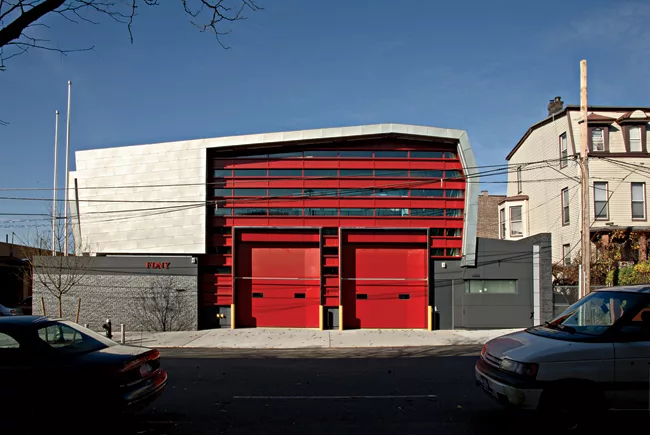
Ennead used immediately identifiable firehouse doors set into alternating glass and metal panels and wrapped in a form inspired by a firefighter's helmet for this Bronx station housing a specialized r
Rescue Company 3
Ennead
New York
Ennead used immediately identifiable firehouse doors set into alternating glass and metal panels and wrapped in a form inspired by a firefighter's helmet for this Bronx station housing a specialized rescue unit.
Photo © Jeff Goldberg/Esto
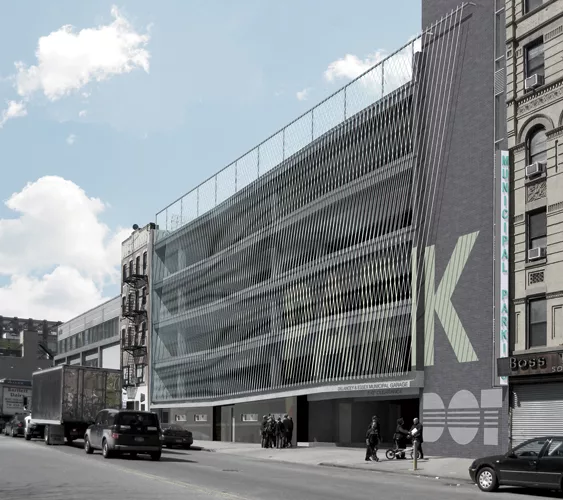
Charged with rehabilitating a municipal parking facility on Manhattan's Lower East Side, the architects draped the structure's east-facing facade in cables made of a lightweight composite metal sheath
Delancey and Essex Street Municipal Garage
Michielli + Wyetzner Architects
New York
Charged with rehabilitating a municipal parking facility on Manhattan's Lower East Side, the architects draped the structure's east-facing facade in cables made of a lightweight composite metal sheathed in stainless steel. The practical design allows light and air to penetrate while recalling the neighborhood's history as a center of textile production.
Photo courtesy Michielli + Wyetzner Architects
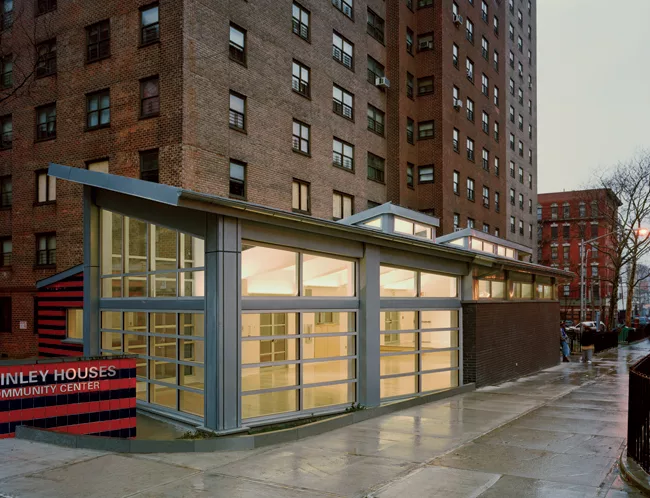
Commissioned by the DDC for a Bronx public housing complex, this community room incorporates generous fenestration to distinguish it from surrounding brick-clad buildings.
McKinley Community Center
Alexander Gorlin Architects
New York
Commissioned by the DDC for a Bronx public housing complex, this community room incorporates generous fenestration to distinguish it from surrounding brick-clad buildings.
Photo © Michael Moran
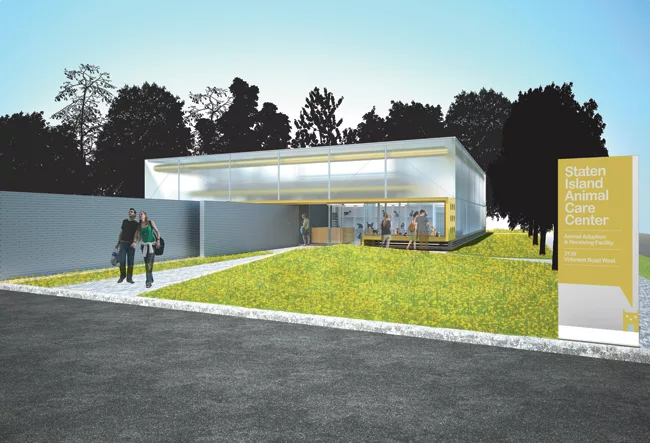
Garrison gave animals prime window space both to lure would-be adopters and to allow daylighting.
Staten Island Animal Care Center
Garrison Architects
New York
Garrison gave animals prime window space both to lure would-be adopters and to allow daylighting.
Image courtesy Garrison Architects
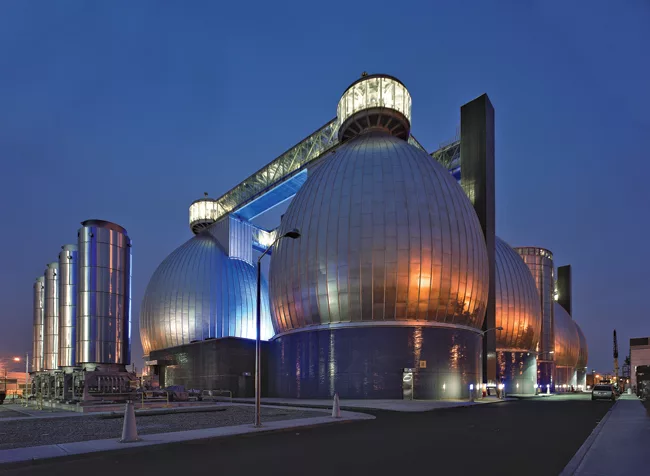
Working for the Department of Environmental Protection, Ennead wrapped this facility's 'digester eggs' in stainless steel. At night, they look almost too glamorous for their function, processing waste
Newtown Creek Water Pollution Control Plant
Ennead
New York
Working for the Department of Environmental Protection, Ennead wrapped this facility's 'digester eggs' in stainless steel. At night, they look almost too glamorous for their function, processing wastewater.
Photo © Walter Dufresne
Colorful pathways and signage guide visitors through this new children's library adjacent to the borough's main branch, also master-planned by 1100 Architect. Activities inside connect to the surround
Queens Central Library Children's Discovery Center
1100 Architect and Lee H. Skolnick Architecture + Design Partnership
New York
Colorful pathways and signage guide visitors through this new children's library adjacent to the borough's main branch, also master-planned by 1100 Architect. Activities inside connect to the surrounding neighborhood through sidewalk-facing glass walls.
Photo © Michael Moran
A skylit central corridor separates book stacks from a community room and staff offices in this one-story library. The design brings daylight into the building and, the architects say, was inspired by
Mariners Harbor Branch Library
Atelier Pagnamenta Torriani Architects
New York
A skylit central corridor separates book stacks from a community room and staff offices in this one-story library. The design brings daylight into the building and, the architects say, was inspired by a cracked oyster ' recalling the Staten Island neighborhood's maritime past.
Image courtesy Atelier Pagnamenta Torriani Architects
Windows on the west-facing side of this aluminum-clad Queens Library branch will give Manhattanites, directly across the river, a view of patrons walking between floors in the 80-foot-tall building.
Hunters Point Library
Steven Holl Architects
New York
Windows on the west-facing side of this aluminum-clad Queens Library branch will give Manhattanites, directly across the river, a view of patrons walking between floors in the 80-foot-tall building.
Image courtesy Steven Holl Architects
Displacement ventilation inside and a glazed curtain wall paired with interior light shelves are two of this building's sustainable strategies.
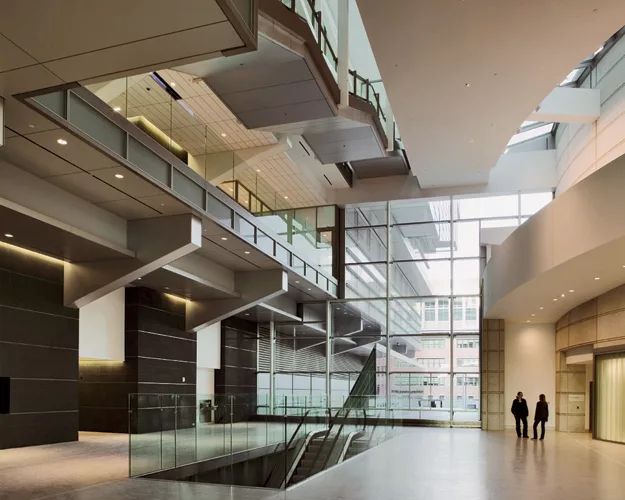
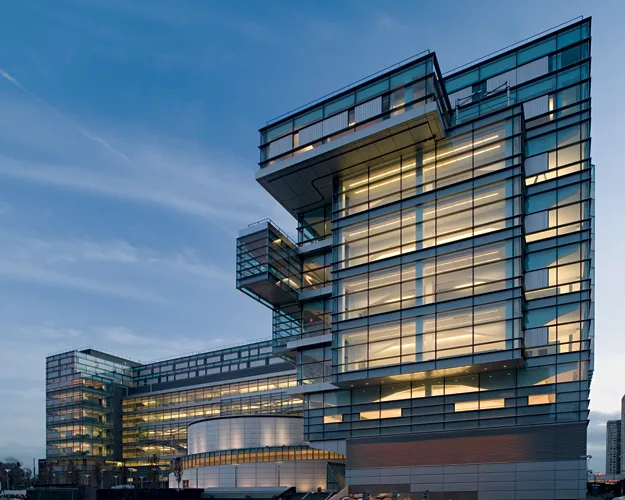
Bronx County Hall of Justice
Rafael Vi'oly Architects
New York
Displacement ventilation inside and a glazed curtain wall paired with interior light shelves are two of this building's sustainable strategies.
Photo © Paul Warchol
Next to the Van Wyck Expressway in Queens, the architect's revamp of a maintenance and refueling station for Department of Transportation vehicles includes a monitoring station with a shape and facade
Harper Street Yard
Reconstruction Narchitects
New York
Next to the Van Wyck Expressway in Queens, the architect's revamp of a maintenance and refueling station for Department of Transportation vehicles includes a monitoring station with a shape and facade that reference traffic signs.
Photo courtesy Narchitects
The architects enclosed the upper two floors of this Brooklyn station in glass, while red doors open on the ground floor, creating a street-facing facade that reads as both a contemporary facility and
Ennead used immediately identifiable firehouse doors set into alternating glass and metal panels and wrapped in a form inspired by a firefighter's helmet for this Bronx station housing a specialized r
Charged with rehabilitating a municipal parking facility on Manhattan's Lower East Side, the architects draped the structure's east-facing facade in cables made of a lightweight composite metal sheath
Commissioned by the DDC for a Bronx public housing complex, this community room incorporates generous fenestration to distinguish it from surrounding brick-clad buildings.
Garrison gave animals prime window space both to lure would-be adopters and to allow daylighting.
Working for the Department of Environmental Protection, Ennead wrapped this facility's 'digester eggs' in stainless steel. At night, they look almost too glamorous for their function, processing waste
Colorful pathways and signage guide visitors through this new children's library adjacent to the borough's main branch, also master-planned by 1100 Architect. Activities inside connect to the surround
A skylit central corridor separates book stacks from a community room and staff offices in this one-story library. The design brings daylight into the building and, the architects say, was inspired by
Windows on the west-facing side of this aluminum-clad Queens Library branch will give Manhattanites, directly across the river, a view of patrons walking between floors in the 80-foot-tall building.
Displacement ventilation inside and a glazed curtain wall paired with interior light shelves are two of this building's sustainable strategies.
Next to the Van Wyck Expressway in Queens, the architect's revamp of a maintenance and refueling station for Department of Transportation vehicles includes a monitoring station with a shape and facade
September 16, 2011
New York

New York champions design in municipal projects from fire stations and garages to libraries and courthouses.

Photo © Nicholas Buccalo

Click the image above to view recent civic projects in New York City.

Click the image above to view recent civic projects in New York City.

Located in Hunters Point — a formerly industrial neighborhood in the midst of a transformation every bit as sweeping as its view of Manhattan across the East River — a new branch of the Queens Public Library, designed by Steven Holl Architects, will be the jewel in a crown of several projects slated for the area. In their design, Holl and senior partner Chris McVoy blow apart the Carnegie library archetype, punching irregularly shaped windows into an 80-foot-tall facade clad in aluminum panels. These curvy openings will showcase the movement of bodies, like video game characters on an iPad screen, to underscore the library’s evolution from a place that circulates books to one where communities mix and mingle.

When it opens in 2013, the Hunters Point library will join scores of other new branches, cultural facilities, police stations, firehouses, and clinics constructed during New York City’s civic building boom of the last decade. The city’s Department of Design & Construction (DDC), which manages these projects, has become a sterling advocate for innovative architecture. The bureau has not only had a positive impact on neighborhoods in all five boroughs, it has been an important source of commissions for the city’s architects. The DDC also helped institute a high-performance building program to promote New York City sustainability, paving the way for a law passed in 2005, which mandates that most municipal construction projects that cost more than $2 million must achieve a minimum LEED Silver certification. Doing public work has become alluring for architects who want to create “buildings that are clearly about the user,” says Rick Bell, executive director of the AIA’s New York chapter.

The DDC completed nearly $6 billion in new projects and upgrades between 2002 and 2010, and is currently managing the construction of nearly $3 billion more, with $2 billion in additional building in the pipeline. It’s a staggering amount that recalls the days of master builder Robert Moses. In spirit, however, it may more closely resemble Mayor John Lindsay’s Urban Design Group, which sought to bring high-quality architecture to public projects in the late 1960s.

While Mayor Michael Bloomberg often gets credit for the DDC’s success, his predecessor, Rudolph Giuliani, actually created the agency in 1996. But it was Bloomberg who tapped David Burney to become DDC commissioner in 2004. An architect by training, Burney was previously the director of design and capital improvement for the housing authority. One of his first initiatives at the DDC was to create the Design and Construction Excellence (D+CE) program. “When you think about all five boroughs and how much is controlled by the city — the streets, the museums, the libraries — civic architecture is responsible for quite a lot of our environment,” Burney says. “That makes design quality all the more important, right down to the smallest projects.”

The D+CE did away with a procurement process that awarded design contracts to the lowest bidder. In its place, Burney created a quality-based system in which architects apply to join an approved roster. Twenty small firms vie for jobs under $15 million, while eight large offices compete for those between $15 and $50 million All architects, including others beyond the list, may go after the biggest projects — the largest to date has been Perkins + Will’s New York City Police Academy in Queens. With few exceptions, design fees depend on the construction budget: A certain percent for projects under $15 million and another for those over it.

The D+CE program echoes that of the Federal General Services Administration, led until 2005 by Ed Feiner, whom Burney refers to as his mentor. But the federal program relies on well-established architects, while Burney seeks younger and smaller firms.

“A program like this really means everything to us,” says Sara Caples, one-half of the husband-and-wife team Caples Jefferson, whose work for the city includes the Weeksville Heritage Center in Brooklyn — an exhibition building and park incorporating the 200-year-old houses of freed slaves — and an addition to the Queens Theatre in the Park. “It’s allowed us to win national design awards and be published around the world.”

The New York office of the British firm Grimshaw Architects has doubled in size since taking on projects that include renovating the Queens Museum of Art, as well as designing a new Fulton Street Transit Center and the Via Verde housing complex. “We can do what architects were doing 75 or 100 years ago when they were building great public libraries and so forth,” says partner Andrew Whalley.

Such civic work helps architects weather inevitable economic downturns. “It’s very important for any firm to have a consistent level of work,” says James Garrison, whose small, eponymous office has designed six city projects, including a revamped Roberto Clemente pedestrian plaza in the Bronx and the new Staten Island Animal Care Shelter. “Downturns can decimate architectural practice. The big recession of the ’70s cut a tremendous amount of technical knowledge, and this one could do the same.”

Still, there’s a downside to Burney’s approach: The design-build process tends to be arduous. The various clients, or city agencies, control their own construction budgets, and other stakeholders such as city council members, borough presidents, and local community boards all have their say. Depending on the project, the Public Design Commission — which reviews construction on city-owned property — must grant final approval.

To expedite the process the DDC assigns to each project a liaison staffer whose sole responsibility is to champion design, not to watch budgets or schedules. “A lot of clients can be wary of architects, especially in city work, thinking they’re going to get something they didn’t ask for,” says Todd Schliemann, an Ennead design principal. “The DDC has been really good about backing us up with the user.” The liaisons also shepherd plans through the maze of city bureaucracy. “We joke that we’re like the dating agency that then becomes the guidance counselor,” says Burney.

Kenneth Jackson
What New York City does successfully is adaptive reuse. Look at the High Line, or Chelsea Market. They show how you shift from being a manufacturing center to basing a new economy on quality of life. People can move anywhere these days. When they're trying to decide should I live in Dallas, where I can get free parking, an acre of land and a swimming pool, or should I live New York, quality of life matters. Architecture is a big part of that.
NEW YORKERS ON NEW YORK
Kenneth Jackson,
historian

With so many reviews and voices involved, the time frame for D+CE projects is typically longer than in the private sector. “And your fee doesn’t go up if your project lasts five years as opposed to two,” says Frank Michielli, a principal of Michielli + Wyetzner Architects.

Critics contend that the program’s focus on small projects distracts from larger issues in Bloomberg’s development agenda. “At some level, design excellence is a sideshow that takes people’s eye off the bigger problems of the city,” says Alexander Gorlin. He and some other architects believe that the public-private partnerships behind massive projects outside DDC’s purview, such as the Atlantic Yards redevelopment in Brooklyn, often result in bland architecture that is out of scale with their surroundings. “Economic models drive these projects, not quality,” says BKSK Architects partner Joan Krevlin.

But other observers credit the Bloomberg administration with making New York a more livable city. “Personalities matter,” says Kenneth Jackson, a professor of history at Columbia University. “In the 1960s people said New York was going to hell. Who would have thought that we’d now be selling quality of life? That’s an enormous change. Municipal leadership has a huge amount to do with it.”

Improving quality of life creates a positive cycle, according to Jackson, and this ultimately “underpins the architecture.” Giuliani helped lower crime rates, which lured people back to New York in the Bloomberg era and gave developers confidence to build new apartments. Furthermore, projects like the High Line spur development and propel the idea that good design can be an economic engine.

For now, with the economy in decline and budgets slashed, the number of DDC projects is shrinking. But architects hope that when activity picks up again, the public will retain its newfound appreciation for good design — and the city will continue to take a chance on emerging and established architects alike.

“[The D+CE] just seems like what cities should be doing,” says Deborah Berke, of Deborah Berke & Partners. “It’s so enlightened, particularly for New York, where so many great architects work all over the globe. To have them actually working for their own city is both brilliant and a no-brainer.”

James Murdock is a writer and filmmaker based in New York City.

Share This Story

Looking for a reprint of this article?
From high-res PDFs to custom plaques, order your copy today!

Post a comment to this article

Report Abusive Comment

Subscription Center
  • Create an Account
  • Start a Subscription
  • Manage My Account
  • Sign Up for Newsletters
  • Visit Customer Service
  • Update Preferences

More Videos

Sponsored Content

Sponsored Content is a special paid section where industry companies provide high quality, objective, non-commercial content around topics of interest to the Architectural Record audience. All Sponsored Content is supplied by the advertising company and any opinions expressed in this article are those of the author and not necessarily reflect the views of Architectural Record or its parent company, BNP Media. Interested in participating in our Sponsored Content section? Contact your local rep!

close
  • TAMLYN XtremeTrim Exterior Trim
    Sponsored byTamlyn

    Designing Cleaner Panel Facades: Why Exterior Trim Details Matter

  • Building with Vapor Barriers
    Sponsored byReef Industries, Inc.

    Vapor Barriers Help Control Moisture in Tighter Building Designs

  • Duct Interior with Prodeq System
    Sponsored byHenry, a Carlisle Company

    Designing Resilient Water Containment Systems

DESIGN:ED Podcast
Listen to Architectural Record’s DESIGN:ED Podcast

Events

June 11, 2026

Very Early Warning Fire Detection for Mission-Critical Facilities

Credits: 1 AIA LU/HSW; 1 AIBD P-CE; 0.1 ICC CEU

Examine advanced fire detection strategies that support uptime and enhance safety in data centers and other mission-critical facilities.

June 16, 2026

Focus on the Façade: Exploring Steel, Timber & Fire-Rated Curtain Walls and Channel Glass Systems

Credits: 1 AIA LU/HSW; 1 AIBD P-CE; 0.1 ICC CEU

Explore modern façade and glazing systems that enhance daylighting, fire safety, and thermal performance while expanding architectural design possibilities.

View All Submit An Event

Products

2026 Architect's Square Foot Costbook

2026 Architect's Square Foot Costbook

See More Products

Popular Stories

Practice Matters illustration

What’s in a (Firm’s) Name? Thinking About Succession and Legacy

Coronado Bridge

The Architect’s Guide to San Diego

Practice Matters illustration

By the Numbers: Counting America's Architects

Crane Cove, ONO

Design Vanguard 2026 Winners

House on a Hill

Design Vanguard 2026: Forma

Broader Sustainability of CMU - Free Webinar - May 21, 2026

Related Articles

  • Call for Entries! By the City / For the City Design Competition

    See More
  • A New Era for the City of Culture

    See More
  • Citizen ane

    Review of New Film 'Citizen Jane: Battle for the City'

    See More

Related Products

See More Products
  • 3dthinking.jpg

    3D Thinking in Design and Architecture: From Antiquity to the Future

  • book3.jpg

    If Architecture is a Language, Then a Building is a Story

See More Products
×

The latest news and information

#1 Source for Architectural Design, News and Products

SUBSCRIBE
  • RESOURCES
    • Advertise
    • Contact Us
    • Submit
    • Store
  • ACCOUNT CENTER
    • Create an Account
    • Start a Subscription
    • Manage My Account
    • Sign Up for Newsletters
    • Visit Customer Service
    • Update Preferences
  • PRIVACY
    • PRIVACY POLICY
    • TERMS & CONDITIONS
    • DO NOT SELL MY PERSONAL INFORMATION
    • PRIVACY REQUEST
    • ACCESSIBILITY
  • SERVICES
    • Marketing Services
    • Reprints
    • Market Research
    • List Rental
    • Survey/Respondent Access
  • STAY CONNECTED
    • Linkedin
    • Facebook
    • Instagram
    • YouTube
    • X (Twitter)

Copyright ©2026. All Rights Reserved BNP Media, Inc. and BNP Media II, LLC.

Design, CMS, Hosting & Web Development :: ePublishing