Partners in Design: Alfred H. Barr Jr. and Philip Johnson
Modernism's Backstory: A book and exhibition explore the collaboration that brought modernist architecture to America.
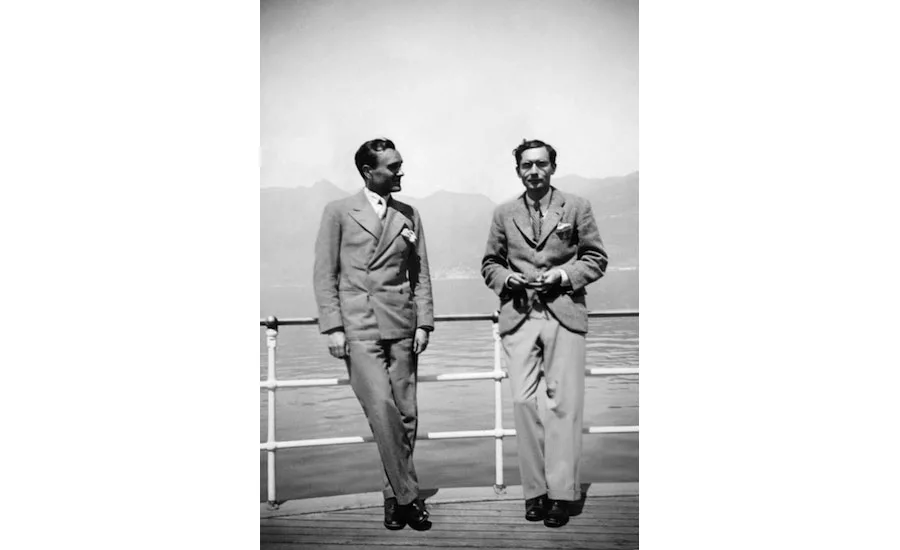
Philip Johnson and Alfred Barr, Lake Maggiore, Switzerland, April 1933.
Photo © The Museum of Modern Art, licensed by SCALA/Art Resource, New York
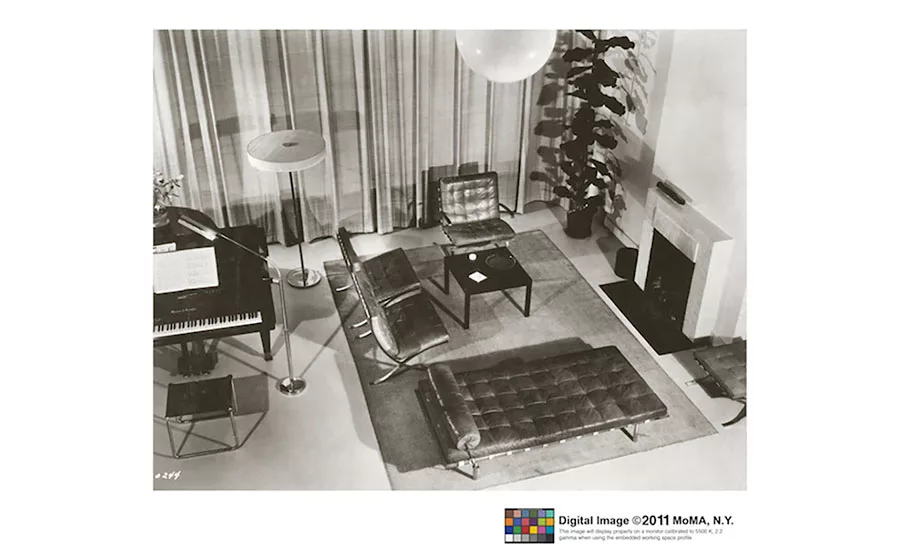
Living room, Philip Johnson’s Turtle Bay apartment, 216 East 49th Street, New York, c. 1934.
Photo © The Museum of Modern Art/Licensed by SCALA/Art Resource, New York.
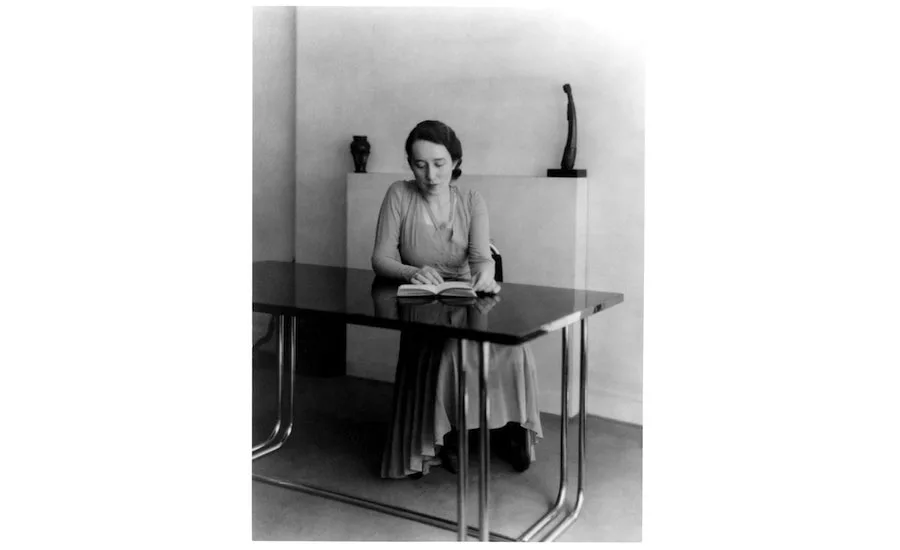
Marga Barr seated at the Donald Deskey table. Barr apartment, Two Beekman Place, c. 1934.
Photo courtesy Victoria Barr
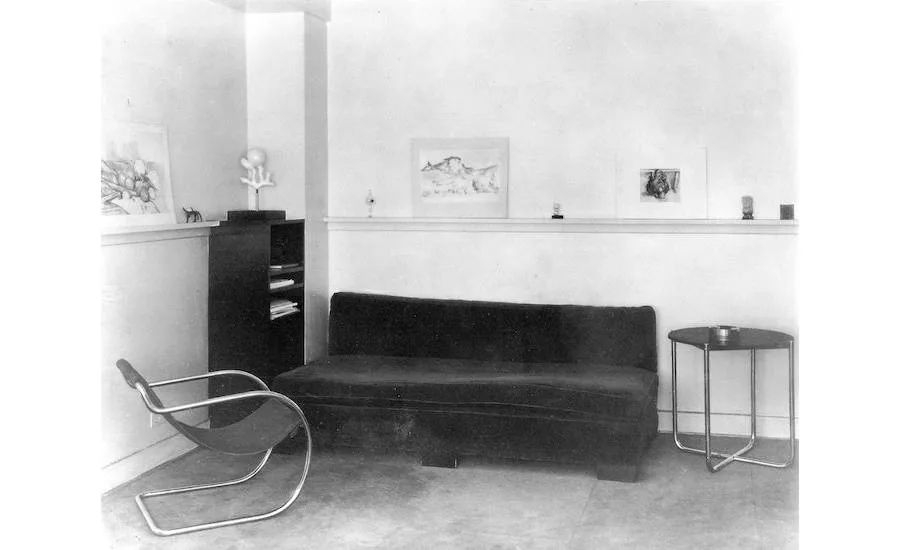
Alfred and Margaret Barr’s living room at 2 Beekman Place with a Johnson-Clauss tubular steel chair and a Donald Deskey table, c. 1934.
Photo courtesy Victoria Barr
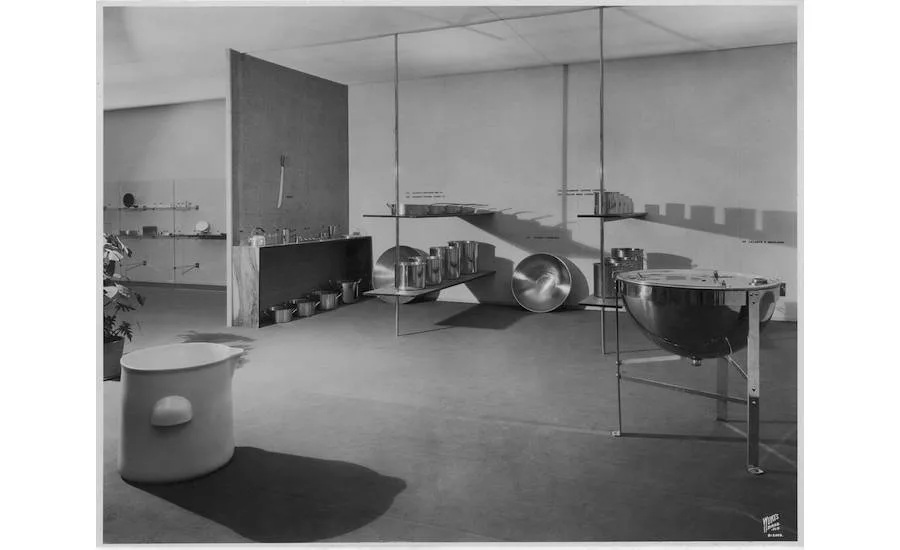
Installation of Useful Objects of American Design Under $10, Museum of Modern Art, November 26 to December 24, 1940.
Photo © The Museum of Modern Art, licensed by SCALA/Art Resource, New York
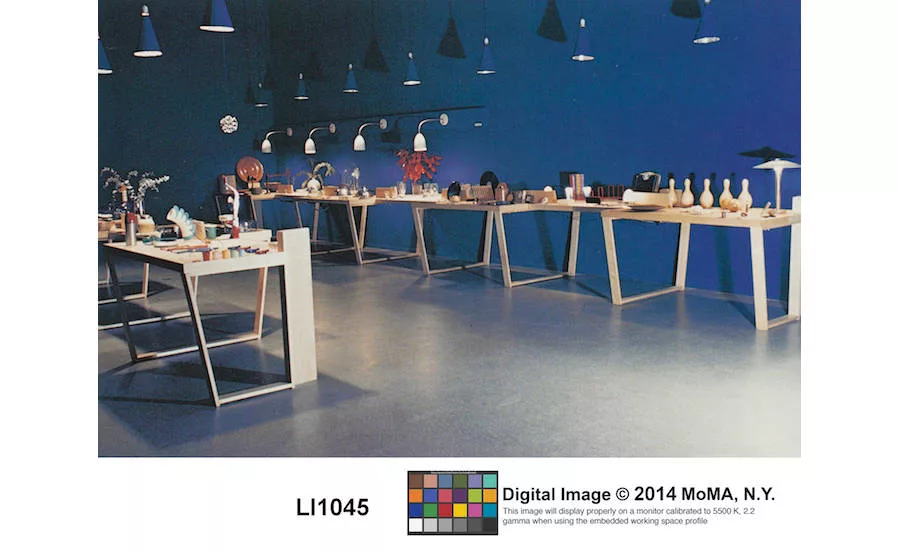
Installation of Useful Objects of American Design Under $10, Museum of Modern Art, November 26 to December 24, 1940.
Photo © The Museum of Modern Art, licensed by SCALA/Art Resource, New York
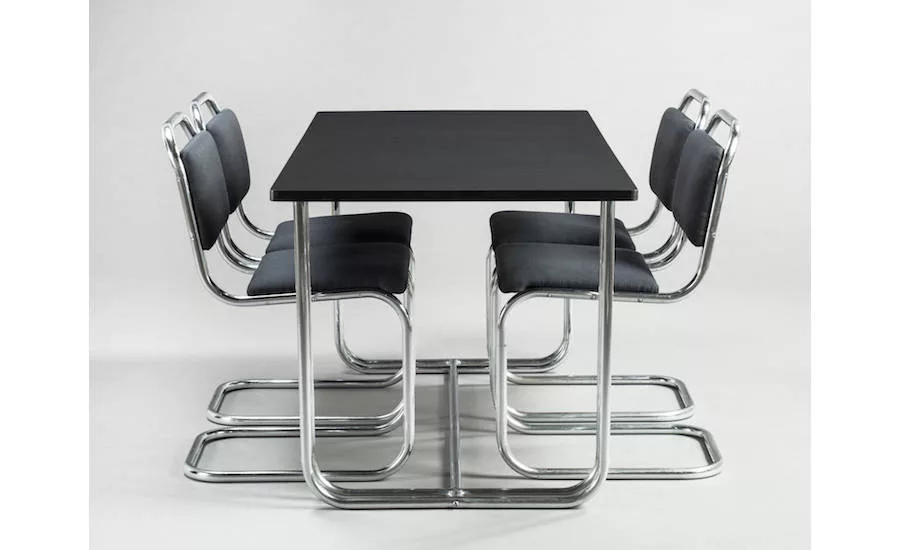
Donald Deskey, dining table and four chairs, c. 1930, Ypsilanti Reed Furniture Company, Ionia, Michigan, the Montreal Museum of Fine Arts, the Liliane and David M. Stewart Collection, gift of Victoria Barr from the Estate of Mr. and Mrs. Alfred H. Barr Jr., D88.139.1–5.
Photo courtesy the Montreal Museum of Fine Arts, photograph by Denis Farley
Architects & Firms
Partners in Design: Alfred H. Barr Jr. and Philip Johnson, edited by David A. Hanks. Monacelli Press, October 2015, 232 pages, $50.
We may think we know all there is about the most famous display of architecture to be mounted in the the U.S., the Museum of Modern Art’s landmark show, Modern Architecture: International Exhibition, curated by Henry-Russell Hitchcock and Philip Johnson in 1932. But there’s always more to dig up about this ultra-influential event and the fertile period from which it emanated, as we find in Partners in Design: Alfred H. Barr Jr. and Philip Johnson. The book explores the close collaboration between MoMA’s first director, Barr, and the exhibit’s curator, Johnson, in bringing modernist architecture to America. While Hitchcock, a Harvard-trained art historian, was important to the theoretical underpinnings of the endeavor, he was off teaching at Wesleyan University, while Barr and Johnson dealt with the show’s gestation, production, and promotion in New York City.
Surprisingly, the Montreal Museum of Fine Arts (MMFA)—not MoMA—has taken on the mission of illuminating the relationship of the two, with the handsomely illustrated book that functions as a catalogue to an exhibition of the same name, scheduled to open in April in Montreal. Both the show and book were assembled and edited by David A. Hanks, curator of a collection belonging to the Liliane and David M. Stewart Program for Modern Design within the MMFA, which provided pieces for the show.
Barr was only 27 in 1929, when he became the director of MoMA, a museum founded by well-heeled arts patrons such as Miss Lillie P. Bliss, Mrs. Cornelius J. Sullivan, and Mrs. John D. Rockefeller, Jr. A year later, Barr asked Johnson, who was just 24, to be the curator for the architecture show. Their travels abroad to research the lean, new work coming out of Europe may not have generated the rich anecdotes of Hemingway and Fitzgerald in Paris, yet the essays by Hanks, Donald Albrecht, Barry Bergdoll, and Juliet Kinchin fill in a lesser-known backstory of Barr and Johnson’s commitment to “exploring modernism in both their personal and professional lives,” as Hanks puts it. For example, on Johnson’s first visit to Dessau in 1929, he wrote to Barr that Gropius’s design for the Bauhaus was “the most beautiful building we have seen of the larger than house variety . . .”
Partners also offers glimpses into the architectural and artistic milieu of New York from the 1920s to the 1940s. Dramatic black-and-white photographs and classic modern graphics by the Montreal design firm Paprika heighten the period aura. As Hanks notes, Barr’s and Johnson’s apartments functioned as laboratories for modernist ideas. In 1930, Barr and his wife, Margaret (Marga), moved into the Southgate building on East 52nd Street, where Johnson (whom Marga referred to as a “delectable and plushy boy”) had a place right under them. Marga recalled: “We were in and out of our apartments—Philip constantly offering hospitality because he had a German butler named Rudolph.” Marga added that the young curator “helped us in the excruciating problem of furnishing our apartment because Alfred wanted it ‘modern’ and it was so very hard to buy simple furniture.” Since the Barrs kept to a tight budget, they found low-cost pieces designed for the Ypsilanti Reed Furniture Company in Michigan by Donald Deskey (who was generally considered too Art Deco-ish by the Bauhauslers). Johnson had the wherewithal to hire Ludwig Mies van der Rohe to design his apartment, but he still wrote his mother to ask if she thought Mies would be too expensive.
Johnson could afford the cost: in one photograph of his later apartment at 216 East 49th Street, we see Oskar Schlemmer’s painting Bauhaus Stairway (1932) that he gave to the museum in 1942. It soon heralded MoMA’s ties to the Bauhaus from its singular position on the grand stair of the museum’s new West 53rd Street home.
The ultramodern residences of the Barrs and Johnson were apt settings for entertaining the art and architecture world, which Albrecht brings to light in his essay, “The High Bohemia of the 1930s.” The two also joined parties at the East Side brownstone of art dealer Kirk Askew and his beautiful wife, Constance, where you could also find Lincoln Kirstein (cofounder of the New York City Ballet with George Balanchine), critic Carl Van Vechten, and composer Virgil Thomson. Hitchcock would be there holding forth, sipping both a demitasse and a brandy. Art dealer Julian Levy called it “the best and most culturally fertile salon I was to know in the thirties.” Johnson referred to the Askew evenings as a “concatenation of Harvard and homosexuals, and modernism as a creed.”
Looking for quick answers on architecture and design topics?
Try Ask RECORD, our new smart AI search tool.
Ask RECORD →
In another essay, Bergdoll points out the difference between the 1932 exhibition and Hitchcock and Johnson’s concurrent book, The International Style: Architecture Since 1922, which became synonymous with the Modern Architecture show. The I.S. book, Bergdoll notes, favored four architects and rendered Germany “more emphatically the epicenter of modernism.” Left out were the American architects—such as Frank Lloyd Wright, Raymond Hood, George Howe, William Lescaze, and Richard Neutra—who were featured in the exhibition and its accompanying paperbound catalogue. Even Gerrit Rietveld’s Schroeder house, also in the show, didn’t make the cut for the book. Bergdoll calls the book’s editing and condensation “complicated and ideologically driven.”
Kinchin explores the 1934 Machine Art show, also curated by Johnson, at MoMA. Again, the modernist agenda is underscored by the photos and her discussion of Barr’s inclusive vision and how Johnson, who installed the show, played up its “eye appeal.” As Kinchin argues, it was “an exhibition of beautiful products, rather than an industrial show or an art exhibition.” Precision instruments, watch springs, glassware, and other such objects emphasized the “sensuous beauty” of such materials as porcelain, enamels, copper, and steel, wrote Barr in the catalogue.
The two collaborators eventually would go their own ways: Johnson, who was director of the first department of architecture and design in any museum, left that post in 1934 to pursue conservative political agendas in the U.S. and an inexplicable infatuation with Nazi Germany. He would soon return to Harvard, this time to earn a B.Arch., and then resume his old MoMA post in 1946. Barr would be dethroned from his directorship in 1943, but also would come back, as the director of museum collections, from 1947 to 1967. Those early, heady years were long gone. But Partners helps fill in important gaps in our understanding of the history of this significant time.
Looking for a reprint of this article?
From high-res PDFs to custom plaques, order your copy today!