Continuing Education: The Kathleen Grimm School for Leadership and Sustainability at Sandy Ground
Where Zero Is the Top Score: An ultra-energy-efficient building defines a new paradigm for New York’s schools.
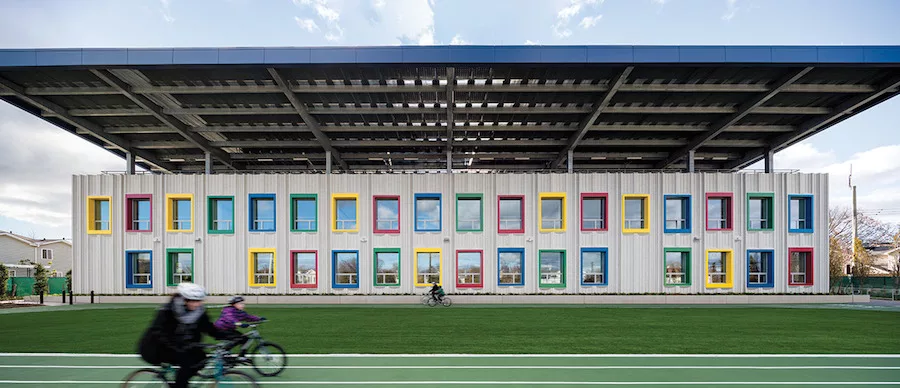
Ribbed precast-concrete panels that are 30 feet tall clad P.S 62’s north (shown), east, and west elevations.
Photo courtesy SOM/© James Ewing
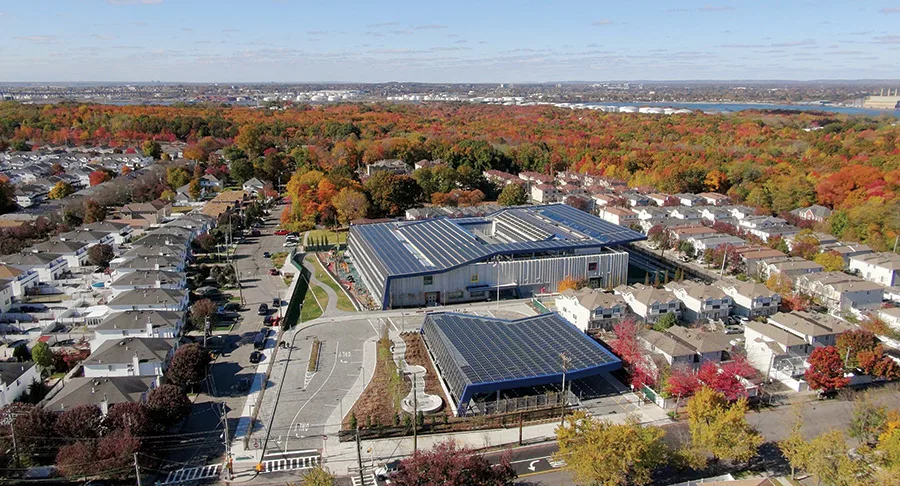
The almost 1,600 PVs covering the school, plus about 400 more sheltering a parking area, are expected to generate 662 mWh of electricity per year.
Photo Stark Video/Aerial New York © SOM
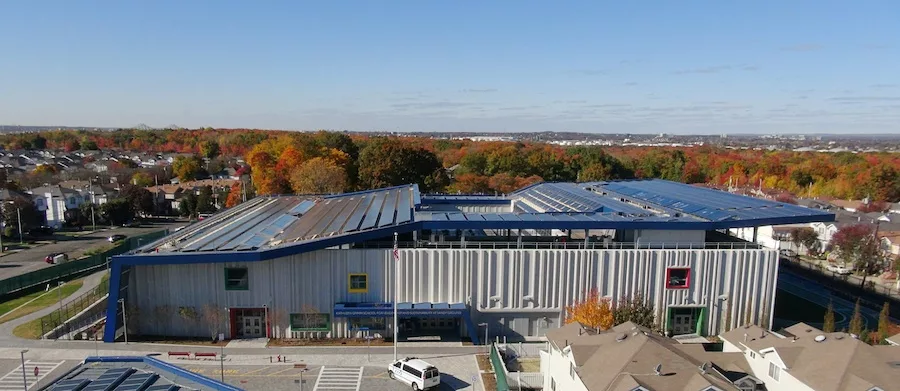
The PV panels cloak the 68,000-sqare-foot, two-story structure, covering the south facade, extending over its roof, and cantilevering out to float above a playing field.
Photo Stark Video/Aerial New York © SOM
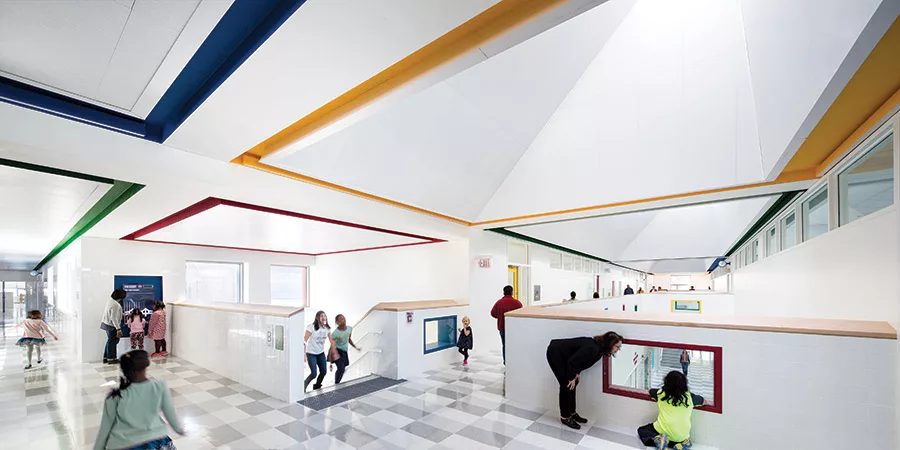
The skylights above the double-story corridors help give the school its lively and fresh atmosphere.
Photo courtesy SOM/© James Ewing
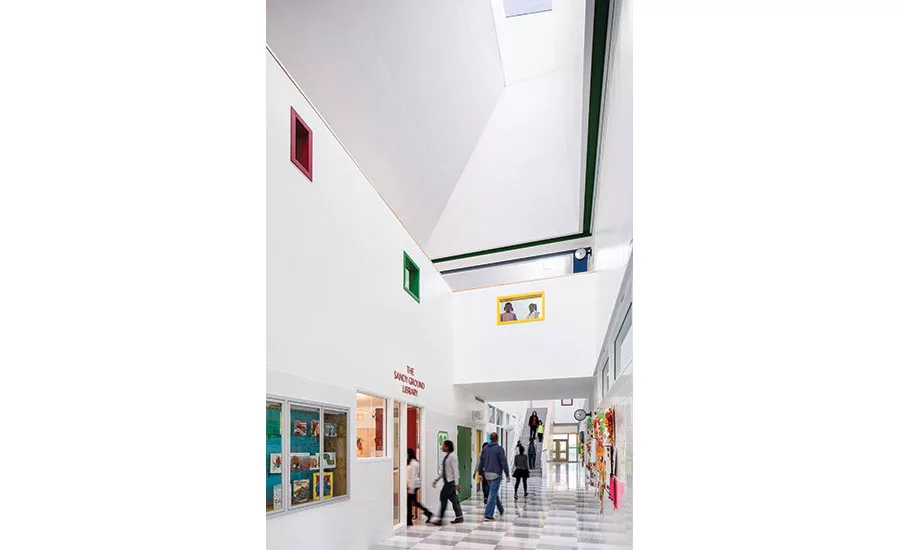
The building has no enclosed stairs. Instead, its two floors are connected by four open staircases, amplifying the facility’s capacious feel.
Photo courtesy SOM/© James Ewing
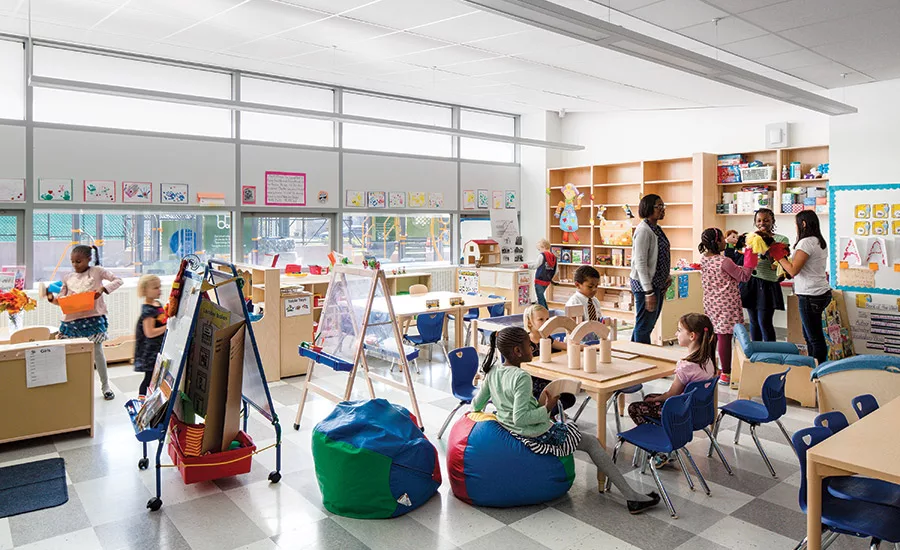
To avoid glare, the south-facing classrooms have two levels of windows: lower-level lites containing vision glass, and clerestories with glazing that includes an aerogel for diffusing sunlight. The sloped suspended ceilings help with even distribution.
Photo courtesy SOM/© James Ewing
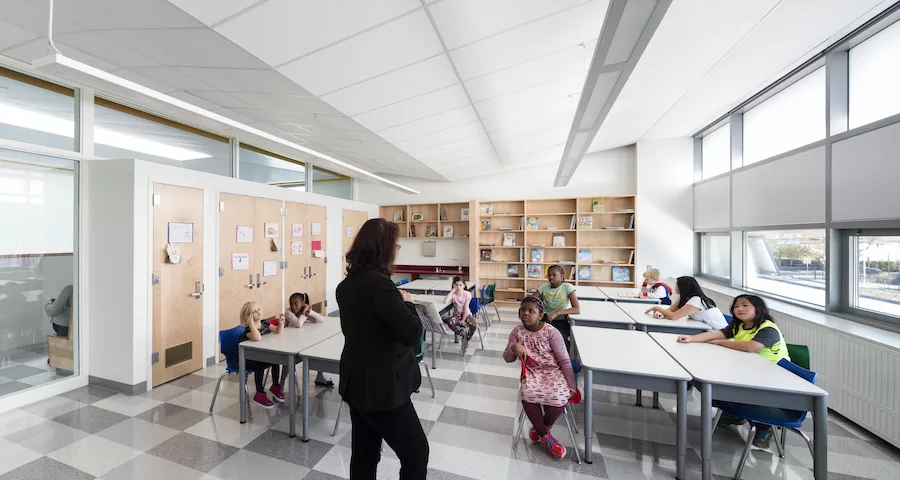
Corridor-facing glazing allows the classrooms to take advantage of the sunlight that enters the building through the corridor skylights.
Photo courtesy SOM/© James Ewing
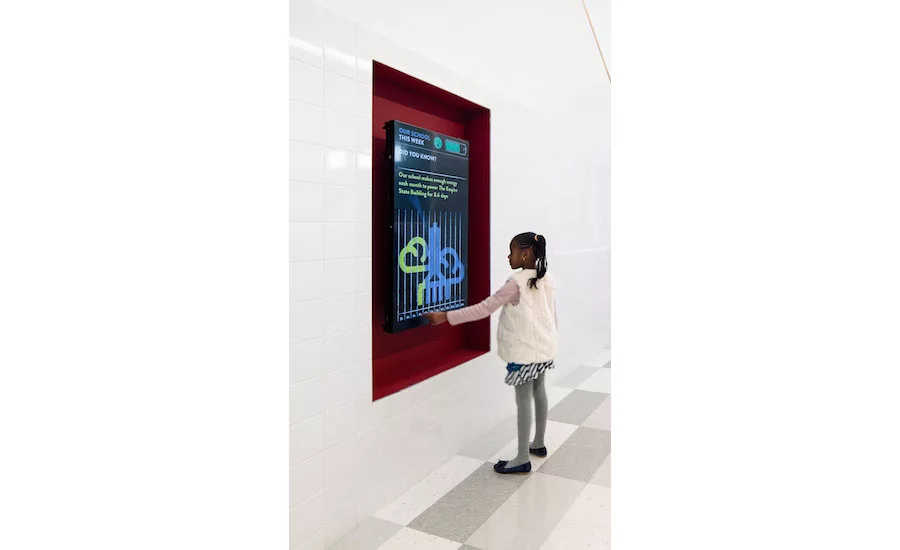
Interactive dashboards placed throughout the building display such information as the amount of electricity generated by the PVs and the amount of energy used in each space.
Photo courtesy SOM/© James Ewing
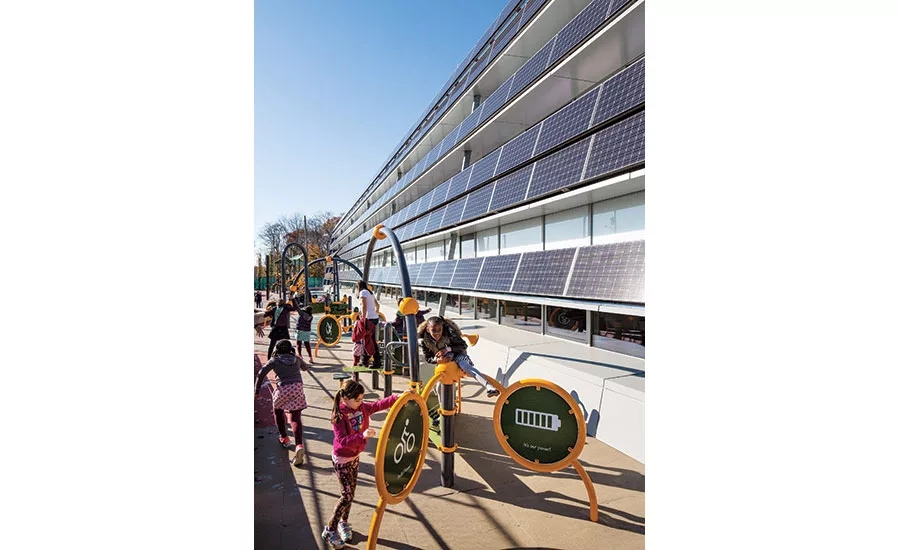
The project team carefully studied the angles of the PVs that clad the south facade and the building’s roof to find the optimum orientation for electricity generation without allowing the panels to shade each other.
Photo courtesy SOM/© James Ewing
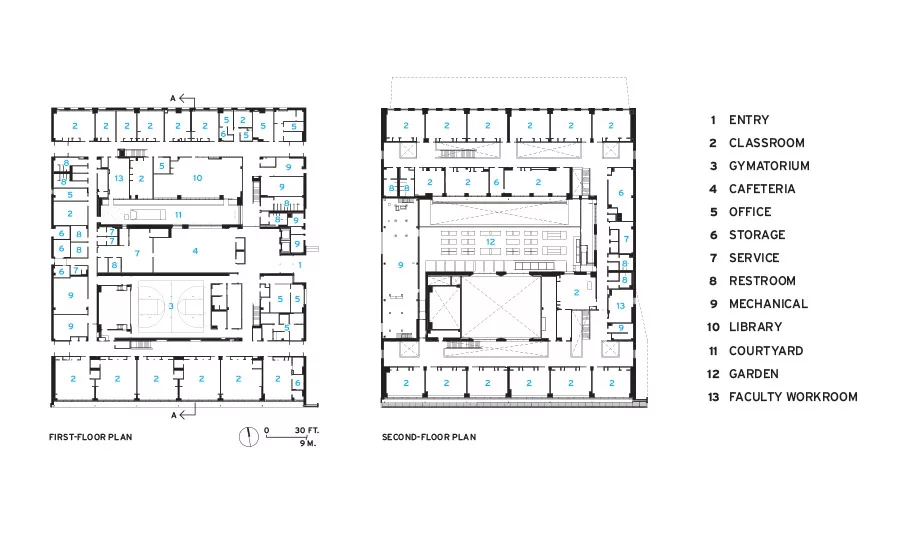
Image © SOM
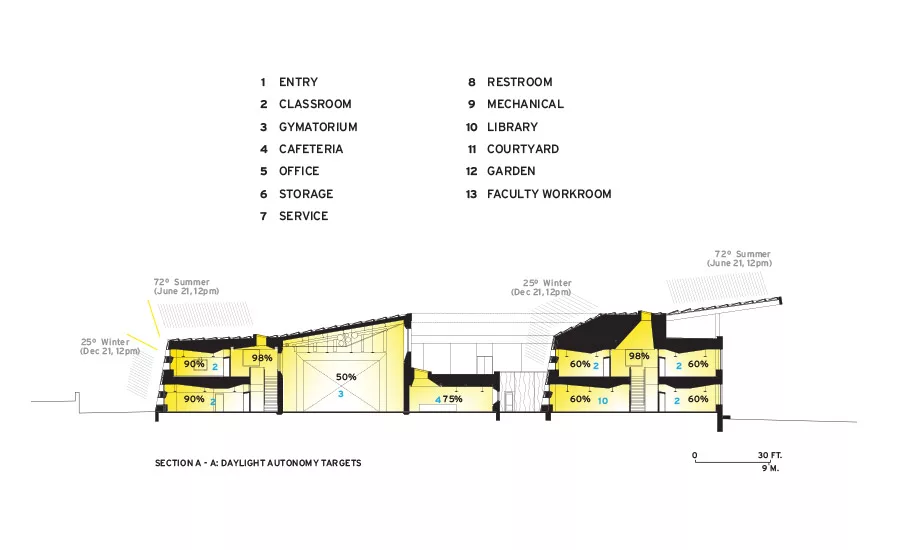
Image © SOM
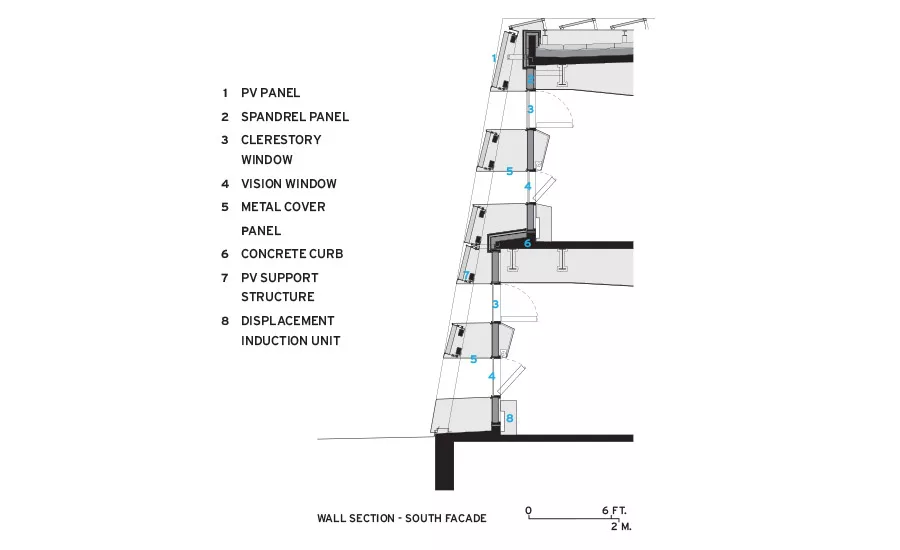
Image © SOM
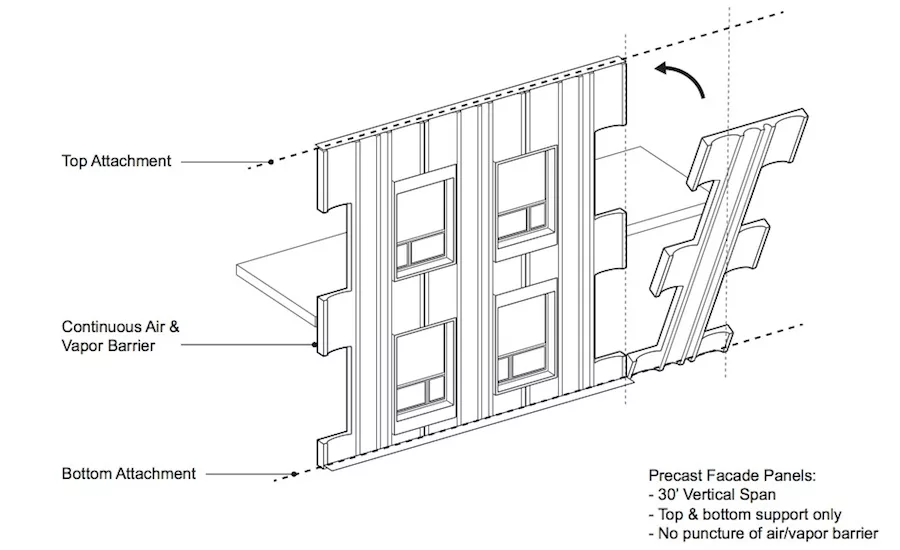
Image © SOM
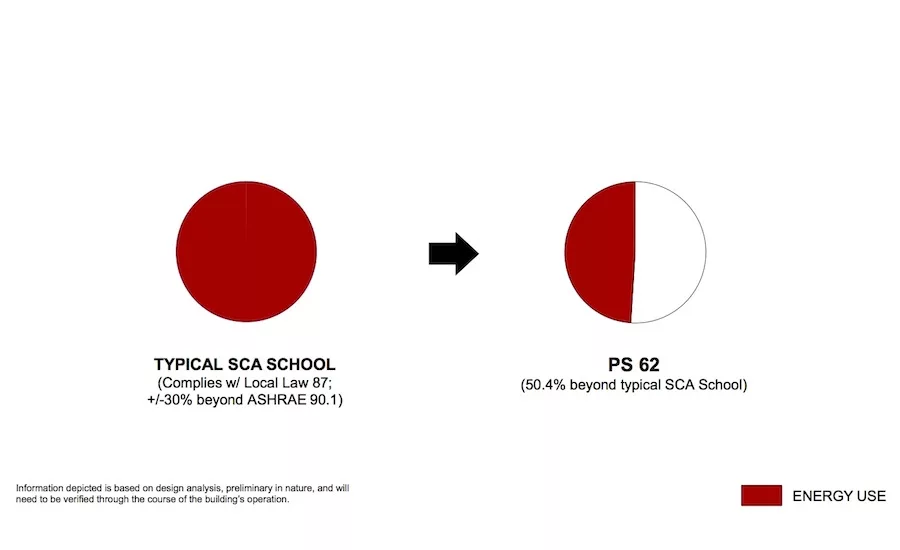
P.S. 62 is expected to use only half of the energy of a typical SCA school.
Image © SOM
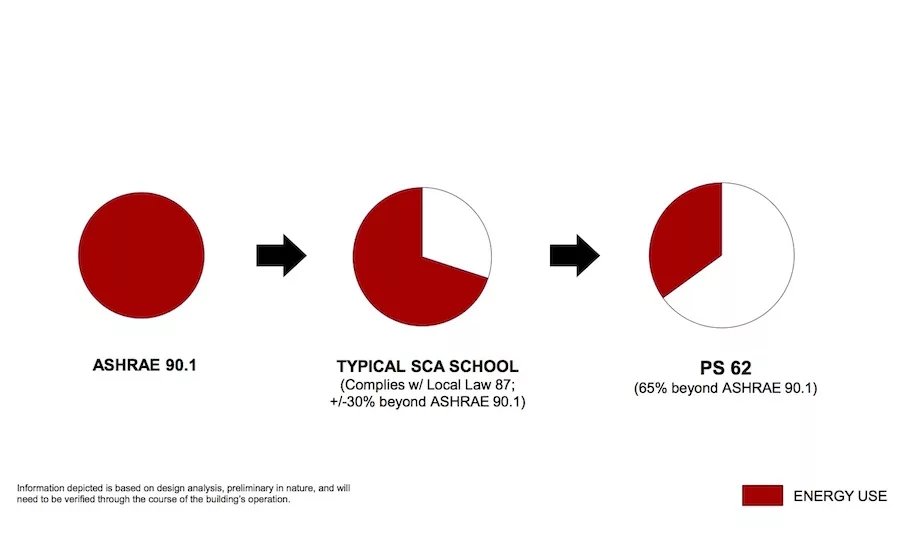
Because the city’s schools must comply with the stringent Local Law 87, which is already 30 percent more efficient than the energy standard ASHRAE 90.1, P.S. 62 is projected to use only about 35 percent of the energy of a typical U.S. school building.
Image © SOM
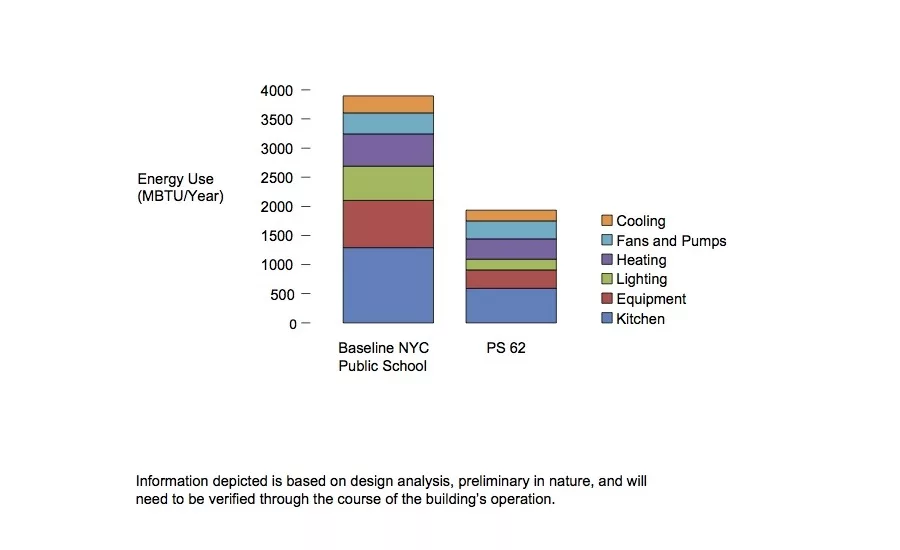
The kitchen accounts for one third of the energy use in a typical SCA school. However, it represents a smaller slice of P.S. 62âs much lower overall energy consumption.
Image © SOM
Architects & Firms
Staten Island, New York
The ambitious environmental agenda of a new elementary school by Skidmore, Owings & Merrill (SOM) on Staten Island, New York, is obvious from the first encounter: almost 1,600 photovoltaic (PV) panels cloak the 68,000-sqare-foot, two-story structure, covering the south facade, extending over its roof, and cantilevering out to float above a playing field. These PVs, plus about 400 more sheltering a parking area, are expected to generate 662 mWh of electricity per year. This energy should make the building—named P.S. 62, the Kathleen Grimm School for Leadership and Sustainability at Sandy Ground, after a longtime deputy chancellor for education—the first net zero energy school in the northeast.
What constitutes a net zero energy building? The industry is still debating this, with the U.S. Department of Energy proposing a standard definition and measurement guidelines only this past fall. But at the most basic level, a net zero energy building (often called a zero net energy building, or simply a zero energy building) is one that over the course of a year produces at least as much energy from renewable sources as it consumes. So far, only 39 nonresidential projects have documented their performance in the U.S., verifying that they are zero energy, according to a tally released in early 2015 by the nonprofit the New Buildings Institute. Eight of those are K–12 school buildings.
If these figures make net zero seem like a high bar, a school in New York presents an especially tough challenge. The city’s density makes it difficult to find a site that allows sufficient roof space or unshaded and correctly oriented facade area to mount PV panels—the most viable renewable-energy source for net zero aspiring projects, explains E. Bruce Barrett, vice president for architecture and engineering at the city’s School Construction Authority (SCA). But in 2010, when the SCA’s capital planning and real-estate group presented Barrett with a 3.5-acre site in a residential neighborhood in the city’s most low-rise borough, she immediately thought that “if there was ever an opportunity for us to do a net zero school, this is it.” Later that year, the SCA won approval from the Department of Education and city officials to move forward with the building and selected SOM’s Education Lab as its architects in early 2011.
From the get-go, P.S. 62 was considered a pilot project—one that would help improve and inform SCA design guidelines, explains Chris McCready, a SOM managing director. The potential for positive impact is considerable, since the city’s 1,600 public schools represent 37 percent of municipal greenhouse gas emissions, points out Roger Duffy, a design partner.
But Duffy, McCready, and their team had their work cut out for them. They knew that even in its quasi-suburban setting, the school would need a vastly reduced energy appetite in order to meet all its needs with the 34,000 square feet of PV panels that would fit on the school structure and over the parking area. So they aimed for a facility that would use only half the energy of a typical New York City school—a particularly ambitious goal since the city’s school buildings must comply with the stringent Local Law 87, which is already 30 percent more efficient than the energy standard ASHRAE 90.1.
The design team tackled this target with extensive energy modeling, developing a set of tightly integrated tactics, both passive and active. One of the most consequential is the daylighting strategy, which in no small part influenced the building’s configuration: the roughly square plan is organized around a long and narrow courtyard and a series of skylights that admit sunlight into the school’s spacious double-height corridors. The classrooms, which face either north or south, so that the sun coming in through their windows and the associated heat gain are easy to control, also have corridor-facing windows for daylight sharing and ceilings contoured to reflect light. The approach yields classrooms that have as much as 90 percent daylight autonomy—a metric that defines the portion of normal school hours when electric illumination is unnecessary. Building-wide, the average daylight autonomy is 60 to 70 percent.
The architects and their consultants were particularly careful to avoid glare, since they were worried that teachers would pull down the window shades, neglect to raise them, and would then rely on electric illumination, even during daylight hours. To lessen the chances of this happening, in the south-facing classrooms, they split the exterior windows into clerestories and low-level lites set at the right height for children to look out. The lower windows contain vision glass, but the higher ones include an aerogel that helps diffuse the sunlight.
Looking for quick answers on architecture and design topics?
Try Ask RECORD, our new smart AI search tool.
Ask RECORD →
The daylighting isn’t all about saving energy, however. In combination with practical materials like vinyl tile flooring, ceramic wall tile, and suspended ceilings, almost all in white or shades of subdued gray, the natural illumination creates a lively and fresh atmosphere. “It changes the whole mood of the building,” says Lisa Sarnicola, P.S. 62’s principal. “It makes the children happy.”
Another critical strategy is the school’s super-insulated and tight envelope, with triple-glazed windows, R-20 walls, and an R-30 roof. To avoid compromising their performance, SOM detailed the handsome, 30-foot-tall precast-concrete panels that clad the east, north, and west facades so that they are anchored only at the top and bottom—an approach that avoids unnecessary penetrations of the air and vapor barrier. “Once you’ve taken care of everything else, infiltration becomes really important,” explains McCready. Although these panels are tall, to simplify their attachment to the underlying structure, they are also pleated, giving them a scale and texture that appeals to children as well as adults.
For indoor climate control, the team opted for a dedicated outdoor air system with energy recovery and demand control ventilation. In the classrooms, perimeter displacement induction units supply conditioned air at a low velocity, which makes the devices both efficient and quiet. The building’s heat pumps are tied to a geothermal system consisting of 80 wells drilled under the school’s athletic field.
Designers considered combining these active technologies with natural ventilation. However, due to security concerns associated with opening the windows and the added layer of operational complexity, they ultimately decided not to pursue a mixed-mode system, says Robert Diemer, a partner with the project’s sustainability consultant, In Posse, a subsidiary of the engineering firm AKF.
To develop the system for wrapping the building in PVs, SOM worked with the Center for Architecture Science and Ecology (CASE), a research effort the firm runs collaboratively with Rensselaer Polytechnic Institute. CASE studied how best to mount the panels, angling them to produce the maximum amount of electricity while making sure they wouldn’t shade each other.
To make certain that the school would use less energy than is produced by these PVs, the project team also took a close look at so-called plug and process loads (PPLs)—those loads not related to general lighting, heating, or cooling, or other systems that provide occupant comfort. These PPLs are created by printers, computers, and other devices powered by AC outlets, and by equipment that supports activities such as cooking. The team deployed several strategies for keeping PPLs in check. In the kitchen, for example, the design and consultant team worked with the SCA, and the department of education’s food service supplier to swap out the typical gas-fired equipment for much more efficient induction appliances. They even reviewed the menu, suggesting that cold lunches occasionally be substituted for hot meals to further cut back on the energy associated with food preparation. While the kitchen accounts for one third of the energy use in a typical SCA school, it represents only 9 percent of P.S. 62’s much lower energy consumption.
Other strategies for reducing P.S. 62’s PPLs include the addition of staff workrooms—one per floor—each equipped with a coffee maker, a microwave, and a refrigerator, among other amenities. The hope is that these rooms will provide a place for teachers to work collaboratively, and, at the same time, deter them from bringing their own power-hungry appliances into the classrooms. Additional features of P.S. 62 that should reduce PPLs are printer stations with energy-efficient machines shared among several teachers. This should eliminate the use of individual printers found in most of the city’s classrooms.
Students will also have a part in helping the school reach its net zero goal. Interactive dashboards mounted throughout the building offer one opportunity for engagement. Although the screens aren’t fully functional yet, kid-friendly graphics designed by Pentagram will eventually display information such as weather conditions, the amount of electricity generated by the PVs, and the amount of energy used in each space. Sarnicola, the principal, plans to hold weekly energy-conservation competitions between classrooms as a “fun and hands-on way” to motivate children and help them gain environmental literacy.
One unusually tricky aspect of the project was the SCA’s strict procurement rules, which sometimes made it difficult to take advantage of the latest technology. For instance, the perimeter displacement induction units, considered integral to the design, were a proprietary product, and therefore required special approval by the agency’s board of trustees. Other elements, such as the PVs, were rapidly evolving, making it a real possibility that the specified panels would be superseded between completion of the bid set and the time the order was actually placed. To help deal with this problem, the construction contract stated that the owner would provide final direction regarding the PVs before the shop-drawing phase.
As the school neared completion, new and improved panels did become available. But, in an ironic turn of events, the entire manufacturing run was snapped up before they could be purchased for P.S. 62. In the end, the earlier generation of panels clads the building. Nevertheless, the project team says that the installed PVs should be more than sufficient to meet the net zero goal since the energy model includes a comfortable cushion.
Even though the architects are confident that the building will operate at net zero, they say it could take as long as three years to fully commission and fine-tune its systems so that it performs as designed. But the project is already having a positive influence—in both large and small ways—on the city’s school design and construction program. Just a few examples of this impact: printer stations instead of individual classroom machines are now standard for new schools, as are teacher workrooms that include pantries. The induction units that required special approval have been made an option for all design teams. But one of the more profound shifts for which P.S. 62 may be responsible is a new emphasis on natural illumination in SCA projects. Barrett says that her team is now on the lookout for opportunities to insert sidelights and transoms in their projects. Echoing the sentiments of the school’s principal, Barrett says, “We were just totally awestruck by the daylighting.”
|
Continuing Education
 To earn one AIA learning unit (LU), including one hour of health, safety, and welfare (HSW) credit, read “Where Zero Is the Top Score,” review the supplemental material at architecturalrecord.com, and complete the online test. Upon passing the test, you will receive a certificate of completion, and your credit will be automatically reported to the AIA. Additional information regarding credit-reporting and continuing-education requirements can be found online at continuingeducation.bnpmedia.com. To earn one AIA learning unit (LU), including one hour of health, safety, and welfare (HSW) credit, read “Where Zero Is the Top Score,” review the supplemental material at architecturalrecord.com, and complete the online test. Upon passing the test, you will receive a certificate of completion, and your credit will be automatically reported to the AIA. Additional information regarding credit-reporting and continuing-education requirements can be found online at continuingeducation.bnpmedia.com.
Supplemental Material
U.S. Department of Energy Learning Objectives 1 Define net zero energy. 2 Define terms relevant to net zero buildings such as “daylight autonomy” and “plug and process loads.” 3 Discuss some of the strategies that SOM used to make P.S. 62 ultra-energy-efficient. 4 Describe some of the challenges the P.S. 62 project team faced in procuring the latest energy-efficient technology for the building. AIA/CES Course #K1601A
For CEU credit, Read “Where Zero is the Top Score” and take the quiz at continuingeducation.bnpmedia.com, or use our architectural record continuing-education app, available in the itunes store.
|
People
Architect: Skidmore, Owings & Merrill LLP
Personnel in architect's firm who should receive special credit: Anthony Vacchione, AIA, Managing Partner Christopher McCready, AIA, Managing Director Austin Harris, AIA, Project Manager Jon Cicconi, AIA, Senior Design Architect Carrie Moore, AIA, Senior Technical Coordinator
Engineers: MEP Engineering: AKF Group Structural Engineering: Desimone Consulting Engineers, PLLC Civil & Traffic Engineering: Philip Habib & Associates Geotechnical Engineering: Langan Engineering and Environmental
Consultants: Landscape Architect: Mark K. Morrison Landscape Lighting Design: Brandston Partnership, Inc Acoustics/AV/IT & Security: Shen Milsom & Wilke Sustainability and Net Zero Consultant: In:Posse R&D Collaborator: Center for Architecture Science & Ecology Graphics and Data Visualization: Pentagram Theater Design: Harvey Marshall Berling Associates Code Consultant: Design 2147 Ltd. Vertical Transportation: Van Deusen & Associates Cost Estimating: VJ Associates Food Service: Hopkins Foodservice Specialists, Inc
General contractor: Leon D. DeMatteis Construction Corporation
Photographers:
James Ewing
646-339-2654
Todd Stark
516-835-2331
Client: New York City School Construction Authority Size: 68,000 square feet Cost: $70 million
Completion date: September 2015 |
ProductsStructural system Steel frame
Exterior cladding Metal Panels: Reynobond, East Coast Metals Metal/glass curtain wall: Viracon, Solera, Oldcastle Building Envelope Precast concrete: BPDL Moisture barrier: Grace Curtain wall: EFCO
Roofing Built-up roofing and greenroof: Henry
Windows Metal frame: EFCO
Glazing Glass: Viracon, Solera, Oldcastle Skylights: Acurlite
Doors Entrances: Special-Lite Metal doors: Weinstein & Holtzman Wood doors: Weinstein & Holtzman Fire-control doors, security grilles: Cornell Special doors (sound control, X-ray, etc.): Weinstein & Holtzman
Hardware Locksets: Sargent Closers: Norton Exit devices: Sargent
Interior finishes Acoustical ceilings: Armstrong, Chicago Metallic Suspension grid: Armstrong, Chicago Metallic Demountable partitions: Scranton Cabinetwork and custom woodwork: Elli Paints and stains: Sherwin Williams Paneling: Armstrong (sound absorbing panels) Plastic laminate: Formica Solid surfacing: Silestone Floor and wall tile (cite where used): Daltile (bathrooms, kitchen, servery) Resilient flooring: Armstrong, Pawling Carpet: Mohawk
Lighting Interior ambient lighting: Peerless, Neoray, Failsafe Downlights: Edison Price, Metalux Exterior: McGraw Edison Dimming System or other lighting controls: Cooper
Conveyance Elevators/Escalators: Canton Accessibility provision (lifts, ramping, etc.): Savaris
Plumbing Mansfield, Air Delights Inc, Delany, American Standard, T&S, Zurn, Elkay, Halsey, Energy Energy management or building automation system: Schneider, Square D Photovoltaic system: Sunpower, Panosonic, Advanced Energy Industries, Power One, Ecolibrium Solar, Unirac
Other unique products that contribute to sustainability: Geothermal system: Multistack, ISCO Industries, Charter Plastics, Chevron Phillips Chemical Co. DOAS Unit: Semco Displacement Induction Unit: Trox Solar Thermal: Lochinvar Energy Bikes: ASE Power |
Looking for a reprint of this article?
From high-res PDFs to custom plaques, order your copy today!