Continuing Education: 3D Printing
Beyond the Prototype: Architects and designers take additive manufacturing to a new level.
Beyond the Prototype
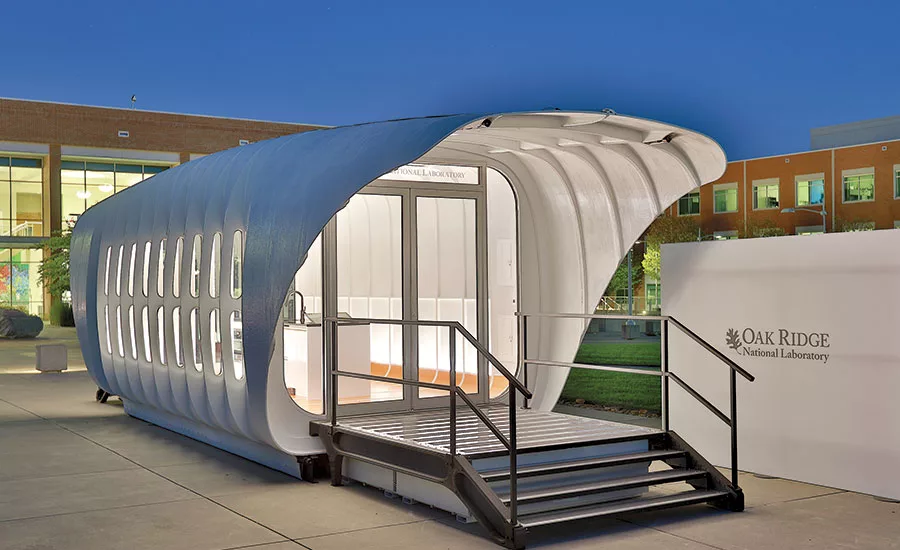
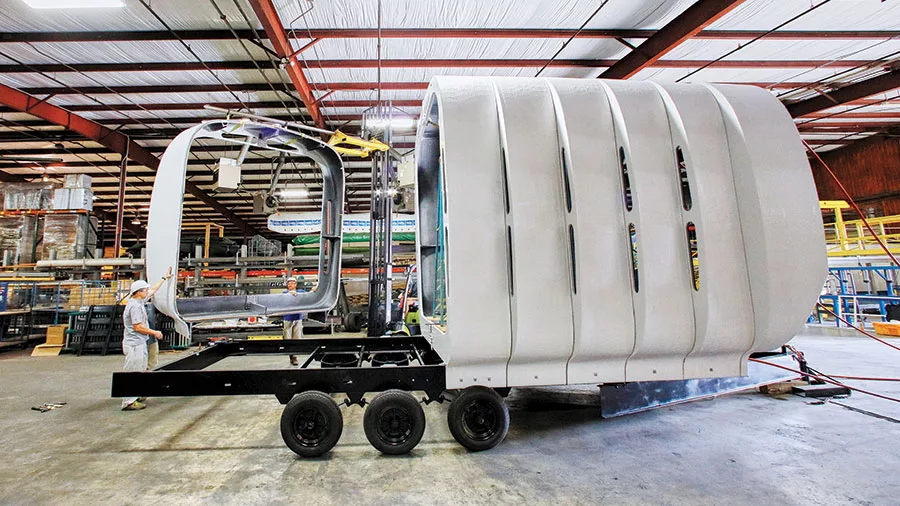
SOM and Oak Ridge National Laboratory have developed a small 3-D-printed building dubbed “AMIE” for “additive manufacturing and integrated energy."
Photo © Oak Ridge National Laboratory
Beyond the Prototype
The structure, assembled from multiple C-shaped channels of carbon-fiber-reinforced ABS plastic, includes photovoltaics on its roof that work in tandem with a generator housed in an accompanying 3-D-printed vehicle.
Photo © Oak Ridge National Laboratory
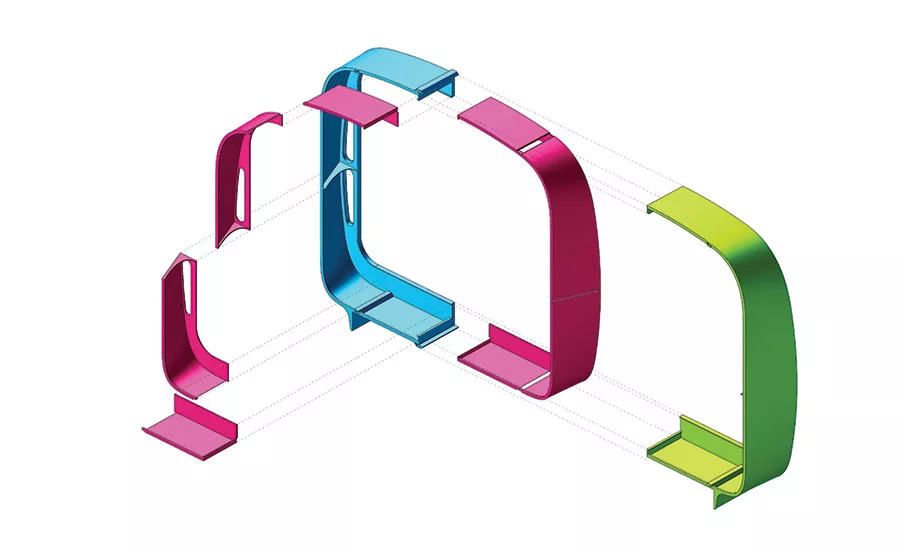
Beyond the Prototype
The structure, assembled from multiple C-shaped channels of carbon-fiber-reinforced ABS plastic, includes photovoltaics on its roof that work in tandem with a generator housed in an accompanying 3-D-printed vehicle.
Photo © SOM

Beyond the Prototype
Arup used additive manufacturing and computational tools to optimize a node for a tensegrity structure. The iterative process created a node that was 75 percent lighter than and half as tall as the original, conventionally fabricated one.
Photo © Arup
Beyond the Prototype
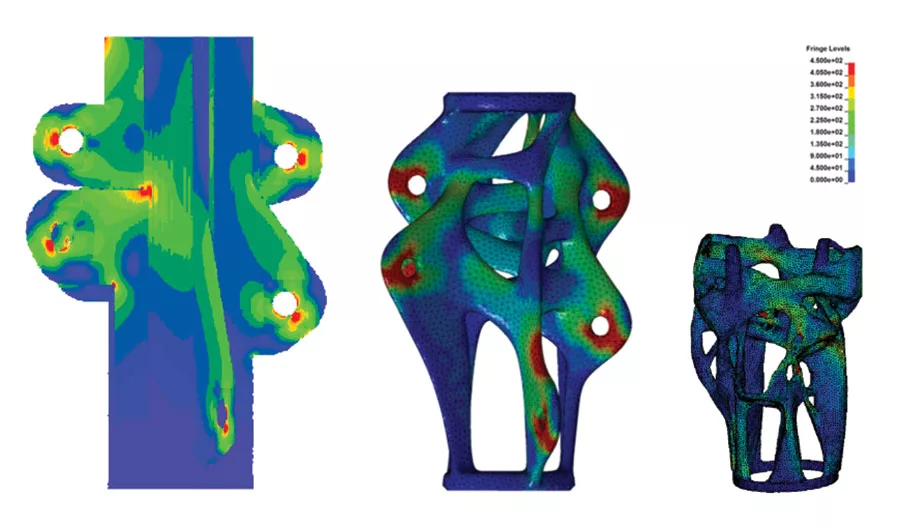
Arup used additive manufacturing and computational tools to optimize a node for a tensegrity structure. The iterative process created a node that was 75 percent lighter than and half as tall as the original, conventionally fabricated one.
Image © Arup

Beyond the Prototype
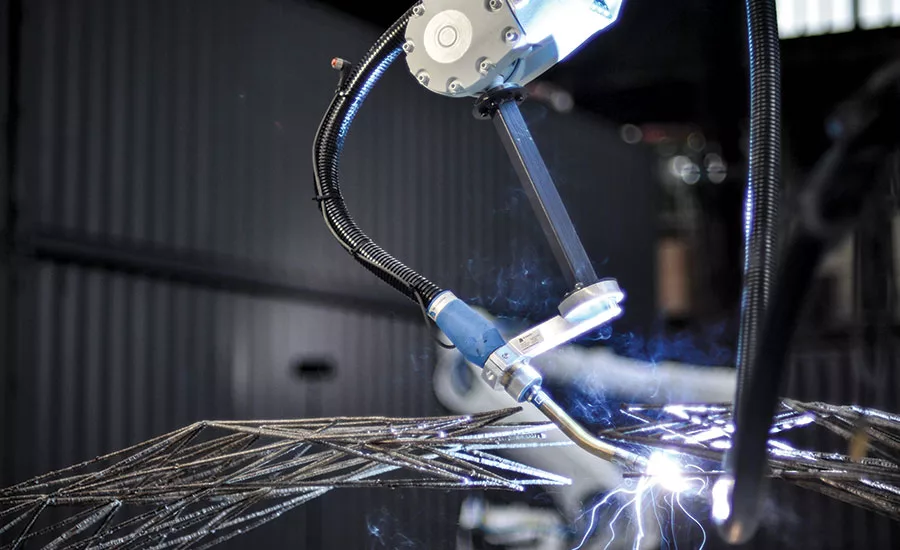
MX3D is building a 3-D-printed pedestrian bridge for an Amsterdam canal.
Image © MX3D
Beyond the Prototype
The fabrication technique developed by the 3-D printing startup resembles drawing in space with molten metal.
Photo © MX3D
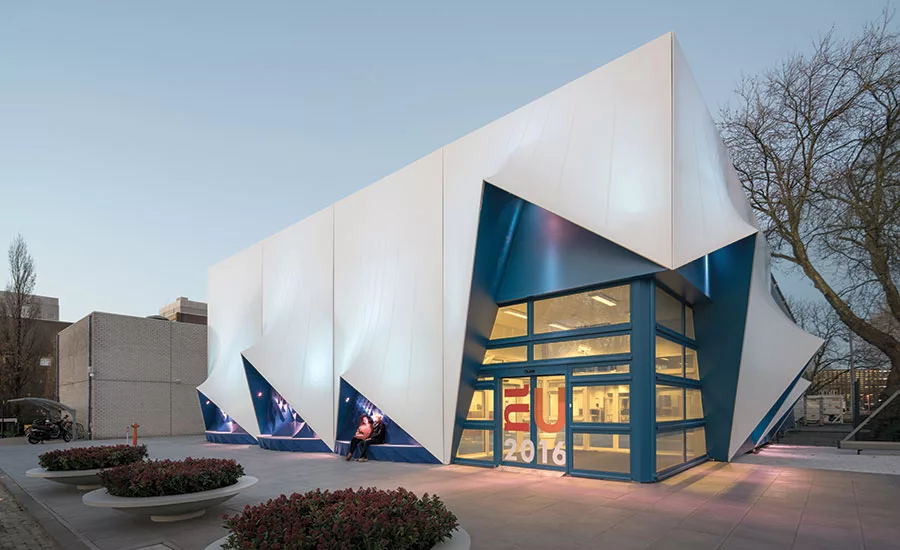
Beyond the Prototype
A facade designed by DUS for a temporary building in Amsterdam includes a skirt-like shading device and triangular elements with integrated benches. These are printed from a bioplastic that can be shredded and reprinted once the facade has been dismantled.
Photo © Ossip Van Duivenbode
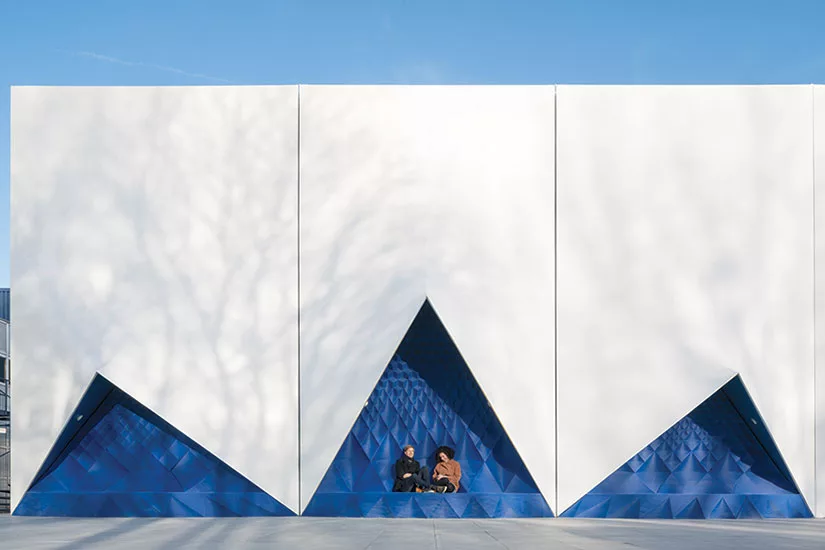
Beyond the Prototype
A facade designed by DUS for a temporary building in Amsterdam includes a skirt-like shading device and triangular elements with integrated benches. These are printed from a bioplastic that can be shredded and reprinted once the facade has been dismantled.
Photo © Ossip Van Duivenbode
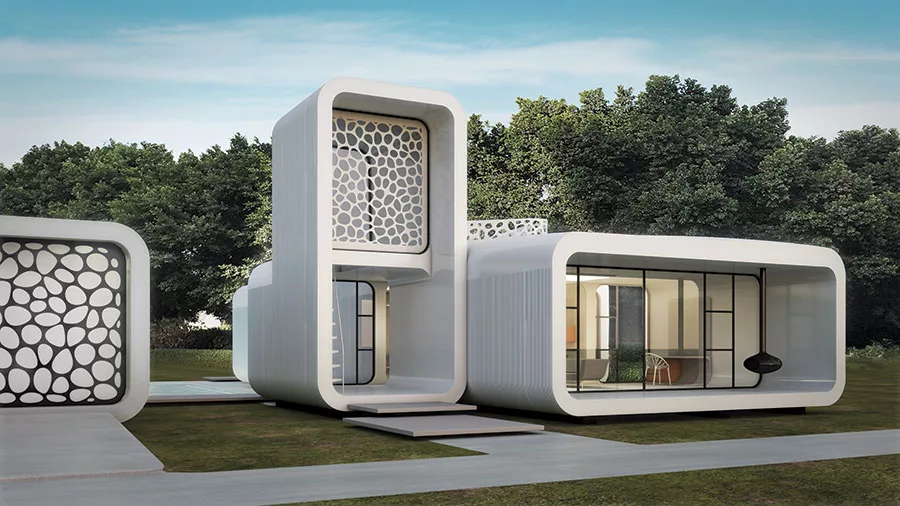
Beyond the Prototype
Gensler’s 3-D printed office, now nearing completion in Dubai, consists of multiple modules surrounding a courtyard. It is part of an effort to create prototypes of 3-D-printed structures suitable for commercial and residential use.
Image © Gensler
Gutenberg’s introduction of movable type six centuries ago was a true revolution. The development forever altered the way information was received and disseminated, democratizing knowledge. Printing’s recent move beyond two dimensions could be similarly transformative. Since 3-D printers were first developed in the 1980s, the technology has made inroads into the aerospace and auto industries and medicine, and it has been embraced by DIYers and tinkerers everywhere.
In architecture, as everyone knows, 3-D printing is now regularly used to make study models and as a rapid prototyping tool, but not to create full-scale functional components or habitable spaces—yet. This situation seems to be on the cusp of changing, however, as architects, engineers, and others explore the process as an alternative to conventional fabrication and construction. Also known as additive manufacturing, 3-D printing is actually a term for several different production techniques that can transform various materials—plastics, metals, ceramics, concrete, and more—into three-dimensional objects of almost any shape or geometry. The forms are produced from a 3-D model or other digital data source by sequentially depositing layers of material one on top of the other and fusing them. It contrasts with other machining methods, such as stamping, cutting, or grinding, which create shapes by removal of unwanted material.
One firm that has been investigating the potential of 3-D printing is Skidmore, Owings & Merrill (SOM). It recently completed the Additive Manufacturing and Integrated Energy (AMIE) demonstration project—a small building the firm designed in collaboration with Oak Ridge National Laboratory (ORNL) in Oak Ridge, Tennessee, and the College of Architecture and Design at the University of Tennessee, among other industry partners. The 450-square-foot carbon- fiber-reinforced ABS plastic structure, which was first exhibited on ORNL’s campus in September, has the ability to operate off the grid: its roof includes thin-film photovoltaics that work in tandem with a natural gas-fired generator housed in an accompanying 3-D-printed vehicle.
Arguably, AMIE’s most sustainable feature is not its source of power but its tight integration of enclosure and structure, which translates into an extremely efficient use of materials. The shelter consists of a series of C-shaped printed channels 12½ feet tall, 6 feet wide, and 2 feet deep—the latter dimension determined by the capabilities of the chosen printer. Although the machine could produce large objects, it did not have the ability to create so-called “support material”—a printed element, eventually to be removed, that keeps complex shapes from slumping over or drooping during fabrication, explains Brian Lee, a partner in SOM’s Chicago office.
Once assembled, and other non-printed elements, such as insulation and air and moisture barriers, are included, the pieces create a highly thermally efficient volume with rounded corners and curved surfaces where the floor, wall, and roof are continuous. The form—a direct outcome of the fabrication method—gives the building stability and the capability to resist wind loads. Curiously, the printed material has a grain similar to wood and is therefore stronger in one direction than the other. So to prevent cracking in the weaker direction, the one perpendicular to the grain, the structure includes post-tensioning tendons that run along the full length of the shelter. “It looks the way it does because we wanted to take full advantage of the additive manufacturing process and the material’s properties,” says Lee.
Another firm that has also been studying how 3-D printing can be deployed to optimize material use and structure is Arup. The engineering firm’s research grew out of a 2008 commission for street lighting in the Hague, the Netherlands, that involved several irregularly shaped tensegrity structures (structures made of isolated struts in compression inside a continuous net of cables in tension). Although the scheme was not realized, it became the basis for Arup’s ongoing investigation of additive manufacturing.
Arup’s study focused on the nodes—the elements that would connect the struts and cables. It would make perfect sense to produce them with 3-D printing since, of the approximately 1,600 steel connector pieces in the series of lighting structures, very few would be identical, says Salomé Galjaard, a senior designer in Arup’s Amsterdam office. Fabricating them conventionally by machining steel plates of different sizes and shapes, and welding them to steel tubes “would have been a production nightmare,” she says. But “the printer does not ‘care’ whether it builds up the same product each time or one that is slightly different,” she says.
Looking for quick answers on architecture and design topics?
Try Ask RECORD, our new smart AI search tool.
Ask RECORD →
The Arup engineers combined 3-D printing with computational tools for structural analysis and parametric modeling. This helped them identify material that could be omitted from the nodes, creating elements with organic shapes that make them look a bit like chunks of Swiss cheese. More importantly for the structural engineers, the process significantly reduced the weight of the nodes, which meant that the forces on the rest of the system’s components, including the cables and struts, were reduced, allowing them to also become smaller and lighter. Further analysis permitted Arup to make the nodes lighter still.
Arup’s final application of this iterative optimization process produced a node that was 75 percent lighter and half as tall as the original, conventionally fabricated node. The lighting structures as a whole were 50 percent lighter. The results have broad implications, including the possible elimination of reinforcement of the buildings from which the lighting elements were to have been hung. The benefits of additive manufacturing can have “a snowball effect,” says Galjaard.
Advocates for additive manufacturing in architecture say that there is more than one way that 3-D printing can help the industry make more efficient use of materials. DUS, a Dutch firm best known for its ongoing 3-D Print Canal House project, recently created a facade for the temporary building in Amsterdam where the Presidency of the Council of the European Union, an EU leadership body, is now meeting. The facade consists of multiple 16-foot-wide and 16-foot tall triangular pieces with integrated benches shaded by tentlike awnings. The triangular elements, which all have slightly different faceted surfaces, are printed from a bioplastic that can be shredded and reprinted once the presidency’s stay in Amsterdam is over in June. Hedwig Heinsman, a DUS founder and partner, makes the point that the recyclability of the printing matrix is not the only resource-conserving aspect of the technology. By its very nature, 3-D printing produces less waste than conventional construction. “By connecting design directly to manufacturing, the process is made much more efficient,” she says.
For the team behind another Amsterdambased 3-D printing endeavor, efficiency is a secondary concern. To Tim Geurtjens, chief technology officer of MX3D—developer of a robotic 3-D printing technology—the main attraction of additive manufacturing is its ability to produce complex shapes with intricate detail. “We can restore the decoration that has gone out of architecture,” he says.
MX3D is working on a 3-D-printed pedestrian bridge that will a span a 28-foot-wide canal in Amsterdam’s red-light district. Designed by Joris Laarman (a product designer who has long been experimenting with 3-D technology at different scales), the bridge is being fabricated in an Amsterdam shipyard and is to be installed on-site in the summer of 2017. It will be made of a still-tobe- determined alloy, using an additive technique that involves the robots and MIG (metal inert gas) welding. The process, which resembles drawing in midair with molten metal, is well suited for production of Laarman’s lacy, cobweb-like span. “We can put the material exactly where we need it,” explains Geurtjens.
Despite all the touted benefits, 3-D printing enthusiasts do not predict that the technology will entirely replace conventional construction anytime soon. Creating a completely 3-D-printed, move-in-ready building, for instance, would require a machine that could print a wide array of materials needed for construction simultaneously or one that could print these materials in multiple passes. This technology is at least a decade off, according to Todd Desmarais, a director in the Chicago office of Gensler. The firm has designed a 2,600-square-foot 3-D-printed office building nearing completion in Dubai. The client is a group of investors that includes the Chinese 3-D printer manufacturer.
The Dubai office project, which is part of an effort to create a prototype for 3-D-printed structures that would be suitable for low-rise residential or commercial use, consists of multiple shoebox-shaped modules surrounding a courtyard. The modules have an inner enclosure of a cement-based material and an outer shell of fiberglass. Both were printed in Shanghai in C-shaped sections and then shipped to Dubai for assembly on-site. There, other elements were also installed in a process that resembles traditional construction, including glazing, casework, and mechanical, electrical, and plumbing equipment.
The impediments to creating a building made entirely with additive manufacturing are not only technical, says Rob Bolin, a senior partner at Syska Hennessy, the Dubai office project’s mechanical engineer. He points out that any printed element for the distribution of air, water, or power—such as ductwork, piping, or conduits—would need to comply with established standards. “The hurdles are in part regulatory,” he says.
But even if 3-D printing technology is not yet advanced enough to create an entire building from additive manufacturing in one go, additive manufacturing can still provide the answer to a variety of pressing problems. SOM’s Lee says that buildings like AMIE could serve as emergency shelter, especially as different printing matrices are developed and tested, and their cost comes down. He raises the possibility that, if there were access to a printer, disaster housing could be printed on-site, from locally sourced material.
Most devotees of the technology do predict that additive manufacturing will infiltrate design and construction practices for buildings—but gradually and selectively. “The conventional process will be more efficient and cheaper for most buildings,” says MX3D’s Geurtjens. However, 3-D printing will make sense where customization is important or for elements with an extra level of complexity. He points to facades in particular.
Arup’s Galjaard agrees that, for the time being at least, use of additive manufacturing will not be widespread. But she expects that we will see the technology used in projects where weight is especially critical—in the components of long-span, operable roofs over stadiums, for instance. She points out, not surprisingly, that to take full advantage of the benefits of additive manufacturing, designers need to “zoom out” and look beyond the individual 3-D-printed element, studying the implications for the whole project. This, she says, “will lead to better design solutions in the long run.”
|
Continuing Education

To earn one AIA learning unit (LU), including one hour of health, safety, and welfare (HSW) credit, read “Beyond the Prototype,” review the supplemental material listed below, and complete the online test. Upon passing the test, you will receive a certificate of completion, and your credit will be automatically reported to the AIA. Additional information regarding credit-reporting and continuing-education requirements can be found online at continuingeducation.bnpmedia.com.
Supplemental Material Additive Manufacturing Integrated Energy Demonstration Oak Ridge National Laboratory
MX3D to Print Steel Bridge in Amsterdam MX3D Bridge
Learning Objectives 1 Define the terms "3-D printing" and additive manufacturing" and describe some of the ways architects and engineers are starting to use these processes for the creation of habitable spaces and full-scale functional components. 2 Discuss how the combination of 3-D printing and computational tools can result in optimized building components, thereby improving structural performance and efficiency. 3 Explain some of the ways 3-D printing, used as an alternative to traditional construction methods, can help reduce construction waste. 4 Discuss current regulatory and technological impediments to widespread adoption of 3-D printing as an alternative to traditional construction methods.
AIA/CES Course #K1605A
For CEU credit, read "Beyond the Prototype" and take the quiz at continuingeducation.bnpmedia.com, or use our architectural record continuing-education app, available in the itunes store.
structure, finishes, and other original fabric when
a building is moved.
significant buildings.
|
Looking for a reprint of this article?
From high-res PDFs to custom plaques, order your copy today!