Architectural Record
search
cart
facebook twitter linkedin youtube
  • Sign In
  • Subscribe
  • Sign Out
  • My Account
Architectural Record
  • NEWS
    • Latest News
    • Awards
    • Interviews
    • Obituaries
    • Podcasts
      • Design:Ed Podcast
      • Sponsored Podcasts
  • OPINION
    • Book Reviews / Excerpts
    • Exhibition Reviews
    • Forum
  • EXCLUSIVES
    • Videos
    • Design Vanguard
    • Top 300 Firms
    • Sponsored Content
    • Sponsored eBooks
    • From the Archives
  • CONTINUING ED
    • Editorial Continuing Ed
    • CE Center
    • CE Academies
  • PROJECTS
    • Buildings By Type
    • Reuse & Renovation
    • Museums & Arts Centers
    • Colleges & Universities
    • Multifamily Housing
    • Interiors
    • Lighting
    • Kitchen & Bath
  • HOUSES
    • Record Houses
    • House of the Month
    • Featured Houses
  • PRODUCTS
    • Products by Category
    • Record Products of the Year
    • Latest Products
  • EVENTS
    • Dates & Events
    • Record on the Road
    • Innovation Conference
    • Sustainability in Practice
    • Women In Architecture
    • Webinars
    • Ad Excellence Awards
    • Submit an Event
  • CONNECT
    • Ask RECORD AI
    • Newsletters
    • Contact
    • Advertise
    • Editorial Calendar
    • Store
    • Customer Service
  • SUBMIT
    • Submission Guidelines
    • RECORD Competitions
  • MAGAZINE
    • Subscribe
    • My Account
    • Digital Edition
    • Current Issue
    • Firm Pass
    • Historic Archive

Modernism Endangered

Why are we so ambivalent about the architecture of the recent past?
By Edward Durell Stone
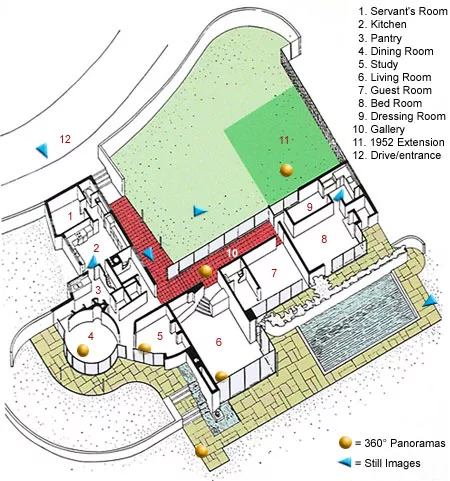
Goodyear house floor plan
Conger Goodyear House
Goodyear house floor plan
Conger Goodyear House
January 18, 2016

"While working on the Museum of Modern Art, I became friendly with A. Conger Goodyear who asked me to design a house on Long Island for him. That he was a wise man was amply demonstrated when he asked for only two master bedrooms; all of his neighbors were saddled with forty-room relies of a former era-and no household help. He became the envy of the community.

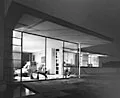
"The site, a barren hilltop, demanded the low horizontal lines of a one-story house. Mr. Goodyear had a fine collection of modern paintings, and I decided to have a gallery serve as a "spinal column" from which all the rooms, with an expansive view to the south, opened, I employed glass walls from floor to ceiling, the ceilings continuing beyond the walls to form wide sheltering eaves. As the house faces south, the eaves were adjusted in depth so that the glass areas were shaded during the summer months, and when the sun was low during the winter months, its welcoming rays penetrated the house through the glass walls.

"The overhanging eaves were a departure from the international style, which placed the glass on the surface of the building unprotected from the sun, and I adopted this principle in all subsequent buildings. Of course, other solutions of sun control are applied to higher buildings. Not only is the overhanging eave an important practical consideration, but I find it aesthetically mandatory on a house with a flat roof, satisfying visually the desire for certain aspects of the pitched roof so long associated with residential architecture.

"This house also represented an effort to solve the approach by automobile. The entrance was provided through a portico overlooking a walled garden so that automobiles and services were removed from the house proper, thus giving both sides of the house an attractive outlook.

"Mr. Goodyear had, through a long period, collected excellent paintings, china, glass and period furniture which we combined with modern furniture. It all looked beautiful together for well-designed things are harmonious regardless of their epoch. I had heeded Mr. Luce's admonishment about simple arithmetic--not only did I meet Mr. Goodyear's budget, but there was twenty-five dollars left over.
 

Looking for quick answers on architecture and design topics?
Try Ask RECORD, our new smart AI search tool.
Ask RECORD →

KEYWORDS: modernism

Share This Story

Looking for a reprint of this article?
From high-res PDFs to custom plaques, order your copy today!

Edward Durell Stone (1902-1978). Born in Fayetteville, Arkansas, Stone studied art at the University of Arkansas, entered the School of Architecture at Harvard University, Cambridge, Massachusetts, and transferred to the Massachusetts Institute of Technology, Cambridge, to study modern design with Jacques Carlu. He toured Europe on a Rotch Traveling Fellowship and on returning to the United States assisted in the design of Radio City Music Hall in New York City.
Previous 1 2 3 4 Next

Post a comment to this article

Report Abusive Comment

Subscription Center
  • Create an Account
  • Start a Subscription
  • Manage My Account
  • Sign Up for Newsletters
  • Visit Customer Service
  • Update Preferences

More Videos

Sponsored Content

Sponsored Content is a special paid section where industry companies provide high quality, objective, non-commercial content around topics of interest to the Architectural Record audience. All Sponsored Content is supplied by the advertising company and any opinions expressed in this article are those of the author and not necessarily reflect the views of Architectural Record or its parent company, BNP Media. Interested in participating in our Sponsored Content section? Contact your local rep!

close
  • TAMLYN XtremeTrim Exterior Trim
    Sponsored byTamlyn

    Designing Cleaner Panel Facades: Why Exterior Trim Details Matter

  • Building with Vapor Barriers
    Sponsored byReef Industries, Inc.

    Vapor Barriers Help Control Moisture in Tighter Building Designs

  • Duct Interior with Prodeq System
    Sponsored byHenry, a Carlisle Company

    Designing Resilient Water Containment Systems

DESIGN:ED Podcast
Listen to Architectural Record’s DESIGN:ED Podcast

Events

June 11, 2026

Very Early Warning Fire Detection for Mission-Critical Facilities

Credits: 1 AIA LU/HSW; 1 AIBD P-CE; 0.1 ICC CEU

Examine advanced fire detection strategies that support uptime and enhance safety in data centers and other mission-critical facilities.

June 16, 2026

Focus on the Façade: Exploring Steel, Timber & Fire-Rated Curtain Walls and Channel Glass Systems

Credits: 1 AIA LU/HSW; 1 AIBD P-CE; 0.1 ICC CEU

Explore modern façade and glazing systems that enhance daylighting, fire safety, and thermal performance while expanding architectural design possibilities.

View All Submit An Event

Products

2026 Architect's Square Foot Costbook

2026 Architect's Square Foot Costbook

See More Products

Popular Stories

Coronado Bridge

The Architect’s Guide to San Diego

SanDiegoAirport

Top 300 Architecture Firms of 2026

Practice Matters illustration

By the Numbers: Counting America's Architects

Crane Cove, ONO

Design Vanguard 2026 Winners

House on a Hill

Design Vanguard 2026: Forma

Focus on the Facade - Free Webinar - June 16, 2026

Related Articles

  • Selma Trail Campsite 1A

    America’s 11 Most Endangered Historic Places in 2021

    See More
  • National Trust Names 11 Most Endangered Sites

    See More
  • National Trust Announces 11 Most Endangered Sites

    See More
×

The latest news and information

#1 Source for Architectural Design, News and Products

SUBSCRIBE
  • RESOURCES
    • Advertise
    • Contact Us
    • Submit
    • Store
  • ACCOUNT CENTER
    • Create an Account
    • Start a Subscription
    • Manage My Account
    • Sign Up for Newsletters
    • Visit Customer Service
    • Update Preferences
  • PRIVACY
    • PRIVACY POLICY
    • TERMS & CONDITIONS
    • DO NOT SELL MY PERSONAL INFORMATION
    • PRIVACY REQUEST
    • ACCESSIBILITY
  • SERVICES
    • Marketing Services
    • Reprints
    • Market Research
    • List Rental
    • Survey/Respondent Access
  • STAY CONNECTED
    • Linkedin
    • Facebook
    • Instagram
    • YouTube
    • X (Twitter)

Copyright ©2026. All Rights Reserved BNP Media, Inc. and BNP Media II, LLC.

Design, CMS, Hosting & Web Development :: ePublishing