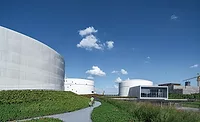
Kaspar Schulz Beer Tank Factory
Precision Crafted: A storied manufacturer of beer tanks wraps its new production facilities in a pristinely fabricated skin.

The 22,000-square-foot beer tank production hall has an off-center opening with a recessed charcoal-gray powdercoated aluminum surface that contains doors and sliding gates for receiving and shipping, material logistics, and parking.
Photography © Roland Halbe

The 32-foot-tall aluminum facade is folded into wedge-shape sections. When sunlit, the planes either shine or lie in shade to evoke the reflection of light on a stainless-steel beer tank. Lens-shaped perforations allow workers to glimpse their surroundings yet offer privacy.
Photography © Roland Halbe

The 32-foot-tall aluminum facade is folded into wedge-shape sections. When sunlit, the planes either shine or lie in shade to evoke the reflection of light on a stainless-steel beer tank. Lens-shaped perforations allow workers to glimpse their surroundings yet offer privacy.
Photography © Roland Halbe

Daylight-controlled LEDs supplement skylights to illuminate the 30-foot-high interior. Radiant panels and media cables have been placed on the ceiling to keep the floor area free.
Photography © Roland Halbe

The reinforced-concrete structure has been left exposed but whitewashed, and a dove-gray epoxy resin coats the floor. A spare stair leads to second-floor offices and meeting rooms.
Photography © Roland Halbe
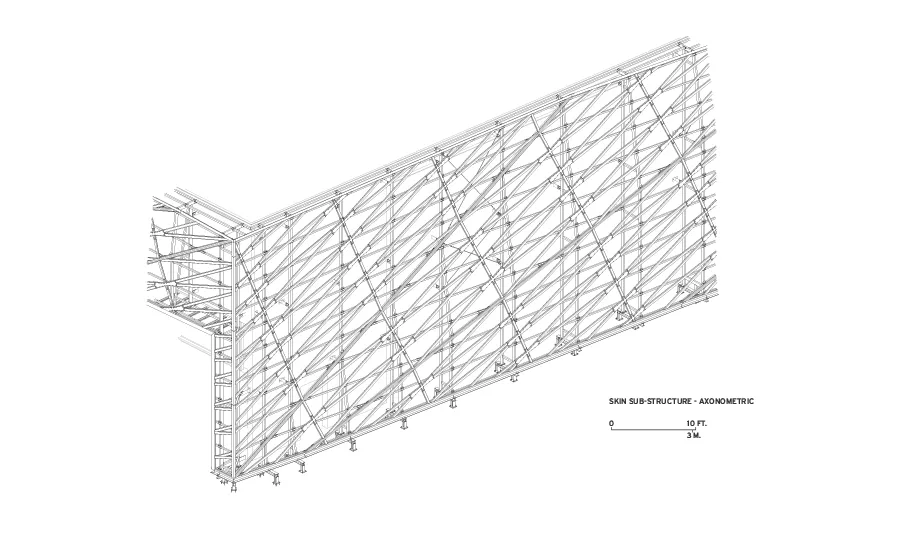
The aluminum skin is independent of the building’s poured-in-place concrete structure, and is instead supported by its own underlying steel and aluminum framework.
Image courtesy Christian Rübbert Arkitekt and Schulz-Hess Architektur

Image courtesy Christian Rübbert Arkitekt and Schulz-Hess Architektur

Image courtesy Christian Rübbert Arkitekt and Schulz-Hess Architektur
Bamberg, Germany
Johannes Schulz-Hess is the 10th-generation owner of the oldest manufacturer of beer brewing tanks in the world. When he assumed control of Kaspar Schulz in 2007, he doubled the workforce to 150 employees and restructured the operations. And, because he is also an architect, he decided—not surprisingly— that an upgrade to the premises was in order.
The factory occupies a deep 240,000-square-foot plot in an industrial zone on the outskirts of the Bavarian city of Bamberg, and is easily glimpsed from the Autobahn and the train. Having occupied the current site for the past half century, it had grown into a nondescript jumble of production halls and supporting buildings. Although the makeover was necessary to increase manufacturing space from 38,000 to 60,000 square feet, Schulz-Hess also wanted to improve workplace conditions and rebrand the company’s identity: “We needed an expressive exterior to stand out from the surroundings,” he says, “and a quiet, introverted interior for the staff to focus on their tasks.”
Schulz-Hess had recently designed a brewery with fellow architect Christian Rübbert, so the architect-owner again turned to him as a collaborator. They devised a two-phase project that required some demolition in addition to the construction of two new production halls and the introduction of an east-west axis through the site, to allow materials and products to be more easily moved around the complex. For the exterior, Schulz-Hess not only wanted the premises to have a more unified appearance, but also he felt it should reference the fabrication that takes place within.
To call attention to Kaspar Schulz’s products, the architects designed a 32-foot-tall aluminum facade, made of elongated diamond- shaped panels, to surround the poured-in-place concrete structure of the factory halls on the eastern, western, and northern exposures. Like a billboard, the facade is an independent construction that is supported by an underlying steel and aluminum framework. On the site’s long, northern exposure, this surface was designed as folded, wedge-shape sections. When sunlit, the angled planes either shine or lie in shade, to evoke the reflection of light on a stainless-steel tank. Grids of lens-shaped perforations, like screens, interrupt the facade to allow workers to look out at their surroundings yet shield them from outside scrutiny.
For the first phase, a 22,000-square-foot production hall, situated along the eastern frontage, was completed in May 2015 (the second building is due to start construction in 2017). Resembling an oversize gateway, the building’s off-center opening, with its recessed charcoalgray powder-coated aluminum surface, contains a series of doors and sliding gates providing access to spaces for receiving and shipping, material logistics, and parking. Immediately behind the facade, a 30-foot-deep zone stretches across the hall, enclosing offices, storage, and meeting rooms on the ground and second floors, and technical spaces in a mezzanine.
Because customers often observe production when placing orders or while their tanks are being assembled, Schulz-Hess sought “a museumlike space” where the steel and copper objects, like art, “occupy the foreground, and the architecture recedes.” Elaborate finishes are kept to minimum. Instead, the reinforced-concrete structure has been left exposed but whitewashed, and the floor has been coated in a dove-gray epoxy resin. Because bright, even light was necessary to maintain the workers’ concentration, skylights are supplemented by daylight-controlled LEDs to illuminate the 30-foot-high interior.
To allow for flexibility and keep the floor area free, the architects placed the supporting technology—radiant panels, perforated for sound attenuation, and media cables—on the ceiling. Perforated metal acoustic sheets on the upper half of the shorter northern and southern walls also dampen the manufacturing din.
Other aspects of the renovation, like the energy-saving strategies, are not immediately apparent. In tandem with the daylight-controlled LEDs, which reduce electrical consumption, a combined heat and power plant (in the new hall) and photovoltaic panels on existing buildings satisfy more than 50 percent of the complex’s energy requirements. Make no mistake: high-precision metal processing is loud and gritty. In Kaspar Schulz’s older production halls, the sour smell of processed metal hangs in the air, and a light patina of steel dust coats the walls and floors. But the new hall has an intensely brilliant interior, even on an overcast winter day. The noise seems muted, and it feels like an almost sacred place, where labor is valued. “The workers act differently here,” says Schulz-Hess. “They are able to see the grime and dirt they produce and readily clean it up.”
The evocative exterior and state-of-the-art interior succeed in repackaging this centuries-old business and providing its employees with a finely tuned workplace. At the close of a recent visit, although he was reflecting on the challenges of staff acquisition, the still-youthful architect- owner seemed to be speaking about himself: “It is important for young people to think that this could be a cool place to work.”
PeopleArchitects: Christian Rübbert Arkitekt, Schulz-Hess Architektur - Christian Rübbert, Johannes Schulz-Hess, Joachim Kaiser, Irene Bonente, design team
Kaiser,
Rübbert,
Christian Rübbert Architekt Obstplatz 3, 39100 Bozen, Italy Phone +39 0471 979969, fax +39 0471 979975
Johannes Schulz-Hess, Dipl.-Ing. Architekt Hallstadter Str. 170, 96052 Bamberg, Germany Phone +49 951 60999 0
Personnel in architect's firm who should receive special credit: Arch. Joachim Kaiser, Arch. Irene Bonente
Architect of record: Schulz-Hess Architektur GmbH, Dipl.-Ing. Architekt Johannes Schulz-Hess
Engineers: Civil: Ingenieurburo Dipl.-Ing.(FH) Klaus Schulz Am Schlossgraben 16, 96117 Memmelsdorf, Germany Building equipment: Ingenieurburo Thomas Klug, Peter Schneider-Str. 44, 96049 Bamberg, Germany
Consultant: Lighting: Zumtobel Licht GmbH, Beratungszentrum Nürnberg, Längenstr. 14, 90491 Nürnberg
Photographer: Roland Halbe, Böheimstrasse 45, 70199 Stuttgart, Germany, phone +49 711 607 40 73
Client: Kaspar Schulz
Size: 22,000 square feet
Cost: Withheld
Completion date: May 2015
|
ProductsStructural system Solid building in concrete Manufacturer of any structural components unique to this project: Structural system in fair-faced concrete, roof and gable wall in steel constructions
Exterior cladding Metal Panels: Aluminium trapezoidal sheets Metal/glass curtain wall: mullion/transom system Schüco FW60 Curtain wall: Aluminium anodized panels, EV1
Roofing Built-up roofing: liquid plastic Kemperol V 210 Elastomeric: Rockwool Georock Metal: Aluminium trapezoidal sheets with acoustical perforation
Windows Metal frame: Schüco AWS 75 BS-SI / Jansen VISS SG
Doors Entrances: Jansen Metal doors: Hörmann STS 62 Fire-control doors, security grilles: Hörmann steel sliding gate T90 Special doors (sound control, X-ray, etc.): rapid action door: EFAFLEX SST-L Basic
Hardware Locksets: FSB Closers: Dorma Security devices: Winkhaus BlueSmart
Interior finishes Paints and stains: Keim Concretal stain Floor and wall tile (cite where used): Floor: Marazzi Sistem N, wall: Sistem C Special interior finishes unique to this project: Industrial flooring: STO Pox epoxy resin
Furnishings Office furniture:Vitra Workit Chairs: Sedus open mind, Brunner Twin Tables: Vitra Workit Other furniture: Werner Works wall unit
Lighting Interior ambient lighting: Zumtobel Sequence Downlights: Zumtobel Panos Task lighting: Zumtobel Tecton Exterior: Hess City Elements
Energy Energy management or building automation system:
Block heat and power plant: Viessmann Vitobloc 200 |
Looking for a reprint of this article?
From high-res PDFs to custom plaques, order your copy today!