Architectural Record
search
cart
facebook twitter linkedin youtube
  • Sign In
  • Subscribe
  • Sign Out
  • My Account
Architectural Record
  • NEWS
    • Latest News
    • Awards
    • Interviews
    • Obituaries
    • Podcasts
      • Design:Ed Podcast
      • Sponsored Podcasts
  • OPINION
    • Book Reviews / Excerpts
    • Exhibition Reviews
    • Forum
  • EXCLUSIVES
    • Videos
    • Design Vanguard
    • Top 300 Firms
    • Sponsored Content
    • Sponsored eBooks
    • From the Archives
  • CONTINUING ED
    • Editorial Continuing Ed
    • CE Center
    • CE Academies
  • PROJECTS
    • Buildings By Type
    • Reuse & Renovation
    • Museums & Arts Centers
    • Colleges & Universities
    • Multifamily Housing
    • Interiors
    • Lighting
    • Kitchen & Bath
  • HOUSES
    • Record Houses
    • House of the Month
    • Featured Houses
  • PRODUCTS
    • Products by Category
    • Record Products of the Year
    • Latest Products
  • EVENTS
    • Dates & Events
    • Record on the Road
    • Innovation Conference
    • Sustainability in Practice
    • Women In Architecture
    • Webinars
    • Ad Excellence Awards
    • Submit an Event
  • CONNECT
    • Ask RECORD AI
    • Newsletters
    • Contact
    • Advertise
    • Editorial Calendar
    • Store
    • Customer Service
  • SUBMIT
    • Submission Guidelines
    • RECORD Competitions
  • MAGAZINE
    • Subscribe
    • My Account
    • Digital Edition
    • Current Issue
    • Firm Pass
    • Historic Archive
Architecture News

Architects Propose Design Solutions for Equitable Restrooms
By Anna Fixsen
Architects Propose Design Solutions for Equitable Restrooms

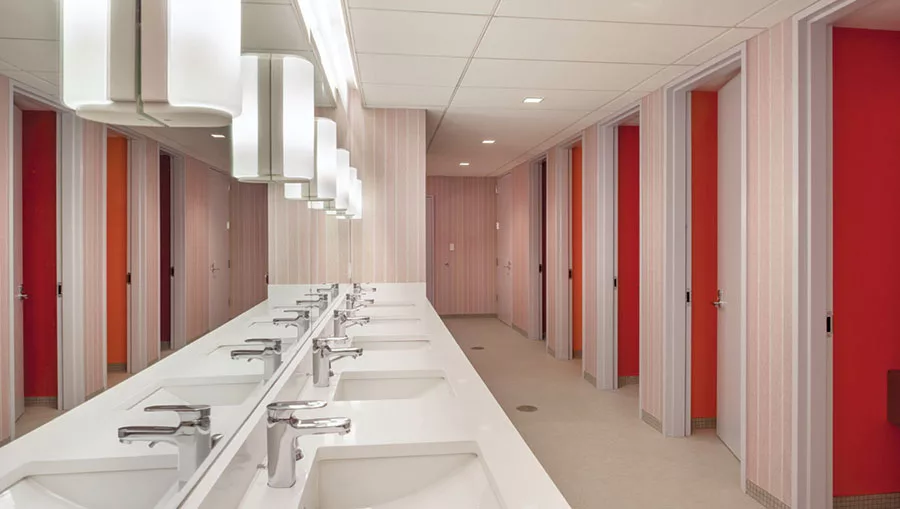
For the Congregation Beit Simchat Torah in New York, the architecture firm ARO designed the restrooms as a line of single-user stalls with a shared sink area.

Photo © Elizabeth Felicella/Esto

Architects Propose Design Solutions for Equitable Restrooms

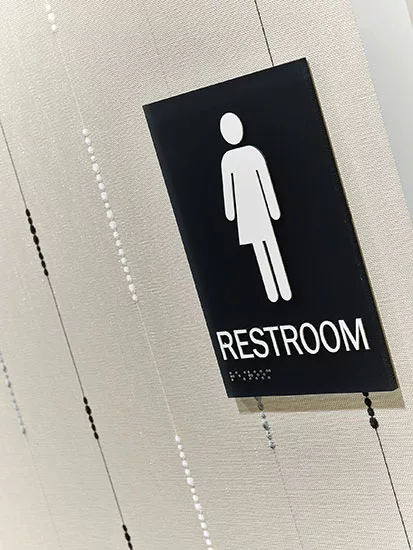
The 21C hotel in Durham, North Carolina, meanwhile, installed new restroom signage designed by artist Peregrine Honig in reaction to the state’s controversial HB2 law.

Photo © 21c Museum Hotels

Architects Propose Design Solutions for Equitable Restrooms

For the Whitman-Walker health center in Washington, D.C., Perkins + Will incorporated all-single-occupant restrooms across the seven-story facility, while still managing to achieve the fixture counts required by the code.

Courtesy of Perkins+Will / ©Eric Laignel
Architects Propose Design Solutions for Equitable Restrooms

For the Whitman-Walker health center in Washington, D.C., Perkins + Will incorporated all-single-occupant restrooms across the seven-story facility, while still managing to achieve the fixture counts required by the code.

Courtesy of Perkins+Will / ©Eric Laignel

Architects Propose Design Solutions for Equitable Restrooms
June 20, 2016

Over the last few months, one of the most banal architectural spaces—the public restroom—has been at the forefront of a national civil rights debate. In late March, North Carolina passed the Public Facilities Privacy and Security Act (also known as House Bill 2) requiring that in public buildings, people use restroom and changing facilities that correspond to the sex listed on their birth certificate, not their gender identity. The bill was approved in fewer than 12 hours.

The backlash was just as swift. PayPal abandoned plans for an expansion into North Carolina. Companies including Apple, Google, and American Express followed. Bruce Springsteen canceled a Greensboro performance. The Justice Department sued the State of North Carolina. Even the AIA South Atlantic Region—comprising Georgia, North Carolina, and South Carolina—jumped into the fray, relocating its triennial conference from Wilmington, North Carolina, to Savannah.

“This action by the North Carolina legislature was in direct opposition to the values we as a professional organization have adopted,” says AIA regional representative Steven Schuster.

Conservative lawmakers cited restroom safety as the rationale behind HB2. But opponents to the measure say such rulings put the LGBT community—a group that already suffers a disproportionate amount of physical and sexual violence—at serious risk. And after the massacre of 49 people at a gay nightclub in Orlando this month, the issue is sure to be the object of renewed focus.

Architects have a critical role in the future of this discussion. While design can never entirely address the pervasive societal biases LGBT individuals face, designers can employ strategic solutions to help ensure access to equal and safe facilities.

One good example of this approach is a new house of worship for Congregation Beit Simchat Torah, an LGBT synagogue in Midtown Manhattan (RECORD, May 2016,). “The design of restrooms is something we take for granted. It’s just sort of automatic—you lay it out and you do it,” says the architect, Stephen Cassell, one of the principals of the firm Architecture Research Office (ARO). It was important to the rabbi and the congregation that the facilities have gender-neutral restrooms. The design of such a restroom was a new undertaking for ARO. But, says Cassell, “Like everything else, it was really about engaging a specific community.” Through dis­cussions with congregants, the architects executed a design with separate stalls, full floor-to-ceiling partitions, acoustically sound doors, and a shared sink space. 

But building codes can be a roadblock for these sorts of designs. Most states and municipalities adopt regulations based on those put forth by the International Code Council (ICC). New York’s plumbing code, for instance, says that “where plumbing fixtures are required, separate facilities shall be provided for each sex” and in equal number, save structures where the total number of employees or customers is 30 or fewer. Designs that deviate from this set of guidelines must get approval from the Department of Buildings. Though ARO’s variance received a stamp of approval from a city inspector, Cassell said the process was time-­consuming.

Looking for quick answers on architecture and design topics?
Try Ask RECORD, our new smart AI search tool.
Ask RECORD →

Some say providing “family-style” auxiliary restrooms that have single-user stalls and their own sink alongside multistall restrooms for men and women could bridge both sides of the gender-neutral restroom debate. But this design solution is only a stopgap, argues David Cordell, a technical coordinator and sustainability leader at Perkins + Will. Writing on the firm’s blog, Cordell said the strategy “potentially singles transgender people out, increasing the likelihood of harassment.” He cites Perkins + Will’s Whitman-Walker health center in Washington, D.C., a clinic that provides HIV care. The team incorporated all-single-occupant restrooms across the seven-story facility, while still managing to achieve the fixture counts required by the code.

Advocates are proposing changes to the plumbing code to make such modifications easier. Last year, the AIA successfully introduced a change to the ICC that would allow the specification of single-user restrooms to satisfy all of a building’s required toilet facilities, in lieu of separate-sex restrooms. This will be implemented as part of the 2018 International Plumbing Code (which is updated every three years). While it would expedite the process, it would ultimately be up to individual states and municipalities whether or not to adopt them. The development process for the 2021 codes begins in January 2018.

In the meantime, says Cassell, architects need to begin actively reconsidering the way they design restrooms. “When you fall into a series of defaults, you don’t question the underlying assumptions,” he says. “Good design comes from questioning those assumptions.” 

Share This Story

Looking for a reprint of this article?
From high-res PDFs to custom plaques, order your copy today!

Anna Fixsen was a staff writer and editor for Architectural Record from 2013 to 2017, during which time she covered topics ranging from new projects to human rights, and edited Firms to Watch—a special section devoted to emerging architecture firms.

Post a comment to this article

Report Abusive Comment

Subscription Center
  • Create an Account
  • Start a Subscription
  • Manage My Account
  • Sign Up for Newsletters
  • Visit Customer Service
  • Update Preferences

More Videos

Sponsored Content

Sponsored Content is a special paid section where industry companies provide high quality, objective, non-commercial content around topics of interest to the Architectural Record audience. All Sponsored Content is supplied by the advertising company and any opinions expressed in this article are those of the author and not necessarily reflect the views of Architectural Record or its parent company, BNP Media. Interested in participating in our Sponsored Content section? Contact your local rep!

close
  • cold storage facility
    Sponsored byCarlisle SynTec Systems

    How Architects Can Design More Continuous Cold Storage Envelopes

  • TAMLYN XtremeTrim Exterior Trim
    Sponsored byTamlyn

    Designing Cleaner Panel Facades: Why Exterior Trim Details Matter

  • Building with Vapor Barriers
    Sponsored byReef Industries, Inc.

    Vapor Barriers Help Control Moisture in Tighter Building Designs

DESIGN:ED Podcast
Listen to Architectural Record’s DESIGN:ED Podcast

Events

June 23, 2026

Enhancing Fire Resistance with Advanced PVC Solutions

Credits: 1 AIA LU/HSW; 1 AIBD P-CE; 0.1 ICC CEU; 1 IIBEC CEH

Evaluate advanced PVC solutions that improve fire resistance, support WUI compliance, and enhance resilience in residential and commercial building design.

June 25, 2026

Designing Glass Railing Systems that Enhance Aesthetics and Meet Code

Credits: 1 AIA LU/HSW; 1 AIBD P-CE; 0.1 ICC CEU

Upon course completion, participants will possess a deeper understanding of glass railings to help ensure that safety, aesthetic, and performance objectives are achieved.

View All Submit An Event

Products

2026 Architect's Square Foot Costbook

2026 Architect's Square Foot Costbook

See More Products

Popular Stories

SanDiegoAirport

Top 300 Architecture Firms of 2026

Lorcan O' Herilhy

California Architect Lorcan O’Herlihy Has Died, Age 66

Coronado Bridge

The Architect’s Guide to San Diego

CCA, Studio Gang

The Winners of the AIA’s 2026 Architecture Award Range from Collegiate Rowing Hubs to Housing for the Homeless

Dusk House

Design Vanguard 2026: ONO

Enhancing Fire Resistance with Advanced PVC Solutions - Free Webinar - June 23, 2026

Related Articles

  • Design Teams Propose Solutions for "Rising Currents"

    See More
  • Architects Propose Alternative Ideas for Spending Federal Dollars

    See More
  • Penn Station Proposal

    Architects Propose Facelifts for Two Major New York City Transit Hubs

    See More

Related Products

See More Products
  • 0470126736.gif

    Modern Sustainable Residential Design: A Guide for Design Professionals

  • superlux.jpg

    SuperLux: Smart Light Art, Design & Architecture for Cities

  • bim design firms.jpg

    BIM for Design Firms: Data Rich Architecture at Small and Medium Scales

See More Products
×

The latest news and information

#1 Source for Architectural Design, News and Products

SUBSCRIBE
  • RESOURCES
    • Advertise
    • Contact Us
    • Submit
    • Store
  • ACCOUNT CENTER
    • Create an Account
    • Start a Subscription
    • Manage My Account
    • Sign Up for Newsletters
    • Visit Customer Service
    • Update Preferences
  • PRIVACY
    • PRIVACY POLICY
    • TERMS & CONDITIONS
    • DO NOT SELL MY PERSONAL INFORMATION
    • PRIVACY REQUEST
    • ACCESSIBILITY
  • SERVICES
    • Marketing Services
    • Reprints
    • Market Research
    • List Rental
    • Survey/Respondent Access
  • STAY CONNECTED
    • Linkedin
    • Facebook
    • Instagram
    • YouTube
    • X (Twitter)

Copyright ©2026. All Rights Reserved BNP Media, Inc. and BNP Media II, LLC.

Design, CMS, Hosting & Web Development :: ePublishing