Building for an Unstable World: 2016 Venice Architecture Biennale
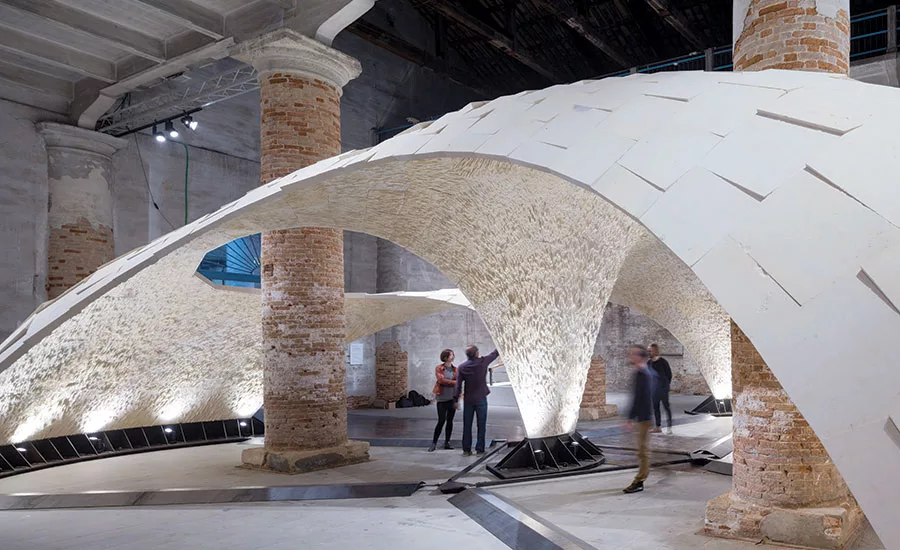
Inspired by past masters but empowered by new technology, a multinational team (ETH Zurich and Ochsendorf, DeJong & Block, with the Escobedo Group) created the “Armadillo Vault” in the Arsenale. The vault suspends 399 stone slabs without adhesives, solely through the use of compressive force.
Photo © Iwan Baan
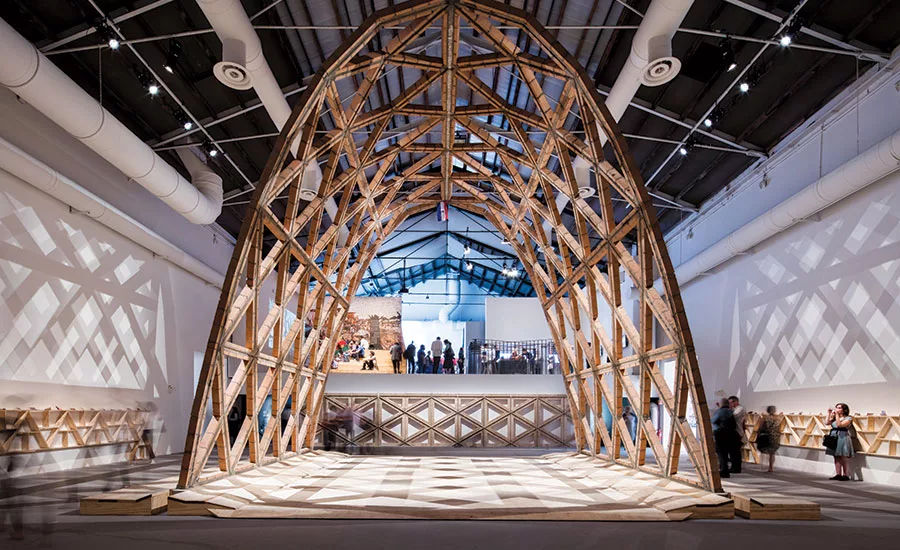
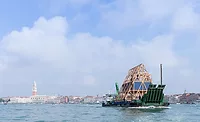
A Paraguayan firm, Gabinete de Arquitectura, won the Golden Lion for Best Participant with a brick-and-timber arch designed to be built cheaply by unskilled labor.
Photo © Luke Hayes
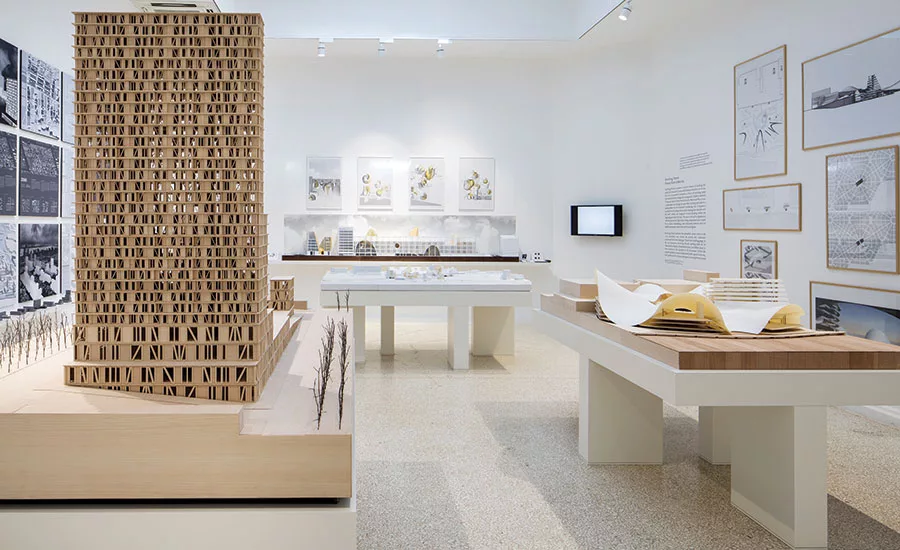
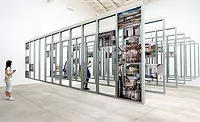
Following the theme, Reporting from the Front, national pavilions put marginalized communities in focus. The U.S. Pavilion presented 12 speculative plans to regenerate Detroit.
Courtesy La Biennale © Francesco Galli
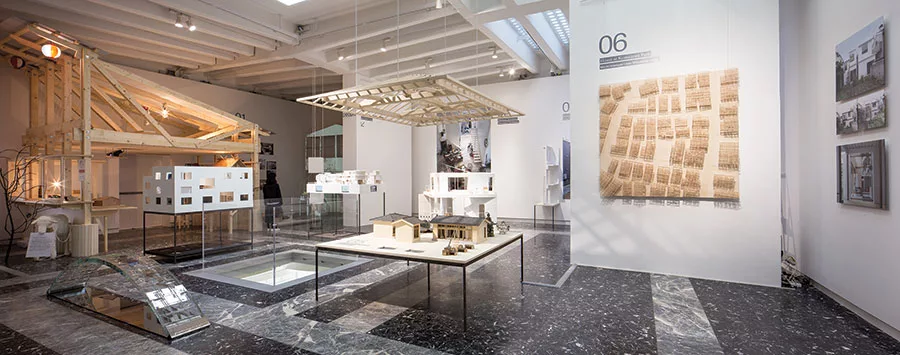
Following the theme, Reporting from the Front, national pavilions put marginalized communities in focus. The Japanese Pavilion explored dense urban living.
Courtesy La Biennale © Francesco Galli
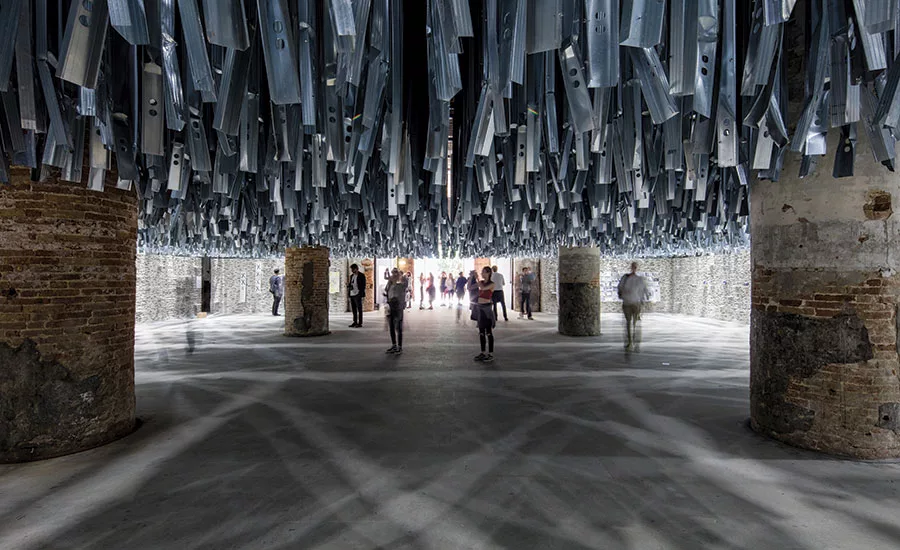
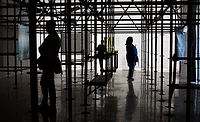
In the entryway of the Arsenale, director Alejandro Aravena covered the walls and ceiling with gypsum board and metal studs left over from last year’s Art Biennale.
Photo © Luke Hayes
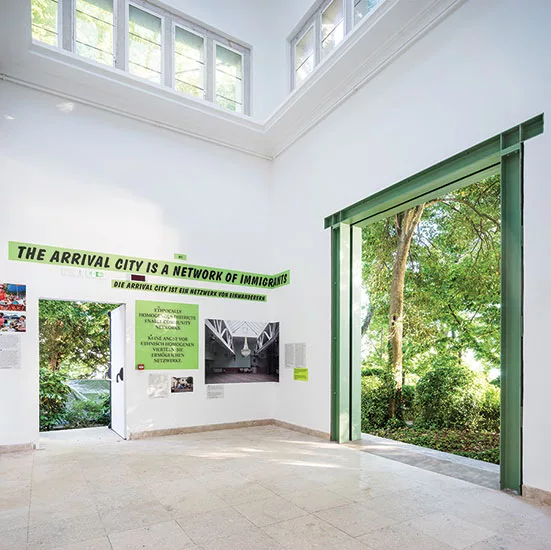
Following the theme, Reporting from the Front, national pavilions put marginalized communities in focus. The German Pavilion grappled with the migrant crisis.
Courtesy La Biennale © Felix Troker
Deep in one corner of the Egyptian pavilion at the 2016 Venice Architectural Biennale, students from the University of Pennsylvania displayed proposals for a dilapidated section of Cairo. Nearby, the Brooklyn-based filmmaker Gary Hustwit (Helvetica) debuted his documentary Workplace, about the New York offices of media giant R/GA. Off-site at the Palazzo Mora, Kevin Slavin, of the MIT Media Lab, was installing a beehive—part of a plan to create a microbiological map of Venice.
One criticism of this year’s Venice Architecture Biennale—that the American presence was too small—seems overblown. There were works by Americans throughout the Biennale, and works by non-Americans often reflected U.S. influences. The Biennale’s director, Alejandro Aravena, has taught at Harvard’s Graduate School of Design—just one of scores of foreign architects in Venice with ties to the U.S. And global teams often included Americans. For example, the Cambridge, Massachusetts, firm Ochsendorf, DeJong & Block helped the famed ETH Zurich create a thin-shell vault of interlocking tiles, one of many “low-tech”
buildings that characterized this Biennale.
Yet Aravena had reason to focus on architects from less-developed countries. This was a Biennale about how architecture can improve the lives of the underprivileged; he was explicit in wanting to address poverty, segregation, natural disasters, crime, traffic, and pollution. He called the show Reporting from the Front, and the U.S. is not the front he had in mind. But there were exceptions: Detroit, the focus of the U.S. pavilion, and Hale County, Alabama, home of Auburn University’s Rural Studio, which was invited by Aravena to fill a section of the Arsenale. There, the Rural Studio created a small theater using bedsprings for walls and stacks of rigid-insulation panels as benches—materials that will be used to help Venice’s homeless population when the Biennale closes (it runs through November 27).
Aravena’s own installations included a cavelike space made with metal studs and plasterboard salvaged from the 2015 Biennale (message: work with what you’ve got). Nearby, in the Arsenale, Chinese architects Wang Shu and Lu Wenyu showed how masonry from demolished buildings can make new buildings greener and more beautiful, while the Paraguayan Gabinete de Arquitectura demonstrated how few bricks are required to build a latticework arch. Over and over, there were ideas for producing structures with materials sourced locally, even in remote villages, and assembled without power tools, that could create housing for millions. In that context, Peter Zumthor’s model of a section of his proposed expansion of the Los Angeles County Museum of Art—a $600 million vanity project—looked, frankly, ridiculous.
But was there enough architecture in this architecture biennale? The parametricist Patrik Schumacher, of Zaha Hadid Architects, walked around the Giardini complaining “there is no work,” meaning the complex, computer-dependent architecture he is known for. “We’re architects, not sociologists,” he added. But visitors seemed to like the pavilions that made strong sociopolitical points, including Germany’s (where parts of walls were removed to symbolize openness to immigrants) or Poland’s (where construction workers spoke, on video, about their sacrifices building for the wealthy).
Some observers described the U.S. Pavilion as retro because it displayed actual architecture, for actual sites. Twelve firms chosen by curators Monica Ponce de Leon and Cynthia Davidson toiled for months, meeting with residents and community leaders to develop possible programs for the sites, then creating elaborate models and renderings for their speculative designs, which filled the pavilion to the rafters. Indeed, there was too much to take in. (Luckily, the show will travel to the Museum of Contemporary Art Detroit next year.)
But in a Biennale that was largely about ways of housing the world’s exploding urban population, the U.S. pavilion didn’t win any awards—the prizes went to the pavilions of Japan and Spain, both of which mounted shows about doing more with less.
Yet cities need not only housing but schools, hospitals, government offices—complex buildings addressing complex programs. Aravena managed to turn the architecture world’s attention to the problems of the underprivileged, and that makes him a hero. There was a lot of rhetoric, and a lot of ingenuity, at his Biennale. But, thanks in large part to Americans, there was also architecture.
Looking for quick answers on architecture and design topics?
Try Ask RECORD, our new smart AI search tool.
Ask RECORD →
Looking for a reprint of this article?
From high-res PDFs to custom plaques, order your copy today!