Architectural Record
search
cart
facebook twitter linkedin youtube
  • Sign In
  • Subscribe
  • Sign Out
  • My Account
Architectural Record
  • NEWS
    • Latest News
    • Awards
    • Interviews
    • Obituaries
    • Podcasts
      • Design:Ed Podcast
      • Sponsored Podcasts
  • OPINION
    • Book Reviews / Excerpts
    • Exhibition Reviews
    • Forum
  • EXCLUSIVES
    • Videos
    • Design Vanguard
    • Top 300 Firms
    • Sponsored Content
    • Sponsored eBooks
    • From the Archives
  • CONTINUING ED
    • Editorial Continuing Ed
    • CE Center
    • CE Academies
  • PROJECTS
    • Buildings By Type
    • Reuse & Renovation
    • Museums & Arts Centers
    • Colleges & Universities
    • Multifamily Housing
    • Interiors
    • Lighting
    • Kitchen & Bath
  • HOUSES
    • Record Houses
    • House of the Month
    • Featured Houses
  • PRODUCTS
    • Products by Category
    • Record Products of the Year
    • Latest Products
  • EVENTS
    • Dates & Events
    • Record on the Road
    • Innovation Conference
    • Sustainability in Practice
    • Women In Architecture
    • Webinars
    • Ad Excellence Awards
    • Submit an Event
  • CONNECT
    • Ask RECORD AI
    • Newsletters
    • Contact
    • Advertise
    • Editorial Calendar
    • Store
    • Customer Service
  • SUBMIT
    • Submission Guidelines
    • RECORD Competitions
  • MAGAZINE
    • Subscribe
    • My Account
    • Digital Edition
    • Current Issue
    • Firm Pass
    • Historic Archive
Opinion

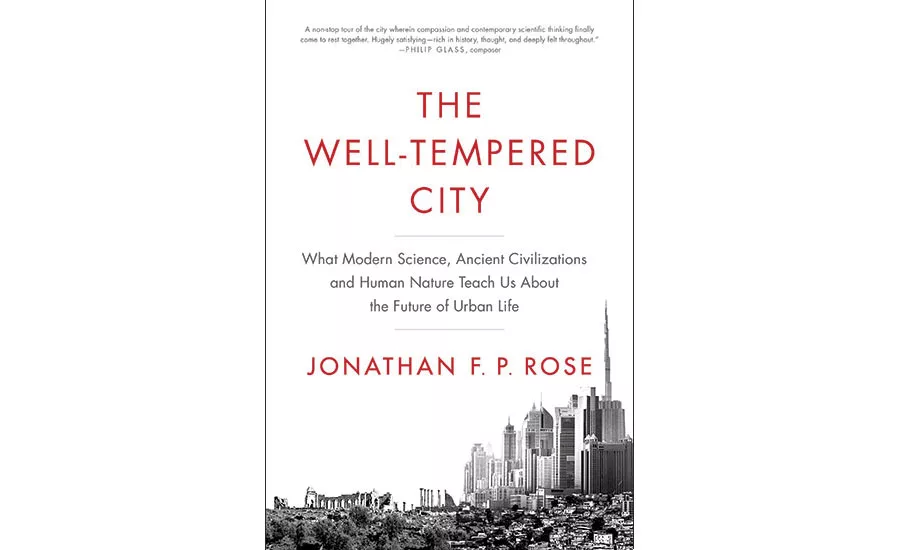
The Well-Tempered City: What Modern Science, Ancient Civilizations and Human Nature Teach Us About the Future of Urban Life
By James Gauer
The Well-Tempered City

The Well-Tempered City: What Modern Science, Ancient Civilizations and Human Nature Teach Us About the Future of Urban Life, by Jonathan F. P. Rose. Harper Wave, September 2016, 480 pages, $18.74.

November 1, 2016

The Well-Tempered City: What Modern Science, Ancient Civilizations and Human Nature Teach Us About the Future of Urban Life, by Jonathan F.P. Rose, Harper Wave, September 2016, 480 pages, $18.74.

Planner and developer Jonathan F. P. Rose’s title for his new book, The Well-Tempered City, alludes to Johann Sebastian Bach’s The Well-Tempered Clavier. Bach’s collection of preludes and fugues in all major and minor keys was composed, says Rose, “to align our highest human aspirations with the sublime harmony of nature. It is a model of the task we have today in designing and reshaping our cities.”

This may sound improbably heady coming from the scion of a prominent family of New York City apartment house developers. But Rose is no ordinary real-estate heir. He is also the intellectual heir of Jane Jacobs, and he cites as a seminal influence her belief that what looks like chaos can actually be a highly advanced form of order. Rose is a serious urban thinker and doer who has combined an academic background in planning and public policy with a successful business building green affordable housing. In his ambitious tome of almost 400 pages, he develops a notion, which he first began to explore as an undergraduate at Yale in the early ’70s, that “the same principles that increase the well-being of humans and natural systems could also guide the development of happier, healthier cities.” 

The book’s five parts each address a quality Rose believes essential to the future of socially and economically viable municipalities: coherence, circularity, resilience, community, and compassion. In the first four sections, he investigates the interdependent networks, both physical and cultural, that define metropolitan centers. 

The chapters in Part 1, “Coherence,” exemplify both the strengths and weaknesses of this approach. In “The Metropolitan Tide,” the author attempts a far-ranging history lesson that is literally all over the map and seems somewhat unfocused. But in “Sprawl and Its Discontents,” he succinctly analyzes sprawl’s causes (federal housing and transportation policies, suburban zoning codes, and subprime lending) and this scourge’s effects (environmental crises and suburban poverty, to name just two) and suggests that the solution lies in an alliterative paradigm of “concentration, complexity, and connection.”

The breadth of Rose’s interests ranges from climate change, cognitive neuro­science, ecology, economics, gardens, green building technology, history, and infrastructure to musicology, parks, planning, psychology, public health, sociology, and transportation. And more. He makes the case that, in cities, these are interconnected, but tying all that together in a coherent narrative is a tall order, and so the book tends to ramble a bit. 

The most focused chapters include “Water Is a Terrible Thing to Waste,” in which the author observes that one reason for the decline of cities and civilizations was expansion beyond the limits of their food and water sources. He tracks efforts to address this problem from the third century CE, when the emperor Diocletian installed an extensive water-supply system in Split, to the present day, when the Gates Foundation is funding experiments in water-saving toilets and small local sewage-treatment systems. The chapter “Green Buildings, Green Urbanism” is lively and informative, which is not surprising, given Rose’s considerable experience with sustainable development. Also excellent is “Prosperity, Equality and Happiness,” a thoughtful essay on the not-always-predictable relationship between economics and human well-being.

In Part 5, “Compassion,” Rose circles back to Bach and espouses an optimistic vision of cities rescued by “science integrated with harmony” and by “altruism arising from trust.” His writing takes a lyrical, almost mystical turn here, which comes as a surprise after all the dense scholarly exposition that precedes it. But his idealism seems authentic, and his hopefulness is welcome.

Looking for quick answers on architecture and design topics?
Try Ask RECORD, our new smart AI search tool.
Ask RECORD →

KEYWORDS: Book Reviews / Excerpts

Share This Story

Looking for a reprint of this article?
From high-res PDFs to custom plaques, order your copy today!

James gauer
James Gauer, an architect and author based in Chicago and San Miguel de Allende, Mexico, is a contributing editor at RECORD.

Post a comment to this article

Report Abusive Comment

Subscription Center
  • Create an Account
  • Start a Subscription
  • Manage My Account
  • Sign Up for Newsletters
  • Visit Customer Service
  • Update Preferences

More Videos

Sponsored Content

Sponsored Content is a special paid section where industry companies provide high quality, objective, non-commercial content around topics of interest to the Architectural Record audience. All Sponsored Content is supplied by the advertising company and any opinions expressed in this article are those of the author and not necessarily reflect the views of Architectural Record or its parent company, BNP Media. Interested in participating in our Sponsored Content section? Contact your local rep!

close
  • TAMLYN XtremeTrim Exterior Trim
    Sponsored byTamlyn

    Designing Cleaner Panel Facades: Why Exterior Trim Details Matter

  • Building with Vapor Barriers
    Sponsored byReef Industries, Inc.

    Vapor Barriers Help Control Moisture in Tighter Building Designs

  • Duct Interior with Prodeq System
    Sponsored byHenry, a Carlisle Company

    Designing Resilient Water Containment Systems

DESIGN:ED Podcast
Listen to Architectural Record’s DESIGN:ED Podcast

Events

June 10, 2026

Rethinking Stormwater – The Power of Porous Paving

Credits: 1 AIA LU/HSW; 1 AIBD P-CE; 0.1 ICC CEU

Learn how porous paving systems support stormwater management, reduce heat island effects, and enhance sustainable site design performance.

June 11, 2026

Very Early Warning Fire Detection for Mission-Critical Facilities

Credits: 1 AIA LU/HSW; 1 AIBD P-CE; 0.1 ICC CEU

Examine advanced fire detection strategies that support uptime and enhance safety in data centers and other mission-critical facilities.

View All Submit An Event

Products

2026 Architect's Square Foot Costbook

2026 Architect's Square Foot Costbook

See More Products

Popular Stories

Practice Matters illustration

What’s in a (Firm’s) Name? Thinking About Succession and Legacy

Practice Matters illustration

By the Numbers: Counting America's Architects

Riverdale House by Studio Lau

Riverdale House by Studio Lau

House on a Hill

Design Vanguard 2026: Forma

Crane Cove, ONO

Design Vanguard 2026 Winners

Broader Sustainability of CMU - Free Webinar - May 21, 2026

Related Articles

  • rabble rousers film still

    ‘Rabble Rousers’ Champions Community Activist Frances Goldin and Grapples with the Past, Present, and Future of Urban Development

    See More
  • Why the Future of Architecture Doesn't Need Us

    See More

Related Products

See More Products
  • 3dthinking.jpg

    3D Thinking in Design and Architecture: From Antiquity to the Future

  • 1118522532.gif

    Future Details of Architecture

  • 047177751X.gif

    Sustainable Urbanism: Urban Design With Nature

See More Products
×

The latest news and information

#1 Source for Architectural Design, News and Products

SUBSCRIBE
  • RESOURCES
    • Advertise
    • Contact Us
    • Submit
    • Store
  • ACCOUNT CENTER
    • Create an Account
    • Start a Subscription
    • Manage My Account
    • Sign Up for Newsletters
    • Visit Customer Service
    • Update Preferences
  • PRIVACY
    • PRIVACY POLICY
    • TERMS & CONDITIONS
    • DO NOT SELL MY PERSONAL INFORMATION
    • PRIVACY REQUEST
    • ACCESSIBILITY
  • SERVICES
    • Marketing Services
    • Reprints
    • Market Research
    • List Rental
    • Survey/Respondent Access
  • STAY CONNECTED
    • Linkedin
    • Facebook
    • Instagram
    • YouTube
    • X (Twitter)

Copyright ©2026. All Rights Reserved BNP Media, Inc. and BNP Media II, LLC.

Design, CMS, Hosting & Web Development :: ePublishing