The Port House by Zaha Hadid Architects
A picturesque fire station on the city’s docks is transformed into a striking office building by a multifaceted glass top.
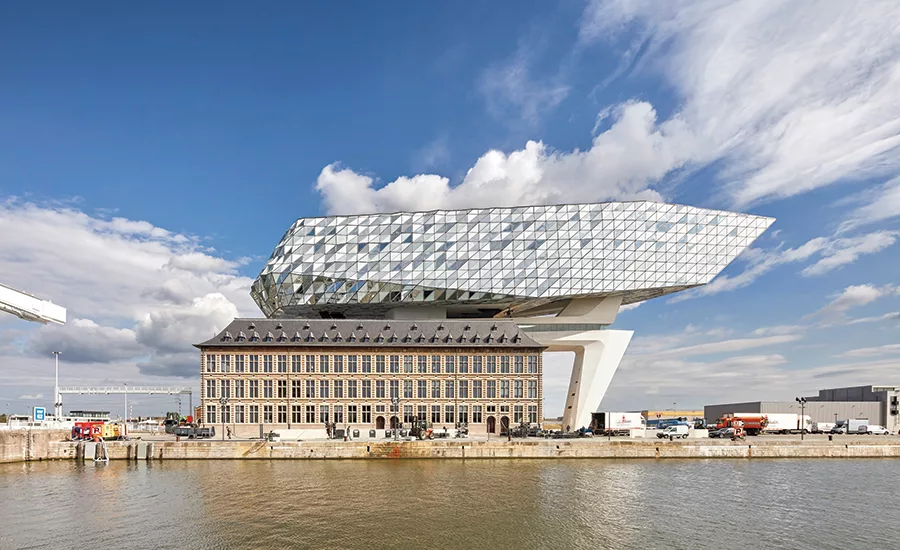
In transforming a century-old fire station into the offices for Antwerp’s Port Authority, Zaha Hadid Architects created a faceted, glazed cloudlike structure atop the older building.
Photo © Hufton + Crow
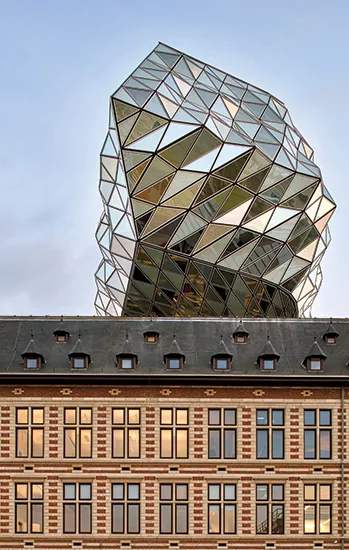
While the old and new sections are stylistically disparate, the size of the upper portion’s glass panes retains the scale and proportion of the lower fenestration.
Photo © Hufton + Crow
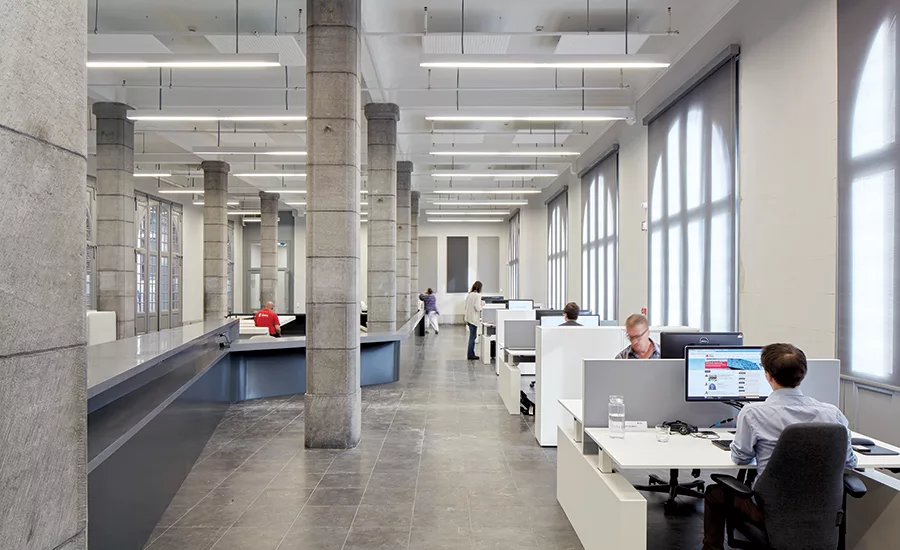
The original station, a copy of a 16th-century Hanseatic League structure, has been stripped to its basic frame for new offices.
Photo © Hufton + Crow
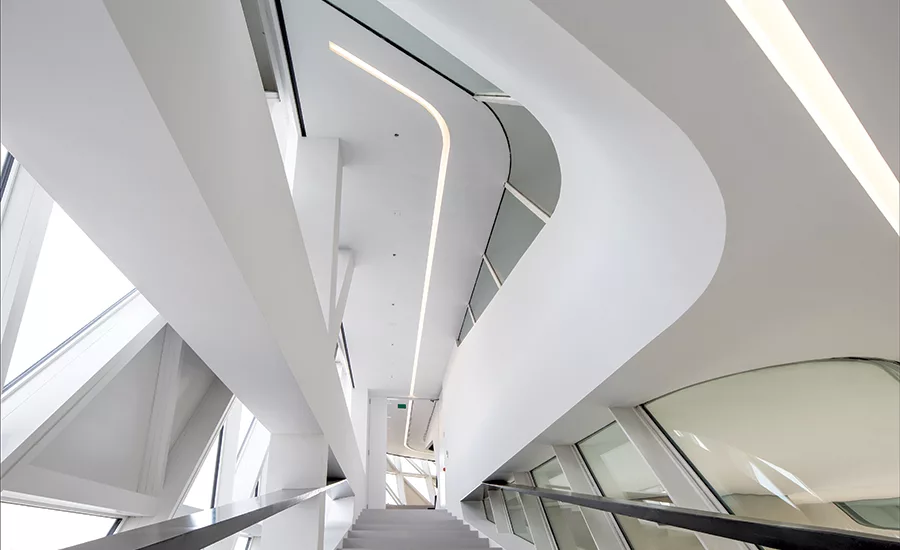
The stairway between the foyer and the auditorium on the sixth floor is enclosed by cloudlike, swerving walls.
Photo © Danica Kus
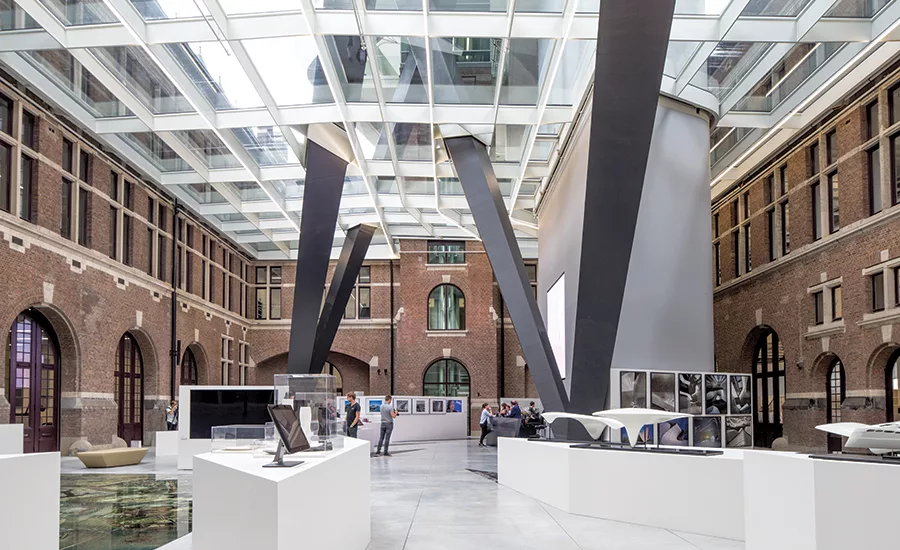
The courtyard functions as a reception and exhibition area. V-shaped black-painted steel columns push through its glazed steel-lattice roof to keep the superstructure rigid.
Photo © Danica Kus
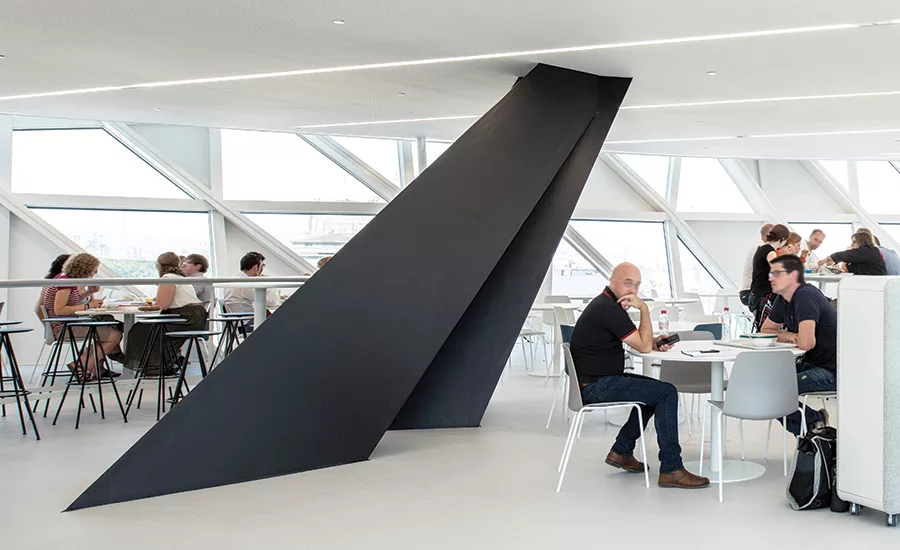
Two diagonal steel supports meet in the sixth-floor restaurant.
Photo © Tim Fisher
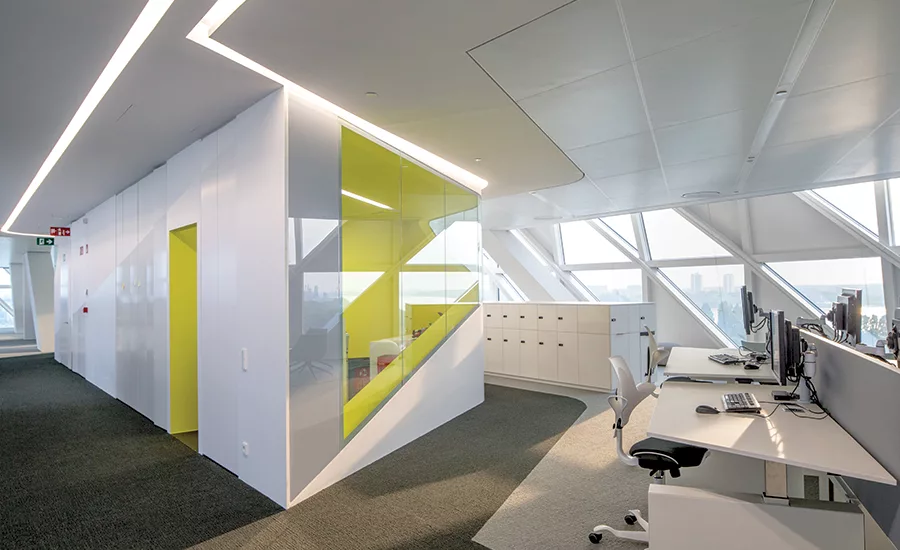
On the seventh floor, offices and meeting rooms echo the lines of the faceted exterior.
Photo © Danica Kus
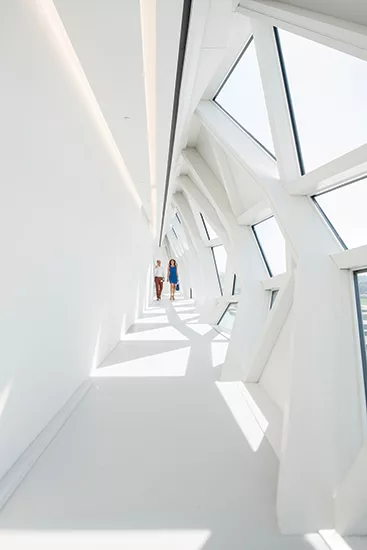
A narrow, vaulted corridor on the periphery of this floor takes visitors along a dramatic route from the foyer to the restaurant.
Photo © Tim Fisher
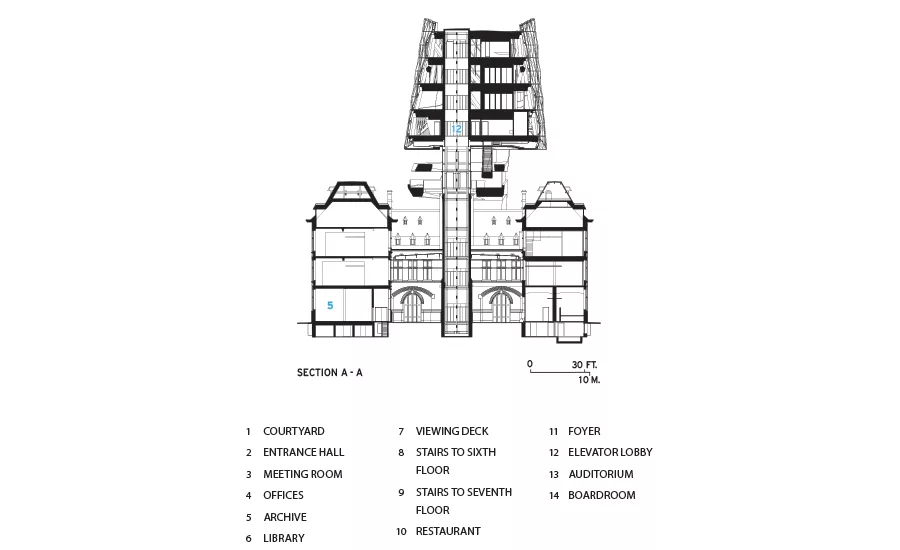
Image courtesy Zaha Hadid Architects
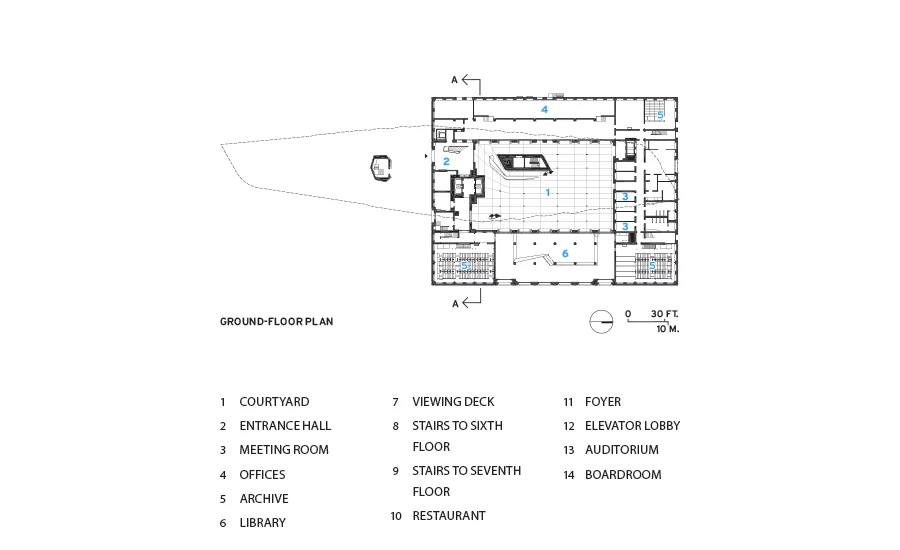
Ground floor plan
Image courtesy Zaha Hadid Architects
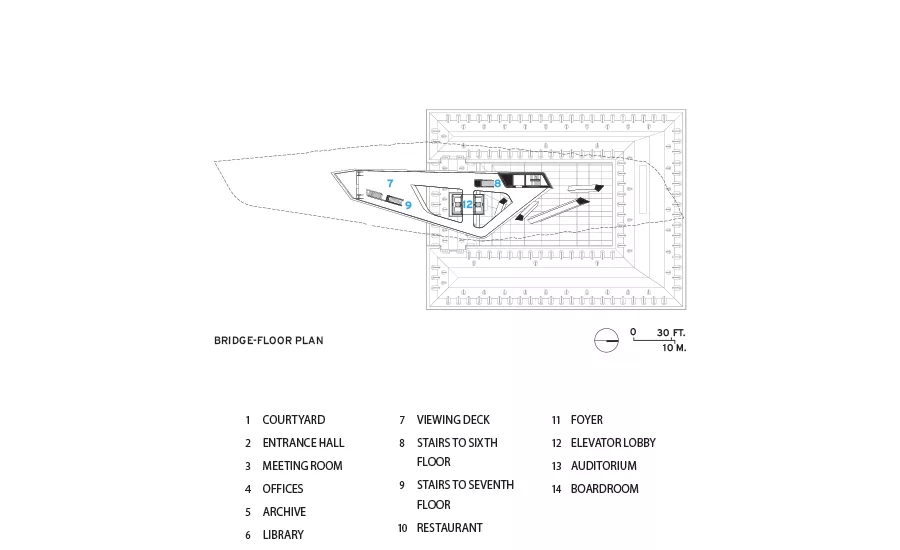
Bridge floor plan
Image courtesy Zaha Hadid Architects
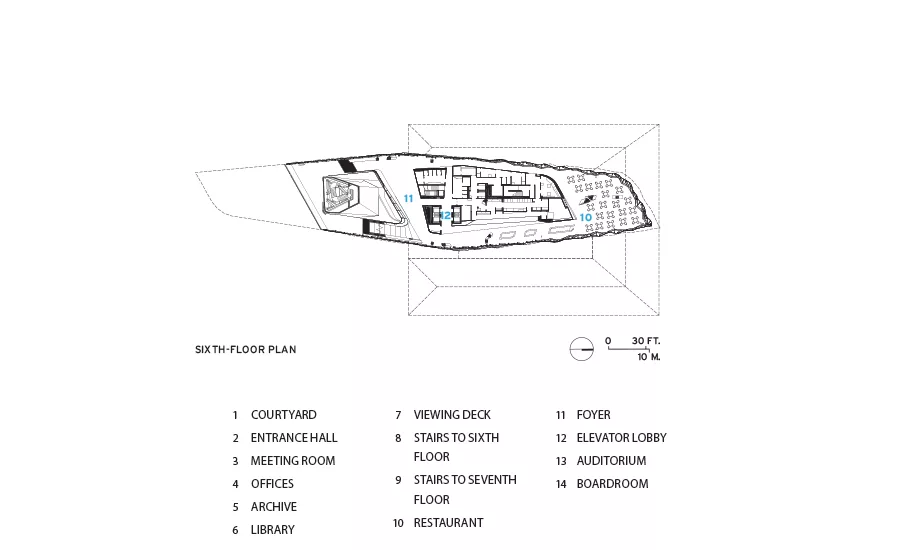
Sixth floor plan
Image courtesy Zaha Hadid Architects
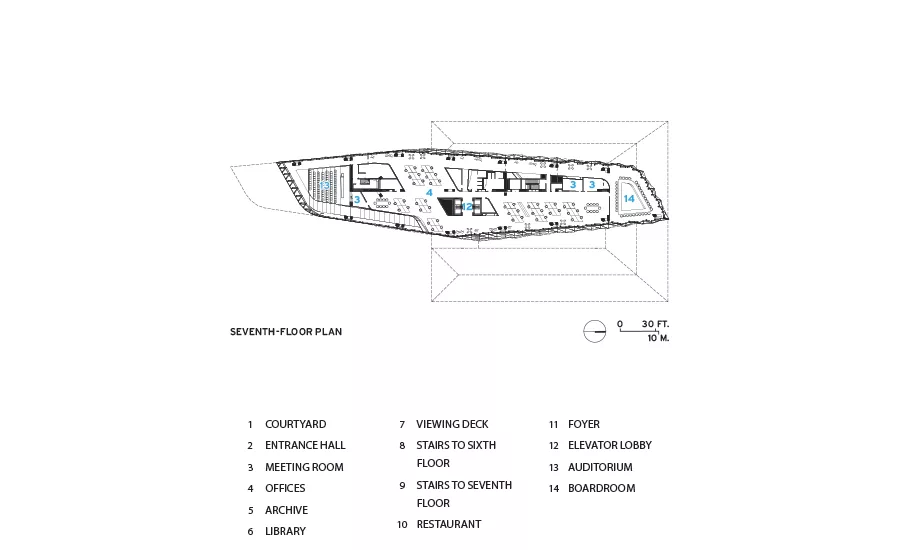
Seventh floor plan
Image courtesy Zaha Hadid Architects
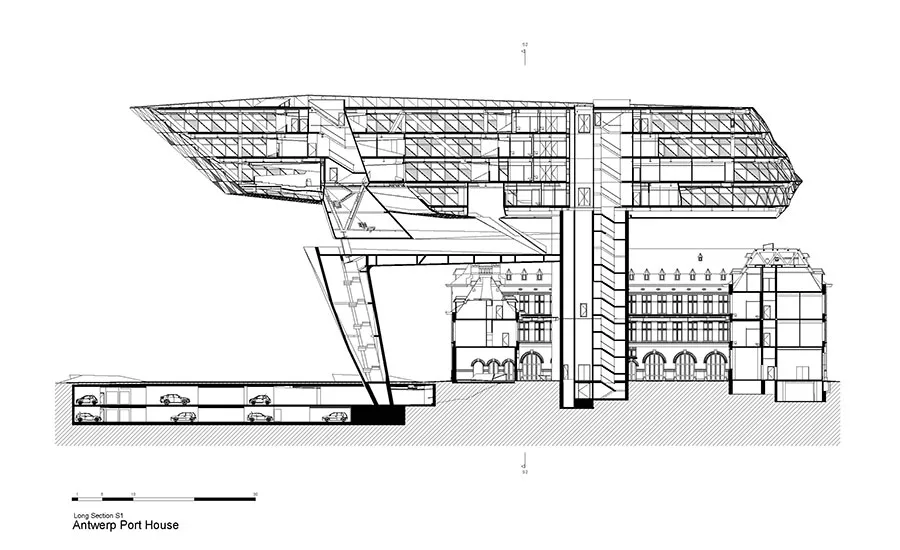
Image courtesy Zaha Hadid Architects
Architects & Firms
Antwerp, Belgium
People/Products
One of the first completed projects from Zaha Hadid’s office since her untimely death, at 65 in March this year, the new Port House on the sprawling docks of Antwerp, Belgium, is a bravura, if distinctly eccentric work. This nine-story headquarters building for the Antwerp Port Authority is not just by Hadid, of course: her long-term codirector, Patrik Schumacher, is equally credited, along with a large team at Zaha Hadid Architects (ZHA). But Zaha was closely involved in this creation, according to Schumacher, which displays her wit, sense of mischief, and knowledge of the history of heroic modernism from Futurism and Russian Constructivism onward. Many of her later buildings, such as her gigantic Heydar Aliyev Center in Baku, Azerbaijan (RECORD, November 2013) became softer, more organic in form. Not this one: this comes from the earlier Zaha mindset, the time of glittering, jagged edges.
It is architecture as giant jewelry, a 66,700-square-foot, four-story extension above a large 71,000-square-foot, existing municipal fire station dating from 1911. Constructed by the city architect, the fire station replicated a long-vanished Hanseatic League merchant’s palace of the 16th century. The stoutly built steel-framed masonry structure fell vacant just as the Port Authority was looking for a new base for its scattered staff. Since the city’s busy docklands area is the second-largest in Europe and fifth-largest in the world, the authority wanted a headquarters that was a symbol of modernity for visiting trade delegations.
The resulting hybrid is a building of extreme visual dynamism, its upper portion floating above the roof of the restored old building. Pointing due south toward the city’s historic riverside and center, it seems both frozen in motion and surging forward. The top’s triangulated glazed cladding starts off flush at the prow but erupts into irregular projections, becoming increasingly crystalline along its length–a reference to Antwerp’s famous diamond trade. According to ZHA’s Belgian-born project director, Joris Pauwels, Zaha did not over-emphasize visual metaphor during the design process. “The layering of the city was what she talked about,” he says, “and how that should have a clear dynamic.”
This diamond vessel assumes an abstract rhomboidal form that is freestanding, touching the old building only via one of two elevator shafts housed in a concrete core in the now glazed-over courtyard. A concrete angled prow rising from the cobbled piazza in front contains a fire stair. These two supports are connected above and below ground to form a vertical ring beam, and the whole structure is then braced by four angled black-painted steel columns rising in V formation from two points in the courtyard. They shoot through the courtyard’s glass roof, interlocking in the new superstructure to keep it rigid.
Three floors of the shimmering airship are actually a steel-truss bridgelike structure, while another floor is slung beneath it on hangers. Large steel subsections were preassembled off-site, floated in by barge, and hoisted into position by crane. The whole was then wrapped in an aluminum-framed glazed cladding system, which conceals the fact that around a third of the panels are solid, to reduce solar gain.
The two halves of the building work as one programmatically in that there are open-plan “hot desking” office floors throughout, housing 450 workers now but with capacity for growth, to 600. However, the larger spaces–a 90-seat auditorium, boardroom, and restaurants—are all in the upper section. A cluster of four panoramic elevators uses the stumpy firemen’s tower of the original building, where hoses were hung to dry.
These elevators shoot through a flash of open daylight between old and new structures: what could have been merely a gap has become something else. It features an open viewing deck in smooth cast-in-place concrete that makes a virtue out of the necessity for the structural beam clamping the two cores together. A staircase, for all the world like the gangplank of a ship, leads down to this terrace from the belly of the floating building above.
Looking for quick answers on architecture and design topics?
Try Ask RECORD, our new smart AI search tool.
Ask RECORD →
The office interiors are as normal as any office could be in such a structure, where angled columns crash through the spaces at intervals, and contractors have struggled to get solar blinds around some of the more awkward, outwardly-leaning corners. In consequence, there is a fair amount of redundant space in the floorplates–though it is a very different matter in the more efficient, if less well daylighted, rectilinear floors of the restored building beneath. Throughout, free-standing pods of ancillary office accommodation, from storage to meeting rooms, are finished in bright yellow, contrasting with the gray floors. Overall, the building has achieved a BREEAM “very good” rating, roughly equivalent to LEED Gold, thanks to groundwater cooling via chilled beams, the waterborne delivery of large parts of the building structure, extensive provision for bicycles and electric cars in a two-level parking garage beneath the cobbled piazza, and of course the total conservation and reuse of the existing building.
The courtyard, now enclosed beneath a glazed steel-lattice roof, acts as a very generous reception lobby and exhibition space. To one side of the courtyard, in the area where fire trucks used to park, there is now a public reading room with access to the Port Authority’s archives.
As with much of Zaha’s output, this is a building that is as easy to criticize as to praise. Many, seeing the images, see only arrogance. It is an undeniably startling, even shocking, juxtaposition of forms. But photographs exaggerate the drama: in actuality, in this wide-open landscape with no nearby buildings, the Port House does not seem so big. And the century-old host building—which is good but not great—holds its own pretty well. No question that, if seen only as a way to achieve extra square footage, the project verges on the perverse. But nobody ever hired Zaha to do ordinary. For me, this is a magnificent work of architectural surrealism that just happens, by force of will, to be a functioning, if in places awkward, workspace. I left shaking my head in admiration.
Looking for a reprint of this article?
From high-res PDFs to custom plaques, order your copy today!