Architects' Original Sin
To atone for the built environment’s impact on the climate, the profession must demonstrate leadership.
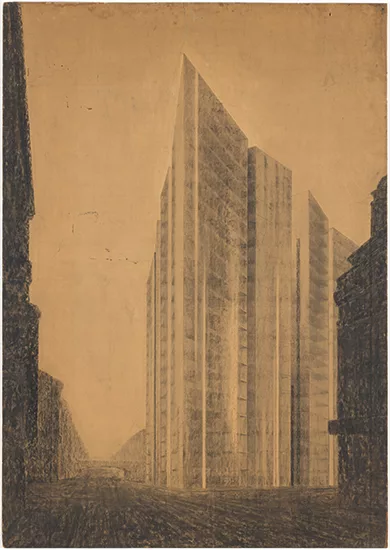
With his 1921 proposal for a crystalline skyscraper on Friedrichstrasse in Berlin, Mies van der Rohe invented a new typology—the now-pervasive all-glass high-rise.
Photo © 2017 Artists Rights Society (ARS), New York / VG Bild-Kunst, Bonn
Last fall, Pope Francis declared that “to commit a crime against the natural world is a sin against ourselves and a sin against God.” In late January, the conservative media mogul and evangelical Christian Joseph Farah put it differently: “Sin, not carbon, causes climate change.”
Either way, if climate change is a sin, much of the burden belongs to architects.
Conventional wisdom has it that transportation and industry are responsible for the lion’s share of greenhouse gases. For example, in February a Boston Globe editorial identified fuel-efficiency standards for vehicles as the best strategy for New England to compensate for the expected void in federal leadership on climate change under the Trump administration. In actuality, however, transportation accounts for only a third of annual CO2 emissions in the U.S., with industry comprising another fifth, according to the U.S. Energy Information Administration. The building sector alone represents nearly half the country’s energy consumption and emissions and three-quarters of electricity use. By far the biggest challenges with climate change are in the built environment.
How much of the built environment is touched by architects is unclear, since estimates range from 2 to 100 percent, depending on whom you ask and who is considered an “architect”— only licensed practitioners or anyone who designs buildings. But our role is both direct and indirect. “We either design it or we highly influence it,” Ed Mazria tells me. “What we do matters greatly.” In 2002, Mazria founded Architecture 2030, a nonprofit whose mission is “to rapidly transform the built environment from the major contributor of greenhouse gas [GHG] emissions to a central part of the solution to the climate and energy crisis.” Fifteen years later, how are we doing in that transition?
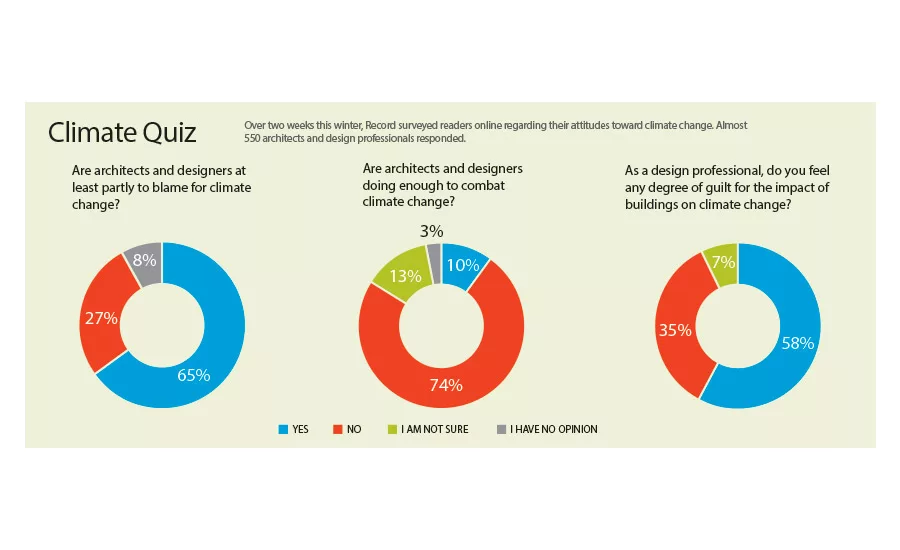
For this article, Architectural Record created a survey on attitudes toward climate change and energy efficiency, to which 547 architects and design professionals from 43 states responded. The share of respondents who say they believe that human activity is changing the climate is 94 percent—24 points higher than the general public, according to recent national polls by researchers at Yale and George Mason universities. (Interestingly, 84 percent of architects responding to RECORD's survey say there is scientific consensus on climate change, so it seems that 10 percent of believers are going on faith alone.) Nearly 85 percent say that combating climate change is either “essential” (55 percent) or “very urgent” (30 percent) for architects, yet only 10 percent say we are doing enough, and 28 percent feel their own organizations are. Two-thirds of practicing architects feel that the profession is partly to blame for climate change, and 58 percent feel some degree of personal guilt about it.
As leaders in shaping the built environment, architects arguably bear the greatest responsibility for the impacts of climate change—but we also have the greatest opportunity to mitigate them. What can we architects do to absolve ourselves? Here are five steps we can take on the road to redemption.
Push for stronger regulation
The survey asked respondents to rank 11 actions “to transform the building sector to reach carbon neutrality,” and seven of their eight top choices relate to regulation. Yet while 90 percent say that climate science should have more influence on public policy, 86 percent feel that combating climate change will become more challenging over the next four years. If the Federal government won’t lead the way, cities and states can, and many are doing so. New York and Washington, D.C., have adopted very advanced building codes, for example. “In large cities, new buildings and major renovations are coming in at half the consumption of the average building,” says Mazria. At the state level, California’s electricity use per capita nearly flattened in the three decades following the 1978 passage of the efficiency standard Title 24, while it rose 50 percent in the rest of the U.S., according to calculations by Berkeley physicist Art Rosenfeld. Now the state has mandated net zero energy targets for all residential buildings by 2020 and all commercial buildings by 2030.
Looking for quick answers on architecture and design topics?
Try Ask RECORD, our new smart AI search tool.
Ask RECORD →
Codes matter, and architects can do more to change them. “They have to play a larger role,” insists Maureen Guttman, president of the Building Codes Assistance Project. “It’s easy for clients to override you by saying that if it’s not required, they’re not going to do it.” Mazria says architects already are having a big impact. “They’re doing a hell of a job in pushing for better regulation.”
Show more leadership
But are they doing a hell of a job in their own projects? Since 2010, the American Institute of Architects (AIA) has tracked the progress of hundreds of firms who have signed the 2030 Commitment, its framework for reaching carbon neutrality by that year. The target was a 60 percent energy reduction from a baseline standard until 2015, when it shifted to 70 percent, and in 2020 it will jump to 80 percent. The annual progress report for 2015 shows that less than 4 percent of the gross square footage designed by 2030 firms met the target for that year. For six years in a row, the average reduction has hovered between 35 percent and 38 percent—about half the current target and about average for all LEED-certified buildings, according to the U.S. Green Building Council. And this is just from the 152 firms who actually submitted data to the AIA, so even the leaders are lagging.
What will it take to accelerate performance? “Getting designers to give a damn,” insists Greg Mella, director of sustainable design for SmithGroupJJR. “Designers still see this as a constraint instead of an opportunity.” Mazria believes the new political climate is motivating more architects. “The new administration has mobilized the profession. People have new passion around these issues. We’re seeing an urgency to act now.”
Offer better training
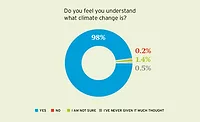
When asked to assess architects’ general state of knowledge about energy-efficient design techniques, 52 percent of survey respondents call it “modest.” Thirty-eight percent call it “good” or “excellent,” and 71 percent label their own knowledge with those terms. Yet while 98 percent claim they understand what climate change is, fewer than half correctly identify its causes. Only 42 percent know that the building sector emits more GHGs than industry or transportation does, and a mere 15 percent know that buildings account for nearly half of emissions. In fact, only 21 percent of people who believe their knowledge is “excellent” answered this correctly. Architects appear to overestimate their own comprehension of the subject.
For example, according to the survey results, architects believe that the No. 1 obstacle to combating climate change is cost. Yet for more than a decade, numerous studies, including a 2007 report by the construction consulting firm Davis Langdon, have demonstrated that green building need not cost more, and the National Renewable Energy Laboratory calculates that adopting current best practices can achieve up to 60 percent reduction in energy without any additional expense. But the perception that higher performance means higher costs is a myth that dies hard.
How can architects wise up? Survey respondents highlight the need for better training in the schools, but this defers responsibility to the next generation of architects. I asked two dozen green building experts for suggestions, and their consensus was that architects should be getting better on-the-job training through their firms and through continuing-education requirements as part of basic practice. Neverthe- less, in 2012, the AIA “sunsetted” the sustainable- design requirements in members’ continuing education, because, it announced, “sustainable-design practices have become a mainstream design intention.” But intention and outcome are different things, and the evidence suggests that more education is sorely needed.
Make renewables more available
“We’ve always known that progress would happen inconsistently,” says Heather Holdridge, sustainability director at Lake|Flato Architects. “It’s more of a kinking curve.” In market theory, a “kinked demand curve” refers to competitors’ decreasing their prices to match each other and avoid losing customers, and we’re seeing this in the solar energy market now. Photovoltaics (PVs) now cost 100 times less than they did in the late ’70s, and the price continues to drop. “Swanson’s Law,” named for Richard Swanson, the founder of PV company SunPower, shows that as the manufactured volume doubles, the cost drops 20 percent. Efficiency also is improving. In the three-year period from 2012 to 2015, the output of solar panels increased 10 percent, while the cost per watt decreased 35 percent. The lesson for architects: specify renewables whenever possible. The greater the demand, the lower the cost.
Still, the experts I interviewed list renewables as the last priority in improving energy performance. Imagine if all power production were clean and renewable. Would this take the pressure off architects to make better buildings? “That question worries me a lot,” Holdridge confesses.
Change our values
In Fire and Memory: On Architecture and Energy, Luis Fernández-Galiano explains that energy was an essential part of architectural theory before the past century, going all the way back to Vitruvius. Modern architecture, however, shifted the values of design by imposing a “dictatorship of the eye” over the skin. Nothing makes this more evident than architects’ infatuation with glass. Le Corbusier called it a “miraculous” material, “the fundamental material of modern architecture,” but it was Mies van der Rohe who truly anointed it. In his 1921 Friedrichstrasse Skyscraper proposal, he singlehandedly invented the now-pervasive all-glass high-rise. If climate change is a sin, Mies was architecture’s Virgil, shepherding us all into the underworld.
“Sealed, glazed facades, now so ubiquitous, lead to higher heating and cooling loads as well as glare and thermal comfort challenges,” explains Andrea Love, director of building science at Payette. Yes, glass allows for more daylight and expansive views, but there’s a point of diminishing returns. Love’s analysis for a sciencecenter project found that a typical double-paned glass facade offered no additional benefits for daylight beyond 25 percent glazing, and thermal discomfort started at 30 percent glazing. The more glass, the more glare, unless the envelope design compensates for this with effective (and potentially expensive) sun shading. “We can compose facades that will perform well and be beautiful with only 30 percent glazing,” insists Love. “It’s time to end our collective passion for all-glass buildings. As designers we should embrace the challenge of creating a new image for what it means to be modern.”
If the Pope is right, our salvation may depend on it.
Looking for a reprint of this article?
From high-res PDFs to custom plaques, order your copy today!