Names to Know at the 2017 Chicago Architecture Biennial: Barkow Leibinger
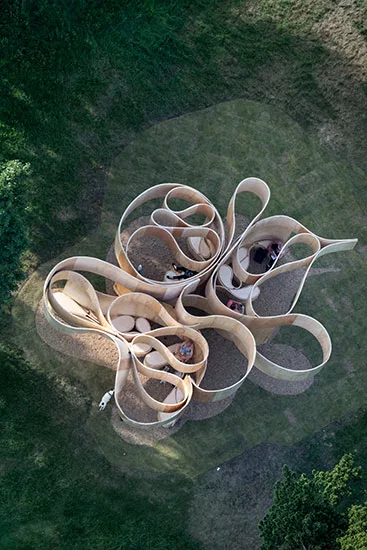
Serpentine Summer House by Barkow Leibinger
London
This free-standing pavilion was designed in 2016 for the Serpentine Galleries to resembles a contoured line drawing. Constructed from flexible plywood and a steel tube frame, the ground level’s anchored benches offers panoramic views of the park while the undulating cantilevered canopy hovers overhead.
Photo © Iwan Baan
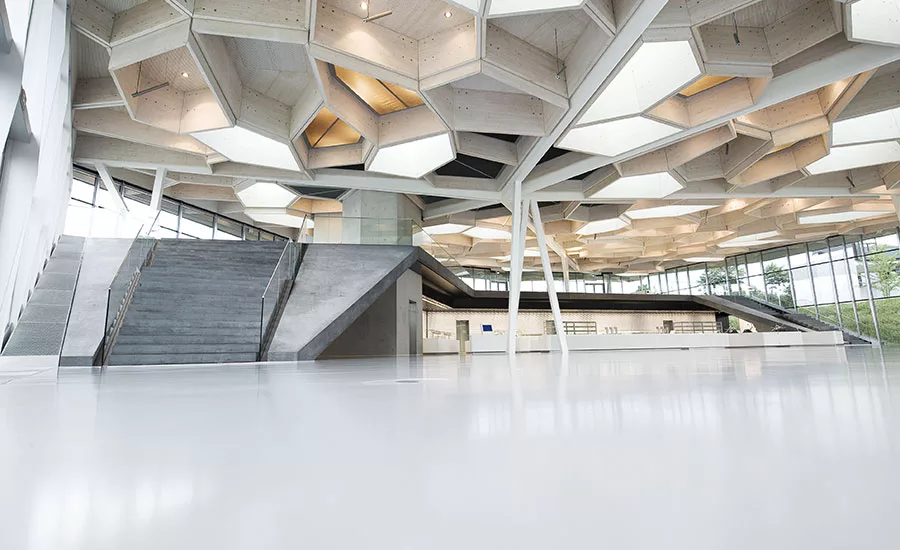
Campus restaurant and event space by Barkow Leibinger
Ditzingen, Germany
This office restaurant and event space, completed in 2008, was conceived of as a pavilion that could seat 700 people at a time. The highlight of the design is the leaf-like roof which arches over the space with the support of clusters of columns below. The program of each cell within the roof varies from being a skylight to acoustic wood planking to a space dedicated to artificial light fixtures.
Photo © David Franck

Tour Total by Barkow Leibinger
Berlin
The 18-story tower was the first building constructed on a new 40-acre mater plan near Berlin’s main train station. The 2012 office tower’s cladding with pre-cast concrete gives the structure a dynamic facade while affording interiors with natural lighting. An offset core allows for column-free workspaces.
Photo © Johannes Foerster
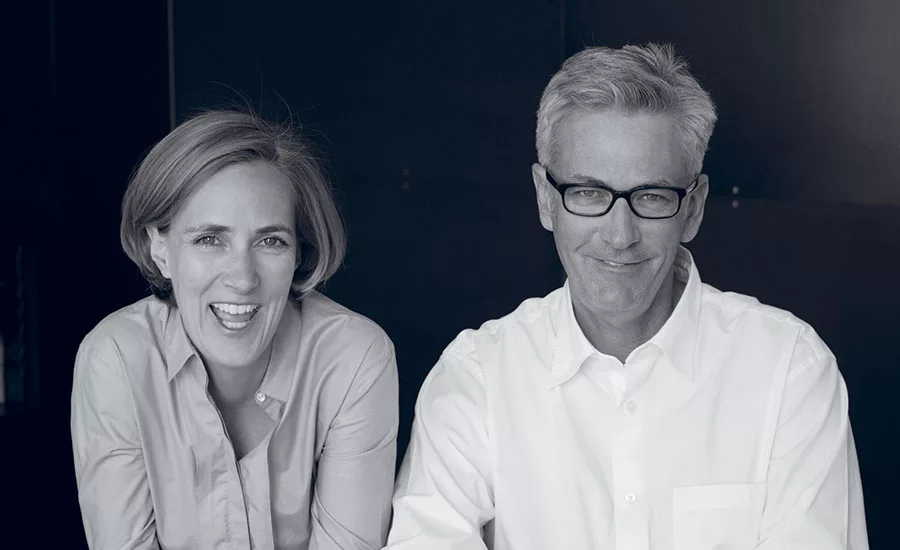
Founding partners Frank Barkow and Regine Leibinger
Photo courtesy Barkow Leibinger
Architects & Firms
Barkow Leibinger is an American/ German architectural practice based in Berlin and New York and was founded in 1993 by Frank Barkow and Regine Leibinger. RECORD asked them five questions about their work at the Chicago Architecture Biennial. Scroll through the slideshow above to see some of their key projects.
Architectural Record: Tell us about your practice. What differentiates you from other firms?
Barkow Leibinger’s discursive research-based approach to architecture and design allows their work to respond to advancing knowledge and technology, locating the practice as an international leader in digital and analogue fabrication techniques. This skill set expands to include new materials, and applications that drive the practice forward as a continuously evolving activity. This focus revolves around a commitment to academic teaching, research, and the practice itself: each are autonomous work areas that simultaneously inform each other beneficially.
How do you get into the creative headspace?
Travel: the direct experience of the world always triggers something that we bring back to the studio and filter.
Who are your design heroes?
Right now, Angelo Mangiarotti's industrial buildings and ceramics. Local Berlin architects Fehling+Gogel are also unsung heroes.
Looking for quick answers on architecture and design topics?
Try Ask RECORD, our new smart AI search tool.
Ask RECORD →
What do you hope to contribute to the Chicago Biennial?
We will show three large-scale models for affordable housing towers in Berlin using three materials, or tectonic approaches, that show how you can instrumentalize history as a provocative and powerful tool for making architecture anew, and not just an "inspiration" or footnote.
Most importantly, when it comes to pizza, deep dish or thin crust?
Deep dish is dope!
The Chicago Architecture Biennial runs from September 19, 2017, to January 7, 2018. Read more of our coverage of the event here.
Looking for a reprint of this article?
From high-res PDFs to custom plaques, order your copy today!