Storey's Field Community Centre and Eddington Nursery by MUMA
Cambridge, England
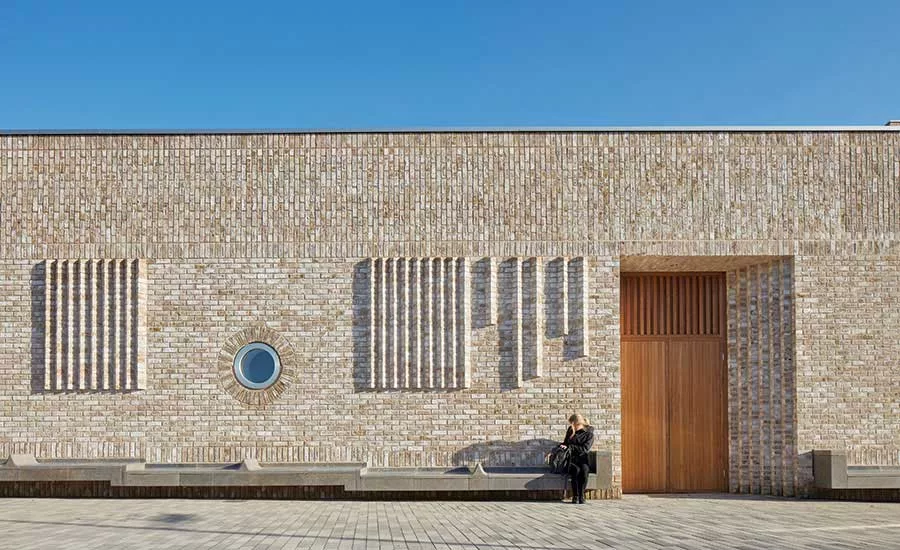
MUMA’s refined brickwork and limestone benches enliven the facade of the nursery’s administration wing.
Photo © Alan Williams
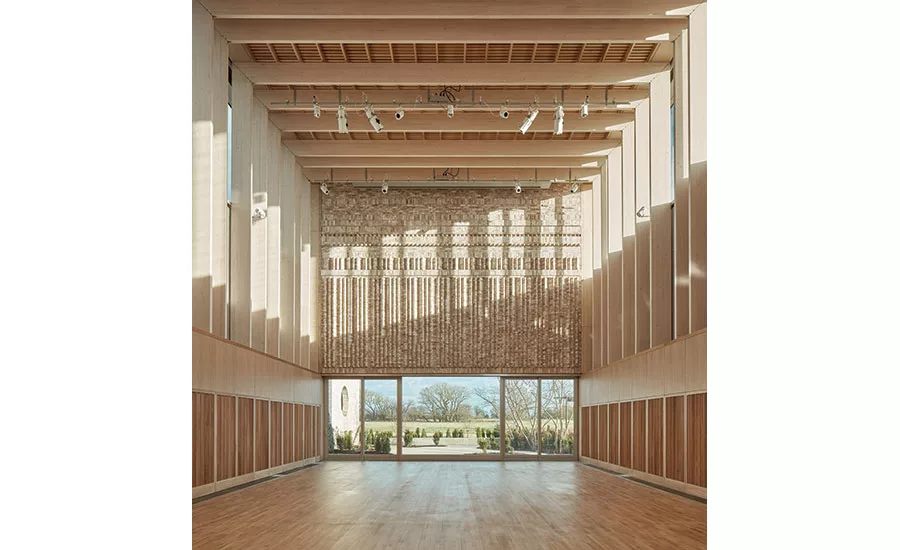
The main hall, in pale timber and textured brick, commands views of Cambridgeshire’s agricultural landscape.
Photo © Alan Williams
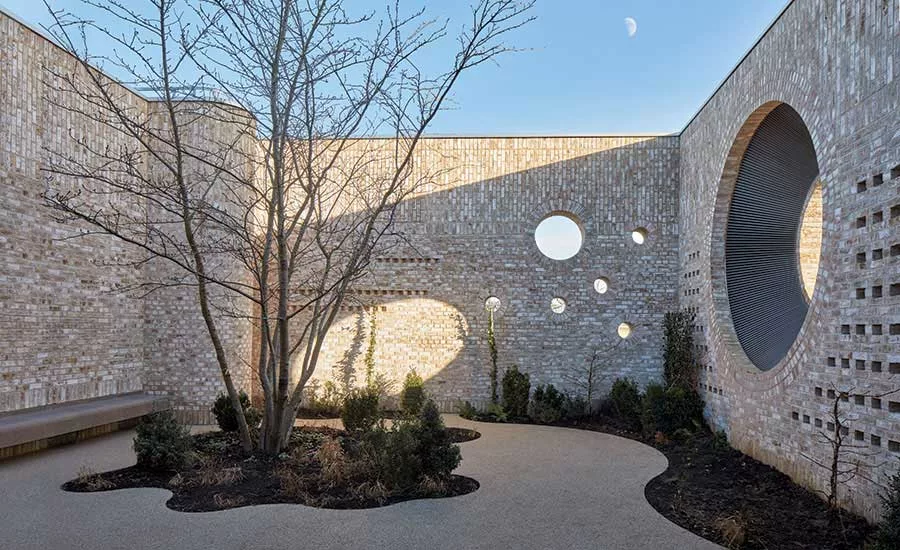
A circular air inlet set into a hollow garden wall provides ventilation for the main hall.
Photo © Alan Williams
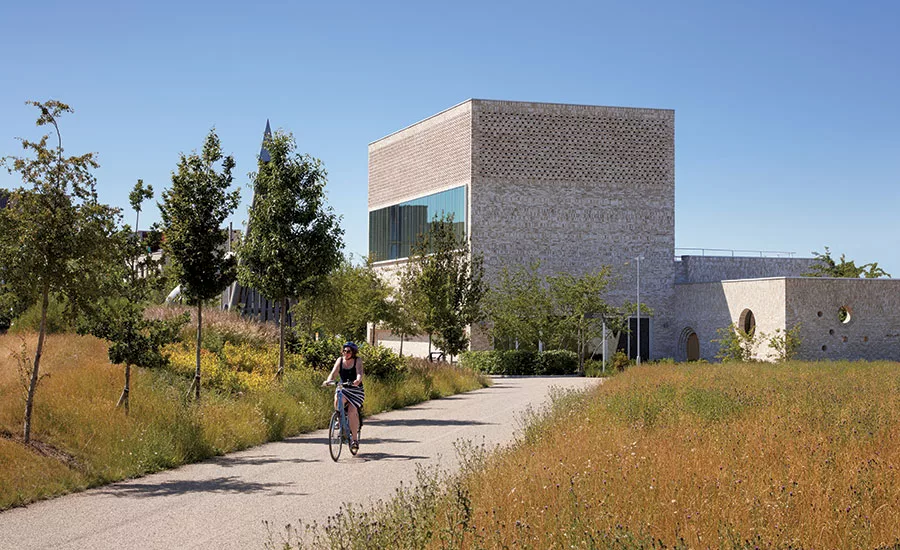
The center sits on the edge of the new district of Eddington and has access to a network of cycling paths.
Photo © Alan Williams
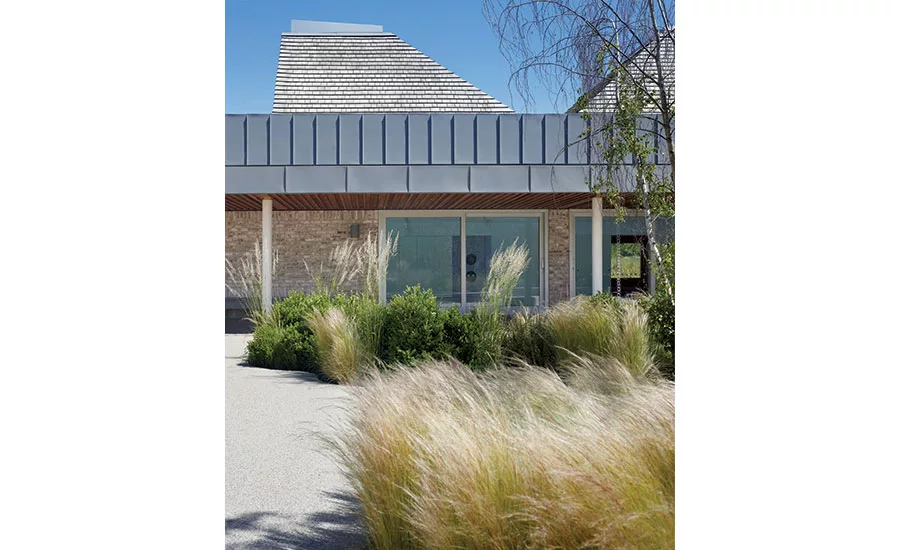
Peaked roof classrooms and a cloistered arcade define the nursery’s playground.
Photo © Alan Williams
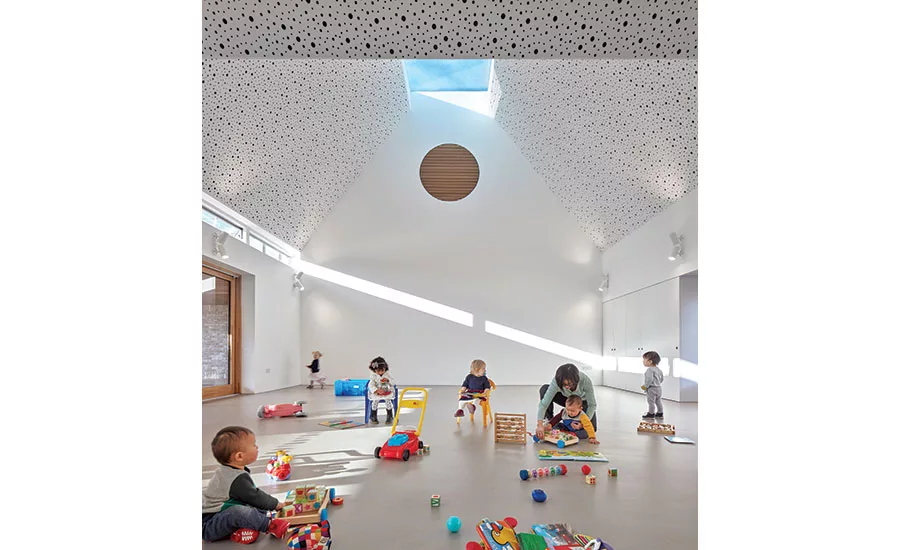
Inside the classrooms, perforated acoustic ceilings rise to skylights. A clerestory, positioned above the cloister roof outside, admits additional daylight.
Photo © Alan Williams
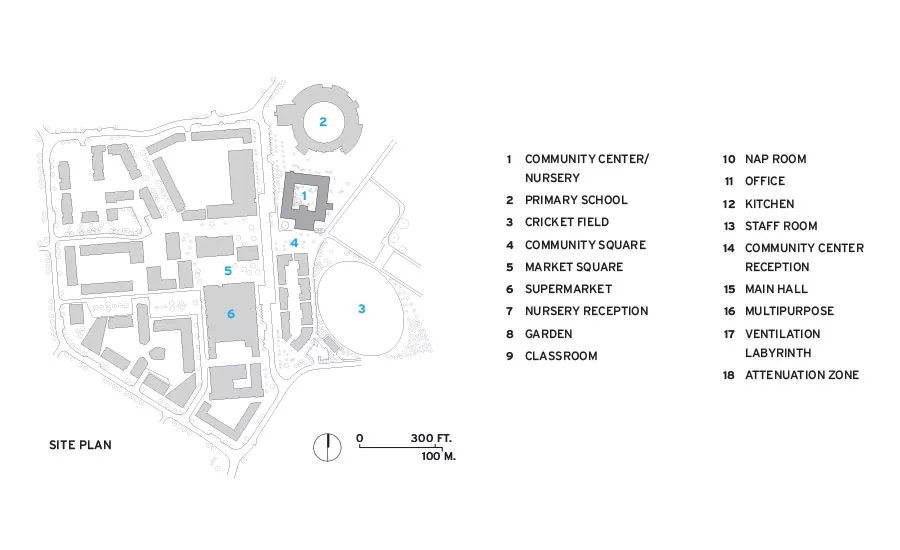
Image courtesy MUMA
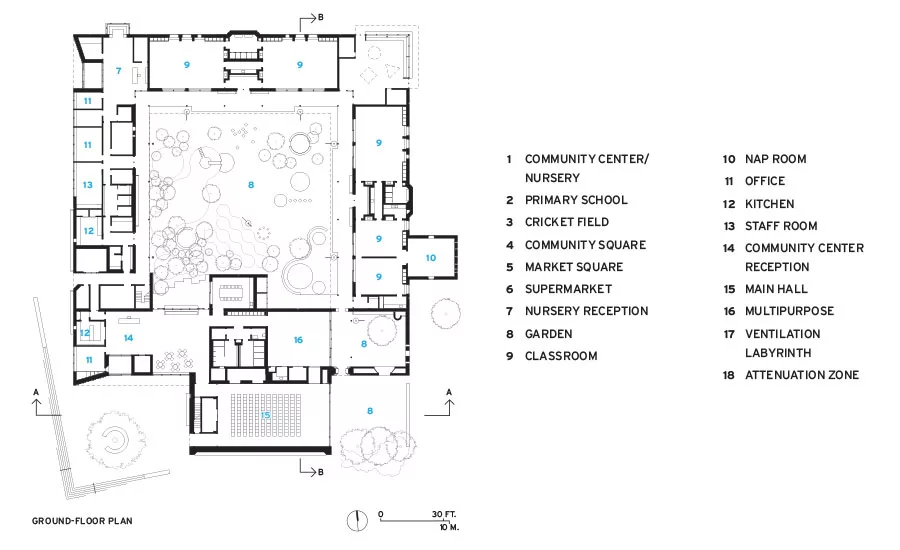
Image courtesy MUMA
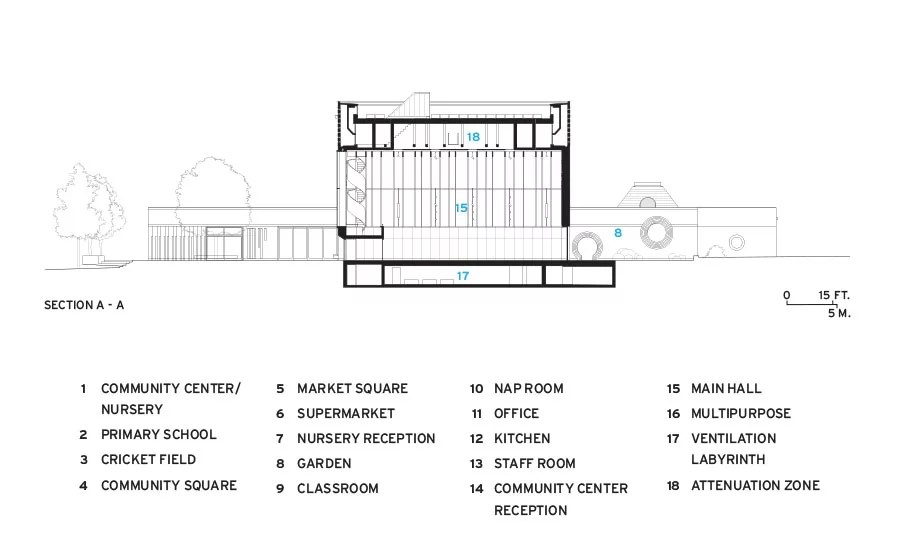
Image courtesy MUMA
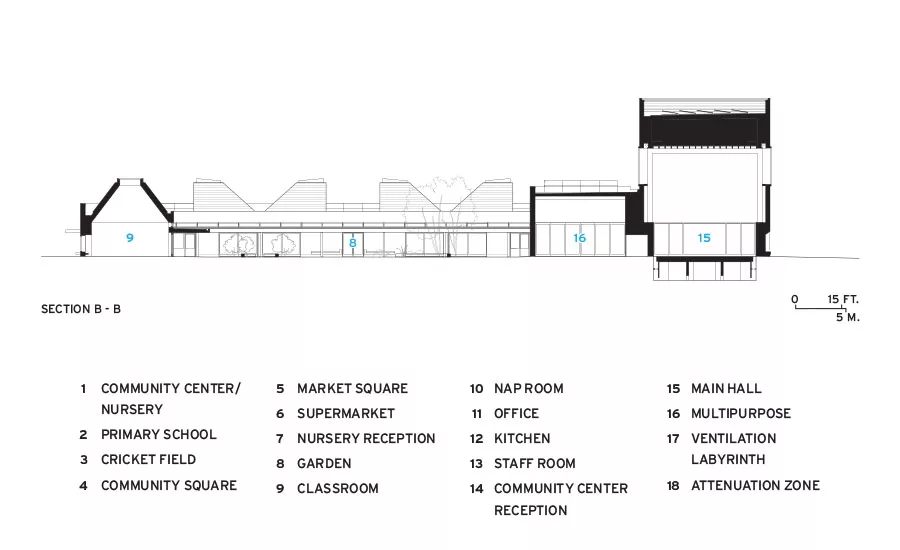
Image courtesy MUMA
Architects & Firms
There’s the old Cambridge of ancient university courts (never called quads, as they are at rival Oxford University), the medieval King’s College Chapel, and students languidly boating on the River Cam, but there is another side to Cambridge. Away from the tourists and film crews, expanding fast in several directions, this is a new southeast-England town in all but name. Recent districts include Eddington, a planned development in the northwest corner of the city, where there is a refined new civic structure by London-based architects MUMA, combining a theater and community meeting rooms with a daycare center.
Additional Content:
Jump to credits & specifications
If Manchester’s Whitworth Art Gallery extension of 2015 was MUMA’s breakout project, then this community center is their first significant all-new public building. Constructed on farmland squeezed between existing suburbs and a highway, it sets out to accomplish a tricky task—provide an anchor for a place that did not previously exist.
You arrive in Eddington by its new market square, surrounded by apartments, a hotel, shops, and a supermarket, with MUMA’s building, Storey’s Field Centre (named after the field it overlooks) set on its eastern edge. Around this building is a dense new mid-rise academic precinct—developed by the university itself to provide affordable rental housing for staff and postgraduate students, condominiums, and R&D facilities for high-tech companies, a Cambridge specialty. MUMA worked within a master plan developed by AECOM but succeeded in tweaking it, to make the community center slightly taller than the other new buildings and angling it a few degrees off the planning grid. This arrangement provides for smaller public gathering spaces, both at the entrance to the center and between its nursery and a neighboring circular elementary school by Marks Barfield Architects. The calm rectilinear forms of the complex, with their textured—and in places perforated—brick, provide civic gravitas.
Since the project is two buildings in one—the center, including the multiuse theater, with one entrance, and the nursery with another—they drew on two famous typologies of the university, as MUMA partner Stuart McKnight explains: the chapel or hall, and the cloister or court (both Cambridge and Oxford universities were originally monastic foundations). Characteristically, in the old colleges, such larger buildings adjoin grass-covered or paved courts, which often have cloister-like perimeter arcades. Same here: the height of the big hall is similar to those in Cambridge’s historic center, while the ground-hugging nursery adopts the form of the cloistered court. The enclosed outdoor area, designed by Sarah Price Landscapes, includes mature gnarled fruit trees “rescued” from commercial orchards, and is both a garden and a secure kid’s playground. The building’s chosen materials are hard-wearing and well crafted: a pale cream textured brick is set off by a mid-gray fossiliferous limestone, used for the long, built-in external benches and the foyer flooring in the community center. Paneling, doors, and interior details are pale oak, while external details, such as copings and rainwater downspouts, are made of stainless steel. The daycare center sparingly uses terrazzo in its lobby rather than limestone; its material and color palette has a greater emphasis on visual and acoustic softness.
In the community center, the main event is the large hall (though hardly huge, with a capacity of 180 seated or 270 standing). This is naturally ventilated: fresh air is brought in from a labyrinthine void below the hall and exits through an attic above. Both spaces also contain acoustic insulation. The fresh-air intake is itself a piece of architecture, taking the form of a large stainless-steel “rose” set in a hollow of a courtyard garden wall.
The hall is acoustically adaptable in a low-tech way. Its natural double-cube-long reverberation time is tempered by a system of motorized blinds and curtains. The internal textured brick is designed to diffuse rather than reflect sound. Visually, the verticality of the design, with lean timber portal frames, is distinctly chapel-like—as is the slender plywood spiral stair disappearing upward from a mezzanine gallery into the roof void, where the lighting-rig mechanisms are housed. You half expect to find a belfry.
The attention to detail throughout the community center is exemplary. The aesthetic is of crisp juxtaposition of durable materials, with occasional splashes of bright color. In the nursery, the scale reduces to toddler size, but there are sensible touches such as lofty, tapering perforated acoustic ceilings with skylights. One room, projecting eastward from behind a run of classrooms, with a constellation of tiny round window lenses, is just for sleeping. Another, busier room features large primary-hued nooks, with windows that are triangular, square, or circular; through these, the small kids can look across to their bigger siblings in the adjacent elementary school. The outdoor arcade around the court links the various rooms and spaces, avoiding internal corridors.
If the inspiration is medieval English, the outcome is distinctly Scandi-modern. This is intelligent, humane architecture of a high order. If only all new town centers enjoyed this level of design attention.
CreditsArchitect: MUMA LLP Studio 27 Waterside 44-48 Wharf Road London N1 7UX United Kingdom Tel: +44 (0)20 7722 2929
Engineers: Aecom – Structural and Civil Engineering Aecom – Mechanical, Electrical, Building Physics
Consultants: Turner & Townsend - Project Manager Gardiner & Theobald - Quantity Surveyor Sarah Price Landscapes - Landscape Consultant Sound Space Vision - Theatre and Acoustic Consultant (Community Centre) FMDC Ltd - Facade Engineering Lumineer - Lighting Consultant Aecom - Acoustics (Nursery) Aecom - Fire Engineering Centre for Accessible Environments - Access Consultant HNBC - BREEAM Consultant Calfordseaden - NEC Supervisor Faithful + Gould - CDM Consultant
General contractor: Farrans Construction Ltd.
Photographer: Alan Williams Photography +44 (0) 776 970 5359 infro@alanwilliamsphotography.com |
SpecificationsStructural System Concrete, timber frame, structural masonry and steelwork Manufacturer of any structural components unique to this project: n'H International Ltd (formally Just Swiss) - Glulam structure (Community Centre) Exterior Cladding Masonry: Brick – Weinerberger “Con Musso” brisk supplied by Taylor Maxwell Brickwork Contractor – Anglian Brickwork Precast concrete: Precast columns – Amber Precast Curtain wall: Wicona Glazing (Community Centre) by Prism Architectural Ltd Other cladding unique to project: Stainless Steel rainwater goods – TP Aspinall & Sons Ltd Roofing Elastomeric: Felt Roofing – Bauder Roofing Metal: VM Zinc Tile/shingles: Cedar Shingles – Marley Eternit Windows Wood frame: Uniform Windows (Nursery) Velfac Windows (Nursery) Glazing Glass: Uniform Windows (Nursery) Velfac Windows (Nursery) Skylights: Wicona by Prism Architectural Ltd Doors Entrances: Entrance Doors – Dorma Metal doors: Assa Abloy Wood doors: Bespoke external doors by Borley Joinery Special doors: Acoustic doors – CW Fields & Sons Ltd Hardware Locksets: Aspex Ironmongery Closers: Dorma Exit devices: Aspex Ironmongery Pulls: Aspex Ironmongery Security devices: Aspex Ironmongery Other special hardware: Aspex Ironmongery Interior Finishes Acoustical ceilings: Knauf perforated plasterboard Suspension grid: British Gypsum Cabinetwork and custom woodwork: Borely Joinery Paints and stains: Dulux Trade Paneling: Timber Wall Linings – CW Fields & Sons Ltd Plastic laminate: Kitchen Walls – Altro Whiterock – Solid Surfacing: Corian Floor and wall tile: Stone Flooring and seating – supplier – Haysom Stone Stone Flooring and seating — fitter — Powell Masonry Resilient flooring: Linoleum by Forbo Nairn Raised flooring: Junkers Ltd Furnishings Reception Furniture: Benchmark Furniture Fixed Seating: Borely Joinery Lighting Downlights: Exenia Lighting Energy Energy management or building automation system: Briggs & Forrester Photovoltaic system: Briggs & Forrester Other unique products that contribute to sustainability: Briggs & Forrester Add any additional building components or special equipment that made a significant contribution to this project: Passive ventilation of Main Hall in Community CentrePassi |
Looking for a reprint of this article?
From high-res PDFs to custom plaques, order your copy today!