Architectural Record
search
cart
facebook twitter linkedin youtube
  • Sign In
  • Subscribe
  • Sign Out
  • My Account
Architectural Record
  • NEWS
    • Latest News
    • Awards
    • Interviews
    • Obituaries
    • Podcasts
      • Design:Ed Podcast
      • Sponsored Podcasts
  • OPINION
    • Book Reviews / Excerpts
    • Exhibition Reviews
    • Forum
  • EXCLUSIVES
    • Videos
    • Design Vanguard
    • Top 300 Firms
    • Sponsored Content
    • Sponsored eBooks
    • From the Archives
  • CONTINUING ED
    • Editorial Continuing Ed
    • CE Center
    • CE Academies
  • PROJECTS
    • Buildings By Type
    • Reuse & Renovation
    • Museums & Arts Centers
    • Colleges & Universities
    • Multifamily Housing
    • Interiors
    • Lighting
    • Kitchen & Bath
  • HOUSES
    • Record Houses
    • House of the Month
    • Featured Houses
  • PRODUCTS
    • Products by Category
    • Record Products of the Year
    • Latest Products
  • EVENTS
    • Dates & Events
    • Record on the Road
    • Innovation Conference
    • Sustainability in Practice
    • Women In Architecture
    • Webinars
    • Ad Excellence Awards
    • AIA 2026 Videos
    • Submit an Event
  • CONNECT
    • Ask RECORD AI
    • Newsletters
    • Contact
    • Advertise
    • Editorial Calendar
    • Store
    • Customer Service
  • SUBMIT
    • Submission Guidelines
    • RECORD Competitions
  • MAGAZINE
    • Subscribe
    • My Account
    • Digital Edition
    • Current Issue
    • Firm Pass
    • Historic Archive
Architecture ProductsProduct Trends & Insights

Perkins and Will’s Material Performance Lab Director Explains Why Specifiers Still Need Its Precautionary List

By Kelly Beamon
July Product Trends

Mary Dickinson, Perkins + Will Sustainable Design Leader and one of three co-directors of its Material Performance Lab

Photo © Courtesy of Perkins + Will
July Product Trends

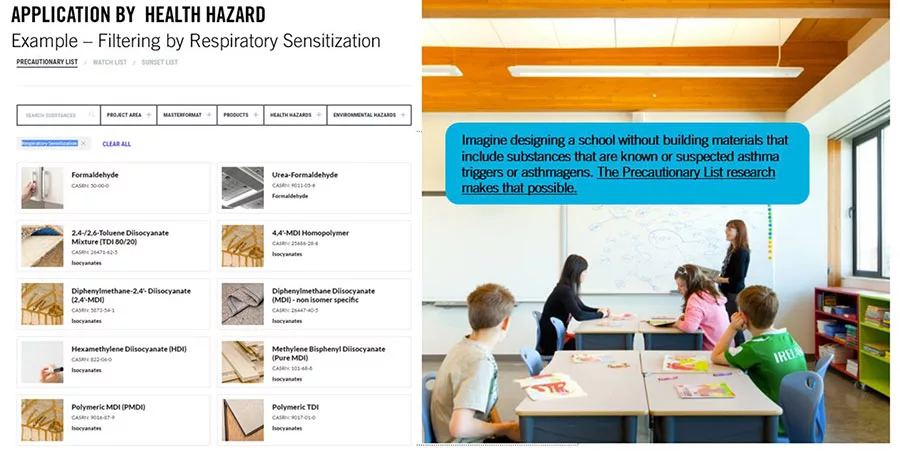
Sample search results from the firm’s Precautionary List.

July Product Trends
July Product Trends
June 25, 2019

Despite the many certifications steering designers and architects toward materials that seem safer and eco-friendly, professionals still need tools to locate the best options available.

Part of the challenge is understanding that a certification doesn’t always mean there’s no health risk. Not all programs, for example, subject manufacturers to the same rigor or transparency requirements. And even when a disclosure label appears to spell out what was used to make a product, every potentially harmful chemical may not be listed.

To fill in the blanks, Perkins and Will has been cataloging harmful substances used in building materials since 2008. Dubbed the Precautionary List, that index has evolved into a free, online database anyone can search by visiting transparency.perkinswill.com.

Mary Dickinson is one of two directors leading the firm’s Material Performance Lab, which generates the data that fuels the index. She shared her insights with products editor Kelly Beamon.


Your firm’s precautionary list continues to evolve, but manufacturers are more transparent than they were 11 years ago, taking such steps as providing health product declarations. Aren’t such disclosures sufficient? 

The way the ingredients are listed, exactly which part of a product contains a high-risk chemical, can still be unclear. We need to know what’s in each component.

Also, it’s best to take a preventative approach. That means looking for alternative products that significantly reduce exposure to health risks, not settling for materials that likely pose some risk.

Looking for quick answers on architecture and design topics?
Try Ask RECORD, our new smart AI search tool.
Ask RECORD →

Do you really track every harmful substance across applications and product categories? That sounds like a tall order.

We catalog substances that show up most readily in the built environment.

And there are two directors. Max Richter is my counterpart based in Vancouver. I’ve also been working with Monica Kumar, an interior designer in our New York office, on the collating of data.

The index is something a lot of firms would like to emulate. But are there immediate steps they can take to vet safer products? 

Yes. Focusing first on materials that cover large surface areas—such as floors and walls—is a reasonable place to start. The AIA’s Healthier Materials Protocol offers several additional frameworks and case studies illustrating ways to achieve material health goals. Any specifier can try these, regardless of the firm’s or the project’s size.


This story was featured in Material World, Architectural Record’s products-focused newsletter. Subscribe today!

Share This Story

Looking for a reprint of this article?
From high-res PDFs to custom plaques, order your copy today!


Kelly Beamon is a former staff writer and editor at Architectural Record.

Post a comment to this article

Report Abusive Comment

Subscription Center
  • Create an Account
  • Start a Subscription
  • Manage My Account
  • Sign Up for Newsletters
  • Visit Customer Service
  • Update Preferences

More Videos

Sponsored Content

Sponsored Content is a special paid section where industry companies provide high quality, objective, non-commercial content around topics of interest to the Architectural Record audience. All Sponsored Content is supplied by the advertising company and any opinions expressed in this article are those of the author and not necessarily reflect the views of Architectural Record or its parent company, BNP Media. Interested in participating in our Sponsored Content section? Contact your local rep!

close
  • 3D configurator
    Sponsored byDoorBird

    How DoorBird’s 3D Configurator Is Redefining Customization Across Residential and Commercial Design

  • interior of modern office
    Sponsored byCurrent

    The Downlight's Second Life: Why Below-Ceiling Serviceability Is the Specification Detail That Matters Most

  • cold storage facility
    Sponsored byCarlisle SynTec Systems

    How Architects Can Design More Continuous Cold Storage Envelopes

DESIGN:ED Podcast
Listen to Architectural Record’s DESIGN:ED Podcast

Events

July 29, 2026

Adaptive Reuse Reimagined: Designing Multifamily Housing from Existing Buildings

Credits: 1 AIA LU/HSW; 1 AIBD P-CE; 0.1 ICC CEU; 1 IIBEC CEH

Examine adaptive reuse envelope strategies that improve energy performance, preserve architectural character, and transform existing buildings into high-performing multifamily housing.

July 30, 2026

Constructing Exterior Walls to Avoid Moisture Issues

Credits: 1 AIA LU/HSW; 1 AIBD P-CE; 0.1 ICC CEU

Examine exterior wall and air barrier system strategies that improve moisture control, energy efficiency, durability, and indoor environmental quality.

View All Submit An Event

Products

Architectural Detailing: Function, Constructibility, Aesthetics, 4th Edition

Architectural Detailing: Function, Constructibility, Aesthetics, 4th Edition

See More Products

Popular Stories

7480 N Delaware

A Portland Apartment Building by Daniel Toole Architecture Stands as a Study in Adaptation

Goldring Woldenberg Park

Continuing Education: Postindustrial Waterfronts

Kaya, San Diego

With San Diego’s Kaya, Jeff Svitak Melds Housing Density with Community

Chacarita Alta Housing

In Paraguay’s Capital, MOS and Adamo-Faiden Rethink Public Housing for Residents of Informal Settlements

House of the Month - Casa BL

In Chile, Alejandro Beals and Loreto Lyon Revive a 1960s House Designed by a Le Corbusier Disciple

Water Containment Waterproofing: Best Practices and System Selection - Free Webinar - July 22, 2026

Related Articles

  • Perkins+Will Precautionary List

    Perkins+Will Relaunches Its Building Product Transparency Website

    See More
  • Perkins+Will Offices

    Perkins+Will Offices by Perkins+Will

    See More
  • Museum House, Seattle

    Perkins&Will Gets Artful with its Design for a Two-Towered Residential Project in Seattle

    See More

Related Products

See More Products
  • facade.jpg

    Sustainable Facades: Design Methods for High-Performance Building Envelopes

  • 047177751X.gif

    Sustainable Urbanism: Urban Design With Nature

See More Products

Events

View AllSubmit An Event
  • September 17, 2025

    Waterproofing Solutions for Shotcrete Foundations: What You Need to Know

    NOW ON DEMANDCredits: 1 AIA LU/HSW; 1 AIBD P-CE; 0.1 ICC CEU; 0.1 IACET CEU; 1 IDCEC CEU/HSW During this 1-hour seminar, attendees will explore the principles, design considerations, and best practices for pre-applied waterproofing systems in shotcrete applications.
View AllSubmit An Event
×

The latest news and information

#1 Source for Architectural Design, News and Products

SUBSCRIBE
  • RESOURCES
    • Advertise
    • Contact Us
    • Submit
    • Store
  • ACCOUNT CENTER
    • Create an Account
    • Start a Subscription
    • Manage My Account
    • Sign Up for Newsletters
    • Visit Customer Service
    • Update Preferences
  • PRIVACY
    • PRIVACY POLICY
    • TERMS & CONDITIONS
    • DO NOT SELL MY PERSONAL INFORMATION
    • PRIVACY REQUEST
    • ACCESSIBILITY
  • SERVICES
    • Marketing Services
    • Reprints
    • Market Research
    • List Rental
    • Survey/Respondent Access
  • STAY CONNECTED
    • Linkedin
    • Facebook
    • Instagram
    • YouTube
    • X (Twitter)

Copyright ©2026. All Rights Reserved BNP Media, Inc. and BNP Media II, LLC.

Design, CMS, Hosting & Web Development :: ePublishing