Herzog & de Meuron Expands Its Museum Küppersmühle

A top-floor gallery is illuminated with a saw-tooth skylight. Photo © Simon Menges

The mill’s grain silos have been incorporated into the museum. Photo © Simon Menges

The just-completed extension is brick, as are most of the existing structures. Photo © Simon Menges

A complex of harbor-side former industrial buildings in Duisburg, Germany, comprise the MKM. Photo © Simon Menges
Architects & Firms
Although it looks like one structure, Museum Küppersmühle (MKM), in Duisburg, Germany, is a collage. This was the case long before its latest extension—which opened last week—was built. The MKM, which houses a collection focusing on post-war German art, was originally a series of three old flour mills on the banks of an inland harbor off the Rhine. These buildings, imposing but with plenty of charming brick detailing, including subtle classical pilasters and relief patterns, date from 1908. Several years later a new owner added a boiler house with a chimney. Adjoining steel silos were constructed in the 1930s.
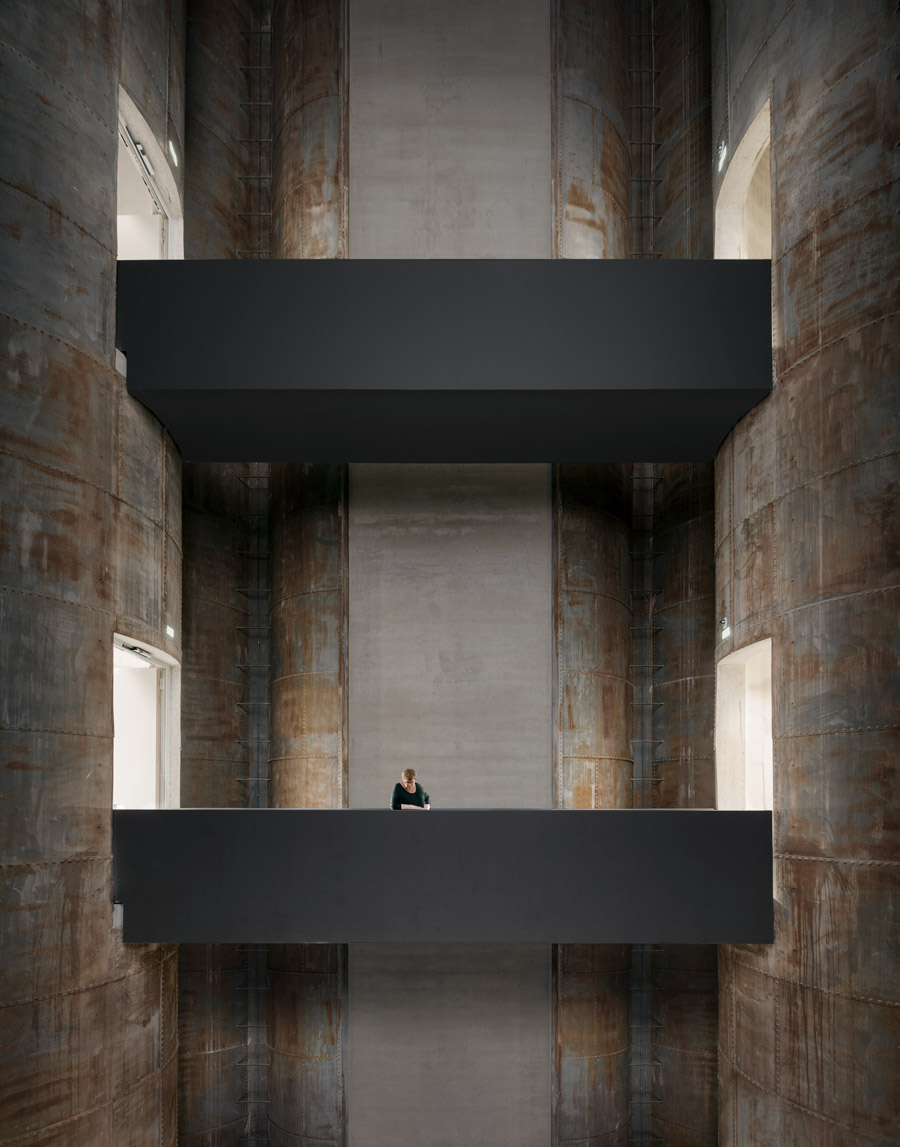
Bridges connect the museum’s new and old wings. Photo © Simon Menges
Since the mill closed in 1972, the hulking complex spent two decades unused. But it was subsequently augmented by a series of adaptations, each designed by the Swiss practice Herzog & de Meuron. The first, completed in 1999, was a developer-led renovation which created a block of offices in the western-most mill building and an art gallery in the rest. The second was an extension which began in 2006 but was finally abandoned in 2011 when its steel work was discovered to have been poorly constructed. The most recent architectural intervention, just completed, rescues and reworks the second phase scheme. The process of converting the mill into the gallery for modern art has been fraught with difficulty at times, but the result is a delightful interplay between the original industrial structures and the post-industrial additions. The assemblage is especially successful on the exterior.
The new eastern extension is a respectful riff on the original brick structures; a more sober addition than the peach-tinted concrete stairwell appended to the historical buildings in the 1999 conversion. Although it looks like it is clad in tasteful thin terracotta tiles, on closer inspection, it is much rougher: made from brick that has been broken across the core holes to produce a creviced, crenelated surface. On the east facing facade, the brick has been laid to create fins at a 45-degree angle to the line of the building, resulting in a mesmerizing, textured finish that complements the color of the original structures, while creating an intriguing, highly crafted effect which alludes to the buildings’ new, non-industrial purpose.
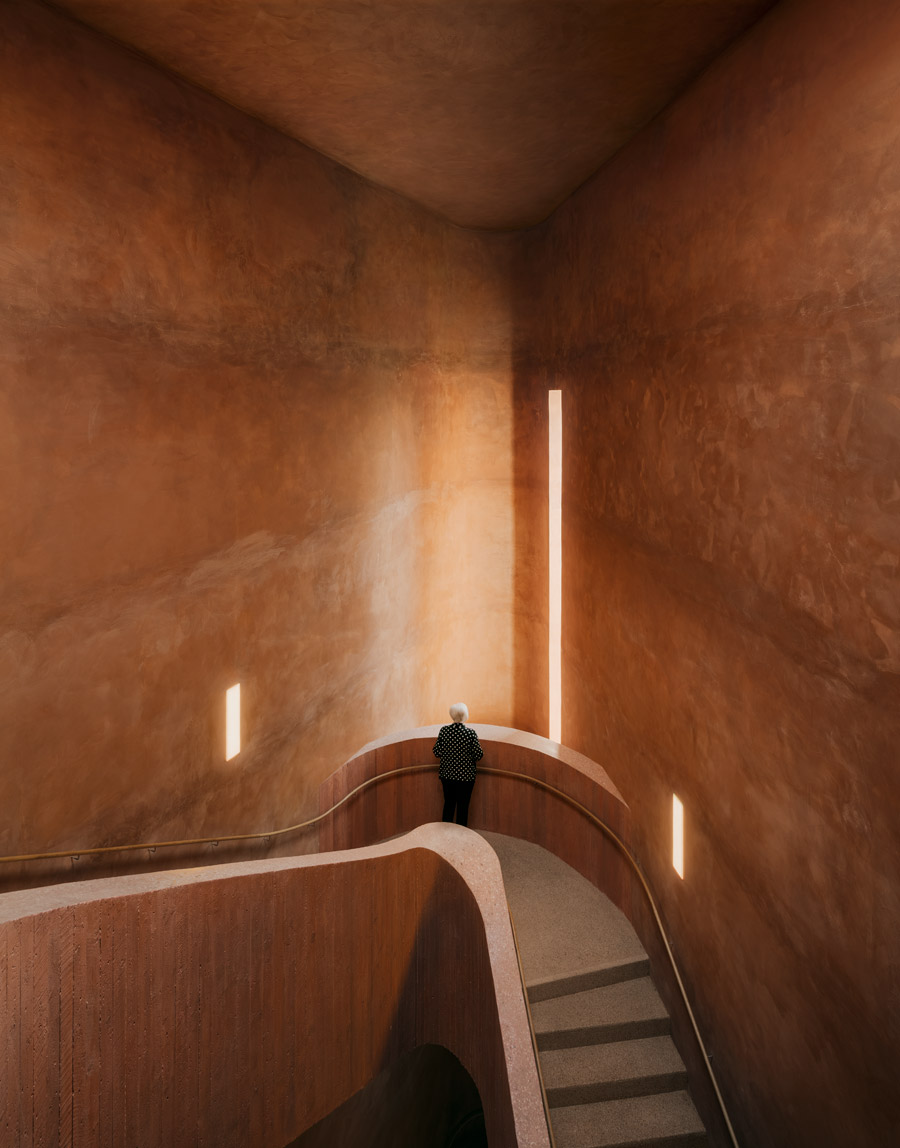
A new sculptural stair echoes one built in the part of the complex renovated in 1999. Photo © Simon Menges
Herzog & de Meuron was initially attracted to the project because of its affinity to the Tate Modern in London, another imposing former industrial building made out of brick. Comparisons with the firm’s work on that project are helpful. Where only the shell of the Tate Modern was preserved, the load-bearing structure of the Küppersmühle was incorporated into the 1999 renovations. The structure was so robust that lofty exhibition spaces (up to 20 feet tall) for the big serious German art, could be achieved by removing floors.
Comparison between the way in which Herzog and de Meuron added extensions to their earlier work is also revealing. When building an add-on to the Tate Modern, Herzog & de Meuron, in keeping with evolutions in contemporary art and its curation, created new types of galleries; from naturally lit top floor spaces down to the converted subterranean oil tanks. But at the MKM, the new galleries, like those in the older sections, are primarily homogenous white cubes. The floors from the previous conversion have simply been continued through to the new extension at the same heights, creating rooms identical to the ones in the 1999 building. Admittedly there is the stunning sudden expansion of space one experiences when crossing one of three bridges that pass through the old grain silos (or similarly when one passes beneath them on a new basement link between the extension and the 1999 conversion). Generally though, the new gallery spaces are uniform, punctuated only occasionally by welcome ribbons of glazing.
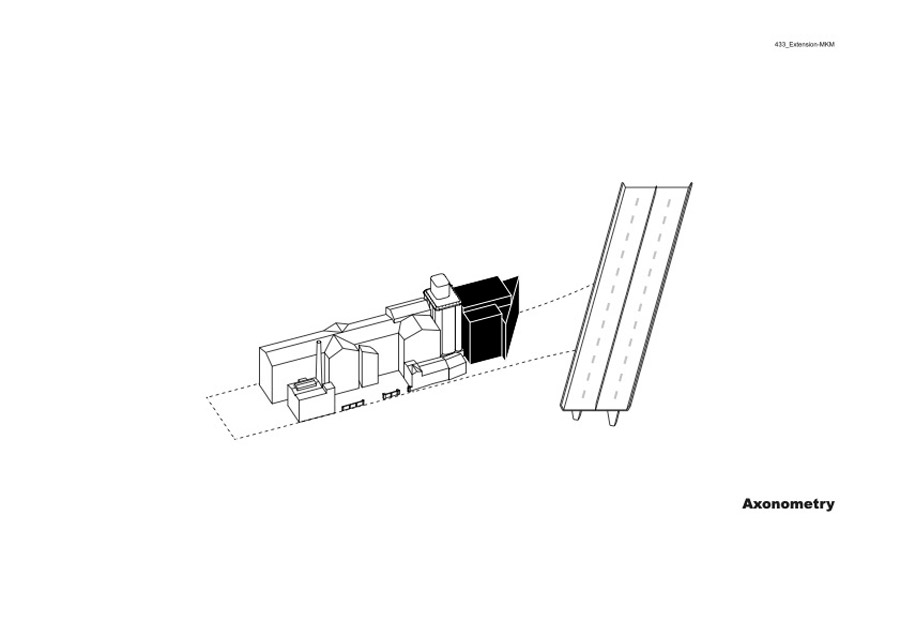
Drawing © Herzog de Meuron
Of course, the fact that the building houses a private collection ultimately makes the MKM a very different beast to the Tate Modern, which is a publicly funded institution. The collection of post-war German art the former houses is owned by the Ströher family, heirs to the Wella hair product fortune, and has been hung with their close oversight. They have arranged the work in ruthlessly democratic fashion with dour academic abstract expressionists getting as much wall space as pioneers like Georg Baselitz.
This rigidity of the exhibition space is heightened by the sensual staircase inserted into the eastern apex of the new extension (more hidden than a similar stairwell in the 1999 version). In contrast to the overly ordered galleries, these staircases are snaking, sculptural pieces of in situ poured concrete. The walls have an amber render, creating a sepia glow to the light, in contrast to the relentless whiteness of the gallery space.
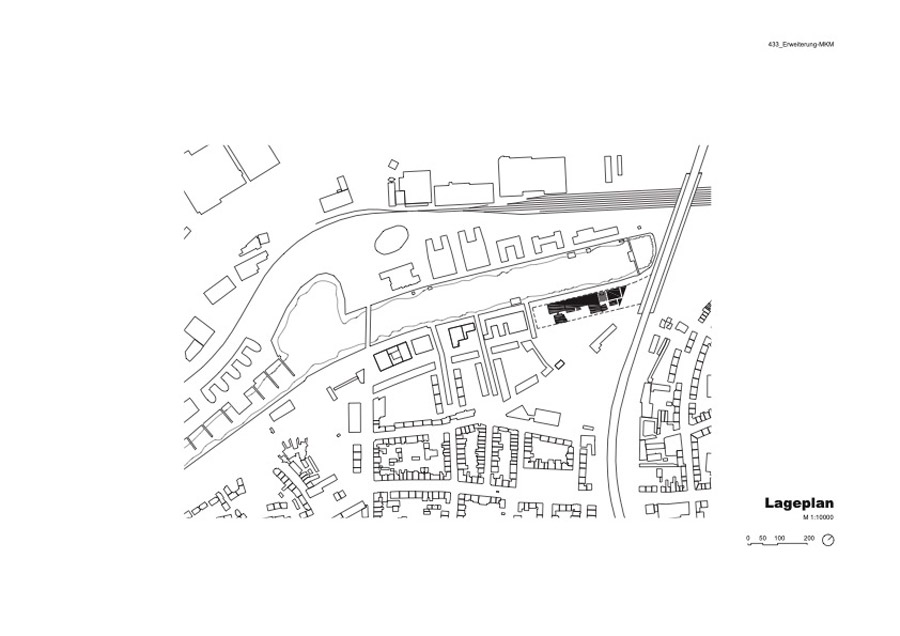
Drawing © Herzog de Meuron
The galleries though are almost impressively old-fashioned, according to the clients demands. In the future, when the collection is guarded less zealously and has been added to—as is planned—one can imagine that the silos might be used as exhibiting space. Further adaptations to the existing internal layout might create more variety in gallery size and shape. Then the numerous, fascinating narratives that exist in post-war German art could be explored and would match the fascinating nuanced history told on the museum’s exterior.
Looking for quick answers on architecture and design topics?
Try Ask RECORD, our new smart AI search tool.
Ask RECORD →
Looking for a reprint of this article?
From high-res PDFs to custom plaques, order your copy today!