Architectural Record
search
cart
facebook twitter linkedin youtube
  • Sign In
  • Subscribe
  • Sign Out
  • My Account
Architectural Record
  • NEWS
    • Latest News
    • Awards
    • Interviews
    • Obituaries
    • Podcasts
      • Design:Ed Podcast
      • Sponsored Podcasts
  • OPINION
    • Book Reviews / Excerpts
    • Exhibition Reviews
    • Forum
  • EXCLUSIVES
    • Videos
    • Design Vanguard
    • Top 300 Firms
    • Sponsored Content
    • Sponsored eBooks
    • From the Archives
  • CONTINUING ED
    • Editorial Continuing Ed
    • CE Center
    • CE Academies
  • PROJECTS
    • Buildings By Type
    • Reuse & Renovation
    • Museums & Arts Centers
    • Colleges & Universities
    • Multifamily Housing
    • Interiors
    • Lighting
    • Kitchen & Bath
  • HOUSES
    • Record Houses
    • House of the Month
    • Featured Houses
  • PRODUCTS
    • Products by Category
    • Record Products of the Year
    • Latest Products
  • EVENTS
    • Dates & Events
    • Record on the Road
    • Innovation Conference
    • Sustainability in Practice
    • Women In Architecture
    • Webinars
    • Ad Excellence Awards
    • Submit an Event
  • CONNECT
    • Ask RECORD AI
    • Newsletters
    • Contact
    • Advertise
    • Editorial Calendar
    • Store
    • Customer Service
  • SUBMIT
    • Submission Guidelines
    • RECORD Competitions
  • MAGAZINE
    • Subscribe
    • My Account
    • Digital Edition
    • Current Issue
    • Firm Pass
    • Historic Archive
Projects

Parrish Art Museum by Herzog & de Meuron

Water Mill, New York
By William Hanley
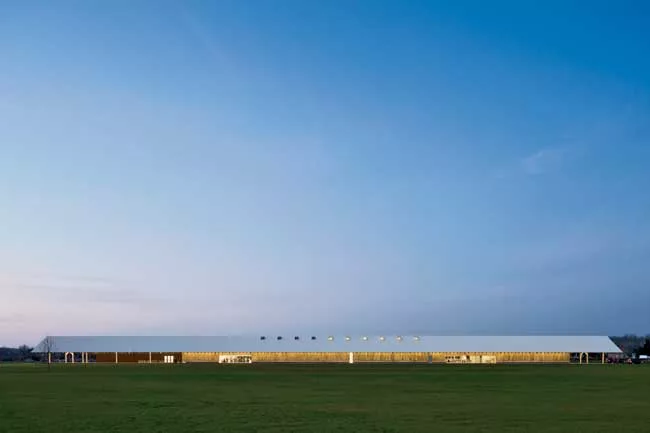
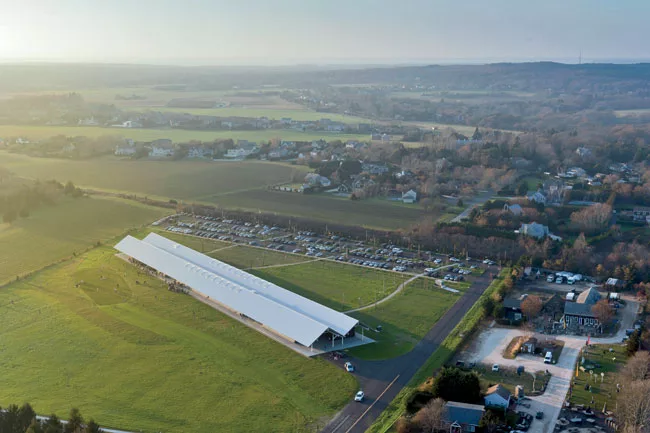
The designers placed the building near the center of a former agricultural site converted into a meadow. The grasses are intended to grow with minimal intervention, softening the view of the Parrish's
Parrish Art Museum
Herzog & de Meuron
Water Mill, New York
The designers placed the building near the center of a former agricultural site converted into a meadow. The grasses are intended to grow with minimal intervention, softening the view of the Parrish's long concrete facade.
Photo © Roland Halbe
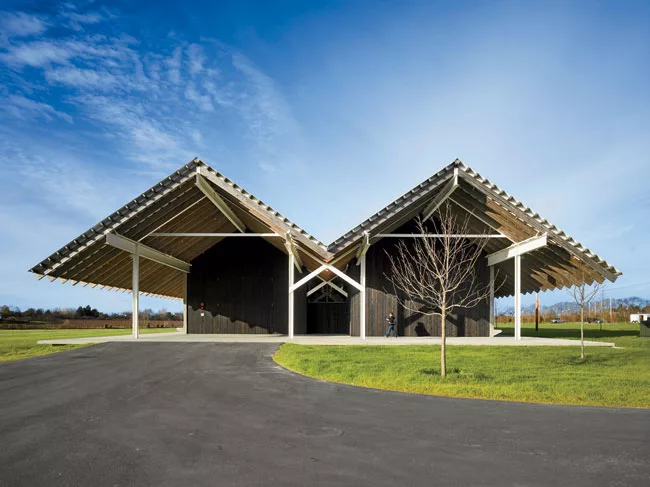
The daylit cottages and barns often converted into studios by Long Island artists inspired Herzog & de Meuron's twin-gabled form.
Parrish Art Museum
Herzog & de Meuron
Water Mill, New York
The daylit cottages and barns often converted into studios by Long Island artists inspired Herzog & de Meuron's twin-gabled form.
Photo © Roland Halbe
While great for catching light, the Parrish's roofline creates a massive trough down the center of the structure.
Parrish Art Museum
Herzog & de Meuron
Water Mill, New York
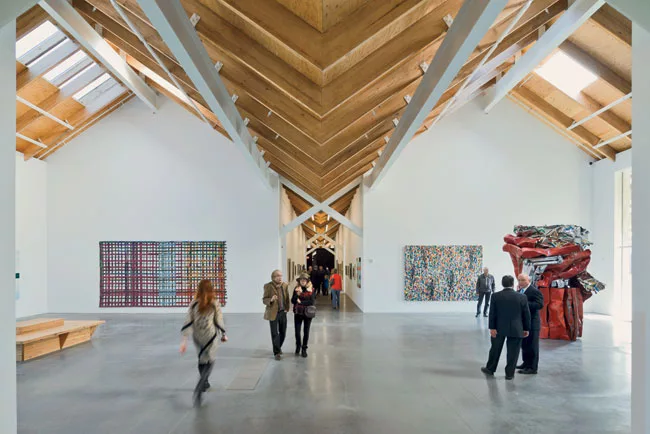
While great for catching light, the Parrish's roofline creates a massive trough down the center of the structure.
Photo © Roland Halbe
To manage rainwater and snow melt, the designers concealed primary and backup pipes in the X-braces that cross the building's central spine; the pipes deliver water to a belowground infiltration syste
Parrish Art Museum
Herzog & de Meuron
Water Mill, New York
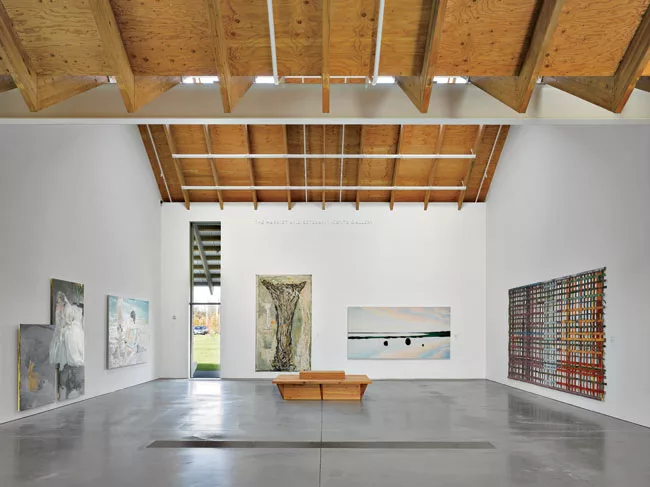
To manage rainwater and snow melt, the designers concealed primary and backup pipes in the X-braces that cross the building's central spine; the pipes deliver water to a belowground infiltration system without adding visual clutter to the building.
Photo © Roland Halbe
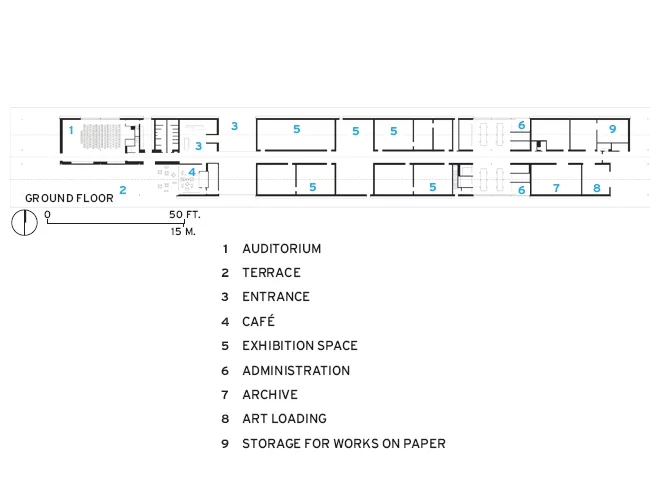
 Based on a 1,000-square-foot unit, some galleries double to 2,000 square feet; others are subdivided into an intimate 500.
Parrish Art Museum
Herzog & de Meuron
Water Mill, New York
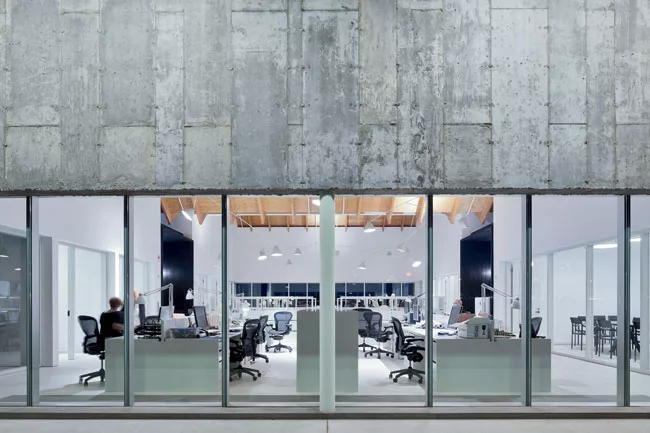
Based on a 1,000-square-foot unit, some galleries double to 2,000 square feet; others are subdivided into an intimate 500.
Photo © Roland Halbe
Parrish Art Museum
Herzog & de Meuron
Water Mill, New York
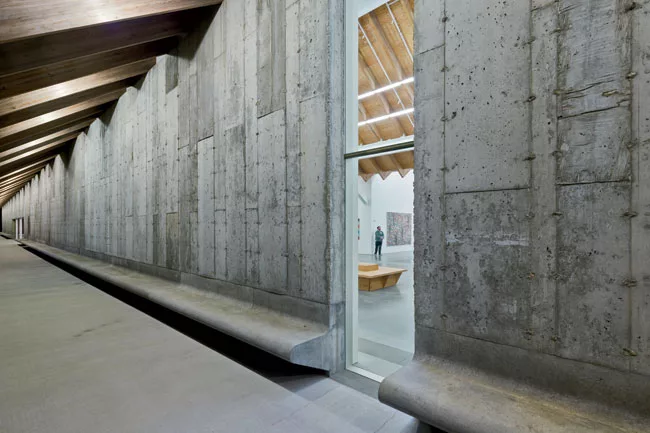
Based on a 1,000-square-foot unit, some galleries double to 2,000 square feet; others are subdivided into an intimate 500.
Photo © Roland Halbe
Back-of-house stairs adjacent to the administrative spaces lead to below-grade art storage.
Parrish Art Museum
Herzog & de Meuron
Water Mill, New York
Back-of-house stairs adjacent to the administrative spaces lead to below-grade art storage.
Photo © Roland Halbe
Outside, the concrete facade slopes out into a bench, allowing visitors to contemplate the landscape under the Parrish's deep eaves.
Parrish Art Museum
Herzog & de Meuron
Water Mill, New York
Outside, the concrete facade slopes out into a bench, allowing visitors to contemplate the landscape under the Parrish's deep eaves.
Photo © Roland Halbe
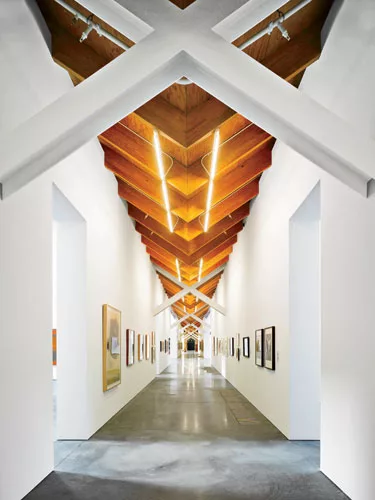
A long circulation spine stretches through the center of the project.
Parrish Art Museum
Herzog & de Meuron
Water Mill, New York
A long circulation spine stretches through the center of the project.
Photo © Roland Halbe
Parrish Art Museum
Parrish Art Museum
Herzog & de Meuron
Water Mill, New York
Image courtesy Herzog & de Meuron
The designers placed the building near the center of a former agricultural site converted into a meadow. The grasses are intended to grow with minimal intervention, softening the view of the Parrish's
The daylit cottages and barns often converted into studios by Long Island artists inspired Herzog & de Meuron's twin-gabled form.
While great for catching light, the Parrish's roofline creates a massive trough down the center of the structure.
To manage rainwater and snow melt, the designers concealed primary and backup pipes in the X-braces that cross the building's central spine; the pipes deliver water to a belowground infiltration syste
 Based on a 1,000-square-foot unit, some galleries double to 2,000 square feet; others are subdivided into an intimate 500.
Back-of-house stairs adjacent to the administrative spaces lead to below-grade art storage.
Outside, the concrete facade slopes out into a bench, allowing visitors to contemplate the landscape under the Parrish's deep eaves.
A long circulation spine stretches through the center of the project.
Parrish Art Museum
January 16, 2013

Architects & Firms

Herzog & de Meuron

Early on an autumn afternoon, an untitled 1990 abstraction by Esteban Vicente in the new Parrish Art Museum presented a smudged block of azure hovering over brushy patches of red-orange and umber. Two hours later, the angle of the sunlight coming into the gallery had shifted, and the new light made the warm colors catch fire and the blue sour and recede.

The change was unusual. While many museums allow daylight to enter their galleries, they typically filter it to a neutral glow. The Parrish lets the coastal light of New York's East End of Long Island color the experience of the work on view. Shifting and tonal, light enters the gallery as it might have entered Vicente's Bridgehampton barn-turned-studio in the mid'20th century. 'You find many artists who work here because of the landscape and the light in this place,' says Ascan Mergenthaler, Herzog & de Meuron's partner in charge of the project. 'We took the classic Long Island artist's studio, with a house shape and skylights, as a model for the museum building.'

As you drive east on the Montauk Highway, the Parrish emerges between rural hamlets with an incongruously industrial scale. A long, low rectangular volume, it could be a big-box store or the giant cousin of one of the agricultural buildings that dot the area. At 614 feet long but less than 100 feet wide, its narrow end elevations peak in twinned gables like two fused-together barns. A long metal roof overshoots the structure to create sheltered porches on all sides. Throughout the 34,400-square-foot building, a limited selection of materials'concrete, wood, metal, glass'and luminous open spaces give the museum stunning simplicity, made all the more remarkable because it was born of necessity.

Long before the Hamptons signified celebrities and billionaires summering in secluded vacation compounds, artists and their less ostentatious patrons fled the clamor of New York for the East End. The Parrish counts work by those with a connection to the region as the core of its collection, which now numbers 2,600 objects in a variety of media and spans artists from William Merritt Chase, Fairfield Porter, and Willem de Kooning to Chuck Close and April Gornik. But the Italianate 1897 building by Grosvenor Atterbury in Southampton that served as the museum's previous home lacked space for both its growing holdings and its program of temporary exhibitions. After an aborted attempt to expand, museum officials decided to build. In 2005 they acquired a site a few miles down the road, just outside the hamlet of Water Mill, and selected Herzog & de Meuron to design a new facility.

Mergenthaler and his team envisioned the new Parrish as a cluster of peaked structures, abstracted versions of the barns, sheds, and small residential buildings typically converted by artists into studios. (They also recalled the Monopoly house shapes of earlier Herzog & de Meuron work.) But the museum slashed the original budget of $80 million by nearly two thirds when the recession hit. Despite the dramatic cut, Herzog & de Meuron stayed on board. Mergenthaler reconfigured the constellation of buildings into a single long volume but kept the pointed form. 'It was clear that we would have to work with repetition, and it was a really simple idea to repeat one module in a long way,' he says. The project opened in November at a cost of $26.2 million; with 7,600 square feet of galleries, it nearly triples the museum's exhibition space.

To keep costs down, Mergenthaler used the pocked and craggy concrete that covers the museum's long exterior sides after seeing similarly rough walls in a local basement. The scruffy character of the mottled concrete keeps the vast expanses from looking monotonous. 'The thing that you really engage with first has to have a presence, a solidity, and a character,' says Mergenthaler. 'It's not just cladding.'

Visitors arrive at the museum along paths through a meadow of unmanicured local grasses that lead from a rear parking lot to the entry. Inside, the firm placed the galleries in a grid at the center of the building and bookended them with administrative space on one side and, on the other, a black-box theater and a caf' with a broad outdoor terrace. A cathedral-like axis runs through the center of the conjoined gables and connects all the interior spaces before dead-ending at the offices and theater. Konstantin Grcic designed much of the furniture, including a caf' chair that will have its commercial debut at the Salone del Mobile in Milan this spring. He also created the spindly, Calderesque lamps that hang from a modestly finished plywood ceiling in the entry and office areas.

Looking for quick answers on architecture and design topics?
Try Ask RECORD, our new smart AI search tool.
Ask RECORD →

The galleries, on the other hand, rely on East End daylight supplemented by side-mounted compact fluorescents for illumination. The gabled roofs face true north and south, and while most museums prefer the uninflected character of northern light, each set of three north-facing skylights at the Parrish comes with one wild card to the south. The southern skylights spike the galleries with a more varied and colorful light that gets a volatile glow from coastal water vapor. 'Straight up, the sky looks much like it does everywhere else,' says Andrew Sedgwick of Arup's lighting division, who consulted on the project. 'But down near the horizon, it changes color and brightness more than you would see in other places.' The angle of the roof allows the openings to capture a wide field of daylight without harming the artwork. In fact, the designers applied only UV coating and a nearly invisible hex-cell filter to the glass'look up, and you can see clouds passing'just to block the harshest summer light. According to Sedgwick, the amount of sun exposure that works receive balances out over the course of a year to stay within the threshold recommended by conservators. For shows that include photography or works on paper, scrims stretched on wooden frames manually mount into the skylights'a far cry from the complex and expensive motorized shading systems in many museums today.

The varied light presents a challenge for curators used to constant conditions, but it also captures the character of its place. By adapting its artist's-studio concept to a severely cut budget, rather than starting from scratch, Herzog & de Meuron created one-of-a-kind exhibition spaces. At the Parrish, work created on the East End appears in a way that approximates its origins, while other work takes on the character of the museum's context. And in every gallery, the light is spectacular.

Completion Date: November 2012

Size: 34,400 square feet

Cost: $26.2 million

Architect:
Herzog & de Meuron

People

Owner: Parrish Art Museum, Water Mill, USA

Architect:
Herzog & de Meuron

Personnel in architect's firm who should receive special credit:
Partners: Jacques Herzog, Pierre de Meuron, Ascan Mergenthaler (Partner in Charge)

Project Team: Philip Schmerbeck (Associate, Project Director), Jayne Barlow (Associate), Raymond Jr. Gaëtan Jack Brough, Marta Brandão, Sara Jacinto, Tom Powell, Nils Sanderson, Leo Schneidewind, Camia Young

Design Consultant
Herzog & de Meuron, Basel, Switzerland

Executive Architect
Douglas Moyer Architect PC, Sag Harbor, NY, USA

Engineers:
Structural Engineering
S.L. Maresca & Associates, Hampton Bays, NY, USA
Mechanical Engineering
Buro Happold, New York, NY, USA

Furniture Design
Konstantin Grcic Industrial Design, Munich, Germany

Landscape Architect
Reed Hilderbrand Landscape Architecture, Watertown, MA, USA

Consultants
Geotechnical Consultant
Langan, New York, NY, USA

Civil Engineering
Nelson, Pope & Voorhis Engineers & Surveryors, Melville, NY, USA

Security Consultant
Duciella Venter & Santore, New Haven, CT, USA

AV/IT/Acoustics Consultant
Shen/Milsom/Wilke, New York, NY, USA

Commissioning Agent
Dometech, Edison, NJ, USA

Concrete Consultant
Reginald D. Hough, Rhinebeck, NY, USA

Lighting Designer
ARUP Lighting (Andrew Sedgwick), London, UK

Lighting Engineer
ARUP Lighting, New York, NY, USA

Signage Design
LaPlaca Cohen, New York, NY, USA

Soil Engineer
D.B. Bennett, P.E., East Hampton, NY, USA

Surveyor
Saskas Surveying Company, P.C., East Hampton, NY, USA

CONTRACTORS
Fire Protection
Chevally Enterprises, Ronkonkoma, NY, USA

Roofing
Dynasty RSW, LLC, Calverton, NY, USA

Insulation
Cary Insulation, Bohemia, NY, USA

Plumbing
North Sea Plumbing and Heating, Southampton, NY, USA

Concrete
Palatial Concrete, Calverton, NY, USA

Decorative Metal
La Forge Francaise Ltd., Riverhead, NY, USA

Electrical
CM Richey Electrical, Ronkonkoma, NY, USA

Excavator
Bistrian Materials, East Hampton, NY, USA

Exterior Siding
Louis Dion, Babylon, NY, USA

General Contractor
Ben Krupinski Builders (Justin Fulweiler), East Hampton, USA

Geothermal Wells
Casola Well Drillers, Southampton, NY, USA

HVAC Contractor
Kolb Mechanical, Mattituck, NY, USA

HVAC Controls
County Pneumatic Controls, Inc., East Quogue, NY, USA

Landscape
Whitmores , East Hampton, NY, USA

Low Voltage Contractor
Bri-tech, Bohemia, NY, USA

Masonry
MOE Masonry Inc., Southampton, NY, USA

Metal Framing
LoCascio Enterprises, East Islip, NY, USA

Millwork
Michael Verde Millwork, Bridgehampton, NY, USA

Painting
Mims Family Painting, Shirley, NY, USA

Pilings
James H. Rambo, Southampton, NY, USA

Signage
Precision Signs, Amityville, NY, USA

Site Lighting Poles
Greg Smith Electrical, Kings Park, NY, USA

Steel
Tebbens Steel, Calverton, NY, USA

Stucco
Classic Construction, Holbrook, NY, USA

Tile
Lido Stone Works, Calverton, NY, USA

Water Mains, Utilities
RCR Contracting, Hampton Bays, NY, USA

Windows & Glass
Westhampton Architectural Glass, Westhampton Beach, NY, USA

Wood Flooring
Bayshore Flooring, Ronkonkoma, NY, USA

Wood Framing
FBC Contractors, Center Moriches, NY, USA


Products

Glass and Glazing: Westhampton Architectural Glass

Tile: Lido Stone Works

Wood Flooring: Bayshore Wood Flooring

Parrish Chair
Custom designed production furniture suite by Konstantin Grcic Industrial Design for the museum and manufactured by Emeco (Pennsylvania, USA). Suite Consists of stacking cafe chair, low stacking chair, Cafe tables and low tables.

Lighting
Custom designed suspended lighting system at public reception areas and office administration wing by Konstantin Grcic Industrial Design and fabricated by Litelab (New York, USA)


KEYWORDS: New York

Share This Story

Looking for a reprint of this article?
From high-res PDFs to custom plaques, order your copy today!
Post a comment to this article

Report Abusive Comment

Subscription Center
  • Create an Account
  • Start a Subscription
  • Manage My Account
  • Sign Up for Newsletters
  • Visit Customer Service
  • Update Preferences

More Videos

Sponsored Content

Sponsored Content is a special paid section where industry companies provide high quality, objective, non-commercial content around topics of interest to the Architectural Record audience. All Sponsored Content is supplied by the advertising company and any opinions expressed in this article are those of the author and not necessarily reflect the views of Architectural Record or its parent company, BNP Media. Interested in participating in our Sponsored Content section? Contact your local rep!

close
  • TAMLYN XtremeTrim Exterior Trim
    Sponsored byTamlyn

    Designing Cleaner Panel Facades: Why Exterior Trim Details Matter

  • Building with Vapor Barriers
    Sponsored byReef Industries, Inc.

    Vapor Barriers Help Control Moisture in Tighter Building Designs

  • Duct Interior with Prodeq System
    Sponsored byHenry, a Carlisle Company

    Designing Resilient Water Containment Systems

DESIGN:ED Podcast
Listen to Architectural Record’s DESIGN:ED Podcast

Events

June 16, 2026

Focus on the Façade: Exploring Steel, Timber & Fire-Rated Curtain Walls and Channel Glass Systems

Credits: 1 AIA LU/HSW; 1 AIBD P-CE; 0.1 ICC CEU

Explore modern façade and glazing systems that enhance daylighting, fire safety, and thermal performance while expanding architectural design possibilities.

June 18, 2026

Rebooting the Aging Office Building

Credits: 1 AIA LU/HSW; 1 AIBD P-CE; 0.1 ICC CEU; 1 PDH

Explore façade retrofit strategies and award-winning design concepts that can transform aging office buildings into healthier, higher-performing workplaces for today’s hybrid workforce.

View All Submit An Event

Products

2026 Architect's Square Foot Costbook

2026 Architect's Square Foot Costbook

See More Products

Popular Stories

SanDiegoAirport

Top 300 Architecture Firms of 2026

Coronado Bridge

The Architect’s Guide to San Diego

House A on a Hill

Design Vanguard 2026: Santiago Valdivieso

Dusk House

Design Vanguard 2026: ONO

Crystal Bridges Museum of American Art expansion

Safdie Architects Returns to the Crystal Bridges Museum of American Art for Major Expansion

Focus on the Facade - Free Webinar - June 16, 2026

Related Articles

  • First Look: Herzog & de Meuron's Parrish Art Museum

    See More
  • Memphis Art Museum

    Memphis Art Museum, Designed by Herzog & de Meuron, Readies for December 2026 Opening

    See More

Related Products

See More Products
  • Architectural Record - October 2025

    Architectural Record October 2025 Issue

  • Architectural Record - February 2026

    Architectural Record February 2026 Issue

See More Products
×

The latest news and information

#1 Source for Architectural Design, News and Products

SUBSCRIBE
  • RESOURCES
    • Advertise
    • Contact Us
    • Submit
    • Store
  • ACCOUNT CENTER
    • Create an Account
    • Start a Subscription
    • Manage My Account
    • Sign Up for Newsletters
    • Visit Customer Service
    • Update Preferences
  • PRIVACY
    • PRIVACY POLICY
    • TERMS & CONDITIONS
    • DO NOT SELL MY PERSONAL INFORMATION
    • PRIVACY REQUEST
    • ACCESSIBILITY
  • SERVICES
    • Marketing Services
    • Reprints
    • Market Research
    • List Rental
    • Survey/Respondent Access
  • STAY CONNECTED
    • Linkedin
    • Facebook
    • Instagram
    • YouTube
    • X (Twitter)

Copyright ©2026. All Rights Reserved BNP Media, Inc. and BNP Media II, LLC.

Design, CMS, Hosting & Web Development :: ePublishing