KPF Transforms a Former Post Office into New Workspace for Meta
New York City

Architects & Firms
“Hacking Farley.” This was the in-house name that Kohn Pedersen Fox (KPF) principal Hana Kassem and her team gave their task, undertaken between 2019 and 2023, of transforming some 700,000 square feet, across five stories, of midtown Manhattan’s landmark Farley Post Office Building into office space for Meta, the parent company of Facebook. Much of that storied 1914 McKim, Mead, and White building was, in a 2020 project by SOM, adaptively reused as the new Moynihan Train Hall. This skylit waiting room has—despite its now famously inhospitable scarcity of seating and superabundance of pixelated advertising—palliated conditions in the intercity rail, commuter rail, and subway complex that have suffered ever since the 1963 destruction of Charles McKim’s 1910 original Pennsylvania Station and the willful neglect of its successor.
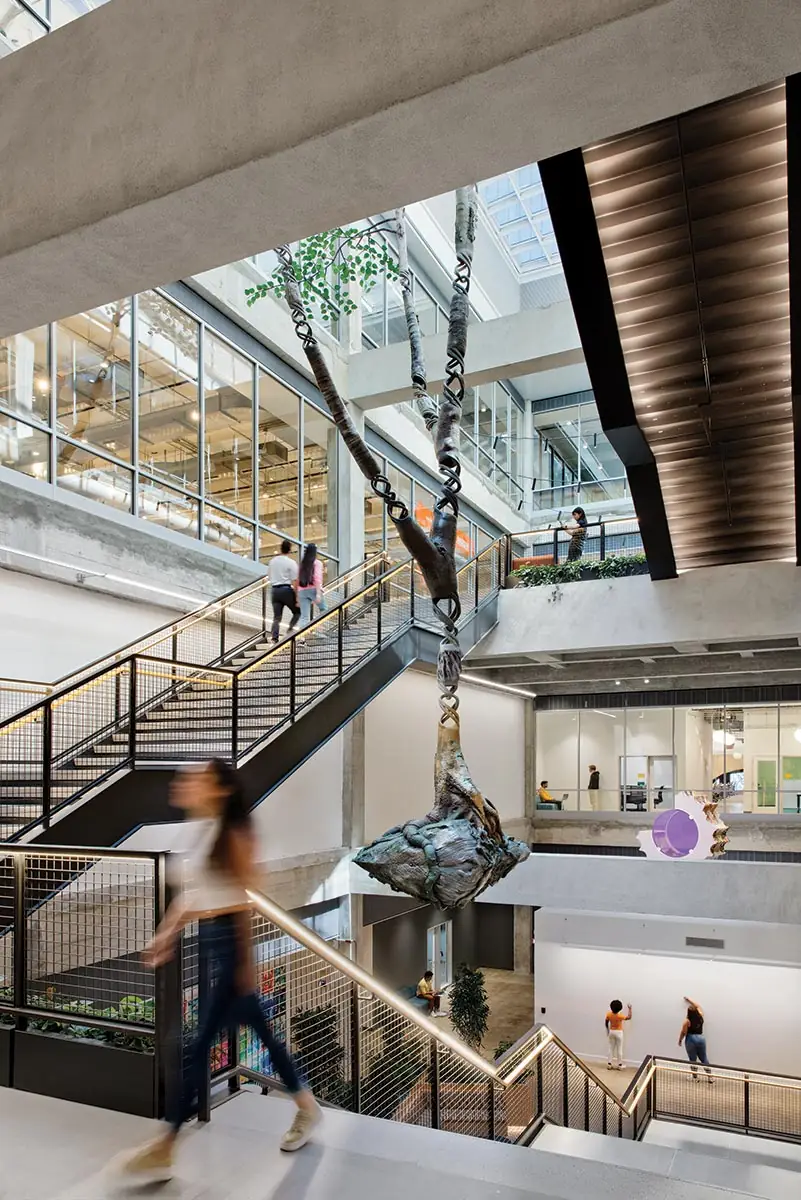
Flexible workspaces overlook the atrium (top of page), where Timur Si-Qin’s 50-foot-tall sculpture Sacred Footprint dramatically hangs (above). Photo © Connie Zhou, click to enlarge.
While hacking may at first seem an alarming procedure, especially for a technology company, the creative ingenuity of the life-hack—of the resilient repurposing or recoding of a legacy platform as something newly useful—is a best practice for the compounding effects of global heating and the advent of a post-energy-surplus and hyperurbanizing world. This means conservation of inherited resources—including the already built environment. By expanding into the century-old former postal facility, Meta’s move signals that new Class A office space may be ever less necessary or desirable, especially when more resourceful, characterful, and environmentally responsible alternatives are available. And, more poetically, as Kassem noted during a recent tour, it also addressed the power of place. “Farley was already a place of connection, communication, and technology,” she said.
1
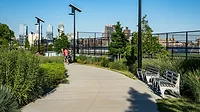
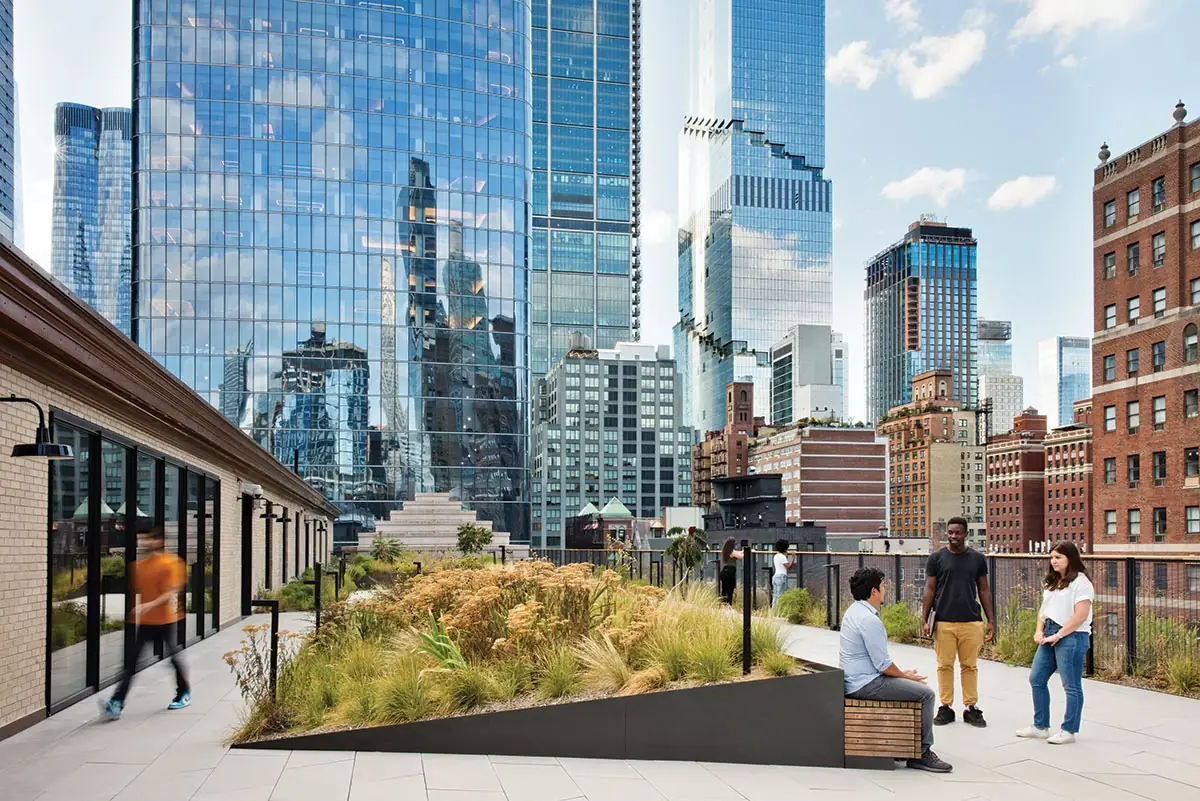
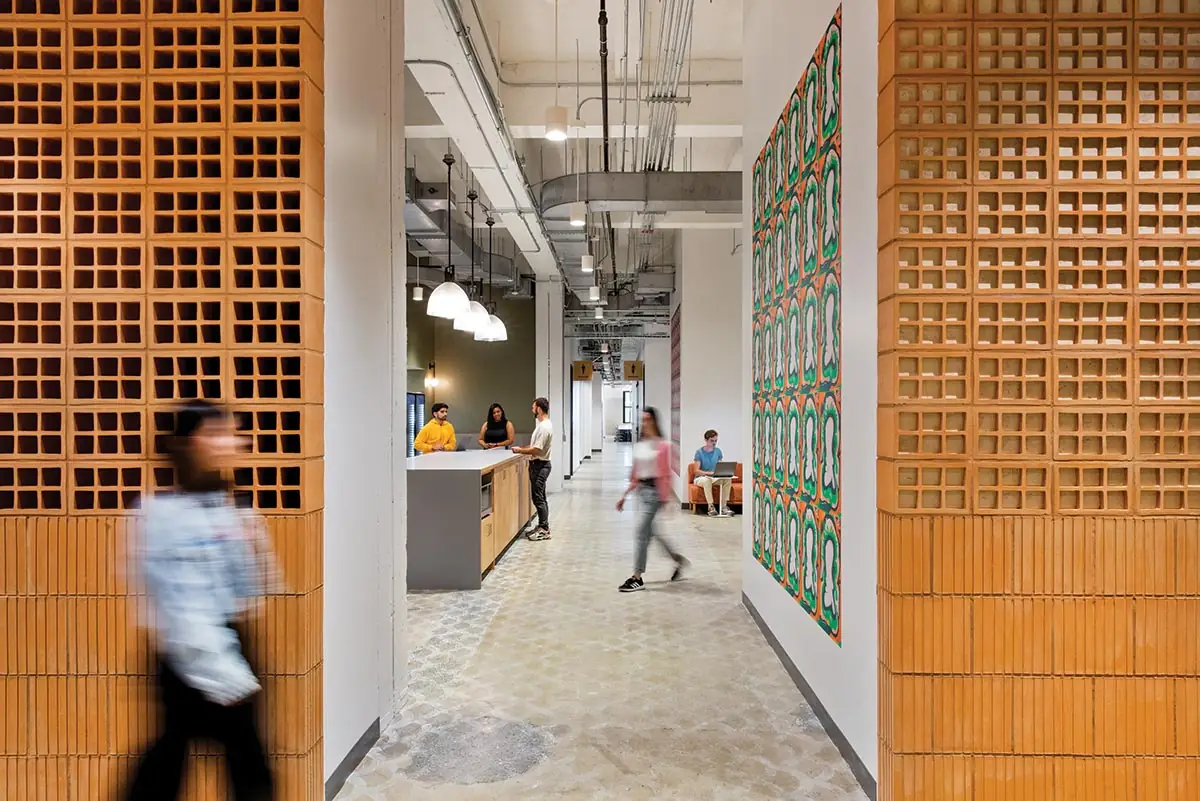
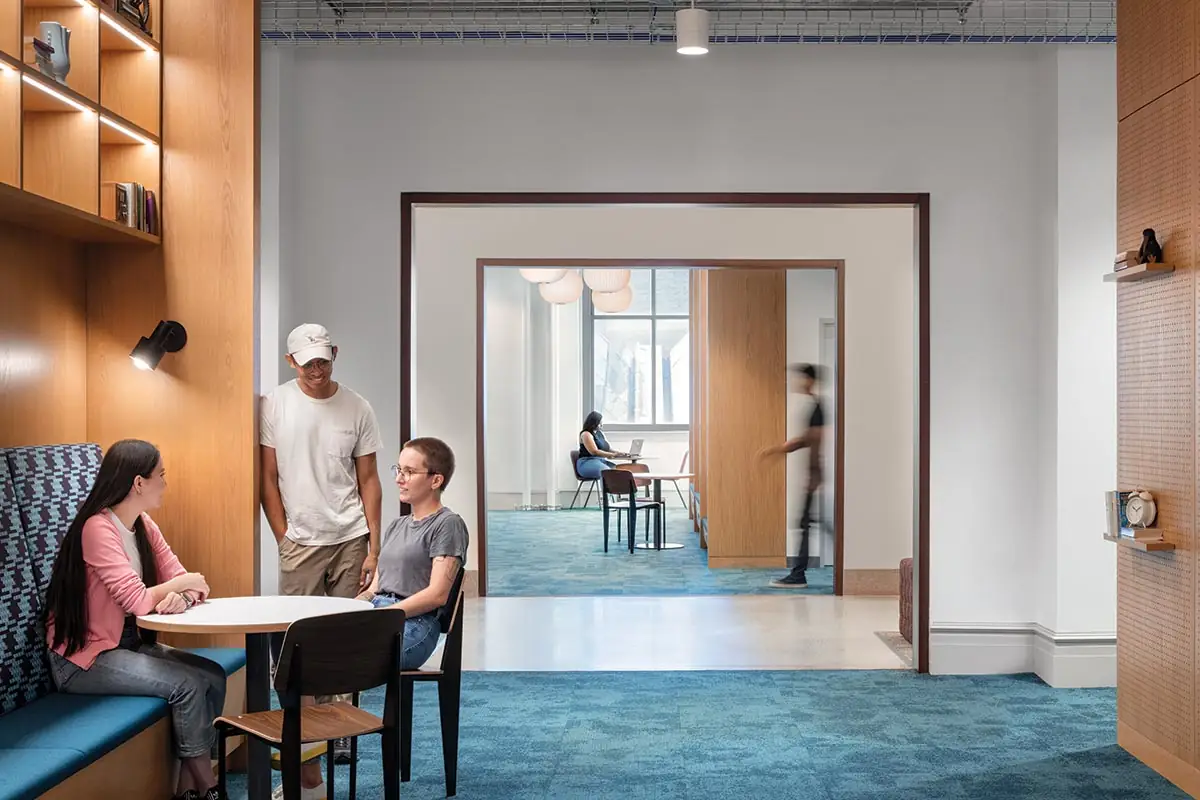
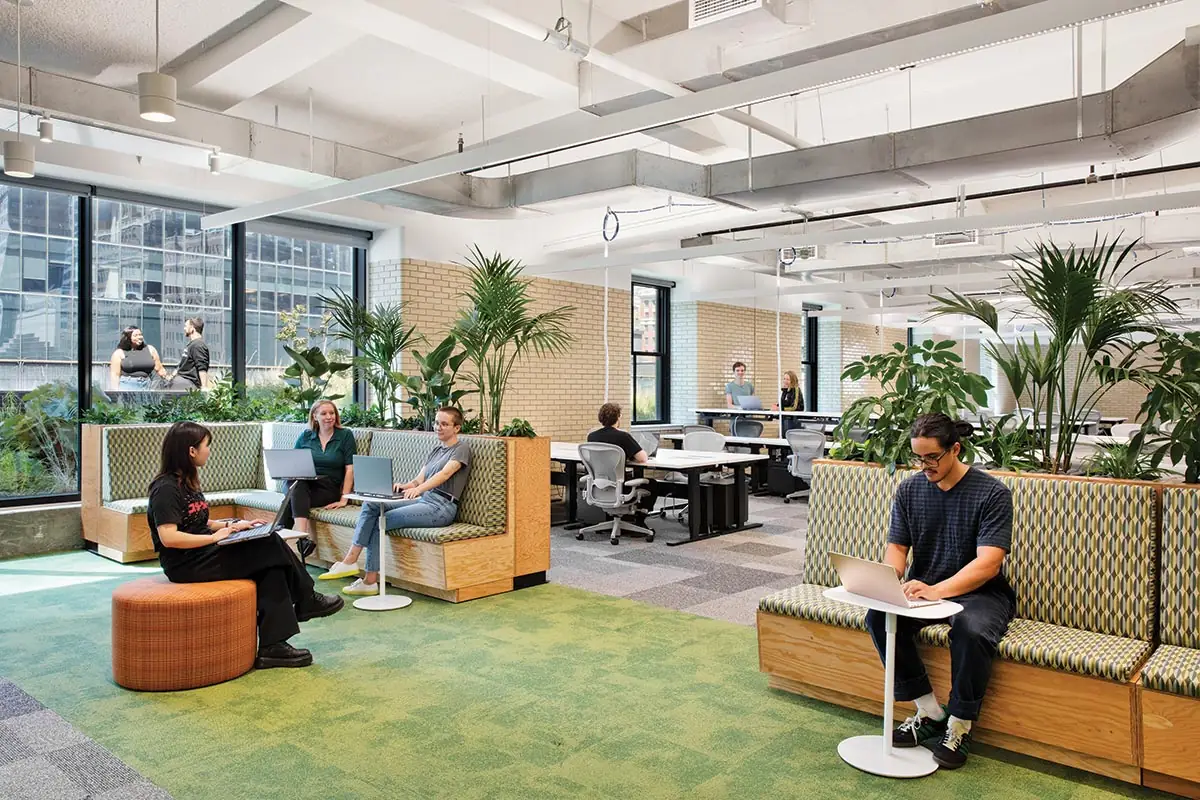
Terraces (1), microkitchens (2), and breakout spaces (3 & 4) provide room for gathering and conversation. Photos © Connie Zhou (1, 2 & 4), Pierce Harrison (3) click to enlarge.
2
3
4
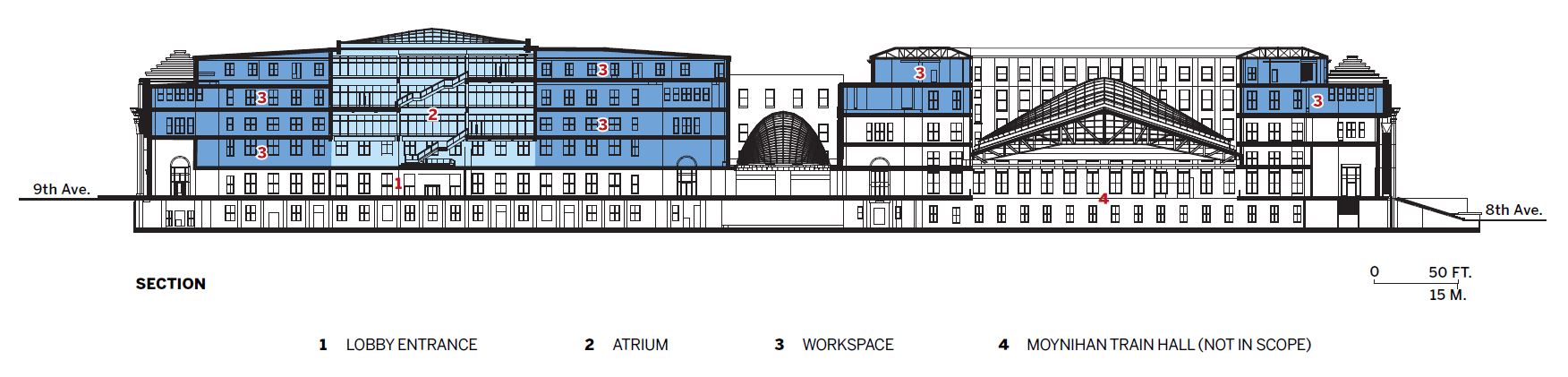
KPF’s intervention wraps around SOM’s new public waiting room like a doughnut around a hole, and uses space above the still-operational local post office behind the building’s famous Eighth Avenue colonnade. It also makes the most of the workhorse half of the campus, an annex fronting Ninth Avenue that, since built in the 1930s, has filled the remainder of the city block. Spatially, a wayfinding system, conceived as a trek through a landscape, has been applied to this vast volume. From modest entrances along train-station concourses or a street-facing entrance on West 33rd Street, a double-height lobby leads, by way of a monumental staircase with amphitheater seating, up and over what’s called the “pass,” to the base of a four-level atrium populated by staircases and leafy interior landscaping by Scape.
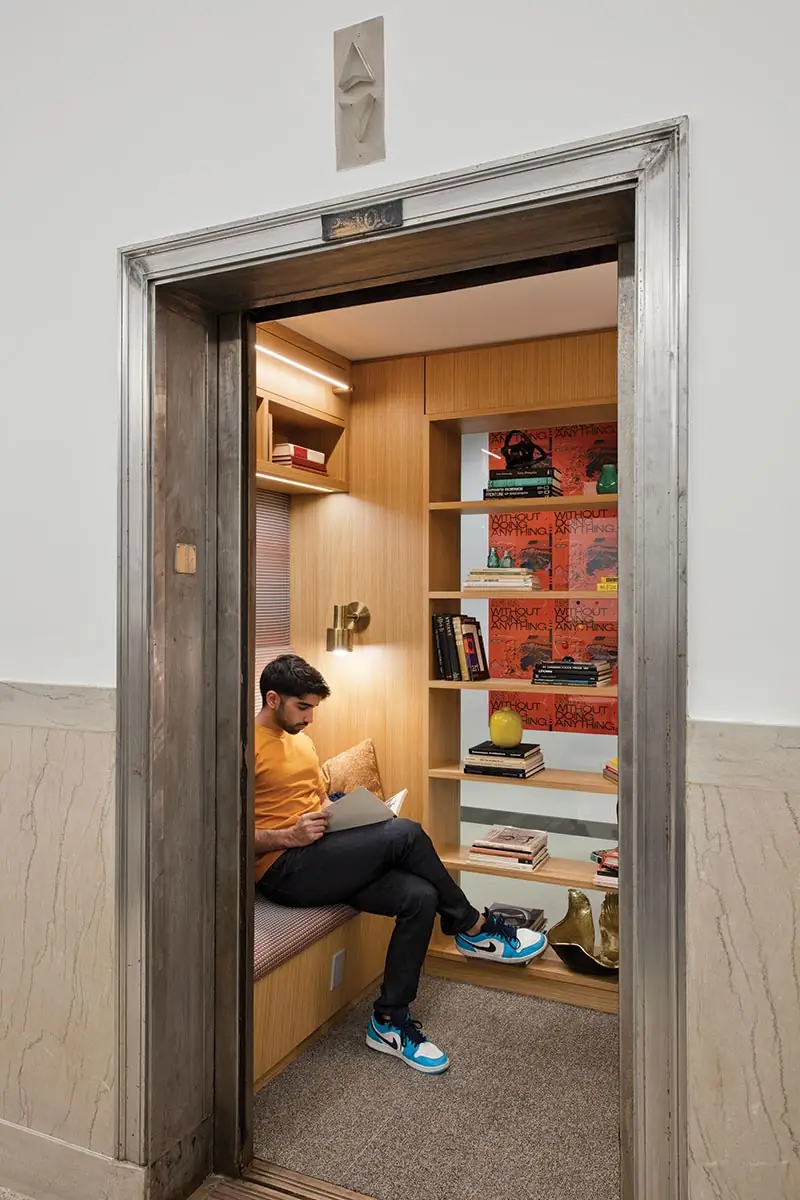
Elevator cabs have been reused as focus nooks. Photo © Connie Zhou
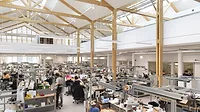
Intuitive navigation through the cross-section—beyond mostly cubicle-free acres of desks, food halls, and library-like refuges—is supported by such semiconsciously apprehended details as level-to-level differentiations in background brickwork patterning, but more directly by themes for each floor. Biophilic elements and abundant greenery highlight the uppermost level, which is ringed by a planted terrace behind a parapet. Creative reuse of historic corridors and elevator lobbies distinguishes another level where the preservation of those elements was required—by the very 1965 municipal Landmarks Law passed after the loss of the old Penn Station. This treatment makes a virtue of a necessity by leaning into the uncanny theatricality of elevators-turned-reading-nooks, or of a restored and reconstructed globe-lit and transom-doored corridor that, amid the surrounding office landscape, looks like a film noir set. Other ready-made elements, described by Kassem as having a “garage aesthetic,” include a ferroconcrete structural frame around the lobby and atrium that were left as KPF found them. “There was a lot of craftwork,” said Kassem, “and a lot of attention to issues like patching walls. Do you erase time? Do you record time? Do you make that recording an extension of time into the present?”
This close attention to material practice and to spatial procession speaks to the poignancy of having designed office space during the pandemic years and for a technology company that is simultaneously investing ever more in the virtual simulacra of the so-called metaverse. “When people come back,” Kassem asked, “what are they going to be wanting to come back for? What creates encounter and community?” As her team designed, she reflected, “it heightened for all of us how important the physical and tactile is in our day-to-day practice, which informed our thinking about the experience.” A pessimistic vision for a metaverse is one in which a collective illusion supplants or segregates itself from a public commons. But a more radically optimistic vision is suggested by KPF’s interventions, in which the new is legibly woven into the old—and evocative contemporary elements (such as a fish scale pattern borrowed from historic details elsewhere in the building, then enlarged and skimmed onto concrete floors) acknowledge and celebrate their own artifice, yet also support both spatial and temporal orientation. “It’s not about homogeneity,” said Kassem about the creative repurposing of historical fabric, in words that could also describe a social network or a digital pocket universe at its best. “It’s forgiving, it’s inclusive, it’s honest, it asks you to approach, and there’s always an opening.”
Click section to enlarge
Read about other office projects from the August 2023 issue.
Credits
Architect:
KPF — Hana Kassem, design principal; Jill N. Lerner, managing principal; Claudia Cusumano, managing director; Jenny Martin, job captain, director; Octavio Ulloa Thomas, senior associate principal; Erica Cho, Shannon Hayes, associate principals; Rafael Duarte, Yashil Mudaliar, Yennifer Diaz Moscoso, Maria Jose Hurtado Ortiz, Morta Bautrenaite, design team
Skidmore Owings & Merrill (original renovation, including atrium, historic elevator lobbies, historic corridors, entrances along train-station concourses, and street-facing entrance on West 33rd Street)
Engineers:
Robert Derector Associates (m/e/p & IT); Severud Associates (structural)
Consultants:
Gardiner & Theobald (project & cost manager); Longman Lindsey (acoustics); Lighting Workshop (lighting); LEED (Vidaris); Scape (landscape); J.T. Magen & Company (construction)
Client:
Meta Platforms
Size:
730,000 square feet
Cost:
Withheld
Completion Date:
October 2022
Sources
Doors:
Mistal Architectural Metal & Glass, Miller Blaker, McKeon
Hardware:
Schlage (locksets); LCN Closer, DormaKaba (closers)
Interior Finishes:
Armstrong World Industries, International Cellulose (acoustical ceilings); Maharam, Knoll Textiles, Designtex (textiles); Benjamin Moore, Sherwin-Williams, Ideapaint (paints/stains); Unika Vaev, SpinneyBeck, Turf Design (paneling); Daltile, Casalgrande Padana, Town & Country Surfaces (floor/wall tile); Nora by Interface, Stonhard, Altro, Shaw Industries, Milliken (flooring/carpet); Formica (plastic laminate)
Lighting:
Solais, Lumenpulse, Selux, Bega, B-K Lighting
Looking for quick answers on architecture and design topics?
Try Ask RECORD, our new smart AI search tool.
Ask RECORD →
Looking for a reprint of this article?
From high-res PDFs to custom plaques, order your copy today!