Landscape
A Florida Park by Brooks + Scarpa Foregrounds Coastal Resiliency
July 1, 2025
Landscape
A Florida Park by Brooks + Scarpa Foregrounds Coastal Resiliency
July 1, 2025An overlook pavilion anchors the compact park, which doubles as coastal-resiliency infrastructure. Photo © Mark Herboth
Walking among the sea grape, gumbo-limbo, and green buttonwood trees in DC Alexander Park, enjoying the ocean breezes from its sculptural belvedere or watching children climbing and swinging on its play equipment, it’s easy to forget the urgent role that urban landscapes play in coastal-resiliency efforts. This is particularly true in cities like Fort Lauderdale, where the combination of sea-level rise, intensifying storms, and escalating temperatures is creating unprecedented climate stresses on the South Florida city’s residents and built environment. It is in the context of these challenges that Brooks + Scarpa have created resilience in multiple ways—as resistance to weather shocks like flooding and storm surge, as protection from heat, and as habitat for indigenous species—while also crafting public space full of delightful moments in which to play and rest.
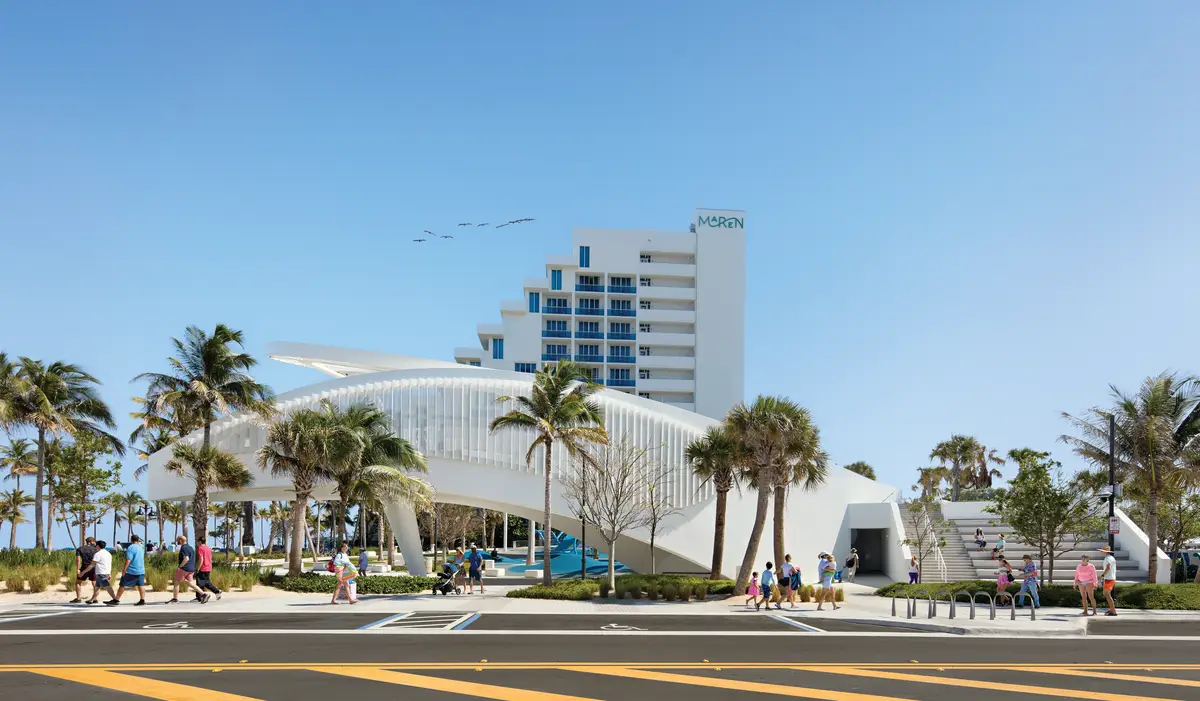
The amphitheater faces a community plaza. Photo © Mark Herboth, click to enlarge.
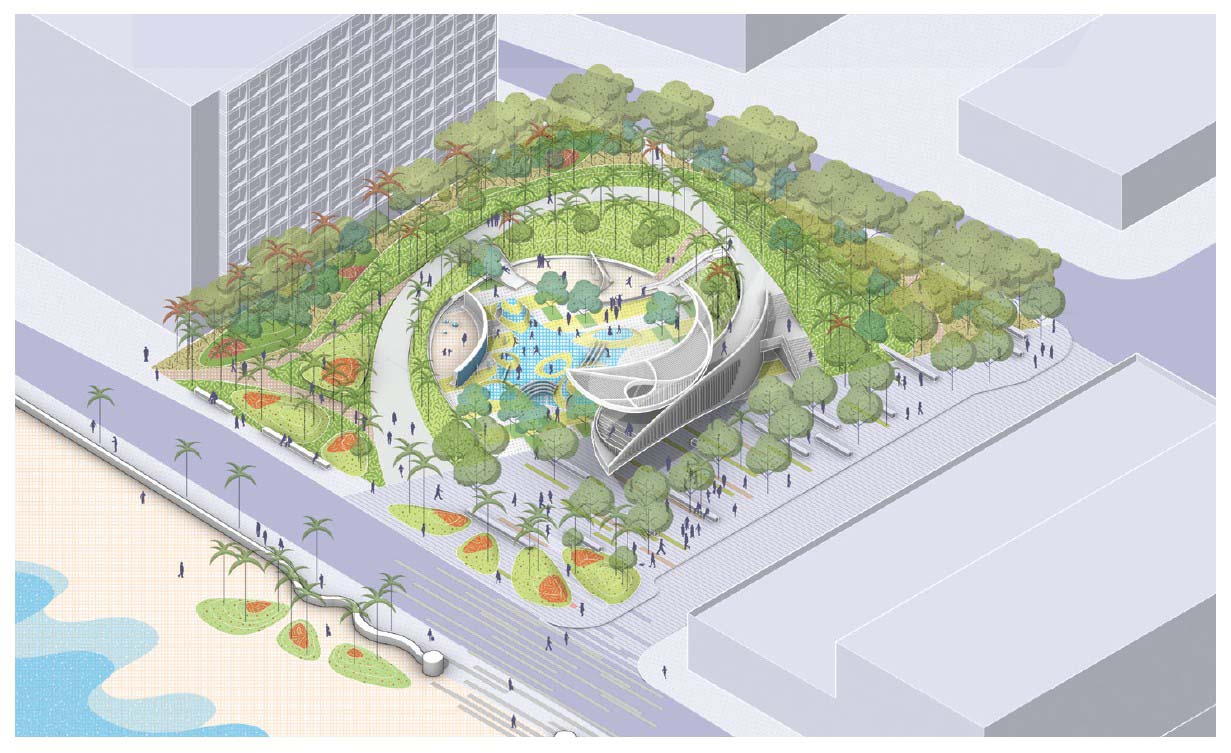
DC Alexander Park is the last of four public-space projects completed as part of Fort Lauderdale’s decade-long commitment to coastal-resilience investments. The 1.2-acre site, which most recently served as a surface parking lot, sits at a narrow point on a barrier island between the Atlantic Ocean and the Fort Lauderdale Aquatic Complex and International Swimming Hall of Fame. Brooks + Scarpa partners Lawrence Scarpa and Jeffrey Huber designed the project, working with Paul Weinberg of Keith, who served as landscape architect of record, and Shiff Construction. Together, they produced an elegant design that accommodates active and passive recreation and restores habitat while addressing complex requirements related to climate adaptation.
Brooks + Scarpa’s multifaceted approach builds on Huber’s research into design responses to climate stressors. His 2024 book, Salty Urbanism, details strategies through which the built environment can address sea-level rise, saltwater intrusion, habitat loss, and rising temperatures. In projects like DC Alexander Park, “landscape became infrastructure,” Huber told me when we visited the site.
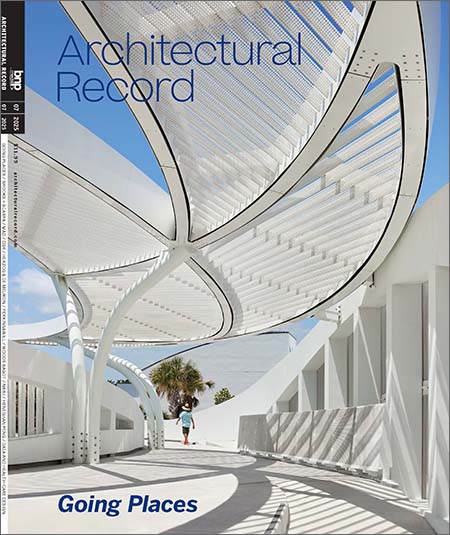
The park’s most prominent element is a curvaceous biomorphic pavilion that emerges out of a “ramping dune” and ends with a 25-foot cantilevered platform overlooking the ocean. The building combines a muscular concrete and steel structure with a diaphanous perforated metal skin, fabricated by EES Design Studio, that appears ethereal at sunrise and sunset. The spiraling continuity of earthworks and architecture shields the playground without walling it off from the street, achieving what Huber describes as “enclosure without barriers.” The pavilion also fulfills a requirement of the client: create an iconic “Instagram moment” backdrop.
1
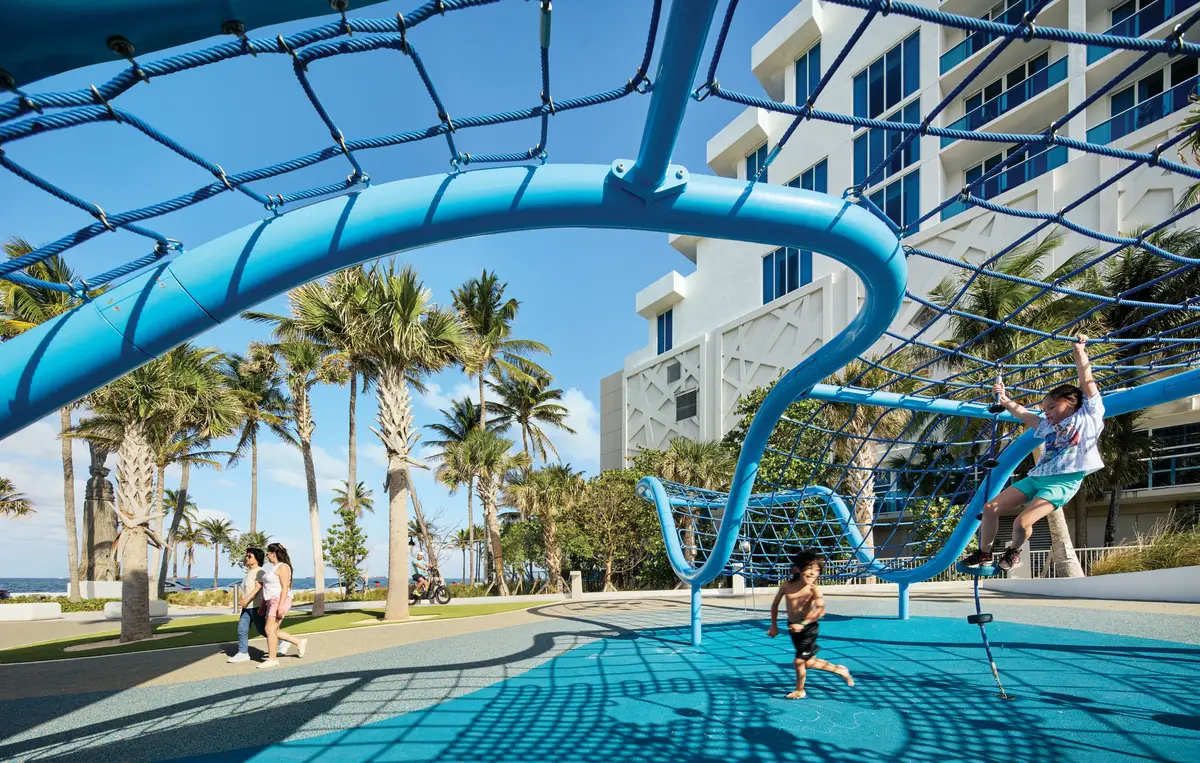
A playscape (1) joins the overlook (2). Photos © Mark Herboth

2
The site boasts a rich history. The parcel was given to the city by real-estate developer David Clifford “DC” Alexander in 1916. Along with Robert Hugh Birch, Alexander was responsible for ensuring public access to the beach in perpetuity by insisting that a boulevard run along the coast. The plot once hosted a fort and, from 1928 to 1967, was the site of a major civic landmark, the Las Olas Casino Pool. This Spanish Revival complex housed the state’s first Olympic-size pool and was filled with seawater from the Atlantic. Prior to European settlement, the area was used by the Seminoles as a trading post, and in 1983 Hungarian sculptor Peter Wolf Toth memorialized this legacy by siting one of his Whispering Giants sculptures there. The park design retains the 30-foot-tall cypress bust in its original location, though the work stands awkwardly adjacent to, rather than integrated into, the new landscape.
Florida’s marine environment creates significant challenges for buildings and landscapes. Both must be designed to survive storm surge, hurricane-force wind, and constant exposure to salt spray. The pavilion employs a massive foundation to withstand the dynamic forces imparted by cyclonic winds and large waves, along with galvanized rebar and a concrete admixture that prevents saltwater corrosion. The plants used throughout the park are species adapted to life in the coastal upland habitat, and their roots help lock the newly constructed dunes in place. The dunes are growing, and Huber notes with pride how sand carried by sea breezes migrates from the beach to the mounds in the park. The “rewilded landscape” won’t require irrigation once the plants are established, yet will accommodate a minimum of 3½ inches of rain in a single storm. It has already weathered storm surge during the spring king tides.
The project’s concern with public space extends beyond the site’s boundaries. Brooks + Scarpa reconceived the small street that forms the park’s north edge as a civic plaza, which will link to any future redevelopment across the street. The tropical maritime hardwood hammock areas that bound the park are designed to mitigate flooding on the adjacent streets by absorbing rain and excess surface water, and the lighting used throughout the site is designed to protect sea turtles that nest on the nearby beach. As a model of recreational space envisioned as resilient infrastructure, DC Alexander Park should have an impact in excess of its modest dimensions.
Click drawings to enlarge

Looking for a reprint of this article?
From high-res PDFs to custom plaques, order your copy today!
Looking for quick answers on architecture and design topics?
Try Ask RECORD, our new smart AI search tool.
Ask RECORD →