Spiritual Projects 2025
The Ismaili Community Gets a New Home in Houston
December 1, 2025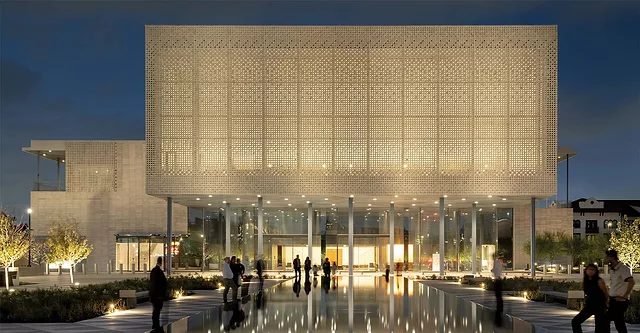
Spiritual Projects 2025
The Ismaili Community Gets a New Home in Houston
December 1, 2025The Ismaili Center, Houston.

The number seven, as in other Abrahamic faiths, is considered sacred among Ismaili Muslims, a branch of Shia Islam that emphasizes values of tolerance, volunteerism, and pluralism. The new Ismaili Center in Houston, the first of its kind in the United States, is the seventh around the world, and, architecturally, the building lives up to its numerological significance. The design, by London-based Farshid Moussavi Architecture with DLR Group, beat out entries by big-name firms (including OMA and David Chipperfield Architects), winning a 2019 competition. The team synthesized various spatial typologies and formal motifs shared across traditions to create a multifunctional building and garden that is at once cross-cultural and distinctly Islamic. “The mandate was to be inspired by the architectural heritage of the Muslim world,” says Moussavi, “but to make that heritage speak to the contemporary American city.”
The Houston complex follows centers in London, by Casson Conder Partnership; Lisbon, by Raj Rewal; Toronto, by Charles Correa; and others in Vancouver, Dubai, and Dushanbe, Tajikistan. Each center was commissioned, starting in the mid-1980s, by the late Prince Karim Aga Khan IV, the faith leader and architectural patron responsible for his titular design award. It is the largest of these to date, which is fitting for Houston, a city of superlatives. Home to one of the busiest ports in the U.S., it is the biggest metropolis in Texas by both population and geography. According to some metrics, it is also one of the most ethnically and religiously diverse cities in the nation. Not only is it home to televangelist Joel Osteen’s megachurch but also to the country’s largest Ismaili population. The center plays a dual role as a hub for this local community and as an ambassador within the broader cosmopolitan context, with a gallery, black-box theater, and event halls serving the public at large.
In 2006, the Aga Khan purchased an approximately 11-acre linear parcel (five times longer than it is wide) on the south bank of Buffalo Bayou. In car-centric Houston, the site is prominently located at the intersection of two major thoroughfares, Montrose Boulevard and Allen Parkway. The land remained undeveloped for more than a decade, while other Ismaili Centers were being completed. In August 2017, when Hurricane Harvey devastated Houston, about half of the sloping site was submerged, with water rising unimaginably more than 25 feet on the bayou side. The placement of the building was, in part, determined by how far those floodwaters reached.
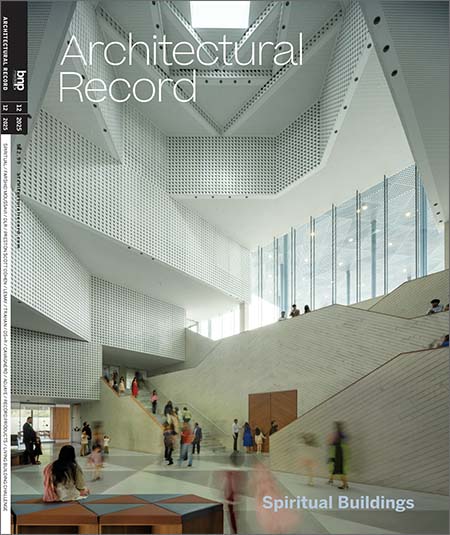
Photo © Nic Lehoux
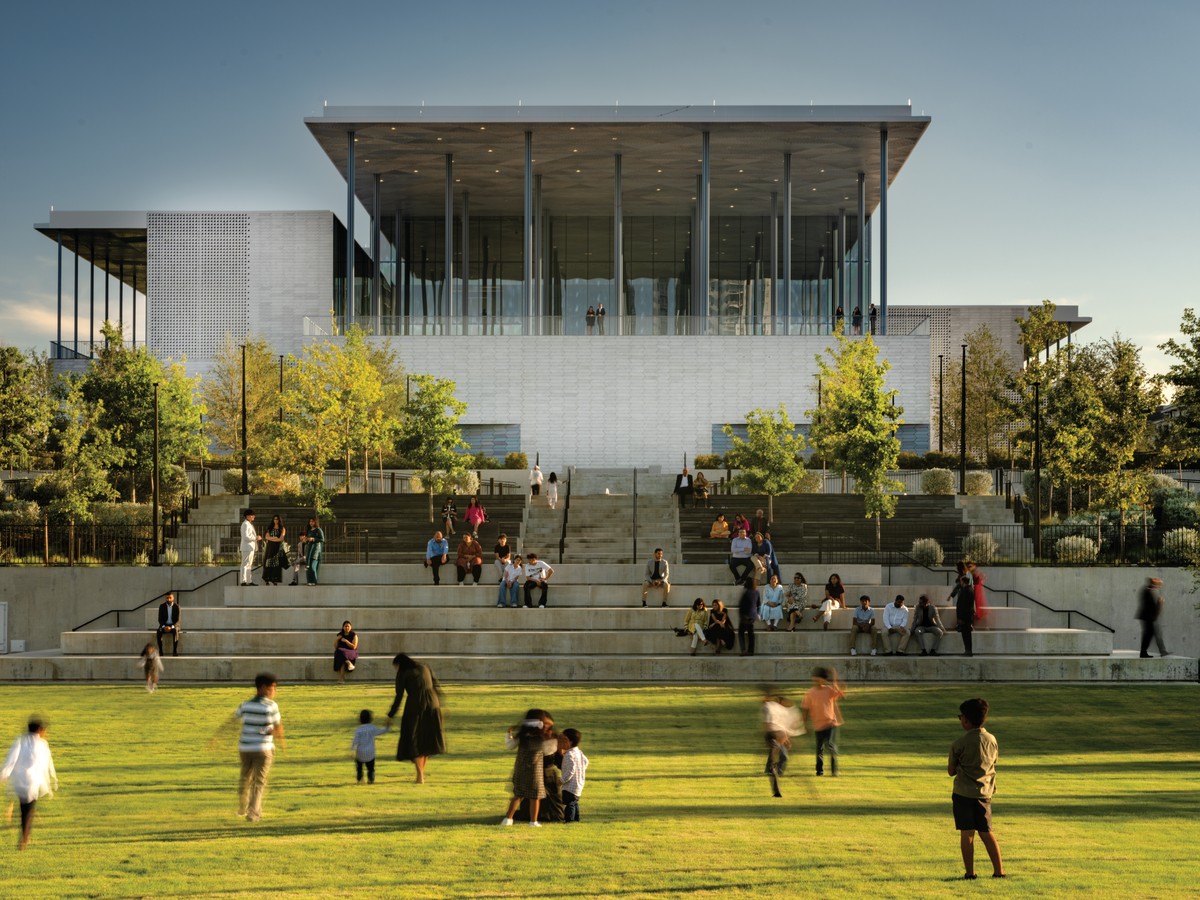
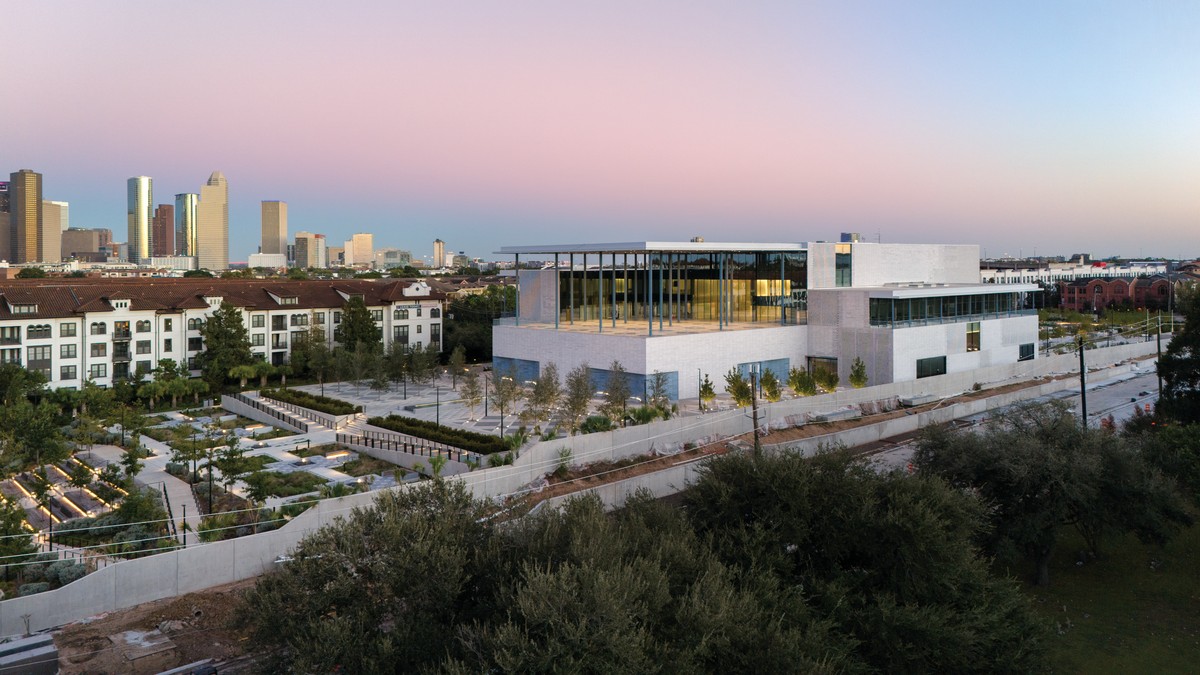
Today, the perimeter of the site is ringed by a high wall, with the monumental complex—an amalgamation of boxy forms whose heft is softened by screen walls—sitting roughly in the center. Nine acres of public gardens, designed by landscape architects Nelson Byrd Woltz, cascade to its north and south. The perimeter walls, which will soon be covered by creeping fig, both help mitigate the intense traffic noise and pay homage to Persian walled gardens. The symmetrical terraced landscape, with reflecting pools, tree-lined promenades, fountains, and rigorous geometric motifs, also evokes Islamic tradition but with a South Texas twist: each of the terraces features a different biome of native plantings, from paddle cacti and agave at the top of the site through prairie grasses and woodland oaks, stepping down to bayou brush. Thomas Woltz, senior principal at Nelson Byrd Woltz, calls it a “transect of Texas.” This blending of traditional forms with local life is not only an apt metaphor for the hybrid identity of the Ismaili diaspora but also a strategic design. In 2024, Hurricane Beryl dumped nearly 12 inches of rain on Houston, flooding the lowest terrace. The new landscaping weathered its first test, absorbing the water within a matter of hours.
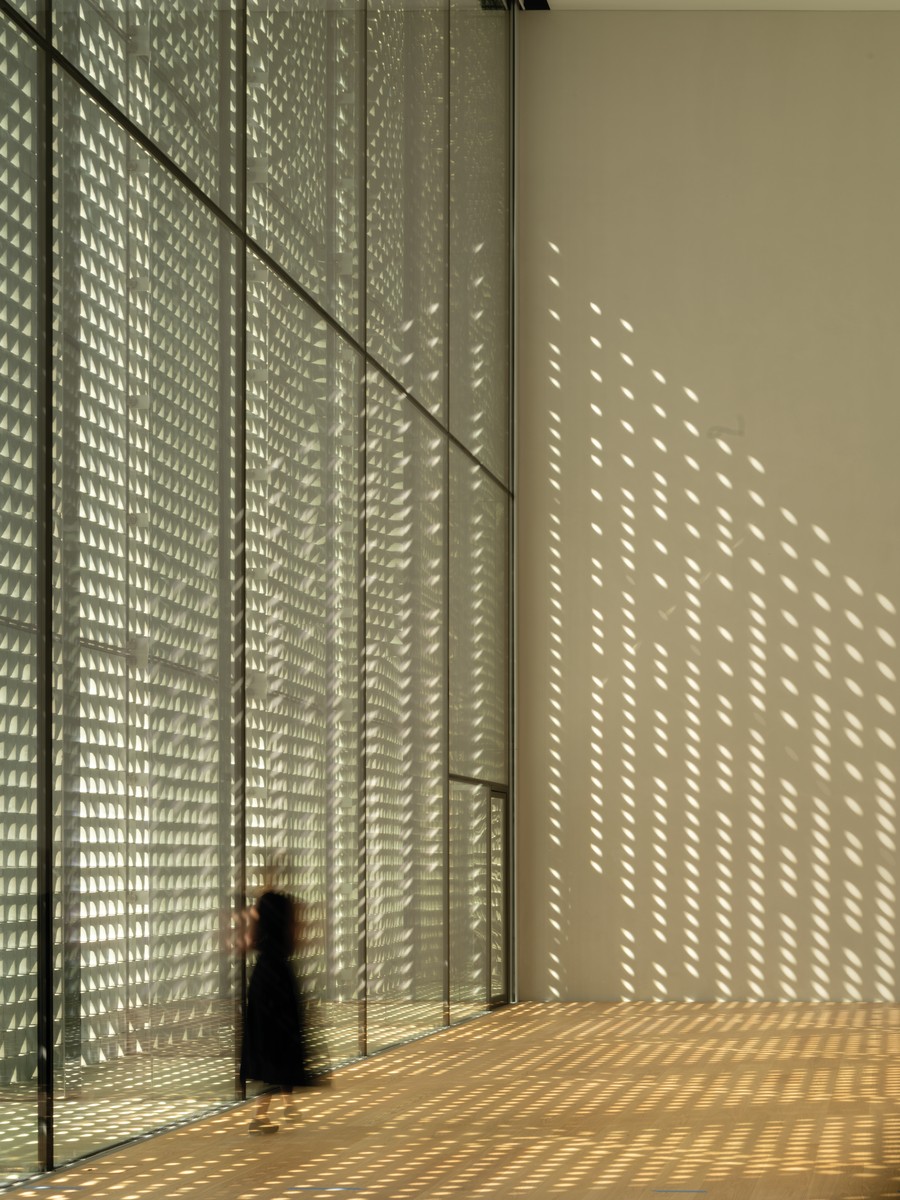
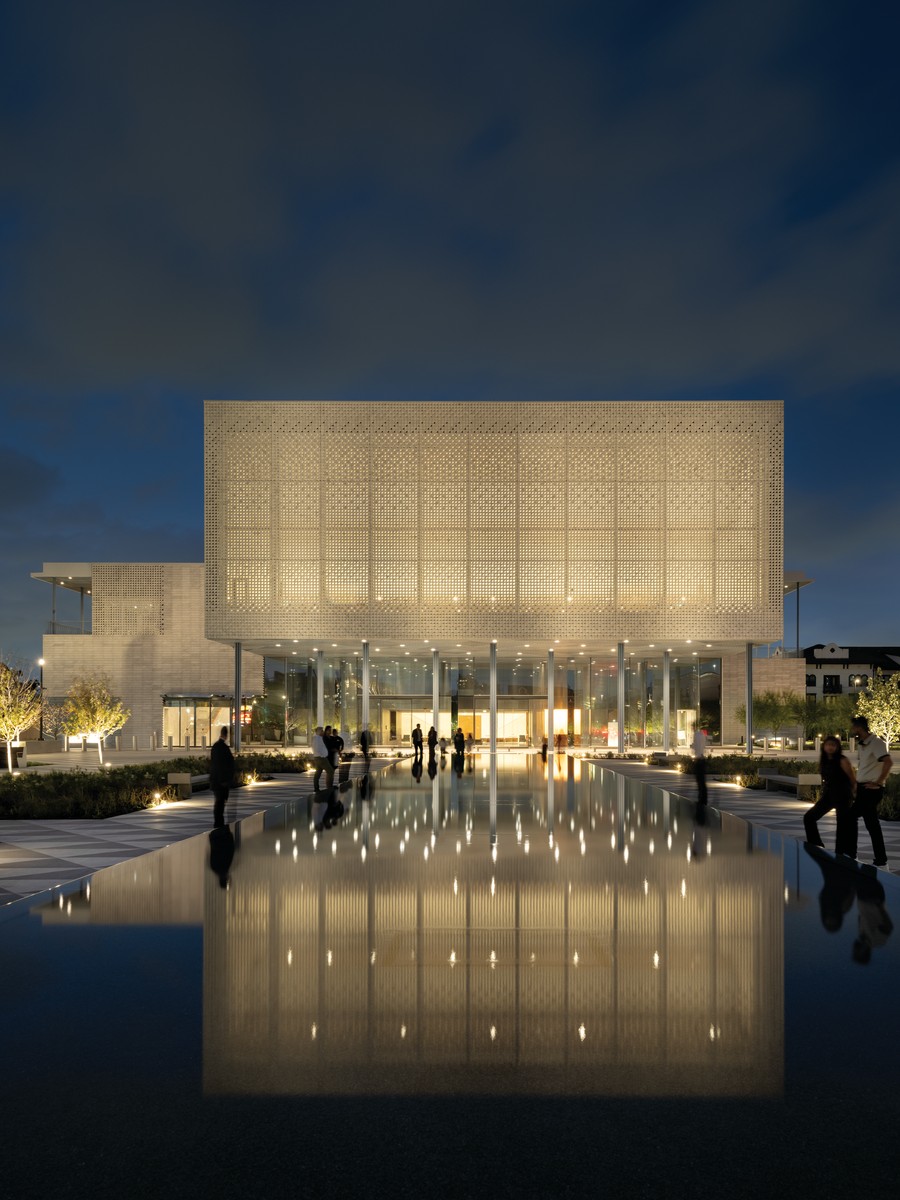
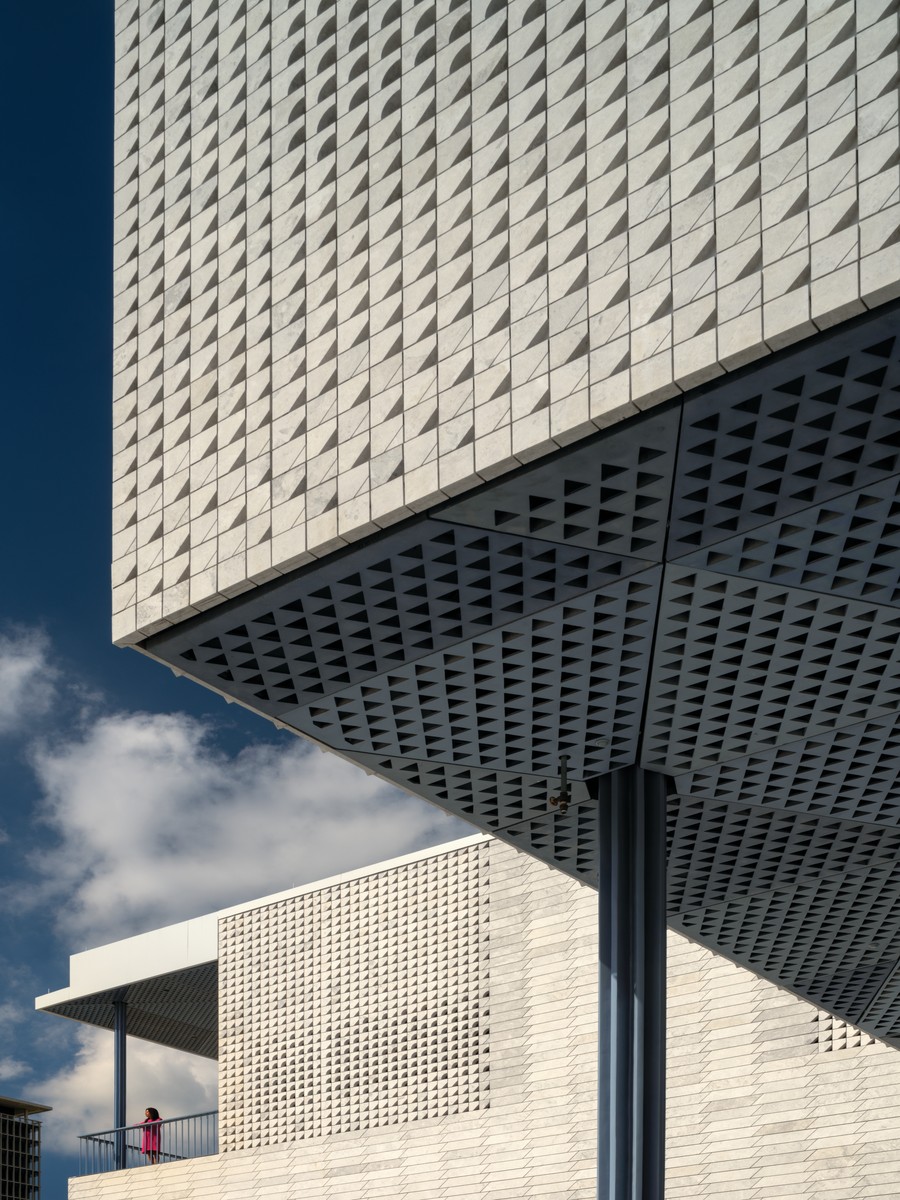
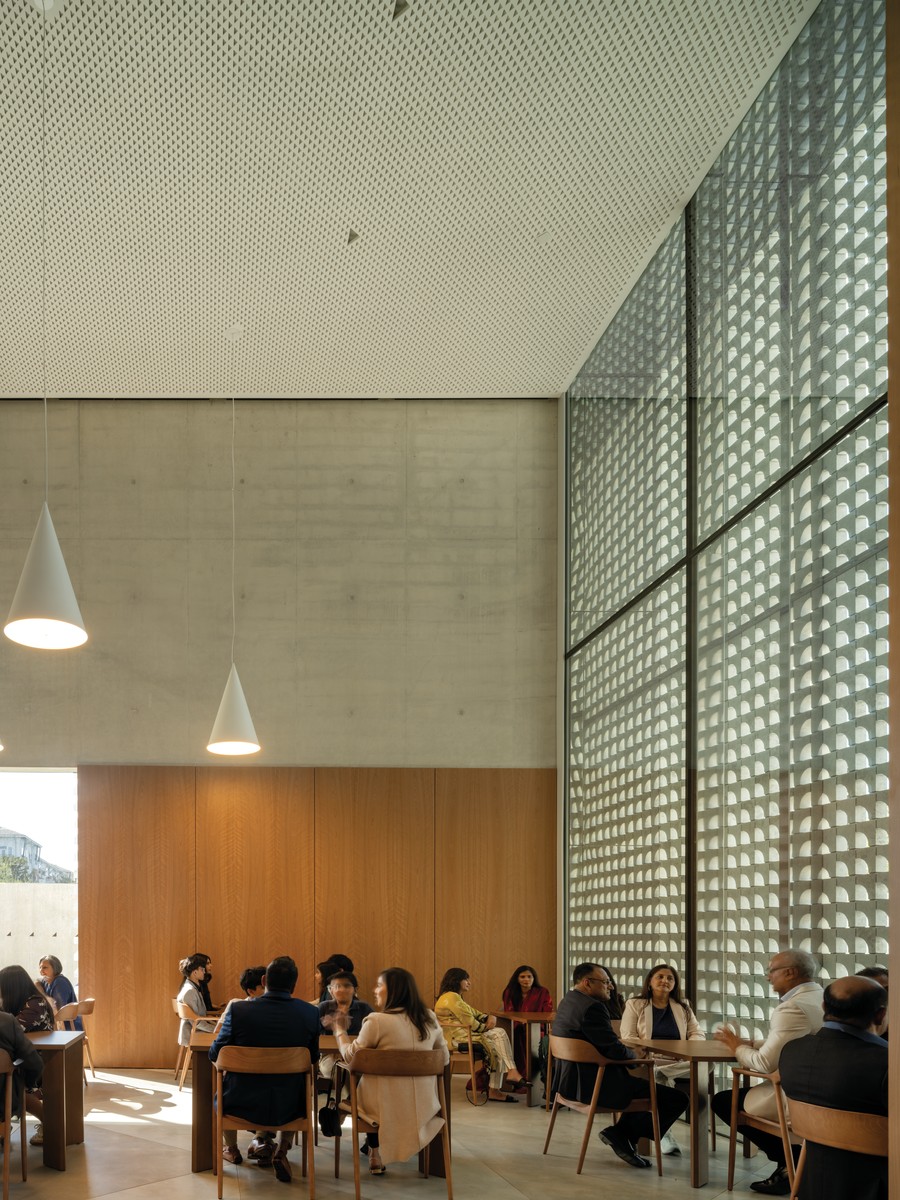
Composed as alternating monolithic masses and shaded verandas in a roughly cruciform arrangement, the enormous 150,000-square-foot, five-story structure is really four buildings in one. The three public-facing programs—religious, social, and educational—each have their own entrances on the ground level. Administrative offices for the volunteers who staff the center, including a lavish suite for the Aga Khan, are located on the top two floors. Vast swaths of the building—including the large volume containing the event space over the primary entrance—are screened with small blocks of light-gray Turkish marble. These blocks are alternately chamfered or filleted, the latter having the most mass possible removed while remaining structurally viable. The inspiration for these screens are the mashrabiya found in Islamic architecture, but the assembly is that of a beaded curtain, with blocks strung together on tension rods and hung on the facade.
1
2
The main social hall (1), draped in a screen of Turkish marble, floats over the entry veranda, or eivan (2). Photos © Nic Lehoux, click to enlarge.
The grandest of the three entrances is on the central axis through the garden, under a sweeping veranda, whose typological parallel is the Persian eivan. The south eivan and the entry vestibule introduce material and geometric motifs that recur throughout the building. Held aloft by a diagrid of star-shaped welded steel-plate columns—there are 49 such pillars in total throughout the building in honor of Prince Karim, the 49th Imam—the soffit of the veranda is composed of tessellated panels of ultra-high-performance concrete, perforated with an array of triangles and tinted a pale blue, a hue associated with heaven in many religions. Continuing the geometric motif, this triangulation is mirrored in the layout of control joints in the raw-concrete floors throughout the complex. The walls of the vestibule are clad in laminated-silk glass, which produces a shimmering, semi-reflective, and truly otherworldly effect. These surface treatments are consistent in the building, shifting only in color and scale for different spaces.
3
4
5
Tessellated patterns and geometric motifs (3) are ubiquitous throughout the complex, which includes terraced gardens (4 & 5). Photos © Nic Lehoux
This entry procession leads through an American cherry–lined foyer, which feels compressed compared to the double-height eivan and vestibule, to the central atrium—a showstopper of a space. The atrium is the crossroads of the complex, connecting the central religious program with the café and social spaces in the west wing and the gallery, library, and classrooms in the east wing. Towering over this talaar, as it’s known in Persian, cutting through the full height of the building, are stacked rotating and attenuating boxes that lead up to a skylight—a square “oculus” of sorts. The same tessellated screens line the walls of this orthogonal “dome,” to dizzying effect. The soaring space recalls both the intricate detail of Islamic muqarnas and the light-filled domed crossings of European cathedrals.
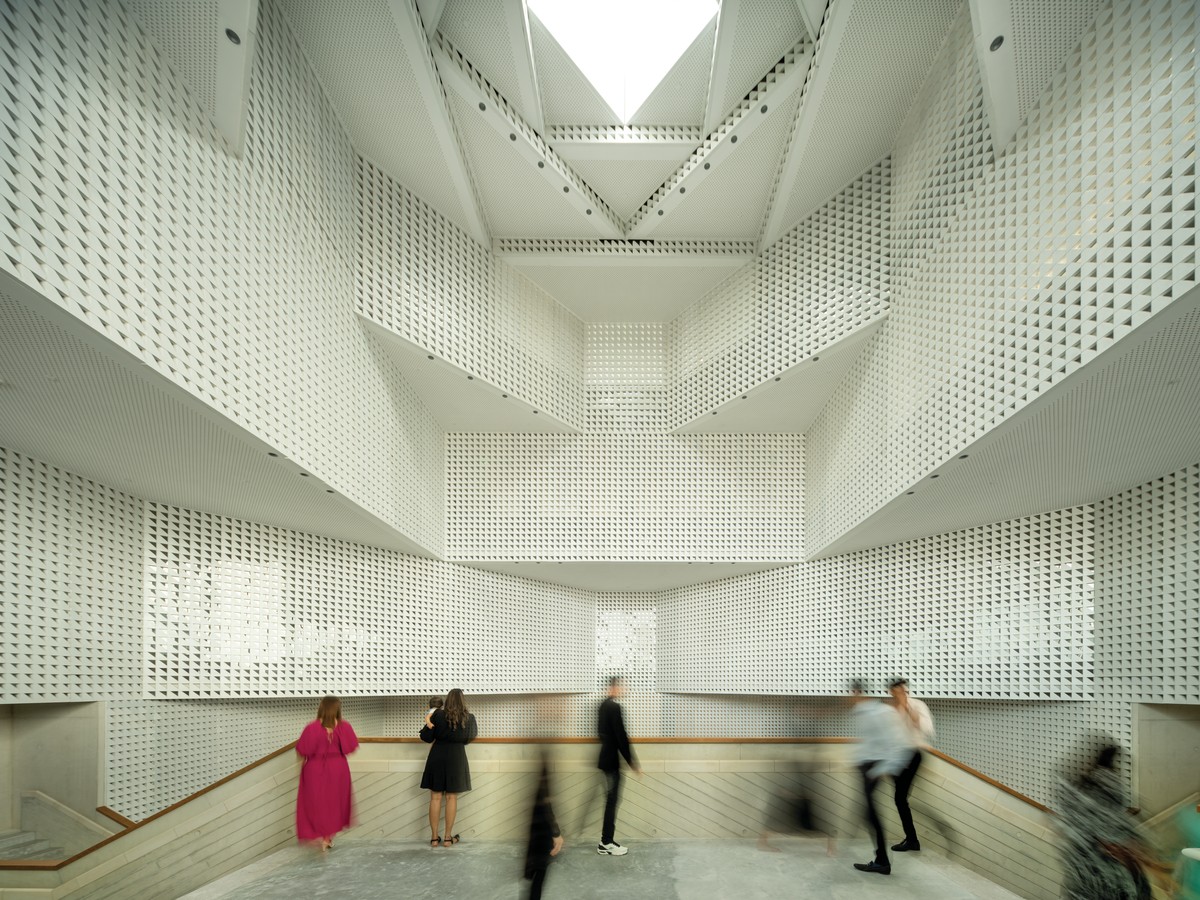
In the central atrium, rotating Vierendeel trusses are clad in the same chamfered pattern, leading up five stories to a square “oculus.” Photo © Nic Lehoux
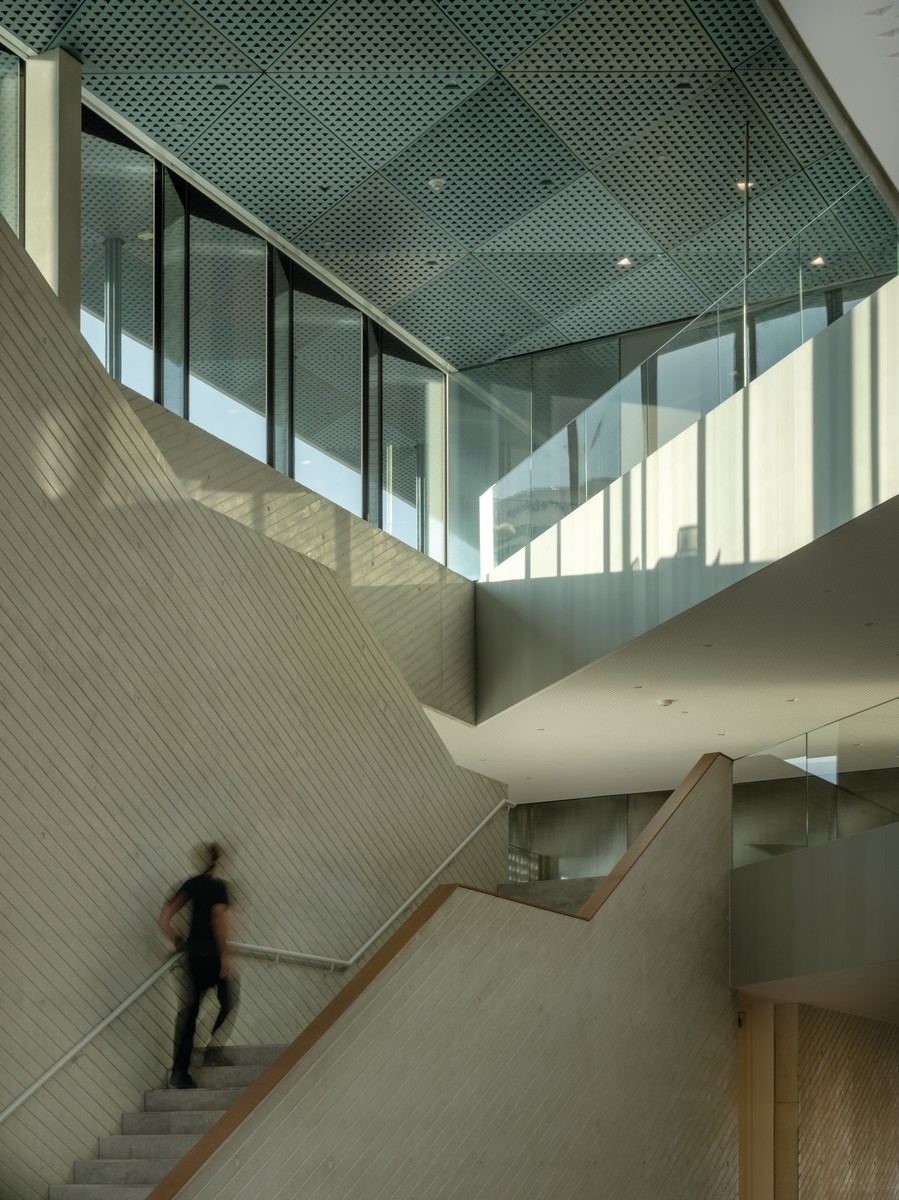
The north wall of the talaar is cast-in-place concrete with symmetrically laid diagonal stripes leading the eye up to the triple-height north eivan on the third floor. In the center of this wall, flanked by a pair of grand staircases, a double door terminates the axis begun in the garden and opens to the prayer hall, or jamatkhana. This ceremonial door is reserved for the Aga Khan, with entry for congregants through two shoe-storage side rooms. If the atrium is a crescendo of scale, verticality, and airiness, the worship space, while no less monumental, is the diminuendo that follows, inviting quiet contemplation and solemnity. Upon entering the jamatkhana—a 115-by-115-foot, double-height, column-free windowless room—a diagonal screen wall reorients 45 degrees toward the qibla in the northeast corner. The walls of the jamatkhana are large anegre-wood panels that bear the names of Allah, Muhammad, and Ali, the first Imam, in Kufic calligraphy rendered in a perforated geometric dot pattern. DLR Group devoted countless hours to sizing the pattern and the panels to ensure that no name would be desecrated.
Looking for quick answers on architecture and design topics?
Try Ask RECORD, our new smart AI search tool.
Ask RECORD →
Looking for a reprint of this article?
From high-res PDFs to custom plaques, order your copy today!
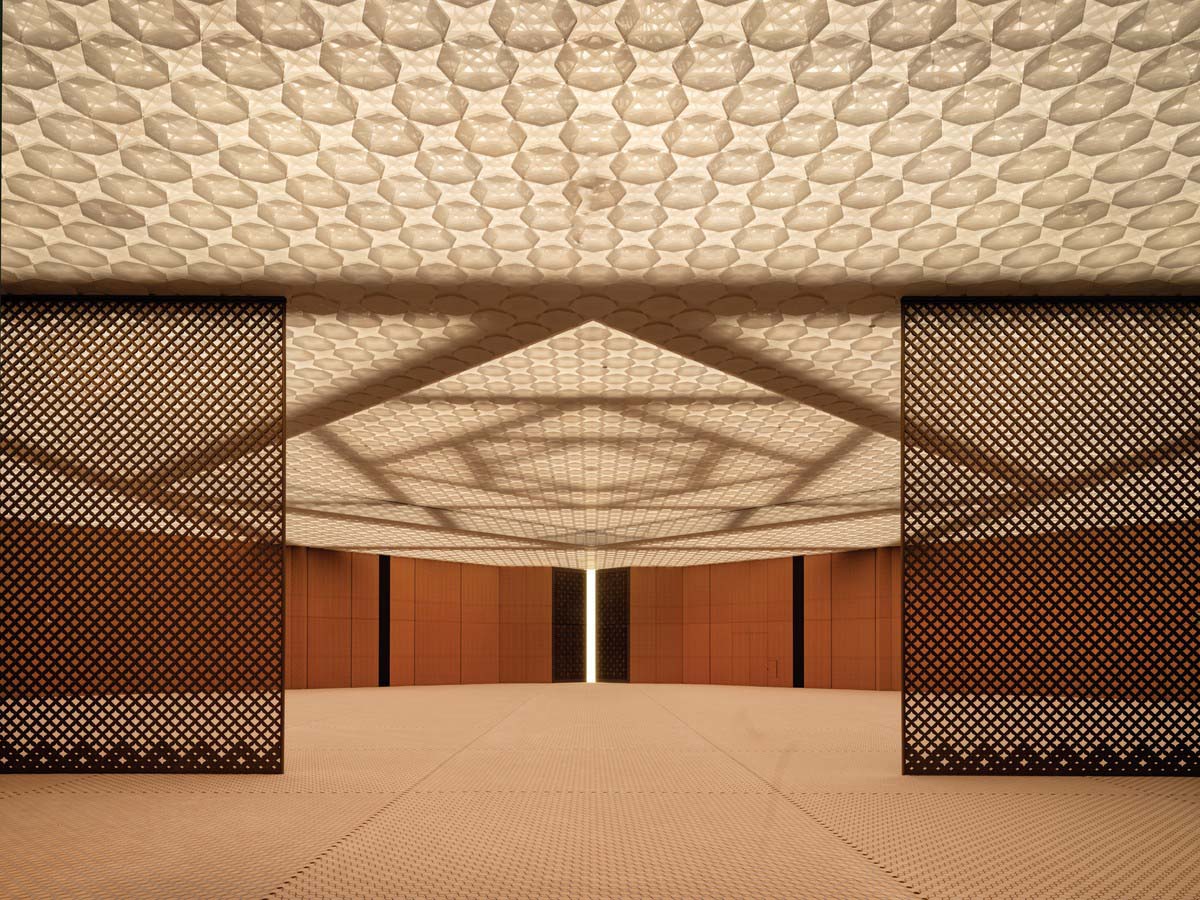
In this quiet yet expansive space, the ceiling hovers like a diaphanous cloud. Seven rotating squares cast hazy shadows on its otherwise luminous aluminum-mesh surface. Functionally, these are a series of complex trusses supporting the eivan above, but symbolically, the veiled pure geometries perhaps allude to the seven heavens of Islamic cosmology. Visually ethereal, the porous surface also accommodates a laminar-flow ventilation system, ensuring comfort while minimizing noise. Exemplifying the community effort that went into completing the center, this custom ceiling was crafted by a local Ismaili fabricator who volunteered its services.
6
Visible as a shadow in the prayer hall (6), a complex series of trusses supports the south eivan. The same materials of cast-in-place concrete, silk-laminated glass, UHPC ceiling panels (7), marble screens, and wood panels (8) are used consistently throughout the building. Photos © Nic Lehoux
7
8
The new Ismaili Center is monumental, not only in its scale and complexity, nor merely as a source of pride for the community and as a resource for Houston at large, but in its ability to distill Islamic traditions to their core principles. Without historicizing, it learns from history to create a building that’s culturally distinct without exoticizing. As Moussavi explains: “Coming from Persian origins, I am particularly frustrated when people use representational and identity politics to explore this heritage. The opportunity of this project was not to resort to mimicry of this heritage but to use its elements, which were never just about symbolism.” The design of the Ismaili Center is “about using architectural instruments, such as geometry, light, order, repetition, and structure, to create spatial experiences for everyone.” By avoiding pastiche and prioritizing the fundamental elements of architecture, the true achievement of the Ismaili Center is in finding and sharing what’s universal.

Image courtesy Farshid Moussavi Architecture

Image courtesy Farshid Moussavi Architecture
Credits
Architect:
Farshid Moussavi Architecture — Farshid Moussavi, Elliott Hodges, Marco Ciancarella, Paniz Pevandi
Architect of Record:
DLR Group — Paul Westlake, Matt Janiak, Emily Moore, Grace Myers
Landscape Architect:
Nelson Bryd Woltz Landscape Architects — Thomas Woltz, Jeffery Aten
Engineer:
AKT II
Engineer of Record:
DLR Group
Consultants:
Gartner (building envelope), Kinetica (concrete)
General Contractor:
McCarthy Building Companies
Client:
IMARA Houston
Size:
150,000 square feet (building); 245,000 square feet (parking)
Cost:
Withheld
Completion Date:
November 2025
Sources
Masonry:
Solid Stone Rainscreen, Camarata Masonry
UHPC Panels:
Kinetica Group
Glazing:
Josef Gartner USA (curtain wall, skylights); Sustainable Glazing Concepts (storefronts, railings)
Doors:
Sustainable Glazing Concepts (automatic entrances); La Force (hollow metal doors, flush wood doors); Won Door (accordion folding partitions); Dovetail (millwork doors)
Interior Finishes:
Clunn Acoustical Systems, Star Silent by Galindo & Boyd, Haworth Trivati, Dovetail Custom Woodworks, Max Grigsby Company, Camarata Masonry, ACS Flooring, Woodright Hardwood Floor
Lighting:
CW Henderson Electric, Mainstage Theatrical
Conveyance:
TK Elevator