Architectural Record
search
cart
facebook twitter linkedin youtube
  • Sign In
  • Subscribe
  • Sign Out
  • My Account
Architectural Record
  • NEWS
    • Latest News
    • Awards
    • Interviews
    • Obituaries
    • Podcasts
      • Design:Ed Podcast
      • Sponsored Podcasts
  • OPINION
    • Book Reviews / Excerpts
    • Exhibition Reviews
    • Forum
  • EXCLUSIVES
    • Videos
    • Design Vanguard
    • Top 300 Firms
    • Sponsored Content
    • Sponsored eBooks
    • From the Archives
  • CONTINUING ED
    • Editorial Continuing Ed
    • CE Center
    • CE Academies
  • PROJECTS
    • Buildings By Type
    • Reuse & Renovation
    • Museums & Arts Centers
    • Colleges & Universities
    • Multifamily Housing
    • Interiors
    • Lighting
    • Kitchen & Bath
  • HOUSES
    • Record Houses
    • House of the Month
    • Featured Houses
  • PRODUCTS
    • Products by Category
    • Record Products of the Year
    • Latest Products
  • EVENTS
    • Dates & Events
    • Record on the Road
    • Innovation Conference
    • Sustainability in Practice
    • Women In Architecture
    • Webinars
    • Ad Excellence Awards
    • Submit an Event
  • CONNECT
    • Ask RECORD AI
    • Newsletters
    • Contact
    • Advertise
    • Editorial Calendar
    • Store
    • Customer Service
  • SUBMIT
    • Submission Guidelines
    • RECORD Competitions
  • MAGAZINE
    • Subscribe
    • My Account
    • Digital Edition
    • Current Issue
    • Firm Pass
    • Historic Archive
Architecture News

Emergency Health Care Gets a New Face in NYC
By Laura Raskin
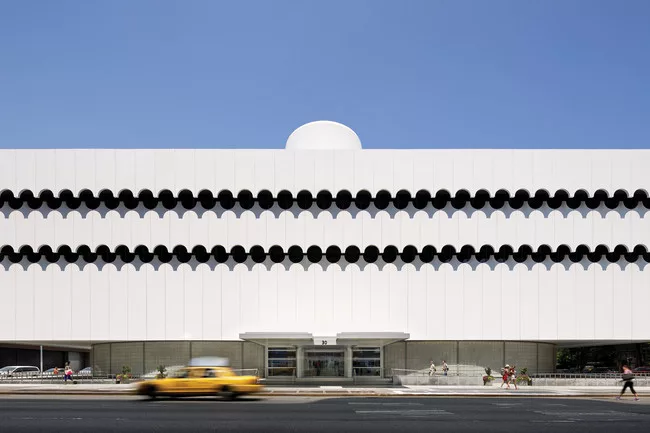
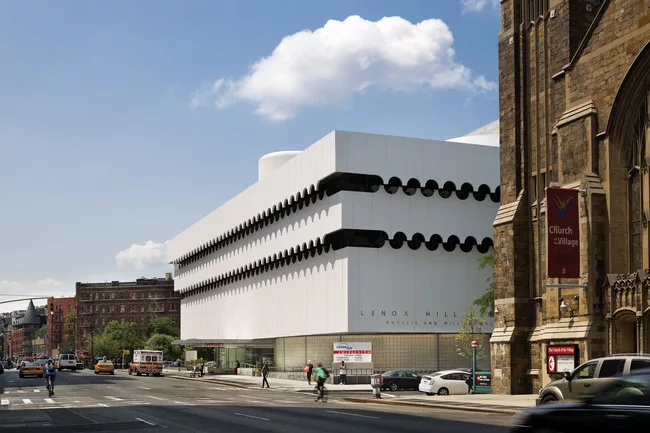
Perkins Eastman restored Albert Ledner&#8217;s 1964 National Maritime Union headquarters in Manhattan&#8217;s West Village, and inserted a stand-alone emergency department inside.<div id='_mcePaste'>&
Emergency Health Care Gets a New Face in NYC
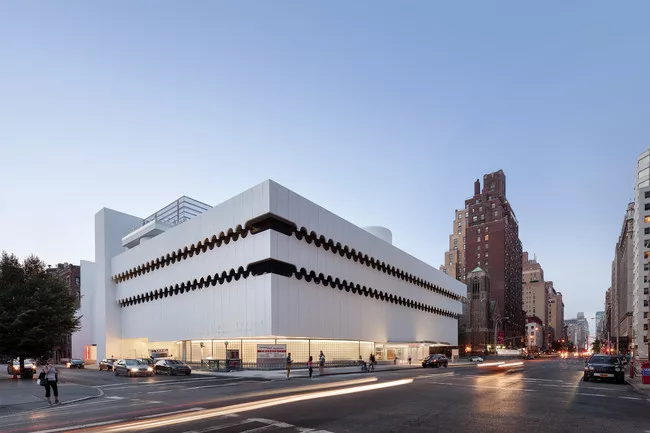
Perkins Eastman restored Albert Ledner’s 1964 National Maritime Union headquarters in Manhattan’s West Village, and inserted a stand-alone emergency department inside.

Photo © Chris Cooper
Emergency vehicles pull into a bay on the building's southern side.
Emergency Health Care Gets a New Face in NYC
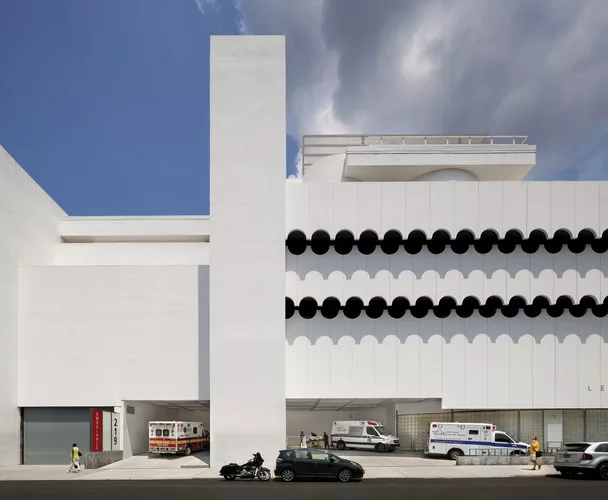
Emergency vehicles pull into a bay on the building's southern side.
Photo © Chris Cooper
Emergency vehicles pull into a bay on the building's southern side.
Emergency Health Care Gets a New Face in NYC
Emergency vehicles pull into a bay on the building's southern side.
Photo © Chris Cooper
Emergency vehicles pull into a bay on the building's southern side.
Emergency Health Care Gets a New Face in NYC
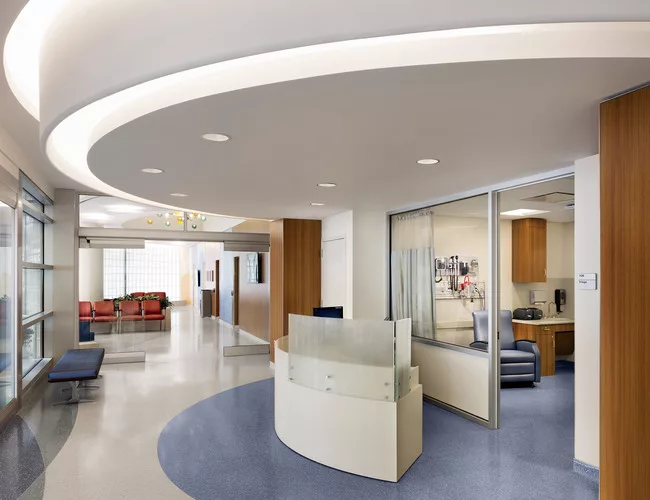
Emergency vehicles pull into a bay on the building's southern side.
Photo © Chris Cooper
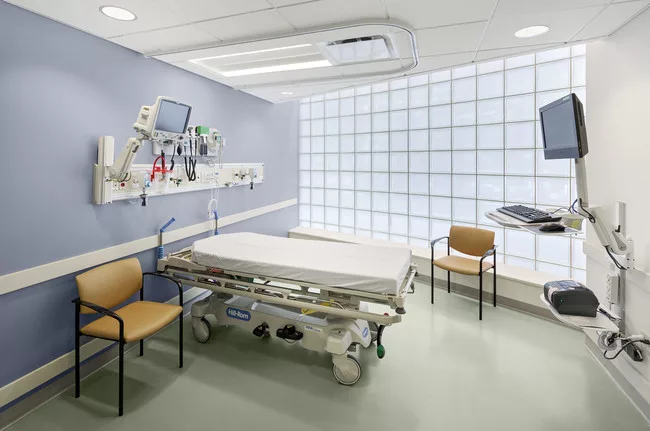
Perkins Eastman replaced the 8-by-8-inch glass bricks in the podium, which bring soft daylight into some exam rooms. The curved glass  walls create bigger rooms too.<br /><div id='_mcePaste'>&#65279;&
Emergency Health Care Gets a New Face in NYC
Perkins Eastman replaced the 8-by-8-inch glass bricks in the podium, which bring soft daylight into some exam rooms. The curved glass walls create bigger rooms too.

Photo © Sarah Mechling
The new entrance lobby.
Emergency Health Care Gets a New Face in NYC
The new entrance lobby.
Photo © Chris Cooper
Walls in the hub of the emergency department (left) don&#8217;t exceed 5 feet in height, allowing staff to see through the nearly block-long room
Emergency Health Care Gets a New Face in NYC
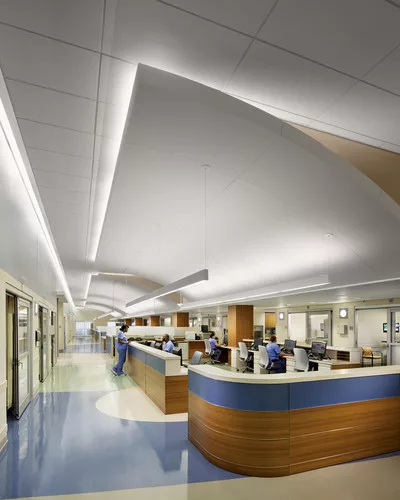
Walls in the hub of the emergency department (left) don’t exceed 5 feet in height, allowing staff to see through the nearly block-long room
Photo © Chris Cooper
As the O&#8217;Toole building, the building had a podium surrounded by a fence and an inhospitable entrance canopy.
Emergency Health Care Gets a New Face in NYC
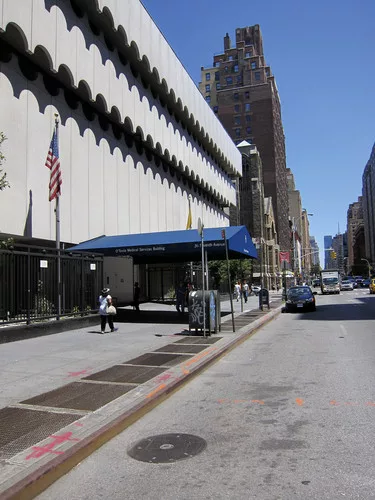
As the O’Toole building, the building had a podium surrounded by a fence and an inhospitable entrance canopy.
Photo courtesy Perkins Eastman
Perkins Eastman restored Albert Ledner&#8217;s 1964 National Maritime Union headquarters in Manhattan&#8217;s West Village, and inserted a stand-alone emergency department inside.<div id='_mcePaste'>&
Emergency vehicles pull into a bay on the building's southern side.
Perkins Eastman replaced the 8-by-8-inch glass bricks in the podium, which bring soft daylight into some exam rooms. The curved glass  walls create bigger rooms too.<br /><div id='_mcePaste'>&#65279;&
The new entrance lobby.
Walls in the hub of the emergency department (left) don&#8217;t exceed 5 feet in height, allowing staff to see through the nearly block-long room
As the O&#8217;Toole building, the building had a podium surrounded by a fence and an inhospitable entrance canopy.
September 15, 2014

Perkins Eastman restored Albert Ledner’s 1964 National Maritime Union headquarters in Manhattan’s West Village, and inserted a stand-alone emergency department inside.


When New York’s St. Vincent’s Hospital closed in 2010 after years of financial strife, Greenwich Village lost a beloved 150-year-old institution that had served the poor and working class and was “ground zero” when the AIDS epidemic erupted in the 1980s. While most of the St. Vincent’s campus was demolished, a quirky precast-concrete building on Seventh Avenue between West 12th and 13th streets, designed by Albert Ledner and completed in 1964, remained. St. Vincent’s purchased it in 1973, but Ledner had designed the building to house the National Maritime Union Headquarters—hence its sturdy rectangular form and scalloped rows of porthole-style windows on the fourth and fifth floors.

Fast-forward to July 17, 2014: the O’Toole building, as it was known during its St. Vincent’s tenure, reopened its doors as the Lenox Hill HealthPlex, a stand-alone, 24-7 emergency department that is a division of Lenox Hill Hospital in Manhattan. Once again, Greenwich Village has an emergency health-care resource and a lovable, weird New York building has been preserved, even as waves of new development rise around it. The facility also represents a countrywide trend. “We’re seeing a transformation in health care into this ambulatory environment,” says Jeffrey Brand, planning principal with Perkins Eastman’s national health-care practice, which turned the O’Toole building into the HealthPlex. “We probably have about eight projects that are all like this.”

By “like this,” Brand means outpatient, stand-alone, one-stop shops for emergency care and day surgery, with pharmacies, imaging, labs, and sometimes cancer care all in one building. “Empirical evidence clearly points to the fact that you do better if you go home every night” rather than stay in a hospital bed, “and these are less expensive buildings to put up,” he says. Like the O’Toole building, many older buildings—from bowling alleys to shopping malls—are being converted into these health-care settings because they are in downtowns, often have pre-existing parking lots, and are easy for people to get to. The Affordable Care Act (which means that hospitals are trying to process more patients) and advances in technology that allow for speedier care are aligning to spur this trend. “It’s a brand-new world in health care, and it’s going to be very efficient for institutions and better for the consumer,” says Brand.

For Perkins Eastman’s New York office, painstaking restoration of the building’s exterior and the adaptive reuse of its interior (from “dumb” medical office building to high-tech emergency department) was a prize of a project. The architects worked to bring it back to Ledner’s original vision, even talking to Ledner (now in his 90s) about their plans. “The one thing I found really fascinating was Ledner’s belief in the power of the circle,” says Duncan Reid, the design principal for the project. “He believed that the circle was the most democratic of all forms because there are no corners. We thought, ‘Wow, that’s a powerful message. Let’s continue that, because the doors are open here for all. We wanted to provide the needed health care here in the Village, given what happened with St. Vincent’s.”

The building is not landmarked, so Perkins Eastman had an easier time retrofitting it for its new function, but it is in a historic district, and the client received historic-preservation tax credits, “so we went even further with our oversight. The state historic office reviewed a lot of things,” says Brand. The architects removed tiles that the National Maritime Union had added to the concrete-paneled facade in 1966, and conducted a scientific analysis of the original paint to match its precise shade of white. The building sits on a plinth, part of which St. Vincent’s topped with rocks. Perkins Eastman removed them, and an ugly fence, and reconstructed the original concrete platform with its checkerboard pattern, adding wheelchair ramps. The architects gutted the interiors, inserting a cutting-edge medical facility on the ground floor with state-of-the-art imaging, surgery, and emergency-medicine technology. The upper four floors will eventually house office space for physicians, ambulatory surgery, and imaging.

Those floors always sat on a pedestal of two intersecting circles, looking like a Venn diagram in plan. The pedestal was made of glass blocks, which the architects replaced (some of the exam rooms are on the other side of these beautiful walls, benefiting from soft daylight while still maintaining privacy). They added a new glass entry vestibule; small patient waiting rooms to the north and south of the entry are rarely full, explains Reid, because the HealthPlex is designed to usher patients right into exam rooms for evaluation and treatment.

The open, airy emergency department has two internal “streets” flanking nurses stations encircled by more rooms for exams and medical tests. Perkins Eastman removed a portion of a mezzanine level that was not original to the building to create higher ceilings above the emergency department. Three curved, sail-like ceiling planes above the nurse stations are faced in acoustic panels. The architects pulled out the north wall of the circle to create more rooms for patients. To the south, they removed a shear wall so that ambulances could pull in off the street. The biggest design challenge, says Reid, was trying to “fit in little individual rooms in a circular floor, and stuffing in all the 21st-century requirements of air, water, and medical gasses.” They turned an underground parking garage into a lab, staff lounge, and other services. (Across West 12th Street, an old St. Vincent’s mechanical building will be razed to make way for the New York City AIDS Memorial, designed by Brooklyn’s Studio a+i.)

The HealthPlex is expecting to treat 20,000 to 25,000 patients per year (it could accommodate 45,000 if necessary), according to executive director Alex Hellinger. “We don’t have a 200- to 800-bed hospital above us competing for the lab and CT scan. You could wait a few hours [in that environment],” he says. The HealthPlex is not a trauma center, and when surgery is required—even though its board-certified surgeons have the capability to crack open a chest, says Hellinger—patients are stabilized and then sent to other hospitals. “As the community comes in, they start to realize, getting to a hospital bed is not important: it’s getting to the first point of contact.”

Share This Story

Looking for a reprint of this article?
From high-res PDFs to custom plaques, order your copy today!

Lr
Laura Raskin, a former RECORD editor, writes about architecture. She recently moved with her family from Brooklyn, New York, to the Green Mountains of Vermont.

Post a comment to this article

Report Abusive Comment

Subscription Center
  • Create an Account
  • Start a Subscription
  • Manage My Account
  • Sign Up for Newsletters
  • Visit Customer Service
  • Update Preferences

More Videos

Sponsored Content

Sponsored Content is a special paid section where industry companies provide high quality, objective, non-commercial content around topics of interest to the Architectural Record audience. All Sponsored Content is supplied by the advertising company and any opinions expressed in this article are those of the author and not necessarily reflect the views of Architectural Record or its parent company, BNP Media. Interested in participating in our Sponsored Content section? Contact your local rep!

close
  • cold storage facility
    Sponsored byCarlisle SynTec Systems

    How Architects Can Design More Continuous Cold Storage Envelopes

  • TAMLYN XtremeTrim Exterior Trim
    Sponsored byTamlyn

    Designing Cleaner Panel Facades: Why Exterior Trim Details Matter

  • Building with Vapor Barriers
    Sponsored byReef Industries, Inc.

    Vapor Barriers Help Control Moisture in Tighter Building Designs

DESIGN:ED Podcast
Listen to Architectural Record’s DESIGN:ED Podcast

Events

June 23, 2026

Enhancing Fire Resistance with Advanced PVC Solutions

Credits: 1 AIA LU/HSW; 1 AIBD P-CE; 0.1 ICC CEU; 1 IIBEC CEH

Evaluate advanced PVC solutions that improve fire resistance, support WUI compliance, and enhance resilience in residential and commercial building design.

June 25, 2026

Designing Glass Railing Systems that Enhance Aesthetics and Meet Code

Credits: 1 AIA LU/HSW; 1 AIBD P-CE; 0.1 ICC CEU

Upon course completion, participants will possess a deeper understanding of glass railings to help ensure that safety, aesthetic, and performance objectives are achieved.

View All Submit An Event

Products

2026 Architect's Square Foot Costbook

2026 Architect's Square Foot Costbook

See More Products

Popular Stories

Lorcan O' Herilhy

California Architect Lorcan O’Herlihy Has Died, Age 66

Obama Presidential Center, Chicago

The Obama Presidential Center Opens on Chicago’s South Side

Spoonbill Ranch

Johnsen Schmaling Architects Integrates Spoonbill Ranch into a Pristine Landscape

West Village Penthouse

Design Vanguard 2026: Brent Buck Architects

Trinity University Business & Humanities District

AIA Announces 2026 COTE Top Ten Awardees

Enhancing Fire Resistance with Advanced PVC Solutions - Free Webinar - June 23, 2026

Related Articles

  • Triboro Hospital

    A Tuberculosis Hospital Gets a New Lease on Life as Affordable and Supportive Housing

    See More
  • a building with a faceted facade on an nyc street

    Brotherhood Sister Sol's Mission of Transformative Support for At-Risk Youth Gets a New Home in Harlem

    See More
  • Faith Museum

    Níall McLaughlin Architects Gives Religion a New Face at a 12th-Century Castle

    See More
×

The latest news and information

#1 Source for Architectural Design, News and Products

SUBSCRIBE
  • RESOURCES
    • Advertise
    • Contact Us
    • Submit
    • Store
  • ACCOUNT CENTER
    • Create an Account
    • Start a Subscription
    • Manage My Account
    • Sign Up for Newsletters
    • Visit Customer Service
    • Update Preferences
  • PRIVACY
    • PRIVACY POLICY
    • TERMS & CONDITIONS
    • DO NOT SELL MY PERSONAL INFORMATION
    • PRIVACY REQUEST
    • ACCESSIBILITY
  • SERVICES
    • Marketing Services
    • Reprints
    • Market Research
    • List Rental
    • Survey/Respondent Access
  • STAY CONNECTED
    • Linkedin
    • Facebook
    • Instagram
    • YouTube
    • X (Twitter)

Copyright ©2026. All Rights Reserved BNP Media, Inc. and BNP Media II, LLC.

Design, CMS, Hosting & Web Development :: ePublishing