Architectural Record
search
cart
facebook twitter linkedin youtube
  • Sign In
  • Subscribe
  • Sign Out
  • My Account
Architectural Record
  • NEWS
    • Latest News
    • Awards
    • Interviews
    • Obituaries
    • Podcasts
      • Design:Ed Podcast
      • Sponsored Podcasts
  • OPINION
    • Book Reviews / Excerpts
    • Exhibition Reviews
    • Forum
  • EXCLUSIVES
    • Videos
    • Design Vanguard
    • Top 300 Firms
    • Sponsored Content
    • Sponsored eBooks
    • From the Archives
  • CONTINUING ED
    • Editorial Continuing Ed
    • CE Center
    • CE Academies
  • PROJECTS
    • Buildings By Type
    • Reuse & Renovation
    • Museums & Arts Centers
    • Colleges & Universities
    • Multifamily Housing
    • Interiors
    • Lighting
    • Kitchen & Bath
  • HOUSES
    • Record Houses
    • House of the Month
    • Featured Houses
  • PRODUCTS
    • Products by Category
    • Record Products of the Year
    • Latest Products
  • EVENTS
    • Dates & Events
    • Record on the Road
    • Innovation Conference
    • Sustainability in Practice
    • Women In Architecture
    • Webinars
    • Ad Excellence Awards
    • Submit an Event
  • CONNECT
    • Ask RECORD AI
    • Newsletters
    • Contact
    • Advertise
    • Editorial Calendar
    • Store
    • Customer Service
  • SUBMIT
    • Submission Guidelines
    • RECORD Competitions
  • MAGAZINE
    • Subscribe
    • My Account
    • Digital Edition
    • Current Issue
    • Firm Pass
    • Historic Archive
Architecture News

A Permanent Home for Peace

Moshe Safdie's United States Institute of Peace opens on the National Mall's last buildable lot.
By Laura Raskin
The United States Institute of Peace
United States Institute of Peace
 
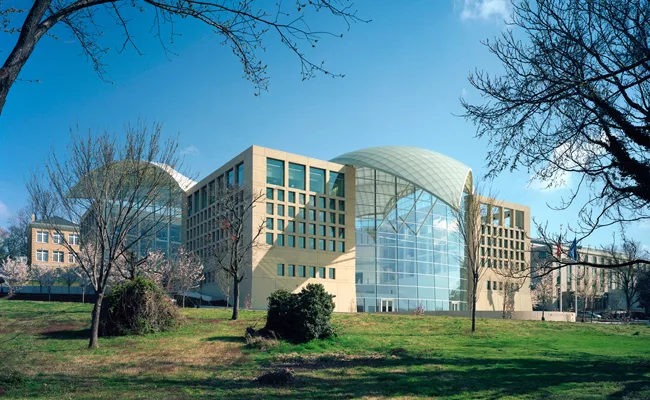
The southeast facade is the public entrance to the Peace Institute.
 
Photo © Timothy Hursley
The United States Institute of Peace
United States Institute of Peace
.
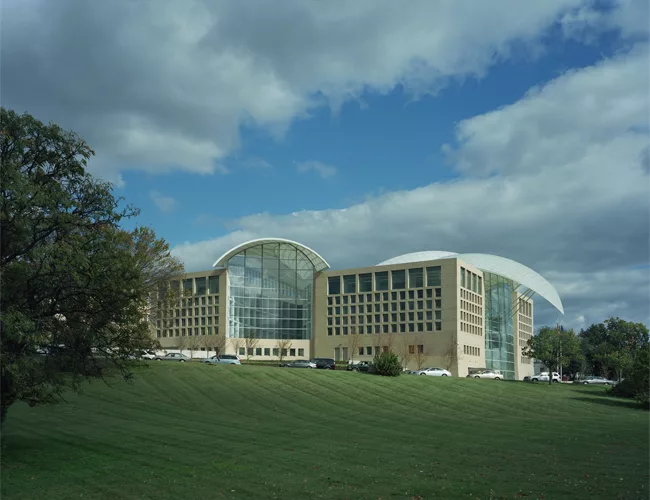
View of southwest facade.
 
Photo © Timothy Hursley
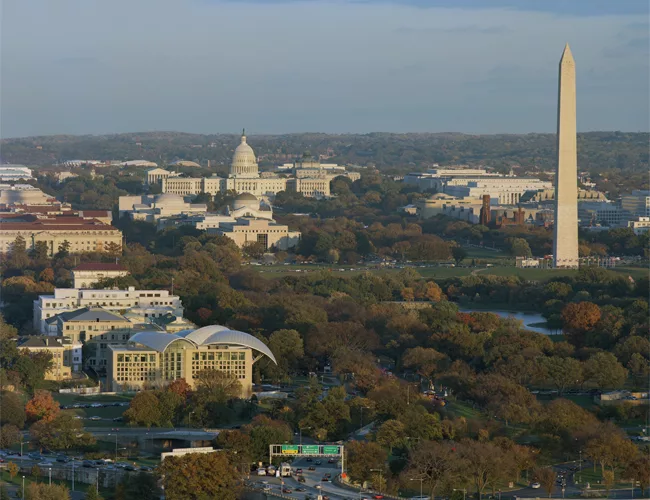
The United States Institute of Peace
United States Institute of Peace
 
View of the National Mall.
 
Photo © Timothy Hursley
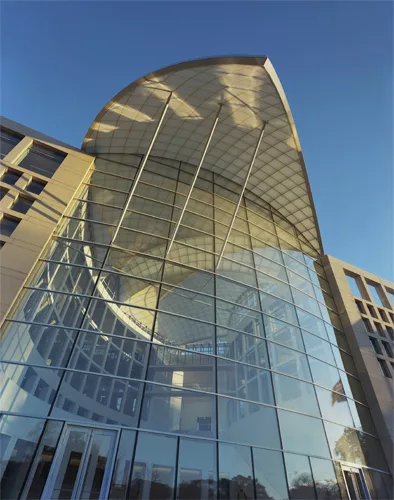
The United States Institute of Peace
United States Institute of Peace
 
View of south facade.
 
Photo © Timothy Hursley
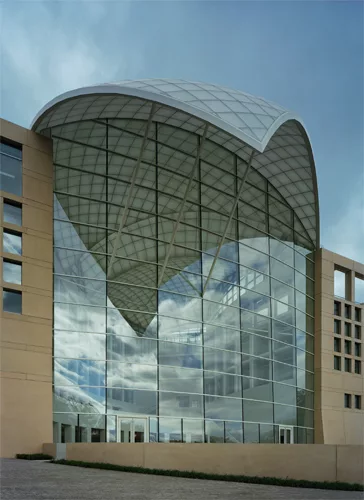
The United States Institute of Peace
United States Institute of Peace
 
View of south facade.
 
Photo © Timothy Hursley
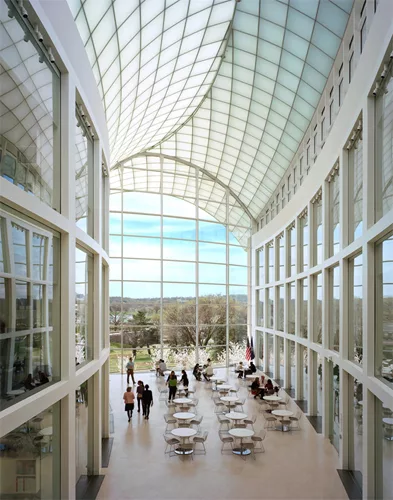
The United States Institute of Peace
United States Institute of Peace
 
The smaller of two, this atrium, lined with window-walled offices, faces the Potomac River and is a more secluded gathering space for institute employees.
 
Photo © Timothy Hursley
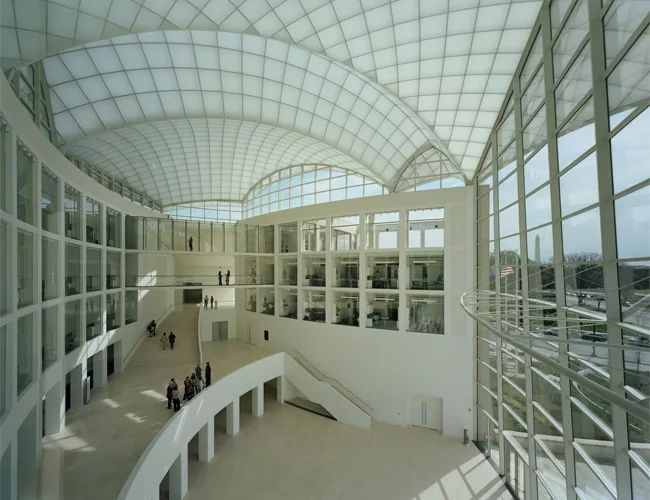
The United States Institute of Peace
United States Institute of Peace
 
Lobby.
 
Photo © Timothy Hursley
The United States Institute of Peace
October 25, 2011

Architects & Firms

Safdie Architects
Moshe Safdie was nibbling crab cakes in the recently completed, 150,000-square-foot glass-and-concrete headquarters he designed for the United States Institute of Peace in Washington, D.C. It was a silver October day, and lunch was served in a boardroom overlooking the Lincoln Memorial, Washington Monument, and Capitol building. “These are great views,” Safdie noted, “and we made the most of them.”
 
The commanding 73-year-old architect had just finished leading a tour of the institute, which had, indeed, scored prime real estate: the last buildable site available on the National Mall—a former parking lot on the northwest corner. Capitalizing on the surroundings, Safdie conceived a building with atria and offices filled with light, thanks to glass curtain walls and a billowing roof made of 1,482 glass panels.
 
Created by Congress in 1984, the institute is a nonpartisan organization whose mission is to help prevent and resolve international violent conflicts. For years, its roughly 325 employees worked in rented space in a nondescript office building, with no common area where they could host dignitaries and other visitors.
 
In 2001, the institute launched a design competition for a new headquarters. In December of that year, it awarded the commission to Safdie, who beat out four other finalists: Pelli Clarke Pelli Architects, Michael Graves and Associates, Polshek Partnership (now Ennead Architects), and Weiss/Manfredi (which withdrew). Prior to the call for entries, Safdie had never heard of the institute. “I couldn’t figure out how such an important institution was not a known quantity,” he says. The organization’s president, Richard H. Solomon, says Safdie’s scheme was chosen because the other proposals “were basically square buildings.”
 
Safdie’s five-story structure is blocky in shape, but it is topped by a sculptural roof whose two pointed wings cantilever over the heavy massing of the acid-etched precast-concrete building. In conceiving the roof, Safdie began with a series of fluid forms, “like a flock of birds,” but the end result evokes a geometric sketch of a single bird’s outstretched wings. Safdie says he’s “not one who believes in overt symbolism,” yet it’s hard not to think of doves, the symbol of peace, when gazing at the roof. The 8-inch-thick roof consists of layers of glass set in a steel tube grid.
 
In addition to creating a pleasant workplace, Safdie wanted to entice the public to wander into the new building. To achieve this he inserted two large atria. One faces the Lincoln Memorial, with an entrance on busy Constitution Avenue. Offices overlook the atrium through window-walls and, in turn, allow visitors glimpses of the inner workings of the institute. A smaller atrium, with an employee entry on Twenty-Third Street, looks toward the Potomac River. Again, glazed rooms overlook the space; at ground level, employees can be seen sitting at patio tables.
 
The headquarters also includes a 20,000-square-foot Global Peacebuilding Center, a new public education initiative containing touch-screen kiosks, a resource center, and classrooms. It will be completed over the next few years.
 
Phase one of the $186 million institute was finished in October, less than three years after construction began. A grand opening is set for later this year.
 
Safdie has been busy. He has three other projects finishing up this fall: the Kauffman Center for the Performing Arts in Kansas City, Missouri; the Crystal Bridges Museum of American Art in Bentonville, Arkansas (read our recent coverage); and the Khalsa Heritage Centre in Anandpur Sahib, India. The institute, despite its prominent location, hasn’t received the same anticipatory fanfare as Crystal Bridges, funded by Walmart heiress Alice Walton. Compared to Crystal Bridges’ eight pavilions set around two ponds, the institute seems less contrived.
 
The roof is the building’s big symbolic gesture—and Safdie agonized over it. For those who work inside the light-filled building, his angst paid off. (During the recent tour, Robin Wright, an institute fellow and author of the new book Rock the Casbah, gushed to Safdie, “I love your building. You bring me closer to God.”) For those who never wander indoors, however, the exterior seems too referential to the heavy classicism of its monumental neighbors. It leaves one wishing Safdie had focused on more than the building’s ethereal crown.

Share This Story

Looking for a reprint of this article?
From high-res PDFs to custom plaques, order your copy today!


Lr
Laura Raskin, a former RECORD editor, writes about architecture. She recently moved with her family from Brooklyn, New York, to the Green Mountains of Vermont.

Post a comment to this article

Report Abusive Comment

Subscription Center
  • Create an Account
  • Start a Subscription
  • Manage My Account
  • Sign Up for Newsletters
  • Visit Customer Service
  • Update Preferences

More Videos

Sponsored Content

Sponsored Content is a special paid section where industry companies provide high quality, objective, non-commercial content around topics of interest to the Architectural Record audience. All Sponsored Content is supplied by the advertising company and any opinions expressed in this article are those of the author and not necessarily reflect the views of Architectural Record or its parent company, BNP Media. Interested in participating in our Sponsored Content section? Contact your local rep!

close
  • TAMLYN XtremeTrim Exterior Trim
    Sponsored byTamlyn

    Designing Cleaner Panel Facades: Why Exterior Trim Details Matter

  • Building with Vapor Barriers
    Sponsored byReef Industries, Inc.

    Vapor Barriers Help Control Moisture in Tighter Building Designs

  • Duct Interior with Prodeq System
    Sponsored byHenry, a Carlisle Company

    Designing Resilient Water Containment Systems

DESIGN:ED Podcast
Listen to Architectural Record’s DESIGN:ED Podcast

Events

June 10, 2026

Rethinking Stormwater – The Power of Porous Paving

Credits: 1 AIA LU/HSW; 1 AIBD P-CE; 0.1 ICC CEU

Learn how porous paving systems support stormwater management, reduce heat island effects, and enhance sustainable site design performance.

June 11, 2026

Very Early Warning Fire Detection for Mission-Critical Facilities

Credits: 1 AIA LU/HSW; 1 AIBD P-CE; 0.1 ICC CEU

Examine advanced fire detection strategies that support uptime and enhance safety in data centers and other mission-critical facilities.

View All Submit An Event

Products

2026 Architect's Square Foot Costbook

2026 Architect's Square Foot Costbook

See More Products

Popular Stories

Practice Matters illustration

What’s in a (Firm’s) Name? Thinking About Succession and Legacy

Practice Matters illustration

By the Numbers: Counting America's Architects

Riverdale House by Studio Lau

Riverdale House by Studio Lau

House on a Hill

Design Vanguard 2026: Forma

Crane Cove, ONO

Design Vanguard 2026 Winners

Broader Sustainability of CMU - Free Webinar - May 21, 2026

Related Articles

  • A+D Museum Finally Lands a Permanent Home

    See More
  • Lynching Memorial Montgomery Alabama

    National Memorial for Peace and Justice Offers Powerful, Haunting Experience

    See More
  • Rendering of Aluminaire House in Palm Springs

    Aluminaire House Finds Permanent Home at Palm Springs Art Museum

    See More

Related Products

See More Products
  • 0470126736.gif

    Modern Sustainable Residential Design: A Guide for Design Professionals

  • 2025-BNi_HOME BUILDERS-CV.jpg

    BNi Building News Home Builders Costbook 2025 (Print Edition)

  • WC_-SCA.png

    Building Great Schools for a Great City

See More Products
×

The latest news and information

#1 Source for Architectural Design, News and Products

SUBSCRIBE
  • RESOURCES
    • Advertise
    • Contact Us
    • Submit
    • Store
  • ACCOUNT CENTER
    • Create an Account
    • Start a Subscription
    • Manage My Account
    • Sign Up for Newsletters
    • Visit Customer Service
    • Update Preferences
  • PRIVACY
    • PRIVACY POLICY
    • TERMS & CONDITIONS
    • DO NOT SELL MY PERSONAL INFORMATION
    • PRIVACY REQUEST
    • ACCESSIBILITY
  • SERVICES
    • Marketing Services
    • Reprints
    • Market Research
    • List Rental
    • Survey/Respondent Access
  • STAY CONNECTED
    • Linkedin
    • Facebook
    • Instagram
    • YouTube
    • X (Twitter)

Copyright ©2026. All Rights Reserved BNP Media, Inc. and BNP Media II, LLC.

Design, CMS, Hosting & Web Development :: ePublishing