Architectural Record
search
cart
facebook twitter linkedin youtube
  • Sign In
  • Subscribe
  • Sign Out
  • My Account
Architectural Record
  • NEWS
    • Latest News
    • Awards
    • Interviews
    • Obituaries
    • Podcasts
      • Design:Ed Podcast
      • Sponsored Podcasts
  • OPINION
    • Book Reviews / Excerpts
    • Exhibition Reviews
    • Forum
  • EXCLUSIVES
    • Videos
    • Design Vanguard
    • Top 300 Firms
    • Sponsored Content
    • Sponsored eBooks
    • From the Archives
  • CONTINUING ED
    • Editorial Continuing Ed
    • CE Center
    • CE Academies
  • PROJECTS
    • Buildings By Type
    • Reuse & Renovation
    • Museums & Arts Centers
    • Colleges & Universities
    • Multifamily Housing
    • Interiors
    • Lighting
    • Kitchen & Bath
  • HOUSES
    • Record Houses
    • House of the Month
    • Featured Houses
  • PRODUCTS
    • Products by Category
    • Record Products of the Year
    • Latest Products
  • EVENTS
    • Dates & Events
    • Record on the Road
    • Innovation Conference
    • Sustainability in Practice
    • Women In Architecture
    • Webinars
    • Ad Excellence Awards
    • Submit an Event
  • CONNECT
    • Ask RECORD AI
    • Newsletters
    • Contact
    • Advertise
    • Editorial Calendar
    • Store
    • Customer Service
  • SUBMIT
    • Submission Guidelines
    • RECORD Competitions
  • MAGAZINE
    • Subscribe
    • My Account
    • Digital Edition
    • Current Issue
    • Firm Pass
    • Historic Archive
Architecture News

Ambitious Energy Goals in SOM Plan for NYC Campus

By Fred A. Bernstein
Ambitious Energy Goals in SOM Plan for NYC Campus


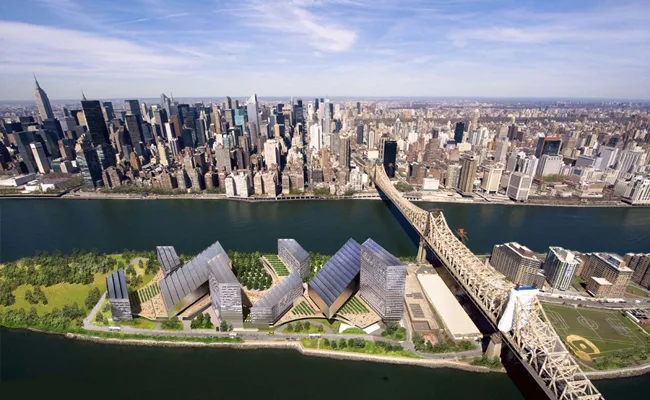
Cornell University topped the competition to build a new tech campus with an SOM design that aims to generate more energy than it uses.
Image courtesy SOM
Ambitious Energy Goals in SOM Plan for NYC Campus
Cornell University topped the competition to build a new tech campus with an SOM design that aims to generate more energy than it uses.
Image courtesy SOM
Ambitious Energy Goals in SOM Plan for NYC Campus
Cornell University topped the competition to build a new tech campus with an SOM design that aims to generate more energy than it uses.
Image courtesy SOM
Ambitious Energy Goals in SOM Plan for NYC Campus
Cornell University topped the competition to build a new tech campus with an SOM design that aims to generate more energy than it uses.
Image courtesy SOM
Ambitious Energy Goals in SOM Plan for NYC Campus
Cornell University topped the competition to build a new tech campus with an SOM design that aims to generate more energy than it uses.
Image courtesy SOM
Ambitious Energy Goals in SOM Plan for NYC Campus
January 9, 2012

Cornell University topped the competition to build a new tech campus with an SOM design that aims to generate more energy than it uses.

Click on the slide show button to view additional images.

When New York City named Cornell University and The Technion-Israel Institute of Technology winners of its highly touted competition for a new “tech campus,” there were cheers in Ithaca and Haifa. Also celebrating were architects in the New York office of Skidmore Owings and Merrill, whose design for the campus, on the south end of Roosevelt Island, were part of Cornell and Technion’s proposal. Among the revelers was Roger Duffy, the partner who has been building the firm’s education practice since the 1990s. Duffy’s current projects include a project for the New School, at 14th Street and Fifth Avenue in Manhattan, and P.S. 62, a public school on Staten Island that, if all goes according to plan, will be the one of the largest “net zero” buildings in the United States.

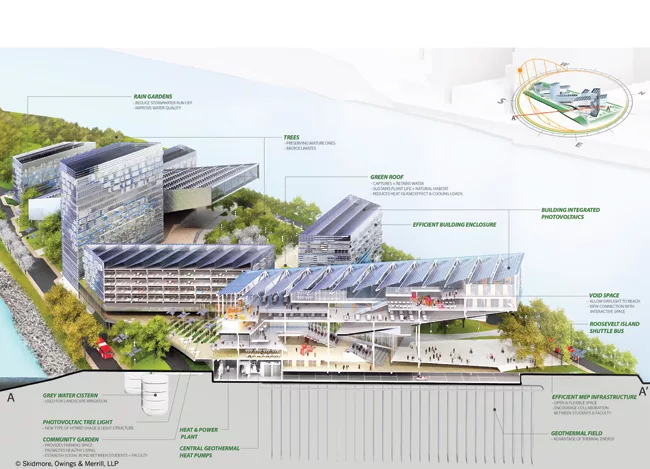
Now Duffy is making a much bigger promise: If Cornell and Technion follow through with SOM’s winning plan, the 400,000-square-foot first phase of the tech campus will also create as much energy as it uses. A solar array that will generate 1.8 megawatts at daily peak and a four-acre “deep earth” geothermal well field will provide heating and cooling and will also recharge fuel cells. According to Duffy, who tends to speak grandly—but in this reporter’s experience, delivers what he promises—the need to produce, and conserve, energy will affect every aspect of the design, with strictly formal considerations giving way to what he calls “a new aesethetic” of sustainability.

Renderings released by SOM show eight silver-colored buildings arranged in a zigzag pattern on the south end of the island where a complex of hospital facilities currently stands. SOM’s buildings, which are meant to foster “impromptu meetings that lead to innovation,” Duffy says, will have large interior courtyards and will be linked by above-ground walkways. The firm’s history with such walkways has not been entirely positive. Back in the mid-1960s Walter Netsch of SOM's Chicago office designed the new campus for the University of Illinois Chicago Circle, which was hailed in part for its extensive system of elevated pedestrian walkways. Thirty years later, the walkways, widely seen as a disaster, were torn down.

Duffy knows that history but says his walkways will be totally different from what he called “Netsch’s rabbit warren.” Colin Koop, who headed the project team under Duffy, says they will be generous public spaces, positioned to become main circulation routes, and programmed with cafes and other amenities to keep them populated. The outdoor walkways, and surrounding park, which were designed in collaboration with James Corner Field Operations, are expected to be open to the public.

When the competition was under way this fall, the SOM/Corner team presented its design to representatives of the Economic Development Corporation and then of the City Planning Commission. So did architects for Cornell/Technion’s competitors, including Ennead, on behalf of Stanford University (which later dropped out of the competition). Still, it’s hard to know how much of a factor architecture was in the city’s choice of Cornell/Technion, given the Bloomberg Administration’s extensive focus on finances. And it isn’t yet known if SOM will design the project and its component buildings (intended to total 2 million square feet by 2043). Though there has been speculation that the university could snub SOM and select a firm with ties to its own architecture school, Cornell would risk delays—as well as blows to its reputation—if it abandoned the architects that helped it win the competition. So far, SOM has begun the land use review stage of the plan, but future phases are still up in the air.

What is clear is that this is a big opportunity for Roosevelt Island. Long home to an asylum and then a smallpox hospital, it was known as Welfare Island until 1973, when the name was changed to attract residents to new apartment buildings (built in accordance with a 1969 master plan by Philip Johnson and John Burgee). In 1989, a subway station opened on the island, dramatically improving access. Now, a monument to Franklin D. Roosevelt, designed by Louis Kahn in the 1970s, is being realized by Mitchell/Giurgola Architects on the island’s southern tip. According to Duffy, the campus he envisions will not overwhelm, but will provide a “great prelude,” to Kahn’s memorial.

Looking for quick answers on architecture and design topics?
Try Ask RECORD, our new smart AI search tool.
Ask RECORD →

Share This Story

Looking for a reprint of this article?
From high-res PDFs to custom plaques, order your copy today!

Fred Bernstein studied architecture at Princeton and law at NYU and writes about both subjects.

Post a comment to this article

Report Abusive Comment

Subscription Center
  • Create an Account
  • Start a Subscription
  • Manage My Account
  • Sign Up for Newsletters
  • Visit Customer Service
  • Update Preferences

More Videos

Sponsored Content

Sponsored Content is a special paid section where industry companies provide high quality, objective, non-commercial content around topics of interest to the Architectural Record audience. All Sponsored Content is supplied by the advertising company and any opinions expressed in this article are those of the author and not necessarily reflect the views of Architectural Record or its parent company, BNP Media. Interested in participating in our Sponsored Content section? Contact your local rep!

close
  • TAMLYN XtremeTrim Exterior Trim
    Sponsored byTamlyn

    Designing Cleaner Panel Facades: Why Exterior Trim Details Matter

  • Building with Vapor Barriers
    Sponsored byReef Industries, Inc.

    Vapor Barriers Help Control Moisture in Tighter Building Designs

  • Duct Interior with Prodeq System
    Sponsored byHenry, a Carlisle Company

    Designing Resilient Water Containment Systems

DESIGN:ED Podcast
Listen to Architectural Record’s DESIGN:ED Podcast

Events

June 10, 2026

Rethinking Stormwater – The Power of Porous Paving

Credits: 1 AIA LU/HSW; 1 AIBD P-CE; 0.1 ICC CEU

Learn how porous paving systems support stormwater management, reduce heat island effects, and enhance sustainable site design performance.

June 11, 2026

Very Early Warning Fire Detection for Mission-Critical Facilities

Credits: 1 AIA LU/HSW; 1 AIBD P-CE; 0.1 ICC CEU

Examine advanced fire detection strategies that support uptime and enhance safety in data centers and other mission-critical facilities.

View All Submit An Event

Products

2026 Architect's Square Foot Costbook

2026 Architect's Square Foot Costbook

See More Products

Popular Stories

Coronado Bridge

The Architect’s Guide to San Diego

Practice Matters illustration

What’s in a (Firm’s) Name? Thinking About Succession and Legacy

Practice Matters illustration

By the Numbers: Counting America's Architects

Inward House

Inward House by VeeV Design Studio

Riverdale House by Studio Lau

Riverdale House by Studio Lau

Broader Sustainability of CMU - Free Webinar - May 21, 2026

Related Articles

  • SOM Plan for New UAE-Backed Egyptian Capital Sparks Controversy and Questions

    See More
  • SOM to Compete With Top Firms to Design Buildings for New Cornell Campus

    See More
  • Piano, SOM's Columbia Plan Stirs Controversy

    See More
×

The latest news and information

#1 Source for Architectural Design, News and Products

SUBSCRIBE
  • RESOURCES
    • Advertise
    • Contact Us
    • Submit
    • Store
  • ACCOUNT CENTER
    • Create an Account
    • Start a Subscription
    • Manage My Account
    • Sign Up for Newsletters
    • Visit Customer Service
    • Update Preferences
  • PRIVACY
    • PRIVACY POLICY
    • TERMS & CONDITIONS
    • DO NOT SELL MY PERSONAL INFORMATION
    • PRIVACY REQUEST
    • ACCESSIBILITY
  • SERVICES
    • Marketing Services
    • Reprints
    • Market Research
    • List Rental
    • Survey/Respondent Access
  • STAY CONNECTED
    • Linkedin
    • Facebook
    • Instagram
    • YouTube
    • X (Twitter)

Copyright ©2026. All Rights Reserved BNP Media, Inc. and BNP Media II, LLC.

Design, CMS, Hosting & Web Development :: ePublishing