Architectural Record
search
cart
facebook twitter linkedin youtube
  • Sign In
  • Subscribe
  • Sign Out
  • My Account
Architectural Record
  • NEWS
    • Latest News
    • Awards
    • Interviews
    • Obituaries
    • Podcasts
      • Design:Ed Podcast
      • Sponsored Podcasts
  • OPINION
    • Book Reviews / Excerpts
    • Exhibition Reviews
    • Forum
  • EXCLUSIVES
    • Videos
    • Design Vanguard
    • Top 300 Firms
    • Sponsored Content
    • Sponsored eBooks
    • From the Archives
  • CONTINUING ED
    • Editorial Continuing Ed
    • CE Center
    • CE Academies
  • PROJECTS
    • Buildings By Type
    • Reuse & Renovation
    • Museums & Arts Centers
    • Colleges & Universities
    • Multifamily Housing
    • Interiors
    • Lighting
    • Kitchen & Bath
  • HOUSES
    • Record Houses
    • House of the Month
    • Featured Houses
  • PRODUCTS
    • Products by Category
    • Record Products of the Year
    • Latest Products
  • EVENTS
    • Dates & Events
    • Record on the Road
    • Innovation Conference
    • Sustainability in Practice
    • Women In Architecture
    • Webinars
    • Ad Excellence Awards
    • Submit an Event
  • CONNECT
    • Ask RECORD AI
    • Newsletters
    • Contact
    • Advertise
    • Editorial Calendar
    • Store
    • Customer Service
  • SUBMIT
    • Submission Guidelines
    • RECORD Competitions
  • MAGAZINE
    • Subscribe
    • My Account
    • Digital Edition
    • Current Issue
    • Firm Pass
    • Historic Archive
Architecture News

"Foreclosed" Reopens the American Dream

By Fred A. Bernstein
Rendering of MOS's <em>Thoughts on a Walking City</em> project for Orange, New Jersey.
Rendering of MOS's Thoughts on a Walking City project for Orange, New Jersey.
Image courtesy MOS
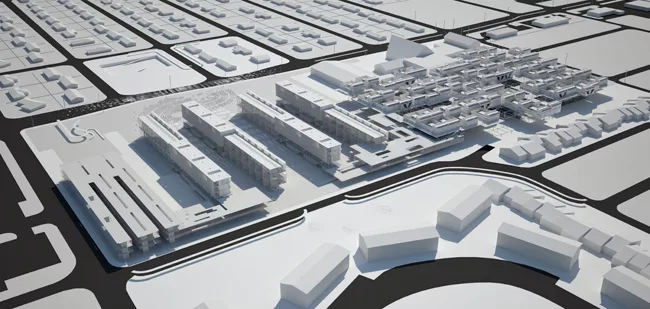
Architectural model, plan view, for MOS's <em>Thoughts on a Walking City</em> project for Orange, New Jersey.
Architectural model, plan view, for MOS's Thoughts on a Walking City project for Orange, New Jersey.
Photo courtesy of Communities by Design
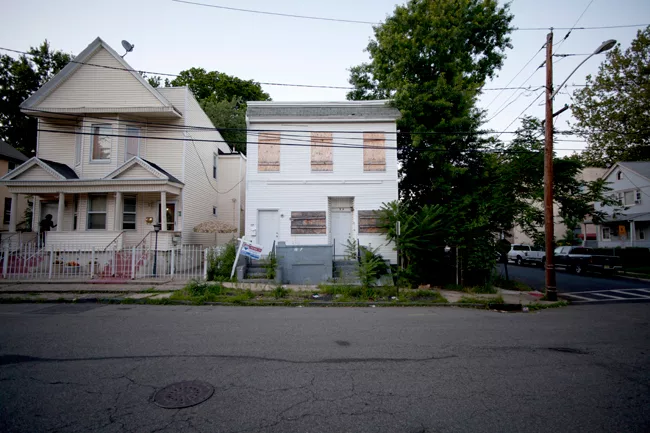
Street view of residences in Orange, New Jersey (the area assigned to MOS).
Photo courtesy MOS Architects
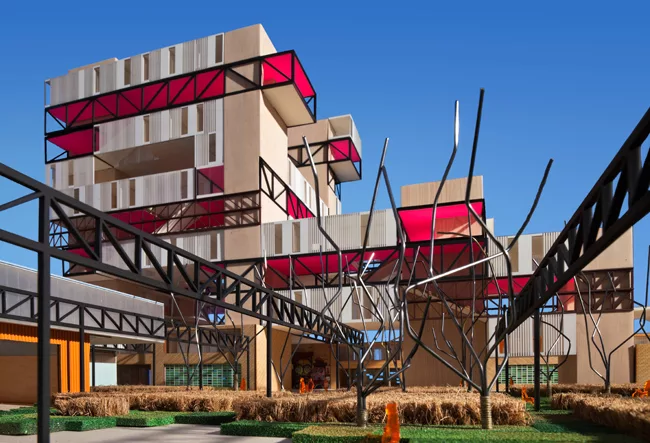
Architectural model for Studio Gang Architects' <em>The Garden in the Machine</em> project for Cicero, Illinois.
Architectural model for Studio Gang Architects' The Garden in the Machine project for Cicero, Illinois.
Photo © James Ewing
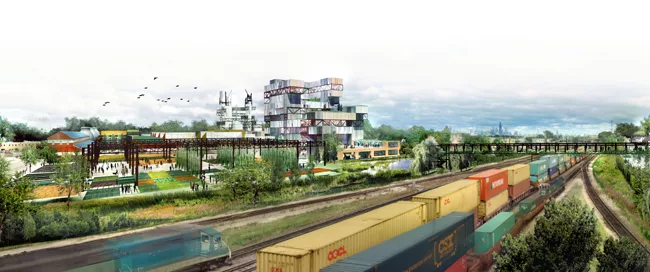
Rendering of Studio Gang Architects' <em>The Garden in the Machine</em> project for Cicero, Illinois.
Rendering of Studio Gang Architects' The Garden in the Machine project for Cicero, Illinois.
Image courtesy Studio Gang Architects
Architectural model, plan view, for Visible Weather's <em>Simultaneous City</em> project for Temple Terrace, Florida.
Architectural model, plan view, for Visible Weather's Simultaneous City project for Temple Terrace, Florida.
Photo © James Ewing
Rendering of Visible Weather's <em>Simultaneous City</em> project for Temple Terrace, Florida.
Rendering of Visible Weather's Simultaneous City project for Temple Terrace, Florida.
Photo courtesy Visible Weather
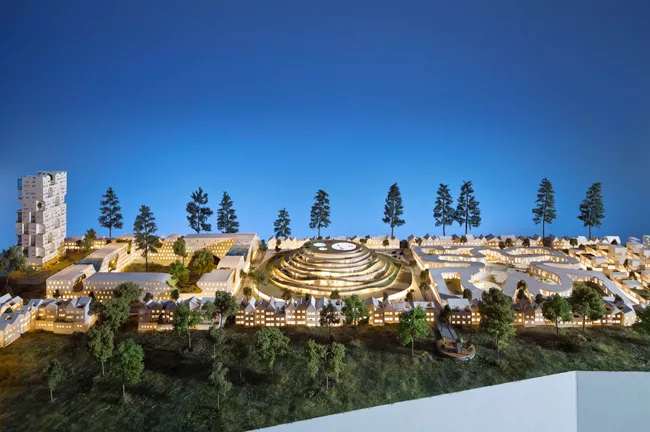
Architectural model for WORKac's <em>Nature-City</em> project for Keizer, Oregon.
Architectural model for WORKac's Nature-City project for Keizer, Oregon.
Photo © James Ewing
Rendering of WORKac's <em>Nature-City</em> for Keizer, Oregon.
Rendering of WORKac's Nature-City for Keizer, Oregon.
Image courtesy WORKac
Architectural model for Zago Architecture's <em>Property with Properties</em> project for Rialto, California.
Architectural model for Zago Architecture's Property with Properties project for Rialto, California.
Photo © James Ewing
Still from <em>View of Life in the New Development</em>, an animation produced as part of Zago Architecture's <em>Property with Properties</em> project.
Still from View of Life in the New Development, an animation produced as part of Zago Architecture's Property with Properties project.
Image courtesy Zago Architecture
Andrew Zago of Zago Architecture presents at the <em>Foreclosed: Rehousing the American Dream Open Studios</em> at P.S.1 in 2011.
Andrew Zago of Zago Architecture presents at the Foreclosed: Rehousing the American Dream Open Studios at P.S.1 in 2011.
Photo by Don Pollard/© The Museum of Modern Art
Jeanne Gang of Studio Gang Architects presents at the <em>Foreclosed: Rehousing the American Dream Open Studios</em> at P.S.1 in 2011.
Jeanne Gang of Studio Gang Architects presents at the Foreclosed: Rehousing the American Dream Open Studios at P.S.1 in 2011.
Photo by Don Pollard/© The Museum of Modern Art
Michael Bell of Michael Bell, Eunjeong Seong: Visible Weather presents at the <em>Foreclosed: Rehousing the American Dream Open Studios</em> at MoMA affiliate P.S.1 in 2011.
Michael Bell of Michael Bell, Eunjeong Seong: Visible Weather presents at the Foreclosed: Rehousing the American Dream Open Studios at MoMA affiliate P.S.1 in 2011.
Photo by Don Pollard/© The Museum of Modern Art
Michael Meredith and Hilary Sample of MOS Architects present at the <em>Foreclosed: Rehousing the American Dream Open Studios</em> at MoMA affiliate P.S.1 in 2011.
Michael Meredith and Hilary Sample of MOS Architects present at the Foreclosed: Rehousing the American Dream Open Studios at MoMA affiliate P.S.1 in 2011.
Photo by Don Pollard/© The Museum of Modern Art
Sam Dufaux of WORKac presents at the <em>Foreclosed: Rehousing the American Dream Open Studios</em> at MoMA affiliate P.S.1 in 2011.
Sam Dufaux of WORKac presents at the Foreclosed: Rehousing the American Dream Open Studios at MoMA affiliate P.S.1 in 2011.
Photo by Don Pollard/© The Museum of Modern Art
Rendering of MOS's <em>Thoughts on a Walking City</em> project for Orange, New Jersey.
Architectural model, plan view, for MOS's <em>Thoughts on a Walking City</em> project for Orange, New Jersey.
Street view of residences in Orange, New Jersey (the area assigned to MOS).
Architectural model for Studio Gang Architects' <em>The Garden in the Machine</em> project for Cicero, Illinois.
Rendering of Studio Gang Architects' <em>The Garden in the Machine</em> project for Cicero, Illinois.
Architectural model, plan view, for Visible Weather's <em>Simultaneous City</em> project for Temple Terrace, Florida.
Rendering of Visible Weather's <em>Simultaneous City</em> project for Temple Terrace, Florida.
Architectural model for WORKac's <em>Nature-City</em> project for Keizer, Oregon.
Rendering of WORKac's <em>Nature-City</em> for Keizer, Oregon.
Architectural model for Zago Architecture's <em>Property with Properties</em> project for Rialto, California.
Still from <em>View of Life in the New Development</em>, an animation produced as part of Zago Architecture's <em>Property with Properties</em> project.
Andrew Zago of Zago Architecture presents at the <em>Foreclosed: Rehousing the American Dream Open Studios</em> at P.S.1 in 2011.
Jeanne Gang of Studio Gang Architects presents at the <em>Foreclosed: Rehousing the American Dream Open Studios</em> at P.S.1 in 2011.
Michael Bell of Michael Bell, Eunjeong Seong: Visible Weather presents at the <em>Foreclosed: Rehousing the American Dream Open Studios</em> at MoMA affiliate P.S.1 in 2011.
Michael Meredith and Hilary Sample of MOS Architects present at the <em>Foreclosed: Rehousing the American Dream Open Studios</em> at MoMA affiliate P.S.1 in 2011.
Sam Dufaux of WORKac presents at the <em>Foreclosed: Rehousing the American Dream Open Studios</em> at MoMA affiliate P.S.1 in 2011.
February 13, 2012

At New York's Museum of Modern Art, Foreclosed: Rehousing the American Dream proposes five solutions to the disconnect between the housing Americans need and the housing America offers.

Rendering of Studio Gang Architects’ The Garden in the Machine project for Cicero, Illinois. Click on the slide show button to view additional images.

Michael Meredith and Hilary Sample of MOS Architects present at the Foreclosed: Rehousing the American Dream Open Studios at P.S.1 in 2011.

At 2,500 square feet, The Museum of Modern Art’s Robert and Joyce Menschel Gallery, site of the exhibition Foreclosed: Rehousing the American Dream, is about the size of the average suburban house. But while that may be too much square footage for the typical family, it is too little for a show this rich. MoMA should consider rehousing “Rehousing.”

The theme of the show, which opens February 15 and runs through July 30, is the disconnect between the housing Americans need and the housing America offers. It opens with an installation by Estudio Teddy Cruz on the absurdities of the McMansion. From there, it turns to presenting new options for America’s inner-ring suburbs, overlooked by developers and abandoned by the affluent for more urban, or more rural, locations.

Foreclosed had its origins in a research project initiated by Reinhold Martin in 2009. Martin, who directs the Temple Hoyne Buell Center for the Study of American Architecture at Columbia University, wondered whether the foreclosure crisis could have a silver lining, by giving Americans reason to rethink one of the most impractical (and wasteful) aspects of the American dream. That, he argued, could lead to the proliferation of new housing types that blur lines between public and private spaces. With Anna Kenoff and Leah Meisterlin, he produced a book, the Buell Hypothesis, last year.

Barry Bergdoll, MoMA’s chief curator of architecture and design, saw an opportunity to test the hypothesis and at the same time create another exhibition in his series of issue-oriented architecture shows. (The last was Small Scale, Big Change: New Architectures of Social Engagement in 2010.) He and Martin commissioned five architecture firms to tackle the problems of specific suburbs identified in the “Hypothesis” as crying out for reinvention. The architects assembled teams that included not just the usual suspects (landscape architects, structural engineers) but also economists, community activists, journalists, climate scientists, and in one case, advertising gurus, who created TV commercials for a reinvented suburb outside Portland.

That proposal is by Amale Andraos and Dan Wood of WORKac, for a section of Keizer, Oregon that would be five times as dense as neighboring suburbs, but with three times as much open space. A gorgeous, dome-shaped structure contains a community composting plant. Around it are buildings that recall the best work of Steven Holl, Bjarke Ingels, and MVRDV. One imagines a developer seeing Andraos and Wood’s elaborate 1:250 model, depicting a gently futuristic suburb, and wanting to break ground tomorrow.

The other star of the exhibition is Jeanne Gang, the Chicago architect. She and her teammates tackled the problems of Cicero, an older Chicago suburb that is filled with rotting industrial facilities but not the kind of housing needed by its large immigrant population. They decided to play to Cicero’s strengths, as what Gang calls an “arrival city,” by creating modular housing that can go up or down in size as families evolve. They also reclaimed industrial facilities as gardens and, like most of the teams, came up with an unconventional financing scheme. Like the very different WORKac proposal, Gang’s Cicero proposal seems practically shovel-ready, even though, as she pointed out in a New York Times op-ed, it remains illegal under Chicago’s zoning code.

The most provocative idea in the show may belong to MOS—the firm headed by Michael Meredith and Hilary Sample—which focuses on East Orange, New Jersey. The plan acknowledges the lack of pedestrian life in today’s suburbs and reclaims the streets themselves as building sites. That allows increased density without the need to demolish existing housing. But if the idea is strong, details, of what the “ribbon” buildings” would look like and how they would function, are sparse.

Less developed is the plan by Michael Bell and Eunjeong Song to revamp parts of Temple Terrace, Florida, near Tampa. The models and renderings are colorless—if the goal was to avoid tropical clichés, the architects succeeded. Andrew Zago went to the other extreme, covering the houses in his proposed development (part of Rialto, California) in patterning so bold, it recalls the work of Ettore Sottsass at the giddy height of Memphis. One extraordinary rendering appears to have been printed out of register (so that colors overlap in unexpected ways), symbolizing the desired blurring of lines between public and private property.

The Buell Hypothesis—that the American dream is big enough to encompass more than one housing paradigm—gets a big boost from MoMA. One leaves the show with newfound optimism about what architecture can do. As Wood put it in an interview with this writer, “Somehow the American dream became about houses in the suburbs. That’s not the real American dream—the real American dream is about imagining a better future.”

Share This Story

Looking for a reprint of this article?
From high-res PDFs to custom plaques, order your copy today!
Fred Bernstein studied architecture at Princeton and law at NYU and writes about both subjects.

Post a comment to this article

Report Abusive Comment

Subscription Center
  • Create an Account
  • Start a Subscription
  • Manage My Account
  • Sign Up for Newsletters
  • Visit Customer Service
  • Update Preferences

More Videos

Sponsored Content

Sponsored Content is a special paid section where industry companies provide high quality, objective, non-commercial content around topics of interest to the Architectural Record audience. All Sponsored Content is supplied by the advertising company and any opinions expressed in this article are those of the author and not necessarily reflect the views of Architectural Record or its parent company, BNP Media. Interested in participating in our Sponsored Content section? Contact your local rep!

close
  • cold storage facility
    Sponsored byCarlisle SynTec Systems

    How Architects Can Design More Continuous Cold Storage Envelopes

  • TAMLYN XtremeTrim Exterior Trim
    Sponsored byTamlyn

    Designing Cleaner Panel Facades: Why Exterior Trim Details Matter

  • Building with Vapor Barriers
    Sponsored byReef Industries, Inc.

    Vapor Barriers Help Control Moisture in Tighter Building Designs

DESIGN:ED Podcast
Listen to Architectural Record’s DESIGN:ED Podcast

Events

June 23, 2026

Enhancing Fire Resistance with Advanced PVC Solutions

Credits: 1 AIA LU/HSW; 1 AIBD P-CE; 0.1 ICC CEU; 1 IIBEC CEH

Evaluate advanced PVC solutions that improve fire resistance, support WUI compliance, and enhance resilience in residential and commercial building design.

June 25, 2026

Designing Glass Railing Systems that Enhance Aesthetics and Meet Code

Credits: 1 AIA LU/HSW; 1 AIBD P-CE; 0.1 ICC CEU

Upon course completion, participants will possess a deeper understanding of glass railings to help ensure that safety, aesthetic, and performance objectives are achieved.

View All Submit An Event

Products

2026 Architect's Square Foot Costbook

2026 Architect's Square Foot Costbook

See More Products

Popular Stories

SanDiegoAirport

Top 300 Architecture Firms of 2026

Lorcan O' Herilhy

California Architect Lorcan O’Herlihy Has Died, Age 66

CCA, Studio Gang

The Winners of the AIA’s 2026 Architecture Award Range from Collegiate Rowing Hubs to Housing for the Homeless

Spoonbill Ranch

Johnsen Schmaling Architects Integrates Spoonbill Ranch into a Pristine Landscape

Obama Presidential Center, Chicago

The Obama Presidential Center Opens on Chicago’s South Side

Enhancing Fire Resistance with Advanced PVC Solutions - Free Webinar - June 23, 2026

Related Articles

  • Reality Check: Developers React to MoMA's Show, 'Foreclosed: Rehousing the American Dream'

    See More
  • Minneapolis and the End of the American Dream House

    Minneapolis and the End of the American Dream House

    See More
  • Slide Show: Maynard L. Parker: Modern Photography and the American Dream

    See More

Related Products

See More Products
  • american arch.jpg

    American Architecture: An Illustrated Encyclopedia

See More Products
×

The latest news and information

#1 Source for Architectural Design, News and Products

SUBSCRIBE
  • RESOURCES
    • Advertise
    • Contact Us
    • Submit
    • Store
  • ACCOUNT CENTER
    • Create an Account
    • Start a Subscription
    • Manage My Account
    • Sign Up for Newsletters
    • Visit Customer Service
    • Update Preferences
  • PRIVACY
    • PRIVACY POLICY
    • TERMS & CONDITIONS
    • DO NOT SELL MY PERSONAL INFORMATION
    • PRIVACY REQUEST
    • ACCESSIBILITY
  • SERVICES
    • Marketing Services
    • Reprints
    • Market Research
    • List Rental
    • Survey/Respondent Access
  • STAY CONNECTED
    • Linkedin
    • Facebook
    • Instagram
    • YouTube
    • X (Twitter)

Copyright ©2026. All Rights Reserved BNP Media, Inc. and BNP Media II, LLC.

Design, CMS, Hosting & Web Development :: ePublishing