Fifty Years Later, Still Scandalizing the Neighbors
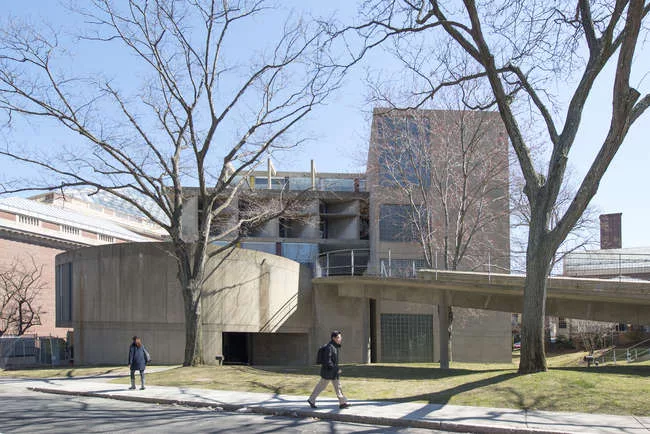
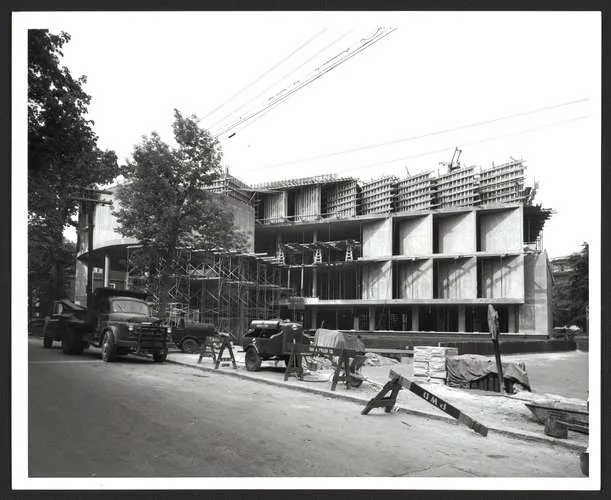
How fast the radical present becomes the historical past. This new-is-old transformation has struck again at Le Corbusier’s Carpenter Center for the Visual Arts at Harvard. The boldly sculpted reinforced-concrete building, the architect’s only realized project in North America and one of the final commissions before his death in 1965, turned 50 on May 28, two weeks before New York’s Museum of Modern Art would open its first major exhibition on the Swiss-born leader of the Modern movement. While time has proved the Carpenter Center’s worth and influence, it has underscored old shortcomings and bared new ones. To mark the anniversary, Harvard displayed fresh material that revealed the genesis of this utterly unconventional five-story structure.
“Dear Corbu,” the dean of Harvard’s Graduate School of Design (GSD), Josep Lluís Sert, wrote on January 23, 1957, urging his former employer to visit the United States. Harvard, Sert said, “can guarantee a grand reception; and from that there are chances that other things may develop.” That letter grew from a 1956 Harvard report on the visual arts and Sert’s desire to have Le Corbusier, fresh off the triumphant opening of Ronchamp chapel, fulfill the report’s vision of an innovative, interdisciplinary arts hub. The exchange led to a building that, for better and worse, presaged the global trend of “starchitecture.” With its slender pilotis, angled brises-soleil, and a diagonal pedestrian ramp that cleaved the structure and cracked open views onto flanking art studios and a wood shop, the Carpenter Center was unmistakably Le Corbusier’s. And that remains its strength and its weakness.
“It has been said that Le Corbusier’s buildings violate the street, and this one violates the street and scandalizes the neighborhood,” New York Times critic Ada Louise Huxtable wrote on May 28, 1963, the day of the building’s dedication. “At the same time, the new building manages to make everything around it look stolid and stale.”
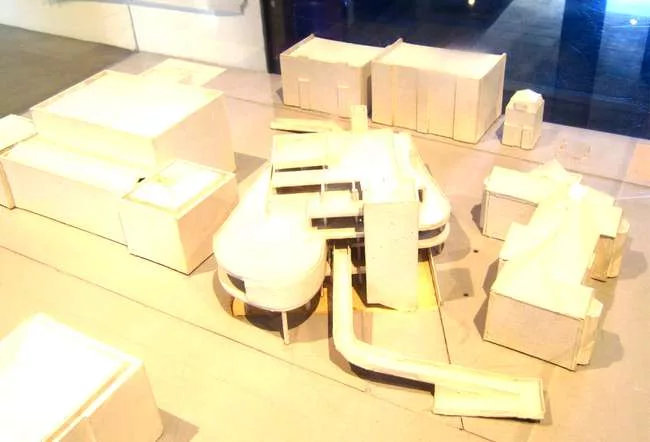
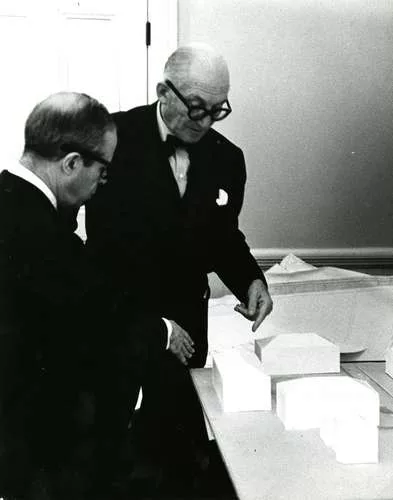
The center’s problematic presence has its roots in the conflict between a tight site just outside Harvard Yard and the building’s expansive program, which put painting, drawing, sculpture, exhibition space, film, and photography under a single roof. Concern over this tension surfaced early on, as we learn from a small but illuminating GSD show, VAC BOS (the architect’s shorthand for Visual Arts Center, Boston): The GSD and the Making of Le Corbusier’s Carpenter Center, curated by Peter Christensen, and on view through May 24 in the GSD's Loeb Library.
An August 31, 1960, letter from Sert warned Le Corbusier that Harvard’s leaders were fretting that the building “too amply fills the site.” The letter proposed a series of tweaks, among them rotating the plan to comply with local setback mandates and altering the ramp so it would not crowd the adjoining Harvard Faculty Club. Le Corbusier accepted these suggestions, though he rejected another: that he mollify traditionalists by using brick as a paving material.
The presentation drawings that accompany these records are artful relics of the pre-parametric age, rendered in light pastels that communicate with sophisticated ease such elemental Corbusian concepts as the free floor plan and facade.
Yet time has done little to soften the sharp edge of the $1.5 million building’s parachute-in urbanism or a deliberately provocative exterior that thumbs its nose at its polite Georgian Revival neighbors. The center remains awkwardly wedged between the Fogg Museum of Art and the Faculty Club, exhibiting what Huxtable rightly termed an “overbusy profusion of elements” that produced “a kind of visual nervous indigestion.” The grassy stretch beneath the ramp is a residual nonplace, while the subterranean courtyard, rimmed with dull gray gravel, is every bit as off-putting as it was 50 years ago—in Huxtable’s cutting words, “more like a prisoner’s exercise yard than an aesthetic retreat.” Surface parking spaces mar the building’s eastern entrance, a miniature version of Le Corbusier’s “towers in a park” becoming “towers in a parking lot.” Only three years later, Robert Venturi’s Complexity and Contradiction in Architecture would chart an alternative path, one far more accepting of the rich ambiguity of the modern city.
The ramp and the interior are the center’s saving graces. The former electrifyingly lifts the visitor above Harvard Yard and allows views into the “deep space” of the building’s studios. The art students and the process of making art are surprisingly showcased, the distinction between inside and outside winningly dissolved. The ramp, often accused of being a useless display of architectural virtuosity, should finally get more everyday traffic after the planned reopening of the Fogg Museum in fall 2014. As part of that project by Renzo Piano, the ramp’s redesigned east end will lead to the Fogg’s new east entrance and be extended all the way to Broadway, a major arterial street.
Most of the students and teachers I spoke with on a recent visit praised the handsomely proportioned, flexible studio spaces and the effectiveness of the brises-soleil in creating soft daylight conducive to their work. “If we didn’t have all these [track] lights on, the natural light would still be amazing,” said Harvard senior Nina Khosrowsalafi. The building, she added, offers a refreshing change from the typical “Harvardian” red-brick box.
Administrators contend that the building’s see-through design has helped foster the original goal of interdisciplinary communication. “I think that works beautifully,” said David Rodowick, the center’s outgoing director.
Yet in this pampered age of creature comforts, complaints about the center’s almost monastic austerity (it was finished three years after Le Corbusier’s monastery at La Tourette) surface quickly. There is only one men’s bathroom, and it’s inconveniently located in the basement. The ramp is too steep to be wheelchair-accessible, though the rest of the building, according to Rodowick, is ADA-compliant. Students say they had to wear coats inside during one particularly fierce cold snap last winter. The original HVAC system, Rodowick acknowledges, needs to be replaced. The building’s upper floors, which lack air-conditioning (Le Corbusier blamed air-conditioning for the prevalence of sinus problems in the U.S.), get so hot in summer that floors four and five are not used for classes at that time. Le Corbusier’s prediction that the building would be cooled by the brises-soleil and tall, narrow operable windows did not pan out. Another unexpected outcome: the all-encompassing concrete is acoustically unsuited to art accompanied by sound.
Even so, these faults do not diminish the Carpenter Center’s enduring architectural quality—its smooth, precisely honed concrete is a pleasure to see and touch, in contrast to the rip-your-skin “corduroy” concrete of Yale’s Paul Rudolph Hall. Nor have the faults diminished the center’s significant influence on both Harvard and American campus design. Here, for the first time, the university reached overseas for a global star and lent its imprimatur to his still-unconventional approach. That opened the door for a wide range of monumental essays in concrete, including the powerful, now beaten-down Boston City Hall of 1968 and the GSD’s urbanistically responsive Gund Hall, which followed a year later.
If, as Huxtable concluded, the Carpenter Center is not Le Corbusier’s best work, it is nonetheless the best chance Americans have to see that work firsthand—and to learn afresh from both its triumphs and ongoing troubles.