Architectural Record
search
cart
facebook twitter linkedin youtube
  • Sign In
  • Subscribe
  • Sign Out
  • My Account
Architectural Record
  • NEWS
    • Latest News
    • Awards
    • Interviews
    • Obituaries
    • Podcasts
      • Design:Ed Podcast
      • Sponsored Podcasts
  • OPINION
    • Book Reviews / Excerpts
    • Exhibition Reviews
    • Forum
  • EXCLUSIVES
    • Videos
    • Design Vanguard
    • Top 300 Firms
    • Sponsored Content
    • Sponsored eBooks
    • From the Archives
  • CONTINUING ED
    • Editorial Continuing Ed
    • CE Center
    • CE Academies
  • PROJECTS
    • Buildings By Type
    • Reuse & Renovation
    • Museums & Arts Centers
    • Colleges & Universities
    • Multifamily Housing
    • Interiors
    • Lighting
    • Kitchen & Bath
  • HOUSES
    • Record Houses
    • House of the Month
    • Featured Houses
  • PRODUCTS
    • Products by Category
    • Record Products of the Year
    • Latest Products
  • EVENTS
    • Dates & Events
    • Record on the Road
    • Innovation Conference
    • Sustainability in Practice
    • Women In Architecture
    • Webinars
    • Ad Excellence Awards
    • Submit an Event
  • CONNECT
    • Ask RECORD AI
    • Newsletters
    • Contact
    • Advertise
    • Editorial Calendar
    • Store
    • Customer Service
  • SUBMIT
    • Submission Guidelines
    • RECORD Competitions
  • MAGAZINE
    • Subscribe
    • My Account
    • Digital Edition
    • Current Issue
    • Firm Pass
    • Historic Archive
Architecture News

Exhibition Review: Sensing Spaces at London's Royal Academy of Arts
By Ali Morris
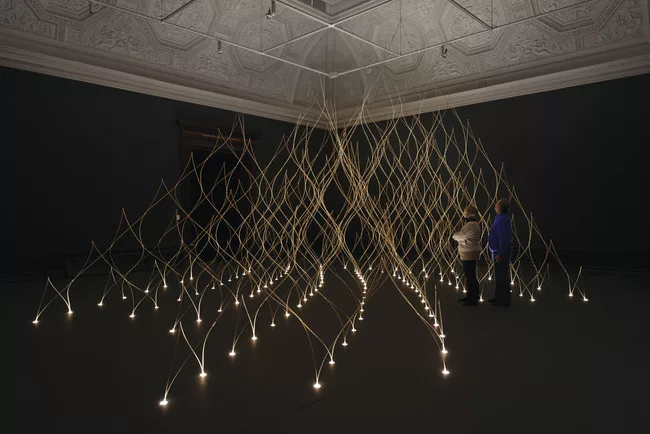
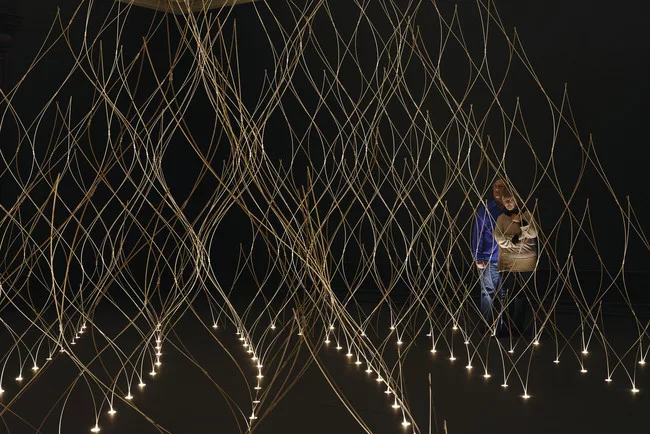
Kengo Kuma's bamboo installation is infused with the scent of Hinoki wood and Tatami mats.
Exhibition Review: Sensing Spaces at London's Royal Academy of Arts
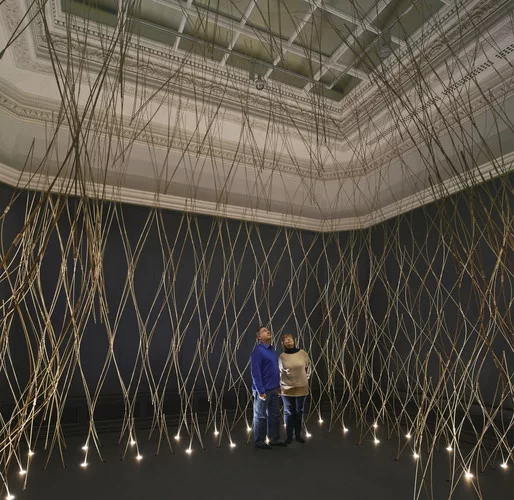
Kengo Kuma's bamboo installation is infused with the scent of Hinoki wood and Tatami mats.
Photo by James Harris © Royal Academy of Arts, London, 2014
Kengo Kuma's bamboo installation is infused with the scent of Hinoki wood and Tatami mats.
Exhibition Review: Sensing Spaces at London's Royal Academy of Arts
Kengo Kuma's bamboo installation is infused with the scent of Hinoki wood and Tatami mats.
Photo by James Harris © Royal Academy of Arts, London, 2014
Kengo Kuma's bamboo installation is infused with the scent of Hinoki wood and Tatami mats.
Exhibition Review: Sensing Spaces at London's Royal Academy of Arts
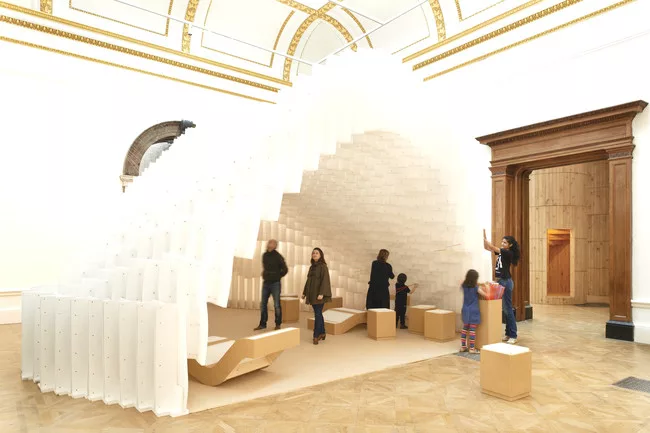
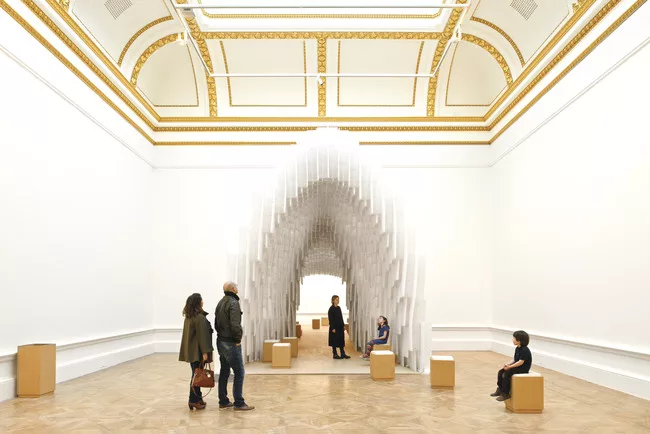
Kengo Kuma's bamboo installation is infused with the scent of Hinoki wood and Tatami mats.
Photo by James Harris © Royal Academy of Arts, London, 2014
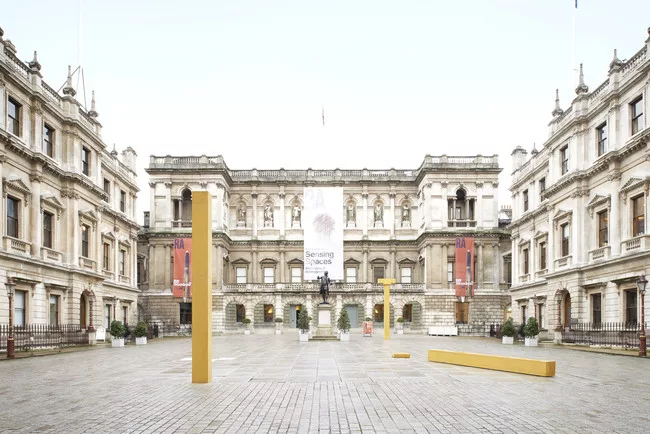
Álvaro Siza's three yellow concrete columns in the gallery’s exterior courtyard.
Exhibition Review: Sensing Spaces at London's Royal Academy of Arts
Álvaro Siza's three yellow concrete columns in the gallery’s exterior courtyard.
Photo by James Harris © Royal Academy of Arts, London, 2014
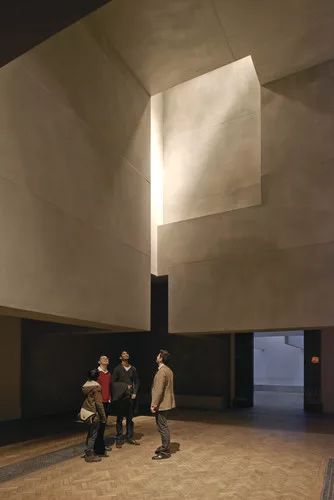
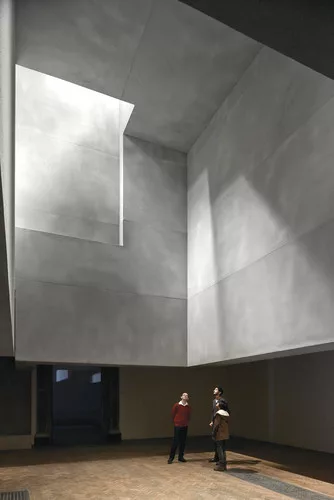
Grafton Architects installed a series of sculptural, suspended volumes in the roof.<br />
Exhibition Review: Sensing Spaces at London's Royal Academy of Arts
Grafton Architects installed a series of sculptural, suspended volumes in the roof.
Photo by James Harris © Royal Academy of Arts, London, 2014
Grafton Architects installed a series of sculptural, suspended volumes in the roof.
Exhibition Review: Sensing Spaces at London's Royal Academy of Arts
Grafton Architects installed a series of sculptural, suspended volumes in the roof.
Photo by James Harris © Royal Academy of Arts, London, 2014
Francis K&#233;r&#233;&#8216;s designed a polypropylene archway into which visitors are encouraged to push plastic straws.
Exhibition Review: Sensing Spaces at London's Royal Academy of Arts
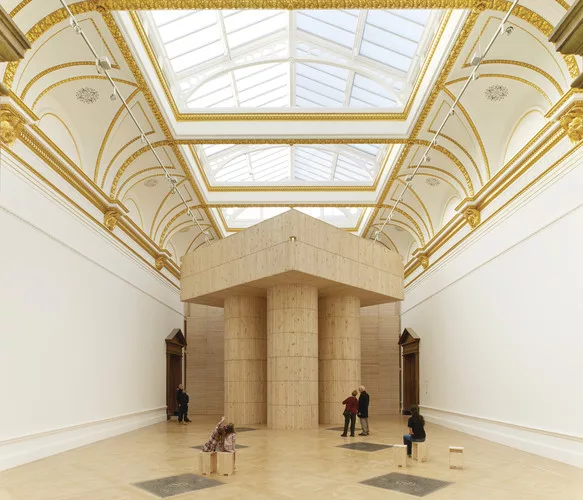
Francis Kéré‘s designed a polypropylene archway into which visitors are encouraged to push plastic straws.
Photo by James Harris © Royal Academy of Arts, London, 2014
Francis K&#233;r&#233;&#8216;s designed a polypropylene archway into which visitors are encouraged to push plastic straws.
Exhibition Review: Sensing Spaces at London's Royal Academy of Arts
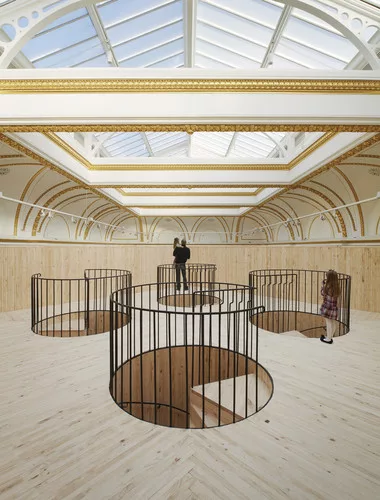
Francis Kéré‘s designed a polypropylene archway into which visitors are encouraged to push plastic straws.
Photo by James Harris © Royal Academy of Arts, London, 2014
Pezo von Ellrichshausen's installation.<br />
Exhibition Review: Sensing Spaces at London's Royal Academy of Arts
Pezo von Ellrichshausen's installation.
Photo by James Harris © Royal Academy of Arts, London, 2014
Pezo von Ellrichshausen's installation.
Exhibition Review: Sensing Spaces at London's Royal Academy of Arts
Pezo von Ellrichshausen's installation.
Photo by James Harris © Royal Academy of Arts, London, 2014
Kengo Kuma's bamboo installation is infused with the scent of Hinoki wood and Tatami mats.
&#193;lvaro Siza's three yellow concrete columns in the gallery&#8217;s exterior courtyard.
Grafton Architects installed a series of sculptural, suspended volumes in the roof.<br />
Grafton Architects installed a series of sculptural, suspended volumes in the roof.
Francis K&#233;r&#233;&#8216;s designed a polypropylene archway into which visitors are encouraged to push plastic straws.
Pezo von Ellrichshausen's installation.<br />
Pezo von Ellrichshausen's installation.
March 26, 2014

Kengo Kuma's bamboo installation is infused with the scent of Hinoki wood and Tatami mats.

"The decisions we make are not all conscious," reflects Álvaro Siza, one of seven architects invited by curator Kate Goodwin to design and install an immersive installation within the galleries of London’s Royal Academy of Arts. “What we do depends much on our experiences.” It is these subconscious memories and instinctive reactions to light, material, and space that visitors to Sensing Spaces are invited to experience first hand.

The installations, with varying degrees of success, go beyond the functional and visual to explore the physical sensation of inhabiting architecture, while also providing insight into the background and sensibilities of each practice.

Standing in the octagonal Central Hall of the Academy’s Main Galleries, visitors are invited to make their own path through the space. Through the doorway to the left, an angular viewing platform supported by four megalithic, cylindrical pillars draws them in. Designed by young Chilean practice Pezo von Ellrichshausen, the pine board structure is fortress-like, evoking the urge to explore: walk up a zigzagging ramp or ascend one of the spiral staircases that wind up the interior of each pillar to access a square viewing deck. From this lofty height, the structure’s high walls block the view below, instead drawing attention to the gallery’s Neoclassical, gilded ceiling and providing a unique opportunity to see its opulence in detail.

Next door, Berlin-based, African-born architect Diébédo Francis Kéré‘s also encourages a childlike feeling of freedom with a polypropylene archway into which visitors are encouraged to push plastic straws. After two months of interaction, the result is a structure with an extremely stubbly, multicolored skin that both adults and children feel compelled to touch and play with. Sucking visitors in through its low but cavernous entranceway, the textured tunnel narrows in the middle before opening up and ejecting them from the other side—what can be a bright, but rather brief, experience on a crowded day.

Taking a more serious tone, Chinese architect Li Xaodong has created a maze-like series of passageways lined with raw hazel sticks. Lit by LED floor panels, visitors navigate their way through the narrow corridor to a calming Zen garden complete with a pebble floor and a mirrored wall that heightens the sense of entering a wide-open space.

Equally immersive is Kengo Kuma’s atmospheric bamboo installation. Set across two dimly lit spaces, he whittled bamboo sticks into a delicate lattice structure and infused them with the scent of Hinoki wood and Tatami mats—aromas that are evocative of the traditional Japanese houses that Kuma grew up in and, he admits, are still capable of sending him into a deep sleep.

In contrast, Irish practice Grafton Architects has used the gallery’s soaring roof to explore the human attraction to light cycles. Working across two gallery spaces—one dark and one light—the architects have installed a series of sculptural, suspended volumes to capture and sculpt daylight that filters into the gallery. In the darker, larger space, light enters through an opening in a monolithic structure that has been inserted into the roof. Subtle variations in light and shadow play across its clean, angular surfaces, causing visitors to stop and marvel. Through the gloom, an archway of bright light beckons you into a smaller, dazzlingly bright gallery where a series of white plaster slats hang across the ceiling, reflecting and diffusing the light around the room.

The subtlest of interventions come courtesy of Portuguese Pritzker Prize-winners Alvaro Siza and Eduardo Souto de Moura, the latter of whom has made a cast concrete replica of two of the gallery’s ornate marble archways. Cast in reinforced concrete using high precision joinery molds, the Brutalist-style replicas are placed perpendicular to their originals, inviting the observer to compare and contrast. Also inspired by the Academy’s architecture, Siza has installed three yellow concrete columns in the gallery’s exterior courtyard: one complete, one with a missing capital, and one on its side as if toppled over, with its capital lying close by. It's a peculiar sight in such a formal setting, but Siza has fulfilled the exhibition’s ultimate goal: to bring the experiential qualities of architecture to the fore.

Sensing Spaces runs through April 6, 2014.

Share This Story

Looking for a reprint of this article?
From high-res PDFs to custom plaques, order your copy today!

Post a comment to this article

Report Abusive Comment

Subscription Center
  • Create an Account
  • Start a Subscription
  • Manage My Account
  • Sign Up for Newsletters
  • Visit Customer Service
  • Update Preferences

More Videos

Sponsored Content

Sponsored Content is a special paid section where industry companies provide high quality, objective, non-commercial content around topics of interest to the Architectural Record audience. All Sponsored Content is supplied by the advertising company and any opinions expressed in this article are those of the author and not necessarily reflect the views of Architectural Record or its parent company, BNP Media. Interested in participating in our Sponsored Content section? Contact your local rep!

close
  • cold storage facility
    Sponsored byCarlisle SynTec Systems

    How Architects Can Design More Continuous Cold Storage Envelopes

  • TAMLYN XtremeTrim Exterior Trim
    Sponsored byTamlyn

    Designing Cleaner Panel Facades: Why Exterior Trim Details Matter

  • Building with Vapor Barriers
    Sponsored byReef Industries, Inc.

    Vapor Barriers Help Control Moisture in Tighter Building Designs

DESIGN:ED Podcast
Listen to Architectural Record’s DESIGN:ED Podcast

Events

June 25, 2026

Designing Glass Railing Systems that Enhance Aesthetics and Meet Code

Credits: 1 AIA LU/HSW; 1 AIBD P-CE; 0.1 ICC CEU

Upon course completion, participants will possess a deeper understanding of glass railings to help ensure that safety, aesthetic, and performance objectives are achieved.

June 30, 2026

Generator Selection and Sizing for Outage-Ready Homes

Credits: 1 AIA LU/HSW; 1 AIBD P-CE; 0.1 ICC CEU

Explore how propane-powered systems and whole-home generators can improve energy resilience, reduce electrical loads, and lower long-term residential costs.

View All Submit An Event

Products

2026 Architect's Square Foot Costbook

2026 Architect's Square Foot Costbook

See More Products

Popular Stories

Obama Presidential Center, Chicago

The Obama Presidential Center Opens on Chicago’s South Side

Lorcan O' Herilhy

California Architect Lorcan O’Herlihy Has Died, Age 66

Spoonbill Ranch

Johnsen Schmaling Architects Integrates Spoonbill Ranch into a Pristine Landscape

Image of Bruce Springsteen Center for American Music

The CookFox-designed Bruce Springsteen Center for American Music Opens in New Jersey

Kìwekì Point, Ottawa, Canada

Perched High Above the Ottawa River, Kìwekì Point Showcases Sweeping Views of the Canadian Capital Region

Designing Glass Railing Systems that Enhance Aesthetics and Meet Code - Free Webinar - June 25, 2026

Related Articles

  • Helene_Binet_archrecord_1170_ss_3.jpg

    Hélène Binet Retrospective Opens at London’s Royal Academy of Arts

    See More
  • Exhibition Review: Ai Weiwei at the Royal Academy of Arts, London

    See More
  • Academy of Arts and Letters Names Prize-Winners

    See More
×

The latest news and information

#1 Source for Architectural Design, News and Products

SUBSCRIBE
  • RESOURCES
    • Advertise
    • Contact Us
    • Submit
    • Store
  • ACCOUNT CENTER
    • Create an Account
    • Start a Subscription
    • Manage My Account
    • Sign Up for Newsletters
    • Visit Customer Service
    • Update Preferences
  • PRIVACY
    • PRIVACY POLICY
    • TERMS & CONDITIONS
    • DO NOT SELL MY PERSONAL INFORMATION
    • PRIVACY REQUEST
    • ACCESSIBILITY
  • SERVICES
    • Marketing Services
    • Reprints
    • Market Research
    • List Rental
    • Survey/Respondent Access
  • STAY CONNECTED
    • Linkedin
    • Facebook
    • Instagram
    • YouTube
    • X (Twitter)

Copyright ©2026. All Rights Reserved BNP Media, Inc. and BNP Media II, LLC.

Design, CMS, Hosting & Web Development :: ePublishing