Architectural Record
search
cart
facebook twitter linkedin youtube
  • Sign In
  • Subscribe
  • Sign Out
  • My Account
Architectural Record
  • NEWS
    • Latest News
    • Awards
    • Interviews
    • Obituaries
    • Podcasts
      • Design:Ed Podcast
      • Sponsored Podcasts
  • OPINION
    • Book Reviews / Excerpts
    • Exhibition Reviews
    • Forum
  • EXCLUSIVES
    • Videos
    • Design Vanguard
    • Top 300 Firms
    • Sponsored Content
    • Sponsored eBooks
    • From the Archives
  • CONTINUING ED
    • Editorial Continuing Ed
    • CE Center
    • CE Academies
  • PROJECTS
    • Buildings By Type
    • Reuse & Renovation
    • Museums & Arts Centers
    • Colleges & Universities
    • Multifamily Housing
    • Interiors
    • Lighting
    • Kitchen & Bath
  • HOUSES
    • Record Houses
    • House of the Month
    • Featured Houses
  • PRODUCTS
    • Products by Category
    • Record Products of the Year
    • Latest Products
  • EVENTS
    • Dates & Events
    • Record on the Road
    • Innovation Conference
    • Sustainability in Practice
    • Women In Architecture
    • Webinars
    • Ad Excellence Awards
    • Submit an Event
  • CONNECT
    • Ask RECORD AI
    • Newsletters
    • Contact
    • Advertise
    • Editorial Calendar
    • Store
    • Customer Service
  • SUBMIT
    • Submission Guidelines
    • RECORD Competitions
  • MAGAZINE
    • Subscribe
    • My Account
    • Digital Edition
    • Current Issue
    • Firm Pass
    • Historic Archive
Architecture News

A Masterpiece, With Shortcomings
By Fred A. Bernstein
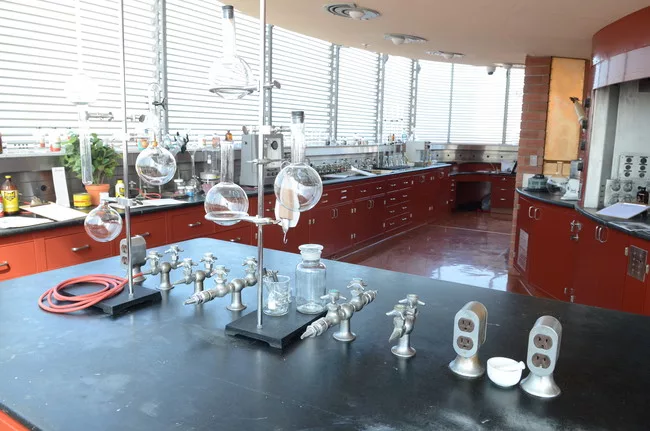
A lab in the Research Tower.
A Masterpiece, With Shortcomings
A lab in the Research Tower.
Photo © Mark Hertzberg
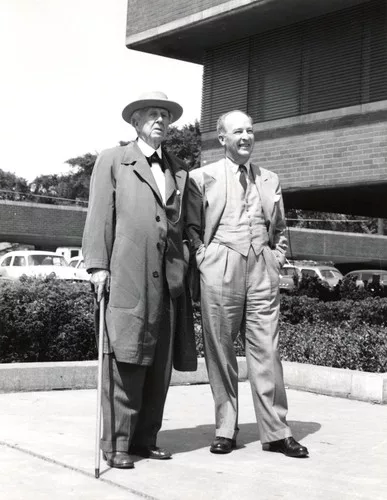
Frank Lloyd Wright and H.F. Johnson Jr.
A Masterpiece, With Shortcomings

Frank Lloyd Wright and H.F. Johnson Jr.
Photo courtesy SC Johnson
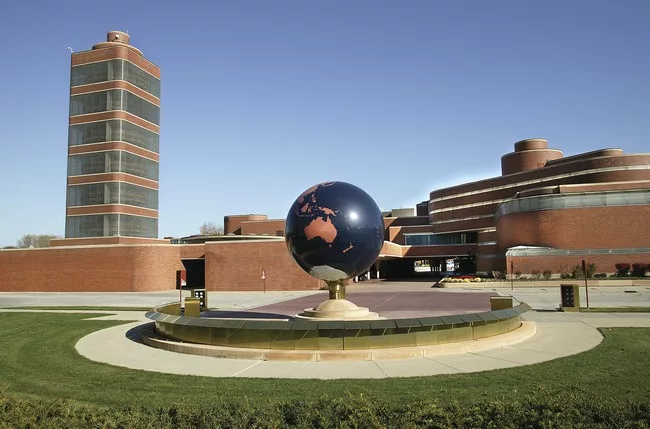
Both the Research Tower (1950) and the company’s Wright-designed Administration Building (1939) are now on the National Register of Historic Places.
A Masterpiece, With Shortcomings
Both the Research Tower (1950) and the company’s Wright-designed Administration Building (1939) are now on the National Register of Historic Places.
Photo courtesy SC Johnson
Both the tower and the Administration Building are made with Wright’s signature Cherokee red brick and feature windows formed from Pyrex glass tubing.
A Masterpiece, With Shortcomings
Both the tower and the Administration Building are made with Wright’s signature Cherokee red brick and feature windows formed from Pyrex glass tubing.
Photo courtesy SC Johnson
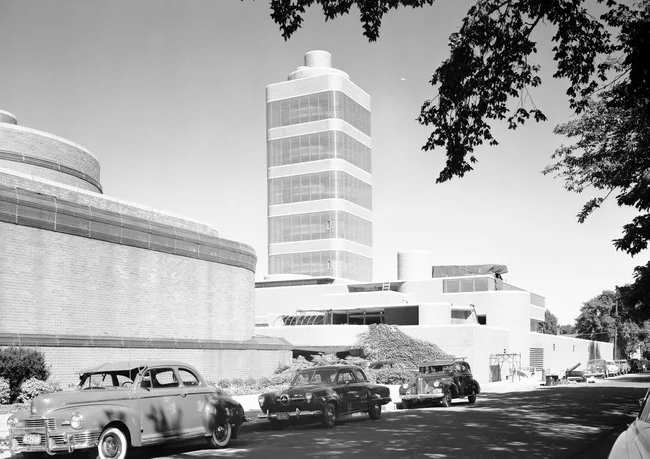
Frank Lloyd Wright designed the tower to serve as the vertical accent to his previously designed Administration Building. (c. 1950)
A Masterpiece, With Shortcomings
Frank Lloyd Wright designed the tower to serve as the vertical accent to his previously designed Administration Building. (c. 1950)
Photo courtesy SC Johnson
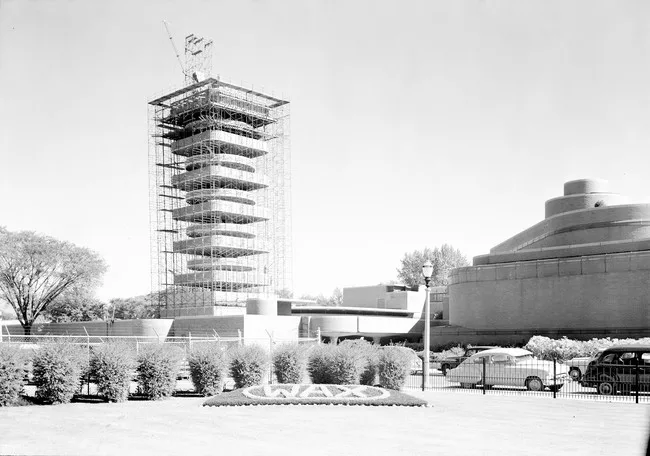
<p class='MsoNormal'>Construction of the tower and its alternating square and circle floors in progress. Construction began on November 6, 1947.</p>
A Masterpiece, With Shortcomings

Construction of the tower and its alternating square and circle floors in progress. Construction began on November 6, 1947.
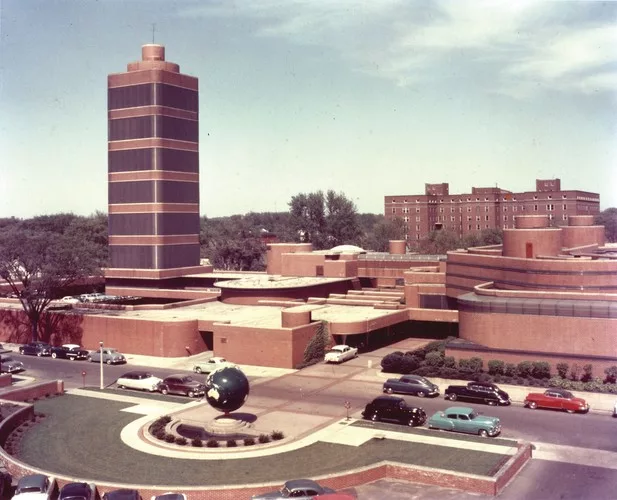
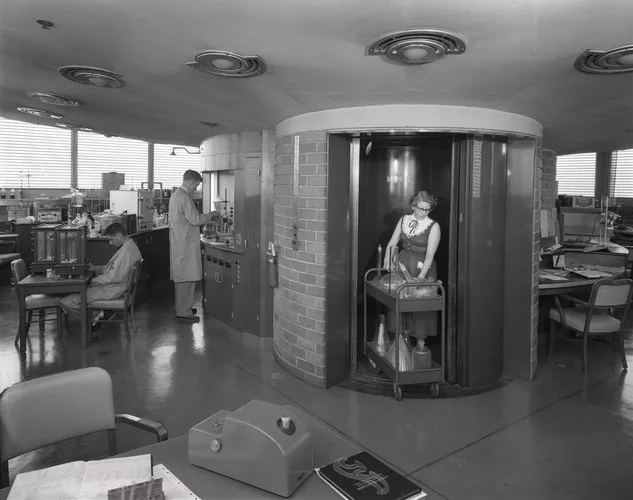
Photo courtesy SC Johnson
An aerial view of the S.C. Johnson campus in Racine, Wisconsin, c. 1955.
A Masterpiece, With Shortcomings
An aerial view of the S.C. Johnson campus in Racine, Wisconsin, c. 1955.
Photo courtesy SC Johnson
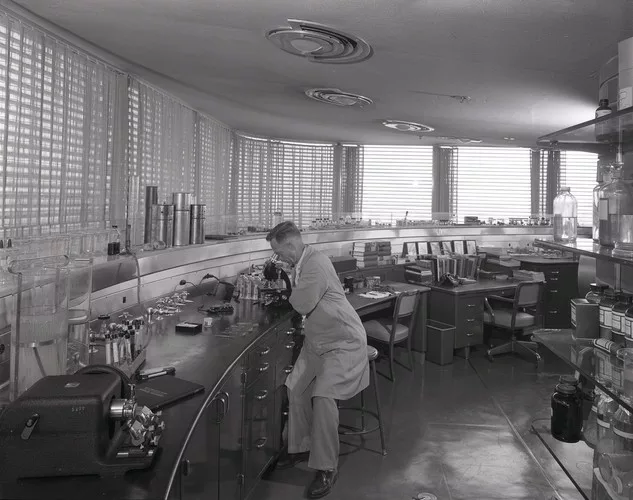
A glimpse inside the Research Tower (c. 1955). The tower served as a hub of innovation and the birthplace to some of the world&#8217;s most beloved household products, including Raid (1955), Glade (19
A Masterpiece, With Shortcomings
A glimpse inside the Research Tower (c. 1955). The tower served as a hub of innovation and the birthplace to some of the world’s most beloved household products, including Raid (1955), Glade (1956), OFF! (1957), and Pledge (1958).
Photo courtesy SC Johnson
Some chemists found Wright&#8217;s &#8220;Helio-lab&#8221; (sun lab) troublesome due to the sun&#8217;s heat and glare that was intensified by the glass-tube windows. Chemists were given sunglasses un
A Masterpiece, With Shortcomings
Some chemists found Wright’s “Helio-lab” (sun lab) troublesome due to the sun’s heat and glare that was intensified by the glass-tube windows. Chemists were given sunglasses until curtains could be installed. (c. 1955)
Photo courtesy SC Johnson
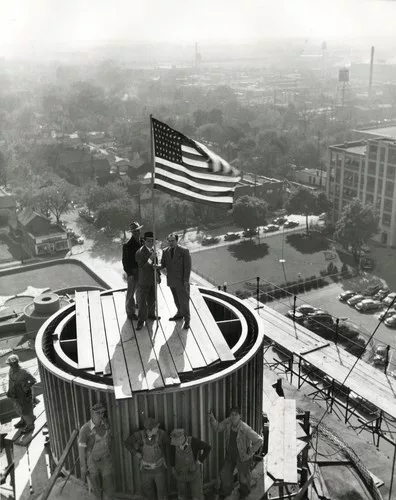
<p class='MsoNormal'>The topping-out ceremony of the tower on October 15, 1949. Jake Stocker, the construction supervisor, is on the right.</p>
A Masterpiece, With Shortcomings

The topping-out ceremony of the tower on October 15, 1949. Jake Stocker, the construction supervisor, is on the right.

Photo courtesy SC Johnson
<p class='MsoNormal'>On December 21, 2013, marking winter solstice, the longest night of the year, SC Johnson relit its Frank Lloyd Wright-designed Research Tower for the first time in 12 months. The
A Masterpiece, With Shortcomings

On December 21, 2013, marking winter solstice, the longest night of the year, SC Johnson relit its Frank Lloyd Wright-designed Research Tower for the first time in 12 months. The lighting ceremony celebrated the extensive restoration to the tower, which involved both exterior and interior updates.

Photo courtesy SC Johnson
<p class='MsoNormal'>The Research Tower is 153 feet high, with 232 stairs that climb 15 stories.</p>
A Masterpiece, With Shortcomings

The Research Tower is 153 feet high, with 232 stairs that climb 15 stories.
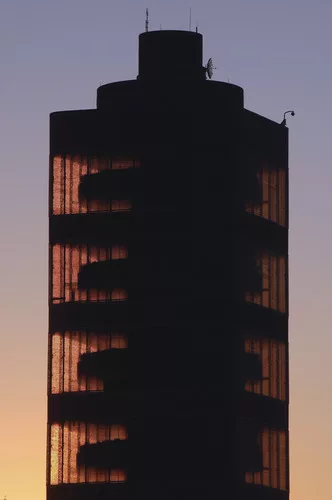
Photo courtesy SC Johnson
<p class='MsoNormal'>The tower's unique taproot core design is illuminated by a sunset.</p>
A Masterpiece, With Shortcomings

The tower's unique taproot core design is illuminated by a sunset.
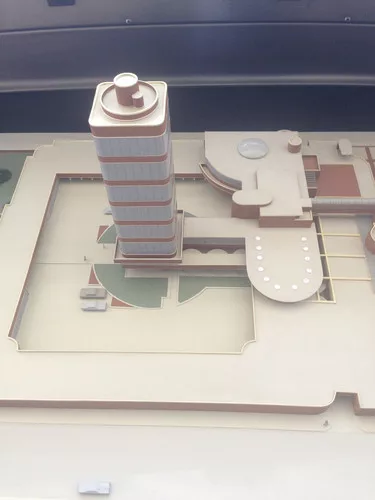
Photo courtesy SC Johnson
A model of the campus.
A Masterpiece, With Shortcomings
A model of the campus.
Photo © Architectural Record
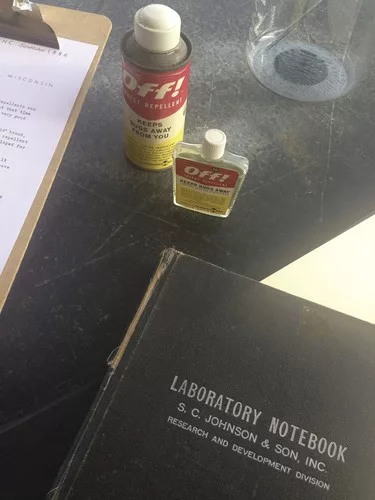
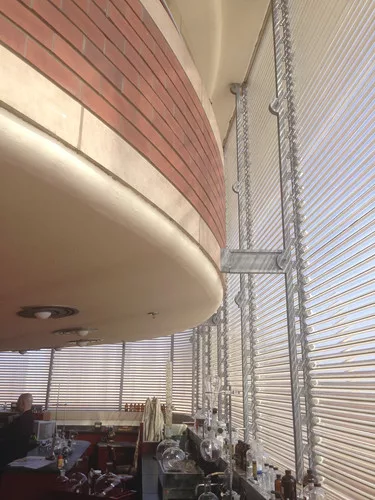
A lab inside the tower.
A Masterpiece, With Shortcomings
A lab inside the tower.
Photo © Architectural Record
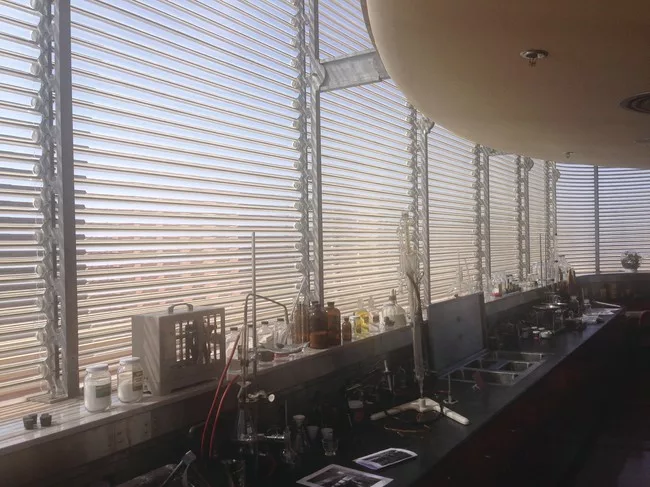
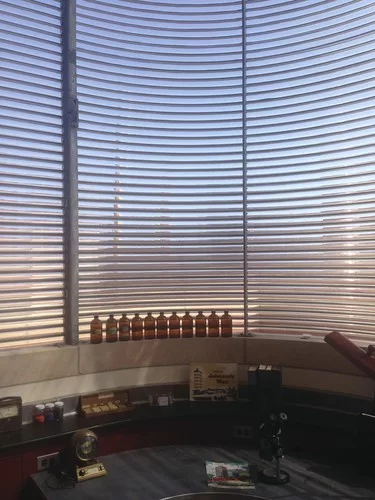
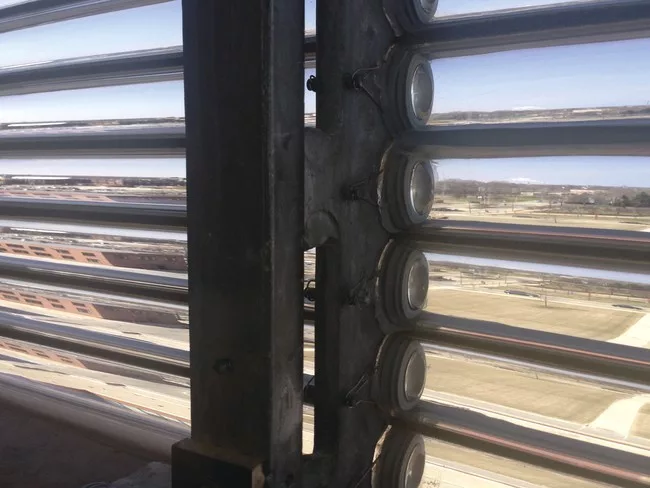
A detail of the Pyrex tube windows.
A Masterpiece, With Shortcomings
A detail of the Pyrex tube windows.
Photo © Architectural Record
A detail of the Pyrex tube windows.
A Masterpiece, With Shortcomings
A detail of the Pyrex tube windows.
Photo © Architectural
A Masterpiece, With Shortcomings
Photo © Architectural Record
A Masterpiece, With Shortcomings
Photo © Architectural Record
A Masterpiece, With Shortcomings
Photo © Architectural Record
A lab in the Research Tower.
Frank Lloyd Wright and H.F. Johnson Jr.
Both the Research Tower (1950) and the company&#8217;s Wright-designed Administration Building (1939) are now on the National Register of Historic Places.
Both the tower and the Administration Building are made with Wright&#8217;s signature Cherokee red brick and feature windows formed from Pyrex glass tubing.
Frank Lloyd Wright designed the tower to serve as the vertical accent to his previously designed Administration Building. (c. 1950)
<p class='MsoNormal'>Construction of the tower and its alternating square and circle floors in progress. Construction began on November 6, 1947.</p>
An aerial view of the S.C. Johnson campus in Racine, Wisconsin, c. 1955.
A glimpse inside the Research Tower (c. 1955). The tower served as a hub of innovation and the birthplace to some of the world&#8217;s most beloved household products, including Raid (1955), Glade (19
Some chemists found Wright&#8217;s &#8220;Helio-lab&#8221; (sun lab) troublesome due to the sun&#8217;s heat and glare that was intensified by the glass-tube windows. Chemists were given sunglasses un
<p class='MsoNormal'>The topping-out ceremony of the tower on October 15, 1949. Jake Stocker, the construction supervisor, is on the right.</p>
<p class='MsoNormal'>On December 21, 2013, marking winter solstice, the longest night of the year, SC Johnson relit its Frank Lloyd Wright-designed Research Tower for the first time in 12 months. The
<p class='MsoNormal'>The Research Tower is 153 feet high, with 232 stairs that climb 15 stories.</p>
<p class='MsoNormal'>The tower's unique taproot core design is illuminated by a sunset.</p>
A model of the campus.
A lab inside the tower.
A detail of the Pyrex tube windows.
A Masterpiece, With Shortcomings
April 21, 2014

Both the Research Tower (1950) and the company’s Wright-designed Administration Building (1939) are now on the National Register of Historic Places.

Any list of the greatest buildings of the 20th century would have to include Frank Lloyd Wright’s SC Johnson Research Tower, the 15-story companion to his equally spectacular administration building in Racine, Wisconsin. On May 2, the company will begin offering tours of the tower for the first time since it was completed in 1950. Expect plenty of debate about whether a building with functional shortcomings can still be considered a masterpiece.

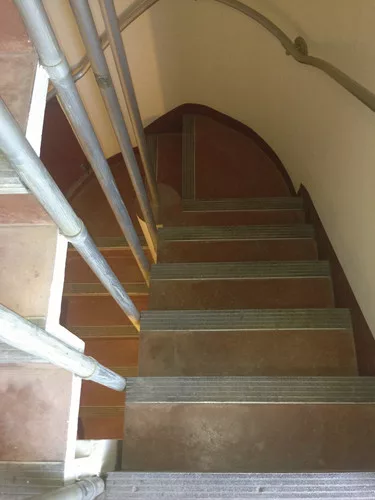
Built in 1950 and closed in 1982, the research tower, which Wright persuaded company president H.F. Johnson Jr. to build, was problematic from the start. True, during the first 10 years it was in use, the firm developed several of its best-known products, including Pledge, Glade, Raid, and Off!; for that reason, Greg Anderegg, the company’s director of global community affairs, says, “I think it worked pretty well.” But Wright’s 153-foot-high tower is inflexible—the small floor plates and built-in furniture ensured that new equipment wouldn’t fit. Worse, the building would be difficult to evacuate in an emergency. Its 13-foot-diameter core contains a small round elevator and a stairway that at some points is a mere 24 inches wide, but makes 180-degree turns. It’s hard to believe the building, without a single operable window, was used as long as it was. (Over the years, according to Anderegg, the company considered—and rejected—various means of creating an additional means of egress.)

And yet the building is spectacularly innovative, with its 15 floors, six of them circular mezzanines, cantilevered off a “taproot” core that extends 50 feet underground. (This may be the closest Wright ever came to creating a truly tree-like tower.) Its windows aren’t sheets of glass but stacks of Pyrex tubes, impractical to maintain but capable of producing gorgeous visual effects.

SC Johnson could have abandoned the building years ago; instead, the privately held company has lavished attention on it. It is in the midst of a five-year, $30 million renovation of the complex, which has so far included replacing every one of the 21,170 bricks and 5,800 Pyrex tubes that form the tower’s exterior. Inside, workers restored two of the floors to their original condition (even propping the spaces with 1950s scientific equipment, documents, and photos from company archives). Sean Malone, president of the Frank Lloyd Wright Foundation, calls the company’s acts “completely unselfish giving.” SC Johnson won’t even charge for tours, which will be offered on Fridays, Saturdays, and Sundays. Given the unreliability of the elevator and the narrowness of the stairs, the number of visitors admitted to the tower will be tightly controlled, and there will be no access for the disabled.

During a recent visit, the building’s charms were apparent. Indeed, the equipment used to “stage” the labs seems oddly out-of-place, a collection of antiques in a still-futuristic building. Also apparent were multiple shortcomings, including bathrooms that would barely pass muster on an airplane, and an inability to modulate natural light. (At one point, Johnson’s workers asked the company to issue them sunglasses.) And the spaces feel claustrophobic, with fresh air scarce and views distorted by the tubing. 

But the building is connected by a Wright-designed bridge to the administration building, which is remarkably light and airy—it’s as if the two structures together demonstrate Wright’s penchant for “compression and release,” although, somewhat strangely, the compression happens in a tower. Some will see the tower’s interiors as proof that Wright cared more about form than function; others will recognize a triumph of architectural experimentation, conducted on behalf of a daring, and patient, client. Neither group of visitors will be disappointed.

For tours, visit scjohnson.com/visit or call (262) 260-2154.

Share This Story

Looking for a reprint of this article?
From high-res PDFs to custom plaques, order your copy today!

Fred Bernstein studied architecture at Princeton and law at NYU and writes about both subjects.

Post a comment to this article

Report Abusive Comment

Subscription Center
  • Create an Account
  • Start a Subscription
  • Manage My Account
  • Sign Up for Newsletters
  • Visit Customer Service
  • Update Preferences

More Videos

Sponsored Content

Sponsored Content is a special paid section where industry companies provide high quality, objective, non-commercial content around topics of interest to the Architectural Record audience. All Sponsored Content is supplied by the advertising company and any opinions expressed in this article are those of the author and not necessarily reflect the views of Architectural Record or its parent company, BNP Media. Interested in participating in our Sponsored Content section? Contact your local rep!

close
  • cold storage facility
    Sponsored byCarlisle SynTec Systems

    How Architects Can Design More Continuous Cold Storage Envelopes

  • TAMLYN XtremeTrim Exterior Trim
    Sponsored byTamlyn

    Designing Cleaner Panel Facades: Why Exterior Trim Details Matter

  • Building with Vapor Barriers
    Sponsored byReef Industries, Inc.

    Vapor Barriers Help Control Moisture in Tighter Building Designs

DESIGN:ED Podcast
Listen to Architectural Record’s DESIGN:ED Podcast

Events

June 23, 2026

Enhancing Fire Resistance with Advanced PVC Solutions

Credits: 1 AIA LU/HSW; 1 AIBD P-CE; 0.1 ICC CEU; 1 IIBEC CEH

Evaluate advanced PVC solutions that improve fire resistance, support WUI compliance, and enhance resilience in residential and commercial building design.

June 25, 2026

Designing Glass Railing Systems that Enhance Aesthetics and Meet Code

Credits: 1 AIA LU/HSW; 1 AIBD P-CE; 0.1 ICC CEU

Upon course completion, participants will possess a deeper understanding of glass railings to help ensure that safety, aesthetic, and performance objectives are achieved.

View All Submit An Event

Products

2026 Architect's Square Foot Costbook

2026 Architect's Square Foot Costbook

See More Products

Popular Stories

Lorcan O' Herilhy

California Architect Lorcan O’Herlihy Has Died, Age 66

Obama Presidential Center, Chicago

The Obama Presidential Center Opens on Chicago’s South Side

Spoonbill Ranch

Johnsen Schmaling Architects Integrates Spoonbill Ranch into a Pristine Landscape

Image of Bruce Springsteen Center for American Music

The CookFox-designed Bruce Springsteen Center for American Music Opens in New Jersey

Three Courtyards House

Design Vanguard 2026: Balsa Crosetto Piazzi

Enhancing Fire Resistance with Advanced PVC Solutions - Free Webinar - June 23, 2026

Related Articles

  • NYPL Substitutes a Master Plan for a Masterpiece

    NYPL Substitutes a Master Plan for a Masterpiece

    See More
  • Reviving a Modest Masterpiece

    See More
  • E1027 House

    ‘E.1027’ Documents—and Dramatizes—Eileen Gray’s Battle with Le Corbusier for Control of Her Modernist Masterpiece

    See More

Related Products

See More Products
  • 047177751X.gif

    Sustainable Urbanism: Urban Design With Nature

See More Products
×

The latest news and information

#1 Source for Architectural Design, News and Products

SUBSCRIBE
  • RESOURCES
    • Advertise
    • Contact Us
    • Submit
    • Store
  • ACCOUNT CENTER
    • Create an Account
    • Start a Subscription
    • Manage My Account
    • Sign Up for Newsletters
    • Visit Customer Service
    • Update Preferences
  • PRIVACY
    • PRIVACY POLICY
    • TERMS & CONDITIONS
    • DO NOT SELL MY PERSONAL INFORMATION
    • PRIVACY REQUEST
    • ACCESSIBILITY
  • SERVICES
    • Marketing Services
    • Reprints
    • Market Research
    • List Rental
    • Survey/Respondent Access
  • STAY CONNECTED
    • Linkedin
    • Facebook
    • Instagram
    • YouTube
    • X (Twitter)

Copyright ©2026. All Rights Reserved BNP Media, Inc. and BNP Media II, LLC.

Design, CMS, Hosting & Web Development :: ePublishing