Architectural Record
search
cart
facebook twitter linkedin youtube
  • Sign In
  • Subscribe
  • Sign Out
  • My Account
Architectural Record
  • NEWS
    • Latest News
    • Awards
    • Interviews
    • Obituaries
    • Podcasts
      • Design:Ed Podcast
      • Sponsored Podcasts
  • OPINION
    • Book Reviews / Excerpts
    • Exhibition Reviews
    • Forum
  • EXCLUSIVES
    • Videos
    • Design Vanguard
    • Top 300 Firms
    • Sponsored Content
    • Sponsored eBooks
    • From the Archives
  • CONTINUING ED
    • Editorial Continuing Ed
    • CE Center
    • CE Academies
  • PROJECTS
    • Buildings By Type
    • Reuse & Renovation
    • Museums & Arts Centers
    • Colleges & Universities
    • Multifamily Housing
    • Interiors
    • Lighting
    • Kitchen & Bath
  • HOUSES
    • Record Houses
    • House of the Month
    • Featured Houses
  • PRODUCTS
    • Products by Category
    • Record Products of the Year
    • Latest Products
  • EVENTS
    • Dates & Events
    • Record on the Road
    • Innovation Conference
    • Sustainability in Practice
    • Women In Architecture
    • Webinars
    • Ad Excellence Awards
    • Submit an Event
  • CONNECT
    • Ask RECORD AI
    • Newsletters
    • Contact
    • Advertise
    • Editorial Calendar
    • Store
    • Customer Service
  • SUBMIT
    • Submission Guidelines
    • RECORD Competitions
  • MAGAZINE
    • Subscribe
    • My Account
    • Digital Edition
    • Current Issue
    • Firm Pass
    • Historic Archive
Architecture News

Universit' Catholique de Louvain Museum

By Robert Such
December 16, 2008

Art Museum to Serve as Dynamic Gateway for Belgian Town

In November 2007, the Université Catholique de Louvain, in Belgium, launched a design competition for a new museum to replace the current, cramped home of its Renaissance paintings, contemporary art, and African sculpture. The winner was announced this past June: Chicago-based Perkins+Will, Brussels architect Emile Verhaegen, and sustainability consultant MATRIciel. The team beat out Charles Vandenhove, Massimiliano Fuksas, and the British firm Tectonics.
Louvain-la-Neuve
Louvain-la-Neuve
Images courtesy Perkins+Will
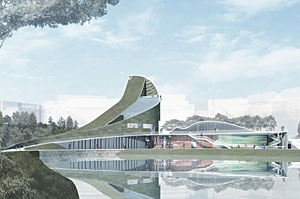
A new art museum for Louvain-la-Neuve, in Belgium, is being designed by Perkins+Will, architect Emile Verhaegen, and sustainability consultant MATRIciel.

The future venue, which consists of two buildings on 1.2 acres overlooking a 17-acre lake, will sit aside one of the main roads leading into the town of Louvain-la-Neuve, located 16 miles southeast of Brussels. The museum site is “a critical intersection of the main town square, a large theater complex, and the lake,” says Ralph Johnson, a design principal at Perkins+Will.

In Louvain-la-Neuve, the entire city center sits atop a giant plinth, with roadways and parking areas placed below. In keeping with this tradition—and in order to maintain unobstructed views between the city center and the lake—the design team opted to burrow one of the museum’s two buildings below ground. A lobby, temporary gallery space, 150-seat auditorium, café, and administrative areas will be situated in this architectural mole.

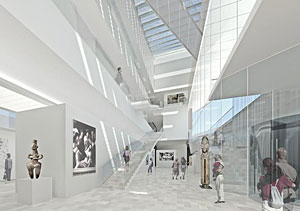
Its counterpart is a twisted and folded tower that measures 115 feet in height and straddles the town’s east-west artery. “We wanted it to look like the earth was in section,” says Johnson says of the cliff-like glass exterior, on which a sedum-planted roof appears to float. Inside the tower, a four-story atrium is capped by a louvered 25-degree roof for an equally sculptural look. Running between the tower and the underground part of the museum is a pedestrian walkway that connects the museum site to the town.

Louvain-la-Neuve has a somewhat unusual history. It was established as a second home of the Catholic University of Leuven, or Louvain, in 1968, when the 583-year-old school split into Dutch- and French-speaking parts. (The Dutch half, Katholieke Universiteit Leuven, stayed in Leuven, on the original campus.) Construction of the Louvain-la-Neuve campus began soon after the division, and within 10 years, the university opened its art museum inside its humanities building, which is where it has remained over the decades. The school cites limited presence as well as insufficient space for temporary exhibits as the reason for the new museum.

Plans and budget are still being revised, but school brass have committed to green technologies: Photovoltaic cells fixed to the atrium’s louvers will power lighting, and a heat pump system linked to the lake by underground ducts will heat the exhibition rooms. The start of construction for the museum is pencilled in for next fall, with the opening scheduled for 2011.

Share This Story

Looking for a reprint of this article?
From high-res PDFs to custom plaques, order your copy today!
Post a comment to this article

Report Abusive Comment

Subscription Center
  • Create an Account
  • Start a Subscription
  • Manage My Account
  • Sign Up for Newsletters
  • Visit Customer Service
  • Update Preferences

More Videos

Sponsored Content

Sponsored Content is a special paid section where industry companies provide high quality, objective, non-commercial content around topics of interest to the Architectural Record audience. All Sponsored Content is supplied by the advertising company and any opinions expressed in this article are those of the author and not necessarily reflect the views of Architectural Record or its parent company, BNP Media. Interested in participating in our Sponsored Content section? Contact your local rep!

close
  • TAMLYN XtremeTrim Exterior Trim
    Sponsored byTamlyn

    Designing Cleaner Panel Facades: Why Exterior Trim Details Matter

  • Building with Vapor Barriers
    Sponsored byReef Industries, Inc.

    Vapor Barriers Help Control Moisture in Tighter Building Designs

  • Duct Interior with Prodeq System
    Sponsored byHenry, a Carlisle Company

    Designing Resilient Water Containment Systems

DESIGN:ED Podcast
Listen to Architectural Record’s DESIGN:ED Podcast

Events

June 10, 2026

Rethinking Stormwater – The Power of Porous Paving

Credits: 1 AIA LU/HSW; 1 AIBD P-CE; 0.1 ICC CEU

Learn how porous paving systems support stormwater management, reduce heat island effects, and enhance sustainable site design performance.

June 11, 2026

Very Early Warning Fire Detection for Mission-Critical Facilities

Credits: 1 AIA LU/HSW; 1 AIBD P-CE; 0.1 ICC CEU

Examine advanced fire detection strategies that support uptime and enhance safety in data centers and other mission-critical facilities.

View All Submit An Event

Products

2026 Architect's Square Foot Costbook

2026 Architect's Square Foot Costbook

See More Products

Popular Stories

Coronado Bridge

The Architect’s Guide to San Diego

Practice Matters illustration

What’s in a (Firm’s) Name? Thinking About Succession and Legacy

Practice Matters illustration

By the Numbers: Counting America's Architects

Inward House

Inward House by VeeV Design Studio

Riverdale House by Studio Lau

Riverdale House by Studio Lau

Broader Sustainability of CMU - Free Webinar - May 21, 2026

Related Articles

  • Lusail Museum

    Qatar Teases Future Herzog & de Meuron–designed Lusail Museum with New Renderings

    See More
  • First Look: Herzog & de Meuron's Parrish Art Museum

    See More
×

The latest news and information

#1 Source for Architectural Design, News and Products

SUBSCRIBE
  • RESOURCES
    • Advertise
    • Contact Us
    • Submit
    • Store
  • ACCOUNT CENTER
    • Create an Account
    • Start a Subscription
    • Manage My Account
    • Sign Up for Newsletters
    • Visit Customer Service
    • Update Preferences
  • PRIVACY
    • PRIVACY POLICY
    • TERMS & CONDITIONS
    • DO NOT SELL MY PERSONAL INFORMATION
    • PRIVACY REQUEST
    • ACCESSIBILITY
  • SERVICES
    • Marketing Services
    • Reprints
    • Market Research
    • List Rental
    • Survey/Respondent Access
  • STAY CONNECTED
    • Linkedin
    • Facebook
    • Instagram
    • YouTube
    • X (Twitter)

Copyright ©2026. All Rights Reserved BNP Media, Inc. and BNP Media II, LLC.

Design, CMS, Hosting & Web Development :: ePublishing