Architects Express Concern Over Economic Stimulus Plan
Driven by a need for speedy delivery and an overarching demand for energy-efficient buildings, federal facilities appear primed for a significant facelift in the near future, if proposed stimulus funds come through.
Within the stimulus package proposed last week by House Democrats, the U.S. General Services Administration (GSA) and Department of Defense-related facilities would be among the bill’s biggest beneficiaries. The current package calls for $7.7 billion for the GSA, including $6 billion for buildings with an emphasis on energy efficiency upgrades and $1 billion for border stations. Meanwhile, more than $10 billion could flow toward defense-related work, including medical facilities and troop housing.
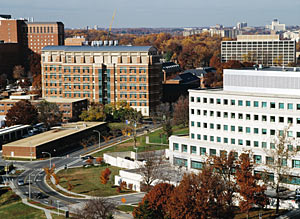
Other significant federal funding proposals include $950 million for Veterans Administration facilities; $1.5 billion for university research facility construction under the National Institutes of Health (NIH); and $500 million for modernization of the NIH campus.
In keeping with President Obama’s call to emphasize green jobs and reduce federal energy use, the stimulus bill focuses on federal projects that have the greatest impact on energy efficiency and conservation. In recent years, the GSA has been pressured by mandates within the Energy Policy Act of 2005 and the Energy and Independence and Security Act of 2007 to quickly ramp up efforts to modernize its facilities with green systems.
Andrew Goldberg, senior director of federal relations with the American Institute of Architects, suggests that the GSA currently has at least $10 billion in work that is “ready-to-go.” “The [proposed package] is a good start,” Goldberg says, “but we don’t think it’s quite enough to meet the GSA’s needs.”
But the breadth of opportunities within any funding package could rely heavily on how legislators define “ready-to-go.” Some have promoted “shovel-ready” projects, which could be interpreted as work that is ready to go to construction. That scenario would leave many architects out of the picture.
Kevin Kampschroer, acting director of the GSA’s Office of Federal High-Performance Green Buildings, says that the agency has yet to compile a priority list of projects for a possible stimulus package but that he expects a broad mix of work to be available for the entire industry. “If we have a design that was done five years ago, before the Energy Policy Act of 2005 was passed, there would be work needed to bring it up to today’s expectations,” he says. “There are a lot of potential opportunities.”
But design industry advocates are calling for a plan that will ensure a broad-range of firms get a fair shake. In an effort to create jobs quickly, House Democrats proposed that much of the work in the stimulus package be let out in three to four months. Goldberg says the AIA is pushing for timelines of up to two years. “The fact is, GSA needs more time to plan these things out properly,” he emphasizes.
Procurement issues could emerge as a critical factor in determining who benefits. Many analysts suggest that traditional design-bid-build methods won’t work under the timelines outlined within the stimulus package. While projects that have been designed but not built might be able to move forward, it could be challenging to get new projects into design.
David Thompson, senior vice president at RTKL of Baltimore, said he expects federal agencies to leverage their emerging experience with design-build and construction-manager-at-risk models to deliver new work. “They can’t afford to go with conventional methods—that would delay things tremendously,” he says.
It’s a scenario that raises concerns among some architects. “We’re hopeful that ‘shovel-ready’ is reinterpreted to be ‘pencil-ready’,” says Steve McDowell, principal at the Kansas City-based design firm BNIM. “Everyone needs to remember that design and planning are part of the economy of building.”
Also at issue is the ability of government contracting agents to handle the heavy load of projects that could enter the pipeline. Larry Bory, vice president of federal government relations at HDR, says that recent slowdowns in workflow have led many agencies nationwide to lay off employees who handle plan reviews and contract negotiations. “There’s a finite amount of capacity in terms of how fast things can move,” he says. “[These agencies] are going to have to go to the industry to find program managers who can administer these contracts. I don’t see how they can do it on their own.”
With so much work primed to move through the pipeline at once, concerns loom over how small firms can benefit. “If the goal is long-term economic recovery, you need to nurture the smaller firms as much as you can,” Goldberg says.
While the prospect of billions in new federal buildings work represents a possible boon for firms nationwide, HDR’s Larry Bory notes that it is only one piece in the bigger picture. Congress is also poised to move forward on the 2009 appropriations bill that was stalled under President Bush and will debate a war supplemental this spring.
“If some projects don’t get into the stimulus package, you could see them come up again [in other legislation],” he says. “That’s where you’ll see a lot of the new construction projects. If you don’t get in on this wave, there will be a few more behind this that you could catch. It will be an amazing year in terms of funding programs.”
Looking for a reprint of this article?
From high-res PDFs to custom plaques, order your copy today!