Architectural Record
search
cart
facebook twitter linkedin youtube
  • Sign In
  • Subscribe
  • Sign Out
  • My Account
Architectural Record
  • NEWS
    • Latest News
    • Awards
    • Interviews
    • Obituaries
    • Podcasts
      • Design:Ed Podcast
      • Sponsored Podcasts
  • OPINION
    • Book Reviews / Excerpts
    • Exhibition Reviews
    • Forum
  • EXCLUSIVES
    • Videos
    • Design Vanguard
    • Top 300 Firms
    • Sponsored Content
    • Sponsored eBooks
    • From the Archives
  • CONTINUING ED
    • Editorial Continuing Ed
    • CE Center
    • CE Academies
  • PROJECTS
    • Buildings By Type
    • Reuse & Renovation
    • Museums & Arts Centers
    • Colleges & Universities
    • Multifamily Housing
    • Interiors
    • Lighting
    • Kitchen & Bath
  • HOUSES
    • Record Houses
    • House of the Month
    • Featured Houses
  • PRODUCTS
    • Products by Category
    • Record Products of the Year
    • Latest Products
  • EVENTS
    • Dates & Events
    • Record on the Road
    • Innovation Conference
    • Sustainability in Practice
    • Women In Architecture
    • Webinars
    • Ad Excellence Awards
    • Submit an Event
  • CONNECT
    • Ask RECORD AI
    • Newsletters
    • Contact
    • Advertise
    • Editorial Calendar
    • Store
    • Customer Service
  • SUBMIT
    • Submission Guidelines
    • RECORD Competitions
  • MAGAZINE
    • Subscribe
    • My Account
    • Digital Edition
    • Current Issue
    • Firm Pass
    • Historic Archive
Commentary & Criticism

When All Systems Seemed Go for Spaceship Earth

By Martin Filler
August 16, 2008

The conjunction this season of four architecture exhibitions on Midcentury Modernism at its most promising and exuberant seems less a coincidence of timing than proof of a new attitude, telling us much about the present even while illuminating the past. This transcontinental grand slam began in New York in June with Buckminster Fuller: Starting with the Universe, at the Whitney Museum of American Art (through September 21); continued in July with Between Heaven and Earth: The Architecture of John Lautner, at Los Angeles’s Hammer Museum (through October 12), and Home Delivery: Fabricating the Modern Dwelling, at the Museum of Modern Art in New York (through October 20); and wraps up in the fall with Eero Saarinen: Shaping the Future, at Minneapolis’s Institute of Art and the Walker Art Center (September 13–January 4, 2009).
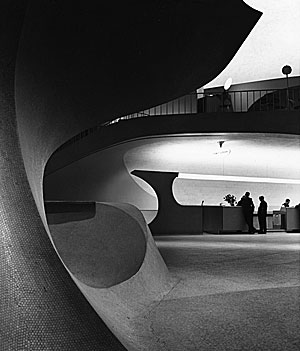
TWA Terminal at JFK
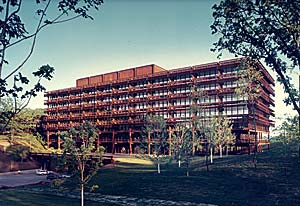
John Deere complex
Photo © Balthazar Korab (Top); Harold Corsini (above)
Eero Saarinen produced romantic Modern icons, such as the TWA Terminal at JFK (top), and businesslike winners, such as the John Deere complex (above), a stylistic range that troubled some critics.

Museums often follow trends in academe, where graduate students constantly seek fresh research topics unmined by earlier scholars. At some magic moment the recent past morphs into history, a transition that never ceases to shock those who lived through events under study. Veterans of ages past often find it hard to admit that divergent memories held by others — the Rashomon effect — might be equally valid.

A presumed benefit of younger, unbiased scholars rediscovering rather than revisiting history is their ability to assess facts without preconceptions. However, as is likewise true of all revivalist design — and Classicism in particular — striving for absolute period fidelity will not efface the telltale imprint of the present on such enterprises.

Interestingly, all four current shows focus on aspects of late Modernism far juicier than the late International Style in its tapped-out corporate phase, the easy target chosen by Postmodern revisionists three decades ago. Whether or not you like the eye-filling, high-flying postwar designs now being presented in museums from coast to coast, these dynamic schemes are far from the cliché glass-and-steel-box piñata whacked by Tom Wolfe and his fellow troglodytes.

Back when Ike was president and Frank Gehry was still Frankie Goldberg, Saarinen, Fuller, and Lautner shared not a style but an outlook, and it was anything but cautious or conformist. The unbridled architectural optimism of that moment, when a triumphant America’s prospects seemed limitless, is irresistibly appealing in contrast to today’s justifiable anxieties about a future filled with menace of every kind, and helps explain a baffling phenomenon like Santiago Calatrava, whose retrograde imagery channels the confident glamour of the early Space Age.

Monographic exhibitions on long-dead artists confirm established historical pedigrees, while assessments of more recent figures seek to solidify their status. A posthumous reputation can slip precipitously even after a stellar career, for reasons as various as poor estate planning, critical backlash, or cultural amnesia. Although few American architects have been more celebrated in their lifetimes than Eero Saarinen, whose work was lauded by the popular press as well as professional journals, his subsequent standing has become ambiguous.

The death of Saarinen in 1961 at the scandalously young age of 51 was universally mourned as a catastrophic loss to architecture. The only consolation was his having built sufficient works of distinction (so his admirers were certain) to clinch a high and lasting place in history. Yet Saarinen’s stylistically irresolute output — businesslike in one project, romantic in the next, without rhyme or reason — didn’t earn the respect of influential historian-critics such as Vincent Scully, Reyner Banham, and Manfredo Tafuri.

Within a decade of Saarinen’s death, some considered him a passé ’50s fad, an architectural hula hoop. This was a cruel reversal, though some of his best work — such as the biomorphic TWA Terminal of 1959–62 at New York’s JFK Airport — quickly entered the canon and stayed there. But uncertainty lingered about his precise rank in the Modernist pecking order.

A big part of Saarinen’s posterity problem has been the lack of advocacy literature. He wasn’t a writer, didn’t move in intellectual circles, and scholarly research was blocked by an ill-judged embargo on his archive that was lifted only after the millennium. His second wife, the well-connected art journalist Aline Saarinen, energetically promoted (and sometimes even reviewed) his work, but she survived him by little more than a decade, unlike the eternal Bauhaus widows Ise Gropius and Sibyl Moholy-Nagy, who stalked historians, courted curators, haunted conferences, and churned out letters-to-editors by the ream.

Public relations can only do so much, however, and in the end there is only the work. Recaps of even the most charmed careers can be unwittingly merciless, and Eero Saarinen: Shaping the Future reveals him to have been an astoundingly facile but sometimes depthless designer, uneven not in sustained phases but from job to job. Yet a number of his many plummy commissions turned out well enough to justify renewed interest, and his underpraised but magisterial John Deere and Company Administrative Center of 1957–63 in Moline, Illinois, now looks better than ever.

Share This Story

Looking for a reprint of this article?
From high-res PDFs to custom plaques, order your copy today!

Post a comment to this article

Report Abusive Comment

Subscription Center
  • Create an Account
  • Start a Subscription
  • Manage My Account
  • Sign Up for Newsletters
  • Visit Customer Service
  • Update Preferences

More Videos

Sponsored Content

Sponsored Content is a special paid section where industry companies provide high quality, objective, non-commercial content around topics of interest to the Architectural Record audience. All Sponsored Content is supplied by the advertising company and any opinions expressed in this article are those of the author and not necessarily reflect the views of Architectural Record or its parent company, BNP Media. Interested in participating in our Sponsored Content section? Contact your local rep!

close
  • TAMLYN XtremeTrim Exterior Trim
    Sponsored byTamlyn

    Designing Cleaner Panel Facades: Why Exterior Trim Details Matter

  • Building with Vapor Barriers
    Sponsored byReef Industries, Inc.

    Vapor Barriers Help Control Moisture in Tighter Building Designs

  • Duct Interior with Prodeq System
    Sponsored byHenry, a Carlisle Company

    Designing Resilient Water Containment Systems

DESIGN:ED Podcast
Listen to Architectural Record’s DESIGN:ED Podcast

Events

June 10, 2026

Rethinking Stormwater – The Power of Porous Paving

Credits: 1 AIA LU/HSW; 1 AIBD P-CE; 0.1 ICC CEU

Learn how porous paving systems support stormwater management, reduce heat island effects, and enhance sustainable site design performance.

June 11, 2026

Very Early Warning Fire Detection for Mission-Critical Facilities

Credits: 1 AIA LU/HSW; 1 AIBD P-CE; 0.1 ICC CEU

Examine advanced fire detection strategies that support uptime and enhance safety in data centers and other mission-critical facilities.

View All Submit An Event

Products

2026 Architect's Square Foot Costbook

2026 Architect's Square Foot Costbook

See More Products

Popular Stories

Coronado Bridge

The Architect’s Guide to San Diego

Practice Matters illustration

What’s in a (Firm’s) Name? Thinking About Succession and Legacy

Practice Matters illustration

By the Numbers: Counting America's Architects

Inward House

Inward House by VeeV Design Studio

Riverdale House by Studio Lau

Riverdale House by Studio Lau

Broader Sustainability of CMU - Free Webinar - May 21, 2026

Related Articles

  • When All Systems Seemed Go for Spaceship Earth

    See More
  • All Systems Go

    All Systems Go

    See More
  • Court Gives Go-Ahead for Jerusalem's Museum of Tolerance

    See More

Related Products

See More Products
  • facade.jpg

    Sustainable Facades: Design Methods for High-Performance Building Envelopes

  • bim design firms.jpg

    BIM for Design Firms: Data Rich Architecture at Small and Medium Scales

See More Products
×

The latest news and information

#1 Source for Architectural Design, News and Products

SUBSCRIBE
  • RESOURCES
    • Advertise
    • Contact Us
    • Submit
    • Store
  • ACCOUNT CENTER
    • Create an Account
    • Start a Subscription
    • Manage My Account
    • Sign Up for Newsletters
    • Visit Customer Service
    • Update Preferences
  • PRIVACY
    • PRIVACY POLICY
    • TERMS & CONDITIONS
    • DO NOT SELL MY PERSONAL INFORMATION
    • PRIVACY REQUEST
    • ACCESSIBILITY
  • SERVICES
    • Marketing Services
    • Reprints
    • Market Research
    • List Rental
    • Survey/Respondent Access
  • STAY CONNECTED
    • Linkedin
    • Facebook
    • Instagram
    • YouTube
    • X (Twitter)

Copyright ©2026. All Rights Reserved BNP Media, Inc. and BNP Media II, LLC.

Design, CMS, Hosting & Web Development :: ePublishing