Architectural Record
search
cart
facebook twitter linkedin youtube
  • Sign In
  • Subscribe
  • Sign Out
  • My Account
Architectural Record
  • NEWS
    • Latest News
    • Awards
    • Interviews
    • Obituaries
    • Podcasts
      • Design:Ed Podcast
      • Sponsored Podcasts
  • OPINION
    • Book Reviews / Excerpts
    • Exhibition Reviews
    • Forum
  • EXCLUSIVES
    • Videos
    • Design Vanguard
    • Top 300 Firms
    • Sponsored Content
    • Sponsored eBooks
    • From the Archives
  • CONTINUING ED
    • Editorial Continuing Ed
    • CE Center
    • CE Academies
  • PROJECTS
    • Buildings By Type
    • Reuse & Renovation
    • Museums & Arts Centers
    • Colleges & Universities
    • Multifamily Housing
    • Interiors
    • Lighting
    • Kitchen & Bath
  • HOUSES
    • Record Houses
    • House of the Month
    • Featured Houses
  • PRODUCTS
    • Products by Category
    • Record Products of the Year
    • Latest Products
  • EVENTS
    • Dates & Events
    • Record on the Road
    • Innovation Conference
    • Sustainability in Practice
    • Women In Architecture
    • Webinars
    • Ad Excellence Awards
    • Submit an Event
  • CONNECT
    • Ask RECORD AI
    • Newsletters
    • Contact
    • Advertise
    • Editorial Calendar
    • Store
    • Customer Service
  • SUBMIT
    • Submission Guidelines
    • RECORD Competitions
  • MAGAZINE
    • Subscribe
    • My Account
    • Digital Edition
    • Current Issue
    • Firm Pass
    • Historic Archive
Commentary & Criticism

One good fit and one bad in New York City

By Robert Campbell, FAIA
July 16, 2009

Curating Wright

The Wright show disappoints in other ways, too. There’s no sense of a governing critical intelligence. The exhibition is simply a haphazard attic of Wrightiana, certainly fascinating for Wright buffs, but lacking a clear point of view. The title is the giveaway: Frank Lloyd Wright: From Within Outward. The idea is that Wright designed his buildings by first planning the interior spaces, and only then shaping the exterior appearance around them. Well, sure he did, but so what? This is a tired cliché, not a stirring theme for a new exhibition. It’s an idea for an old-fashioned show on a new-fashioned artist, because the truth is that Wright is as relevant today as ever. I’d rather have seen an exhibition on Frank Lloyd Wright: Environmentalist. Wright believed in building from local materials, not from costly stuff shipped halfway around the world. Often his buildings grow from the trees and rocks of the site they’re built on. And in a world that today is sinking into universal sameness, Wright was hypersensitive to the nature of place.
The High Line
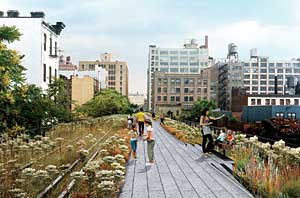
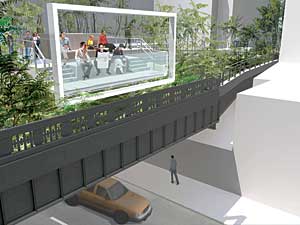
The High Line
images courtesy Diller Scofidio + Renfro and Field Operations
The High Line (renderings, top and above) transforms an elevated rail line into a linear park running through New York City’s West Side.

A friend recently came up with a definition of “place” I hadn’t heard before. “Place,” he said, “is space with meaning.” That’s a pretty good nutshell. The same week I visited the Guggenheim, I had another encounter with a “space with meaning,” when Ric Scofidio gave me a tour of the High Line, the transformation of an overhead New York City rail line into a linear park.

Part of the meaning of the High Line is its place in a larger narrative. The new park is a chapter in the story of the evolution of New York from an industrial seaport economy to a culture of leisure, culture, ideas, and tourism. The High Line becomes an emblem of that transformation. It’s a place in touch with both the past and the future.

It’s rich, too, in associations. It reminds you of the great Promenade Plantée in Paris, which helped inspire it. It recalls the great builder and destroyer Robert Moses, who constructed the High Line as part of the West Side Improvement project in the 1930s. It recalls, too, Jane Jacobs, who stopped Moses from building another overhead connector, the Lower Manhattan Expressway, and who would have loved to see his High Line transformed into a garden. One characteristic of good places is that they open a lode of connecting memories and associations. (MoMA gets another zero for this.)

This isn’t the place to review the High Line’s design, which isn’t yet finished (the first section, which runs from Gansevoort Street in the West Village to 20th Street in Chelsea, opened to the public on June 9). But as far as I could tell, the architects (it’s a collaboration between Diller Scofidio + Renfro and Field Operations) were getting everything right. Nothing has been sentimentalized; nothing looks “designed.” The planting is carefully contrived to look as if it just happened by chance, maybe when passing birds dropped the seeds. Nothing feels imposed. Your path is subtly directed, though, so that you’re intensely aware of the remains of the fading industrial world, where bold elements of concrete and steel still frame views of the city and the Hudson River. You’re equally aware of the essential three-dimensionality of urban space, too often ignored.

The seemingly accidental planting brings other associations to mind. One is with the similar rooftop gardens of Le Corbusier, like the one at his Carpenter Center at Harvard, where the original plan was to let the roof seed itself randomly over time. Another is a poem by William Carlos Williams, Spring and All, where the poet writes of weeds and grass in spring struggling for life on the road to a hospital:

Still, the profound change has come upon them: rooted, they grip down and begin to awaken.

Share This Story

Looking for a reprint of this article?
From high-res PDFs to custom plaques, order your copy today!
Robert Campbell, FAIA, was architecture critic for the Boston Globe and a longtime RECORD contributor.

Post a comment to this article

Report Abusive Comment

Subscription Center
  • Create an Account
  • Start a Subscription
  • Manage My Account
  • Sign Up for Newsletters
  • Visit Customer Service
  • Update Preferences

More Videos

Sponsored Content

Sponsored Content is a special paid section where industry companies provide high quality, objective, non-commercial content around topics of interest to the Architectural Record audience. All Sponsored Content is supplied by the advertising company and any opinions expressed in this article are those of the author and not necessarily reflect the views of Architectural Record or its parent company, BNP Media. Interested in participating in our Sponsored Content section? Contact your local rep!

close
  • TAMLYN XtremeTrim Exterior Trim
    Sponsored byTamlyn

    Designing Cleaner Panel Facades: Why Exterior Trim Details Matter

  • Building with Vapor Barriers
    Sponsored byReef Industries, Inc.

    Vapor Barriers Help Control Moisture in Tighter Building Designs

  • Duct Interior with Prodeq System
    Sponsored byHenry, a Carlisle Company

    Designing Resilient Water Containment Systems

DESIGN:ED Podcast
Listen to Architectural Record’s DESIGN:ED Podcast

Events

June 10, 2026

Rethinking Stormwater – The Power of Porous Paving

Credits: 1 AIA LU/HSW; 1 AIBD P-CE; 0.1 ICC CEU

Learn how porous paving systems support stormwater management, reduce heat island effects, and enhance sustainable site design performance.

June 11, 2026

Very Early Warning Fire Detection for Mission-Critical Facilities

Credits: 1 AIA LU/HSW; 1 AIBD P-CE; 0.1 ICC CEU

Examine advanced fire detection strategies that support uptime and enhance safety in data centers and other mission-critical facilities.

View All Submit An Event

Products

2026 Architect's Square Foot Costbook

2026 Architect's Square Foot Costbook

See More Products

Popular Stories

Practice Matters illustration

What’s in a (Firm’s) Name? Thinking About Succession and Legacy

Coronado Bridge

The Architect’s Guide to San Diego

Practice Matters illustration

By the Numbers: Counting America's Architects

Riverdale House by Studio Lau

Riverdale House by Studio Lau

House on a Hill

Design Vanguard 2026: Forma

Broader Sustainability of CMU - Free Webinar - May 21, 2026

Related Articles

  • One good fit and one bad in New York City

    See More
  • The Juilliard School in New York City

    See More
  • 450 West 37th Street in New York City

    See More

Related Products

See More Products
  • WC_-SCA.png

    Building Great Schools for a Great City

See More Products
×

The latest news and information

#1 Source for Architectural Design, News and Products

SUBSCRIBE
  • RESOURCES
    • Advertise
    • Contact Us
    • Submit
    • Store
  • ACCOUNT CENTER
    • Create an Account
    • Start a Subscription
    • Manage My Account
    • Sign Up for Newsletters
    • Visit Customer Service
    • Update Preferences
  • PRIVACY
    • PRIVACY POLICY
    • TERMS & CONDITIONS
    • DO NOT SELL MY PERSONAL INFORMATION
    • PRIVACY REQUEST
    • ACCESSIBILITY
  • SERVICES
    • Marketing Services
    • Reprints
    • Market Research
    • List Rental
    • Survey/Respondent Access
  • STAY CONNECTED
    • Linkedin
    • Facebook
    • Instagram
    • YouTube
    • X (Twitter)

Copyright ©2026. All Rights Reserved BNP Media, Inc. and BNP Media II, LLC.

Design, CMS, Hosting & Web Development :: ePublishing