Architectural Record
search
cart
facebook twitter linkedin youtube
  • Sign In
  • Subscribe
  • Sign Out
  • My Account
Architectural Record
  • NEWS
    • Latest News
    • Awards
    • Interviews
    • Obituaries
    • Podcasts
      • Design:Ed Podcast
      • Sponsored Podcasts
  • OPINION
    • Book Reviews / Excerpts
    • Exhibition Reviews
    • Forum
  • EXCLUSIVES
    • Videos
    • Design Vanguard
    • Top 300 Firms
    • Sponsored Content
    • Sponsored eBooks
    • From the Archives
  • CONTINUING ED
    • Editorial Continuing Ed
    • CE Center
    • CE Academies
  • PROJECTS
    • Buildings By Type
    • Reuse & Renovation
    • Museums & Arts Centers
    • Colleges & Universities
    • Multifamily Housing
    • Interiors
    • Lighting
    • Kitchen & Bath
  • HOUSES
    • Record Houses
    • House of the Month
    • Featured Houses
  • PRODUCTS
    • Products by Category
    • Record Products of the Year
    • Latest Products
  • EVENTS
    • Dates & Events
    • Record on the Road
    • Innovation Conference
    • Sustainability in Practice
    • Women In Architecture
    • Webinars
    • Ad Excellence Awards
    • Submit an Event
  • CONNECT
    • Ask RECORD AI
    • Newsletters
    • Contact
    • Advertise
    • Editorial Calendar
    • Store
    • Customer Service
  • SUBMIT
    • Submission Guidelines
    • RECORD Competitions
  • MAGAZINE
    • Subscribe
    • My Account
    • Digital Edition
    • Current Issue
    • Firm Pass
    • Historic Archive
Commentary & Criticism

Connect the dots: Dubai, labor, urbanism, sustainability, and the education of architects

By Michael Sorkin
August 16, 2009

There are some small signs of movement, especially in the stirrings of fungibility on the part of planning and landscape. Although I run a program in urban design, I have a fundamental disbelief in any unitary discourse of the city and try to offer access to many. Originally conceived as a way of recuperating physical design from a planning profession that had fallen in thrall to the social sciences, urban design is often taught simply as big building and fixates excessively on historic patterns. But urbanism’s most desperate needs devolve on the new morphologies of sustainability and equity that an exponentially urbanizing world so urgently needs. The urban population increases at the rate of a million people a week and, to me at least, that means that we need to create numerous new cities on an urgent basis, cities that are able to provide for themselves and provide rich lives to diverse populations.
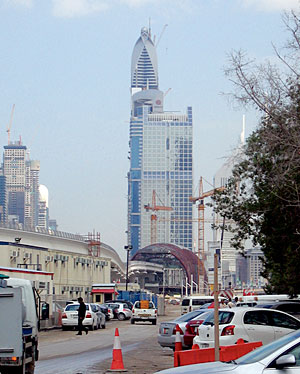
Dubai
Photo ' Robert Ivy
Dubai presents visitors with a still-evolving skyline of the latest and sometimes craziest architectural forms.

The emergence of “landscape urbanism” as a position, if not a discipline, is a hopeful sign. Not simply does the conceit represent the rejection of a hard boundary between the practices of landscape architecture and urban design and planning; it stands, in theory, for a more holistic view of the environment and the indispensability of an integrated perspective in thinking about projects that exceed the architectural scale. And it suggests a strategy of inclusion, rather than an endless consideration of what the disciplines are not. Still, from the perspective of education, it feels a little like rearranging the deck chairs while preserving distinctions that have outlived their usefulness. As environmentalism becomes more and more the central authority for all design, why retain any boundaries at all?

I’ve been dreaming about a school of design that takes the unity, not the autonomy, of disciplines as its predicate, a way of opening the field to the real possibility of its diversity. Our boldest experiments haven’t gotten us too far. The Bauhaus focused, in varying degrees, on social production but retained disciplinary compartments and continued to see architecture as the eternal mother. It had indifferent ideas about the city and virtually nothing to say about the environment. More idiosyncratic, home-grown experiments like Taliesin or Arcosanti also fixated too much on the leading role of architecture (and the infallibility of their particular popes), and were passionately unscientific, though they did have deep commitments to craft and the earth. Alas, architecture’s historic and dangerous conflation of megalomania with the big scale led them to social and organizational dead ends.

Our divided professions tenaciously guard their turf and look disdainfully at neighboring disciplines. How tiresome this is! While I am not suggesting that each designer be an impossibly learned polymath, I am arguing that the common ethical and environmental basis for design is becoming more and more apparent and more and more urgently part of the necessary equipment of anyone who aspires to take an active role in shaping the planet. One solution is to give each student entering a school of design a common grounding on which to build later specialization. This would include rigorous introductions to the environment and natural systems, deep immersion in the social and economic modes of production of the built world, and a vivid grounding in the global histories of physical responses to the question of habitation at every scale.

New kinds of schools

Providing this foundation will take time. Just as so many undergraduate architecture programs are formulae for fundamental illiteracy (too much time spent learning structures and CAD, none on Shakespeare, Oceanic art, or The Tale of Genji), so this reform of the design curriculum carries risks. If the years devoted to education aren’t expanded, then something crucial must be eliminated. Or we can begin to think that design education might be dedicated to producing activists who are prepared either to step into the design environment in a literate and engaged way or to continue to deepen a particular specialization. I don’t argue that the professions must die as autonomous pursuits, rather that we recognize — with new kinds of degrees and new kinds of schools — their deep common basis and the need for new and refreshed syntheses.

Received writ prescribes isolating the men from the women at that school in the Gulf without any particularly satisfying arguments — beyond obedience or human frailty — and so does it keep our own practices and people apart. Witness the appalling state of the earth; we clearly need to educate designers differently. This will mean focusing on what brings us together rather than what keeps us apart. Designers should be equipped with the knowledge of what makes a building sustainable, what drives construction workers to despair, what makes the city humane, what deepens our connection to the landscape, what gives us a sense of real connection to each other. n

Share This Story

Looking for a reprint of this article?
From high-res PDFs to custom plaques, order your copy today!

Post a comment to this article

Report Abusive Comment

Subscription Center
  • Create an Account
  • Start a Subscription
  • Manage My Account
  • Sign Up for Newsletters
  • Visit Customer Service
  • Update Preferences

More Videos

Sponsored Content

Sponsored Content is a special paid section where industry companies provide high quality, objective, non-commercial content around topics of interest to the Architectural Record audience. All Sponsored Content is supplied by the advertising company and any opinions expressed in this article are those of the author and not necessarily reflect the views of Architectural Record or its parent company, BNP Media. Interested in participating in our Sponsored Content section? Contact your local rep!

close
  • TAMLYN XtremeTrim Exterior Trim
    Sponsored byTamlyn

    Designing Cleaner Panel Facades: Why Exterior Trim Details Matter

  • Building with Vapor Barriers
    Sponsored byReef Industries, Inc.

    Vapor Barriers Help Control Moisture in Tighter Building Designs

  • Duct Interior with Prodeq System
    Sponsored byHenry, a Carlisle Company

    Designing Resilient Water Containment Systems

DESIGN:ED Podcast
Listen to Architectural Record’s DESIGN:ED Podcast

Events

June 10, 2026

Rethinking Stormwater – The Power of Porous Paving

Credits: 1 AIA LU/HSW; 1 AIBD P-CE; 0.1 ICC CEU

Learn how porous paving systems support stormwater management, reduce heat island effects, and enhance sustainable site design performance.

June 11, 2026

Very Early Warning Fire Detection for Mission-Critical Facilities

Credits: 1 AIA LU/HSW; 1 AIBD P-CE; 0.1 ICC CEU

Examine advanced fire detection strategies that support uptime and enhance safety in data centers and other mission-critical facilities.

View All Submit An Event

Products

2026 Architect's Square Foot Costbook

2026 Architect's Square Foot Costbook

See More Products

Popular Stories

Practice Matters illustration

What’s in a (Firm’s) Name? Thinking About Succession and Legacy

Practice Matters illustration

By the Numbers: Counting America's Architects

Riverdale House by Studio Lau

Riverdale House by Studio Lau

House on a Hill

Design Vanguard 2026: Forma

Crane Cove, ONO

Design Vanguard 2026 Winners

Broader Sustainability of CMU - Free Webinar - May 21, 2026

Related Articles

  • Connect the dots: Dubai, labor, urbanism, sustainability, and the education of architects

    See More
  • SHoP's design for Atlassian in Sydney.

    Continuing Education: The Office of the Future

    See More
  • Continuing Education: The Future of Glass

    See More

Related Products

See More Products
  • 0470130628.gif

    Sustainable Design: The Science of Sustainability and Green Engineering

  • 047177751X.gif

    Sustainable Urbanism: Urban Design With Nature

  • reuse.jpg

    Resource Salvation: The Architecture of Reuse

See More Products
×

The latest news and information

#1 Source for Architectural Design, News and Products

SUBSCRIBE
  • RESOURCES
    • Advertise
    • Contact Us
    • Submit
    • Store
  • ACCOUNT CENTER
    • Create an Account
    • Start a Subscription
    • Manage My Account
    • Sign Up for Newsletters
    • Visit Customer Service
    • Update Preferences
  • PRIVACY
    • PRIVACY POLICY
    • TERMS & CONDITIONS
    • DO NOT SELL MY PERSONAL INFORMATION
    • PRIVACY REQUEST
    • ACCESSIBILITY
  • SERVICES
    • Marketing Services
    • Reprints
    • Market Research
    • List Rental
    • Survey/Respondent Access
  • STAY CONNECTED
    • Linkedin
    • Facebook
    • Instagram
    • YouTube
    • X (Twitter)

Copyright ©2026. All Rights Reserved BNP Media, Inc. and BNP Media II, LLC.

Design, CMS, Hosting & Web Development :: ePublishing