Architectural Record
search
cart
facebook twitter linkedin youtube
  • Sign In
  • Subscribe
  • Sign Out
  • My Account
Architectural Record
  • NEWS
    • Latest News
    • Awards
    • Interviews
    • Obituaries
    • Podcasts
      • Design:Ed Podcast
      • Sponsored Podcasts
  • OPINION
    • Book Reviews / Excerpts
    • Exhibition Reviews
    • Forum
  • EXCLUSIVES
    • Videos
    • Design Vanguard
    • Top 300 Firms
    • Sponsored Content
    • Sponsored eBooks
    • From the Archives
  • CONTINUING ED
    • Editorial Continuing Ed
    • CE Center
    • CE Academies
  • PROJECTS
    • Buildings By Type
    • Reuse & Renovation
    • Museums & Arts Centers
    • Colleges & Universities
    • Multifamily Housing
    • Interiors
    • Lighting
    • Kitchen & Bath
  • HOUSES
    • Record Houses
    • House of the Month
    • Featured Houses
  • PRODUCTS
    • Products by Category
    • Record Products of the Year
    • Latest Products
  • EVENTS
    • Dates & Events
    • Record on the Road
    • Innovation Conference
    • Sustainability in Practice
    • Women In Architecture
    • Webinars
    • Ad Excellence Awards
    • Submit an Event
  • CONNECT
    • Ask RECORD AI
    • Newsletters
    • Contact
    • Advertise
    • Editorial Calendar
    • Store
    • Customer Service
  • SUBMIT
    • Submission Guidelines
    • RECORD Competitions
  • MAGAZINE
    • Subscribe
    • My Account
    • Digital Edition
    • Current Issue
    • Firm Pass
    • Historic Archive
Design Vanguard

FRPO (Rodr'guez & Oriol Architecture)

A pair of Spanish architects pulls apart programs, then assembles designs with repetitive elements that create rich compositions.
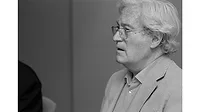
By David Cohn
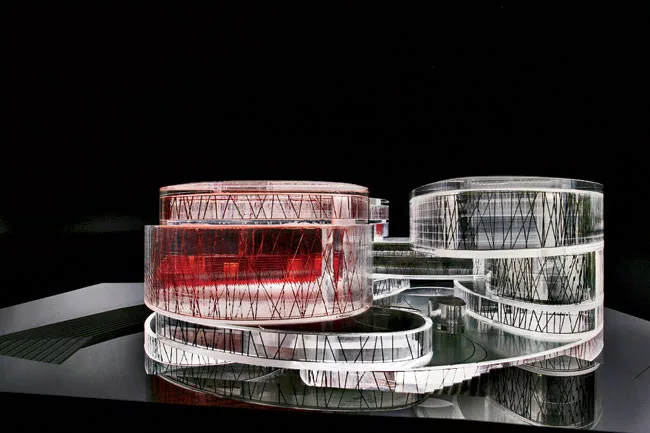
The Access and Services Building stacks 14 programmatic elements on five independent vertical cores. The elliptical shapes overlap within the circular building envelope. The firm won a 2008 competitio
Madrid City of Justice
FRPO (Rodr'guez & Oriol Architecture)
Madrid, Spain
The Access and Services Building stacks 14 programmatic elements on five independent vertical cores. The elliptical shapes overlap within the circular building envelope. The firm won a 2008 competition with Estudio Cano Lasso, but the project has been suspended due to a lack of funding.
Photo © Federico L'pez
This lightweight structure in northern Madrid is built of computer-cut, cross-laminated wood walls, floors, and roofs, and floats on micropiles so as not to harm tree roots. Eleven pavilions (living,
Mo House
FRPO (Rodr'guez & Oriol Architecture)
Madrid, Spain
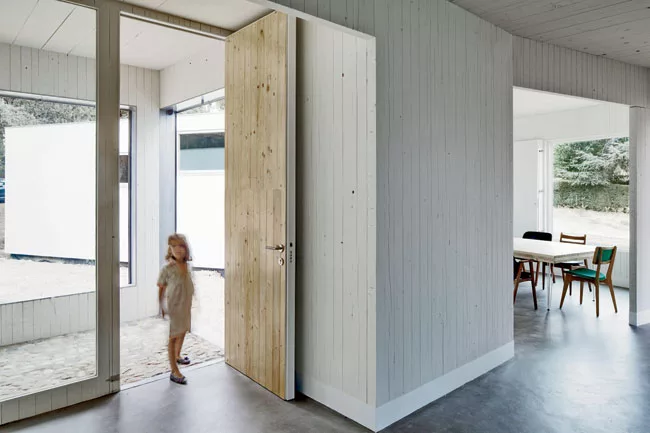
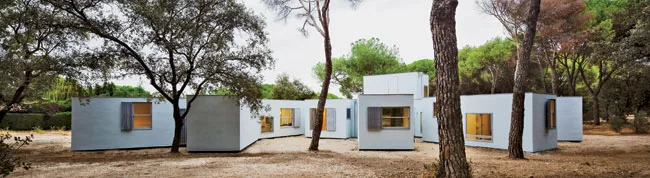
This lightweight structure in northern Madrid is built of computer-cut, cross-laminated wood walls, floors, and roofs, and floats on micropiles so as not to harm tree roots. Eleven pavilions (living, bedrooms, kitchen, studio, etc.) spread out between the trees and are linked by wide circulation spaces into which activities can spill. The stucco exterior, painted-wood interior walls, and continuous concrete floors unify the design. The pavilions' skewed layout creates tangled views through them of indoors and out, and a series of semi-enclosed exterior spaces. The design exemplifies the architects' search for 'systems that generate complexity,' explains Rodr'guez.
Photo © Miguel De Guzm'n
This lightweight structure in northern Madrid is built of computer-cut, cross-laminated wood walls, floors, and roofs, and floats on micropiles so as not to harm tree roots. Eleven pavilions (living,
Mo House
FRPO (Rodr'guez & Oriol Architecture)
Madrid, Spain
This lightweight structure in northern Madrid is built of computer-cut, cross-laminated wood walls, floors, and roofs, and floats on micropiles so as not to harm tree roots. Eleven pavilions (living, bedrooms, kitchen, studio, etc.) spread out between the trees and are linked by wide circulation spaces into which activities can spill. The stucco exterior, painted-wood interior walls, and continuous concrete floors unify the design. The pavilions' skewed layout creates tangled views through them of indoors and out, and a series of semi-enclosed exterior spaces. The design exemplifies the architects' search for 'systems that generate complexity,' explains Rodr'guez.
Photo © Miguel De Guzm'n
For protection from sea winds, the architects excavated a sunken garden on the southern exposure of this lot on the Cantabria coast and built the house over it. Patios for light and circulation slice
OS House
FRPO (Rodr'guez & Oriol Architecture)
Cantabria Coast, Spain
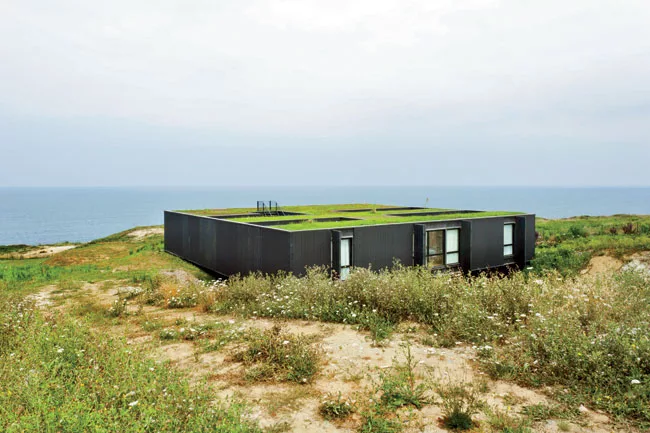
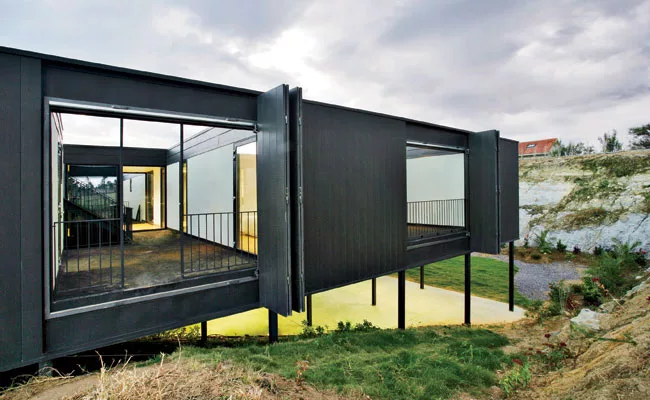
For protection from sea winds, the architects excavated a sunken garden on the southern exposure of this lot on the Cantabria coast and built the house over it. Patios for light and circulation slice through the compact volume to create a hierarchy of uses. The core living area with bedrooms and studio functions independently from less-defined spaces for children, grandchildren, and guests. Spaces open into one another in every direction for flexibility. 'The rooms are simple rectangles,' says Pablo Oriol, 'but all the connections result in complex spatial relations, with transparency from room to room.' The dry-assembled steel structure is clad in zinc.
Photo © Jan Bitter
For protection from sea winds, the architects excavated a sunken garden on the southern exposure of this lot on the Cantabria coast and built the house over it. Patios for light and circulation slice
OS House
FRPO (Rodr'guez & Oriol Architecture)
Cantabria Coast, Spain
For protection from sea winds, the architects excavated a sunken garden on the southern exposure of this lot on the Cantabria coast and built the house over it. Patios for light and circulation slice through the compact volume to create a hierarchy of uses. The core living area with bedrooms and studio functions independently from less-defined spaces for children, grandchildren, and guests. Spaces open into one another in every direction for flexibility. 'The rooms are simple rectangles,' says Pablo Oriol, 'but all the connections result in complex spatial relations, with transparency from room to room.' The dry-assembled steel structure is clad in zinc.
Photo © Jos' Hevia
Warsaw's modern-art museum organized an invited competition for a pavilion promoting its upcoming new building. FRPO proposed a transparent 'art box' set in an 'info forest' of flat wood masts, inviti
Museum of Modern Art in Warsaw
FRPO (Rodr'guez & Oriol Architecture)
Warsaw
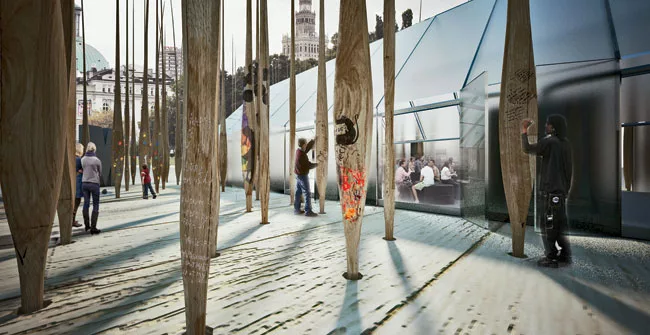
Warsaw's modern-art museum organized an invited competition for a pavilion promoting its upcoming new building. FRPO proposed a transparent 'art box' set in an 'info forest' of flat wood masts, inviting visitors to 'exchange thoughts, drawings, or messages.' The architects explain, 'Citizens interchange experience with curators through contributions to… the space around the events container.'
Image courtesy FRPO
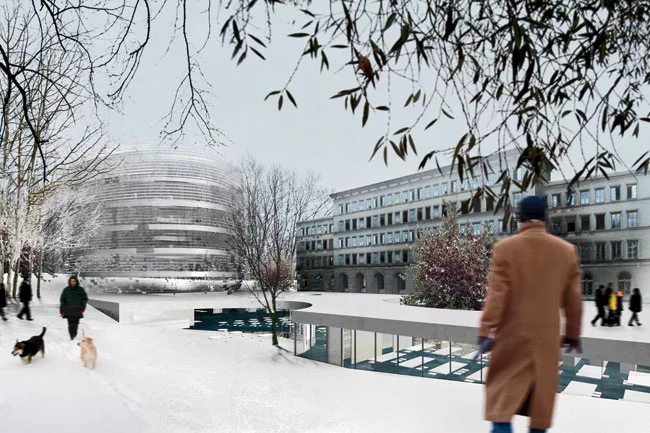
The architects cite Anish Kapoor's Cloud Gate sculpture in Chicago's Millennium Park as an inspiration for their proposed addition to the WTO headquarters in Geneva. A glass and aluminum 'bubble' hous
World Trade Organization
FRPO (Rodr'guez & Oriol Architecture)
Geneva
The architects cite Anish Kapoor's Cloud Gate sculpture in Chicago's Millennium Park as an inspiration for their proposed addition to the WTO headquarters in Geneva. A glass and aluminum 'bubble' houses new offices and is linked to the existing building via an underground wing containing a cafeteria, library, and auditorium. The compact shape offers good energy performance and minimizes the visual impact of the building on its parklike setting near Lake L'man.
Image courtesy FRPO
The Access and Services Building stacks 14 programmatic elements on five independent vertical cores. The elliptical shapes overlap within the circular building envelope. The firm won a 2008 competitio
This lightweight structure in northern Madrid is built of computer-cut, cross-laminated wood walls, floors, and roofs, and floats on micropiles so as not to harm tree roots. Eleven pavilions (living,
For protection from sea winds, the architects excavated a sunken garden on the southern exposure of this lot on the Cantabria coast and built the house over it. Patios for light and circulation slice
Warsaw's modern-art museum organized an invited competition for a pavilion promoting its upcoming new building. FRPO proposed a transparent 'art box' set in an 'info forest' of flat wood masts, inviti
The architects cite Anish Kapoor's Cloud Gate sculpture in Chicago's Millennium Park as an inspiration for their proposed addition to the WTO headquarters in Geneva. A glass and aluminum 'bubble' hous
December 16, 2012

Madrid

When approaching a design problem, Madrid-based architects Fernando Rodr'guez and Pablo Oriol of the firm FRPO try to find a method of attack rather than jumping right in with a solution. Their process often involves breaking the building program into its basic elements, which they then weave back together in surprising ways. Oriol explains, 'We try to arrive at a systematic simplicity, establishing basic rules of play for the design process'but ones that are capable of assuming the full complexity of the program and result in spatial richness.'

A case in point is their 2008 competition-winning design for the Access and Services Building at the Madrid City of Justice (with Estudio Cano Lasso; suspended due to lack of funds), where they tackled a program with disparate elements such as a TV studio, a sequestered jurors' residence, and an auditorium. Their design broke these elements into elliptical discs superimposed over one another at different angles, with terraces, overhangs, and voids in between.

The firm's method can produce very compact designs, such as the OS House on the coast of Cantabria, Spain (2005; with Marco Gonz'lez), or ones that spread like an amoeba between the trees (MO House, Madrid, 2012). It develops projects through multiple models, often shuffling around repetitive elements.

Using patterns of repeated cells in projects is not unusual among other graduates of Madrid's school of architecture, including Luis Mansilla and Emilio Tu''n and the partners in Estudio Entresitio. A number of 'organicist' buildings from the 1960s are based on the same principle, such as the striking White City vacation apartments in Alc'dia, Mallorca (1964), by legendary Madrid teacher Francisco J. S'enz de Oiza. In FRPO's projects, however, cells are not repetitive in size or shape, and their combinations do not necessarily follow regular patterns. The process is both more intuitive and more empirical, responding to the specific conditions of each problem.

The two architects, both 35, became friends in their first year at architecture school in 1995. They pooled resources with other students to share a rented studio, where group members helped each other on school presentations, a common practice in Spain that is often the seed for future firms. Incorporated as Nolaster, the group continued to work together on various projects after graduation, and finally dissolved in 2007. By then Rodr'guez and Oriol had won the City of Justice commission.

Such networking continues to be one of the firm's basic strategies for finding work in these difficult times. For a major competition like the City of Justice, they approached more experienced colleagues'the Cano brothers'for help. Now, like other Spanish firms, FRPO must look abroad for work. Oriol studied for a year at Chicago's IIT, and Rodr'guez spent a year in Berlin. These experiences helped prepare them for competitions for Chicago's Union Station (honorable mention), the World Trade Organization extension in Geneva (second prize), and a pavilion for the Museum of Modern Art in Warsaw. Despite hard times, the architects are optimistic about the future. 'Our position is better than a few years ago,' Oriol maintains. 'Spanish society is better educated, and people are better prepared to appreciate what architects do. For our part, we have to build bridges of understanding with the society in which we live.'

FRPO (Rodr'guez & Oriol Architecture)

FOUNDED: 2007

DESIGN STAFF: 5   

PRINCIPAL: Fernando Rodríguez, Pablo Oriol

EDUCATION: Rodr'guez: ETSA Madrid, M.Arch., 2003. Oriol: ETSA Madrid, M.Arch., 2005.

WORK HISTORY: Rodr'guez: Nolaster, 2005'07. Oriol: Nolaster, 2005'07.

KEY COMPLETED PROJECTS: MO House, Madrid, 2012; El T'rtaro Club, Madrid, 2011; JL Apartment, Madrid, 2011; VS Apartments, Valladolid, Spain, 2008; Plaza de las Letras, Madrid, 2007; OS House, Santander, Spain, 2005

KEY CURRENT PROJECTS: Access and Services Building, Madrid City of Justice (suspended); Woodstone House I, Cantabria, Spain, 2012; VT House, Madrid, 2012; Woodstone House II, Cantabria, 2013; WTVN Villas, Bali, 2013

WEB SITE: www.frpo.es


Share This Story

Looking for a reprint of this article?
From high-res PDFs to custom plaques, order your copy today!
David Cohn is a Madrid-based architecture critic and international correspondent for Architectural Record. His latest book, Spain: Modern Architectures in History, was released in 2025.

Post a comment to this article

Report Abusive Comment

Subscription Center
  • Create an Account
  • Start a Subscription
  • Manage My Account
  • Sign Up for Newsletters
  • Visit Customer Service
  • Update Preferences

More Videos

Sponsored Content

Sponsored Content is a special paid section where industry companies provide high quality, objective, non-commercial content around topics of interest to the Architectural Record audience. All Sponsored Content is supplied by the advertising company and any opinions expressed in this article are those of the author and not necessarily reflect the views of Architectural Record or its parent company, BNP Media. Interested in participating in our Sponsored Content section? Contact your local rep!

close
  • TAMLYN XtremeTrim Exterior Trim
    Sponsored byTamlyn

    Designing Cleaner Panel Facades: Why Exterior Trim Details Matter

  • Building with Vapor Barriers
    Sponsored byReef Industries, Inc.

    Vapor Barriers Help Control Moisture in Tighter Building Designs

  • Duct Interior with Prodeq System
    Sponsored byHenry, a Carlisle Company

    Designing Resilient Water Containment Systems

DESIGN:ED Podcast
Listen to Architectural Record’s DESIGN:ED Podcast

Events

June 10, 2026

Rethinking Stormwater – The Power of Porous Paving

Credits: 1 AIA LU/HSW; 1 AIBD P-CE; 0.1 ICC CEU

Learn how porous paving systems support stormwater management, reduce heat island effects, and enhance sustainable site design performance.

June 11, 2026

Very Early Warning Fire Detection for Mission-Critical Facilities

Credits: 1 AIA LU/HSW; 1 AIBD P-CE; 0.1 ICC CEU

Examine advanced fire detection strategies that support uptime and enhance safety in data centers and other mission-critical facilities.

View All Submit An Event

Products

2026 Architect's Square Foot Costbook

2026 Architect's Square Foot Costbook

See More Products

Popular Stories

Coronado Bridge

The Architect’s Guide to San Diego

Practice Matters illustration

What’s in a (Firm’s) Name? Thinking About Succession and Legacy

Practice Matters illustration

By the Numbers: Counting America's Architects

Inward House

Inward House by VeeV Design Studio

Riverdale House by Studio Lau

Riverdale House by Studio Lau

Broader Sustainability of CMU - Free Webinar - May 21, 2026

Related Articles

  • DH Palencia Power Plant

    Translucent Panels Sinuously Wrap FRPO’s Biomass Plant in Spain

    See More
  • Oriol Bohigas Obituary

    Oriol Bohigas, 1925–2021

    See More
  • Gund-Hall-1.jpg

    The Architecture of Architecture Schools

    See More

Related Products

See More Products
  • ribbonarch.jpg

    Ribbon Architecture: Light, Shadow, and Reflection in Architecture

  • freeing arch.jpg

    Freeing Architecture

See More Products
×

The latest news and information

#1 Source for Architectural Design, News and Products

SUBSCRIBE
  • RESOURCES
    • Advertise
    • Contact Us
    • Submit
    • Store
  • ACCOUNT CENTER
    • Create an Account
    • Start a Subscription
    • Manage My Account
    • Sign Up for Newsletters
    • Visit Customer Service
    • Update Preferences
  • PRIVACY
    • PRIVACY POLICY
    • TERMS & CONDITIONS
    • DO NOT SELL MY PERSONAL INFORMATION
    • PRIVACY REQUEST
    • ACCESSIBILITY
  • SERVICES
    • Marketing Services
    • Reprints
    • Market Research
    • List Rental
    • Survey/Respondent Access
  • STAY CONNECTED
    • Linkedin
    • Facebook
    • Instagram
    • YouTube
    • X (Twitter)

Copyright ©2026. All Rights Reserved BNP Media, Inc. and BNP Media II, LLC.

Design, CMS, Hosting & Web Development :: ePublishing