A Force of Nature
As design teams work toward harnessing air flows around buildings, they are producing some intriguing structures. But just how viable is wind power as a source of on-site renewable energy?
Wind power is the fastest-growing source of megawatts thanks to the jumbo-jet-sized turbines sprouting en masse worldwide. But it also has a significant presence in the city, where gusts regularly send umbrellas to landfills. Rather than considering it a nuisance, architects increasingly view urban wind as a renewable resource for on-building power generation.
Building-integrated wind power (BIWP)—wind turbines mounted on or incorporated within an occupied structure—may lack wind farms’ economies of scale. But like the leading source of on-building renewables—photovoltaics (PVs)—wind turbines offer some advantages in architectural applications. No roads get cut through wilderness to erect towers, and they deliver electricity without power lines and transmission losses. Wind turbines are also attractive to designers and clients looking to express a commitment to sustainability.
Such benefits provide potential for dramatic growth, says mechanical engineer Roger Frechette, principal in the Washington, D.C., office of Interface Engineering. “If there’s data showing that BIWP works and testimony that it’s a good thing to do, there will be an explosion,” he predicts.
So far, however, data is thin, and testimonials show that BIWP is tough to implement. While PV panels are svelte, solid-state devices, turbines are weighty machines that vibrate, make noise, and place stresses on buildings. And those drawbacks vary depending on site factors such as weather, as well as on the turbine selected.
Propeller-style turbines, akin to those used at utility scale, must always face the wind for their airfoil blades to generate lift and spin their horizontal shafts. In contrast, vertical-axis wind turbines (VAWTs), whose upright blades spin a vertical shaft, are agnostic to wind direction. And some eschew airfoils for blades that simply catch wind drag. These drag-based VAWTs are less efficient, but they tolerate turbulent air and produce less noise.
The wind resource itself is harder to assess than the rays harvested with PVs. Speed, direction, and turbulence are affected by local landscape, surrounding structures, and the building they are part of. “Wind in an urban setting is complex and irrational and very difficult to predict,” says John Breshears, president of Architectural Applications, a Portland, Oregon'based engineering and design firm.
Urban wind complexity puts a premium on local wind and weather data and aerodynamic analysis. Tools for the latter are improving, says Gordon Gill, partner at Adrian Smith + Gordon Gill Architecture in Chicago. Desktop computational-fluid-dynamics (CFD) software provides an “almost real-time” simulation of wind behavior. Gill’s firm routinely applies CFD tools from the earliest design stages for a variety of tasks, such as evaluating opportunities for natural ventilation and assessing the impact of downdrafts at street level.
DOCUMENTED IN DETAIL
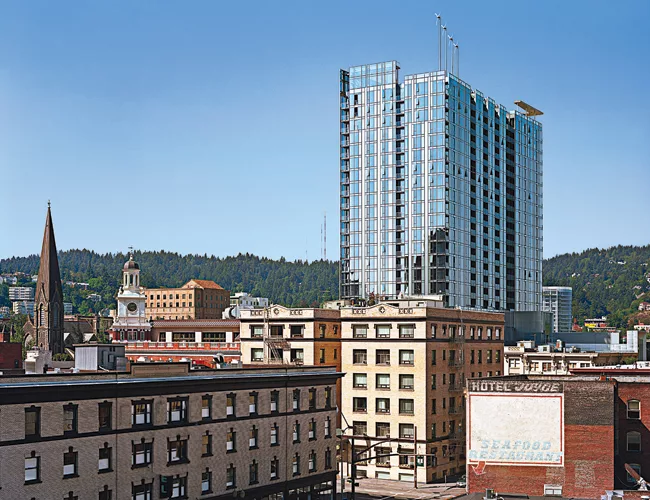
Portland’s Twelve West, a LEED Platinum, mixed-use high-rise by ZGF Architects completed in 2009, exemplifies BIWP’s challenges and opportunities. Fortunately for all who follow, the turbine-system design process was documented in detail by its designers at ZGF: engineer Craig Briscoe, now director of integrated design for the m/e/p firm Glumac, and Breshears.
The pair got started in early 2007 when the client-developer suggested BIWP as a means of helping the project achieve its lofty sustainability goals. Sketches of rooftop turbines—the only option left, since building design was nearly complete—clinched the developer’s interest. Since BIWP was uncharted territory and Portland’s winds are mediocre, ZGF proposed to pursue it as an experiment. “To our surprise they went for it,” says Briscoe.
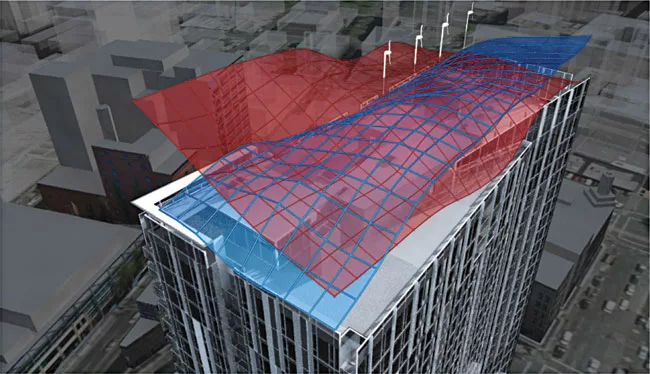
First step: predicting what would be blowing over the 22-story building. Briscoe and Breshears brought in Dutch aerodynamicist Sander Mertens, founder of Delft-based consulting firm Ingreenious. He generated a CFD model of wind regimes around the building, relying on data from Portland’s airport and a NASA database. He projected an average wind speed at roof level of 4.9 meters per second.
AeroVironment, a Monrovia, California'based engineering firm then selling small propeller-style turbines for low-rise buildings, helped ZGF decide where to put turbines. Thomas Zambrano, AeroVironment senior scientist, spent several days with Breshears and Briscoe at a wind-tunnel facility observing air flows around a scale model of Twelve West using bits of thread, cassette tape, and toy airplane propellers. They mapped turbulence above the roof and determined that turbines on its north side, atop 45-foot-tall masts, would “see” an optimally smooth airstream.
From a field of 45 manufacturers, few of which had performance data or certifications for their turbines, ZGF fixed on the Skystream 3.7 horizontal-axis turbine produced by Flagstaff, Arizona'based Southwest Windpower. Its reliability record and certifications for the 12-foot-diameter machine put it way ahead of the pack. Southwest agreed to warranty the product for ZGF’s BIWP application—something that turbine makers (including Southwest) typically shy away from, fearing that turbulence will cause premature wear.
A final step was minimizing vibration and sound. This was doubly important for Twelve West, where the turbines would rise above penthouse apartments. To date there have been no complaints, according to Breshears and Briscoe. But in terms of power generation—BIWP’s raison d’être—it’s only a partial win. The four turbines deliver about 65 percent of the expected 10,000 to 12,000 kilowatt-hours per year. The shortfall comes in winter, when turbulence causes one turbine to pivot away from the rest.
Breshears and Briscoe say Twelve West shows the value of considering BIWP early in design. Masts 10 to 15 feet taller would have done the trick, but maintenance crews would not have been able to lay them flat within the already determined roof design.
While output is limited—about enough to run the elevators—the ZGF team bets that BIWP is making Twelve West’s occupants more aware of the relationship between their behavior and energy demand. For example, people who see the turbines may decide to take the stairs, especially if they know that the supply of clean energy pales in comparison to consumption. As Briscoe puts it, BIWP sends a message about “the importance of using a lot less energy in general.”
SHAPED AND SCULPTED
Architects, meanwhile, are looking beyond rooftops toward building designs that enhance their BIWP potential. Such buildings are sculpted to accelerate wind and maximize BIWP output. They are exciting visual statements, though a dearth of performance data makes their success hard to assess.
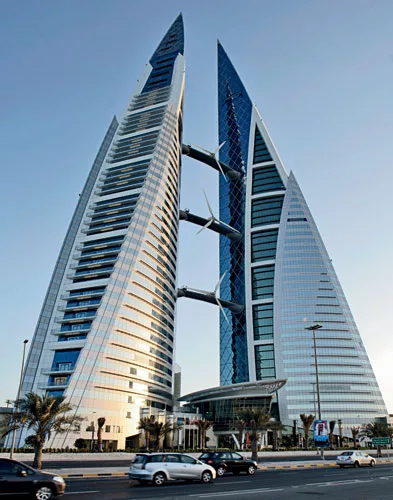
The first high-profile accelerator design was the Bahrain World Trade Center (WTC), completed in 2008 with three 95-foot-diameter horizontal-axis turbines mounted on bridgeways between twin 50-story towers. Danish turbine manufacturer Norwin provided the 225-kilowatt (kW) turbines, which architect Atkins Global predicted would generate up to 1,300 megawatt-hours (mWh) per year. That would be 200 times greater than Twelve West’s BIWP output and would satisfy 11 to 15 percent of the building’s consumption.
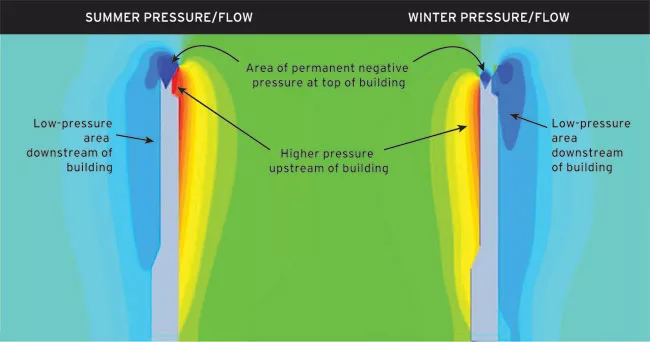
Longer turbine blades multiply the output, because wind power increases as the square of a turbine’s swept radius. Another boost is the buildings’ scooped shape, which is intended to induce an aerodynamic Venturi effect and accelerate air flow between them. That’s a plus since wind power increases as the cube of wind speed.
Real output, however, remains an open question. An Atkins press representative confirms that the turbines are running but says the firm is not free to release operational data. Furthermore, BIWP experts have low expectations. One cause for doubt is the turbines’ fixed orientation. Unlike those at Twelve West, the WTC turbines cannot turn with the wind.
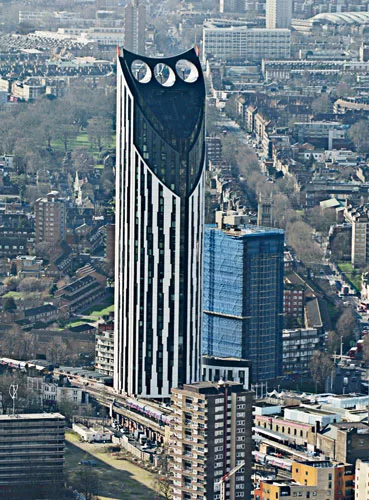
Data is also unavailable for a more recent BIWP icon: London’s Strata SE1, a 485-foot-tall residential tower completed in 2010. In this case it is unclear whether BIWP is generating any electricity.
Strata’s designers at London-based BFLS turned to BIWP to meet renewable-energy mandates, according to the firm’s associate director Robbie Turner, who led the Strata team from planning consent through completion. BIWP got the nod through an intensive design assessment that deemed other options, such as geothermal and solar energy, to be infeasible given Strata’s footprint, its “rights of light” envelope, and its residential program.
BFLS opted to place three 19-kW Norwin turbines within three cowls punched through the top, facing the London summer’s southwesterly winds. A series of inertia-damping pads below the turbines mitigate vibration, and five-bladed rotors were used to reduce noise-generating vortices from the blade tips. The design team anticipated that the turbines could generate 50 mWh per year—up to 8 percent of consumption.
Today the website maintained by Strata’s rental managers presents the turbines as a feature that “translates directly into electricity bill savings for every [sic] of the 408 apartments.” Unfortunately, there is no evidence they are operating. Norwin CEO Ole Sangill says he cannot confirm that Strata’s turbines are running because Norwin’s monitoring system is disconnected.
What is known is that Strata’s BIWP hit technical snags during building commissioning. Sangill cites interference from a system designed to protect maintenance crews that prevented the turbines from operating. Turner says voltage fluctuations on the local grid similarly prompted the BIWP control panel to turn off the turbines.
While these glitches are the sort of “teething troubles” often seen during building commissioning and may be no fault of Strata’s BIWP system, Turner says there were also sporadic noise complaints. Not from tower residents but from neighbors who, in rare weather conditions, perceive a fluttering—something acoustic modeling did not pick up.
CHINA CATCHES WIND
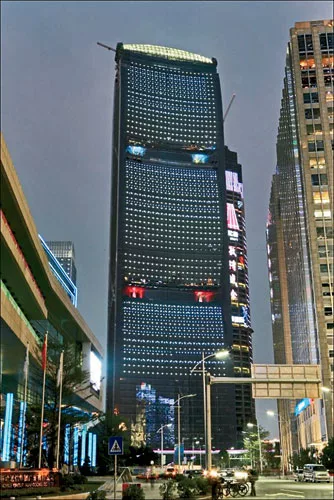
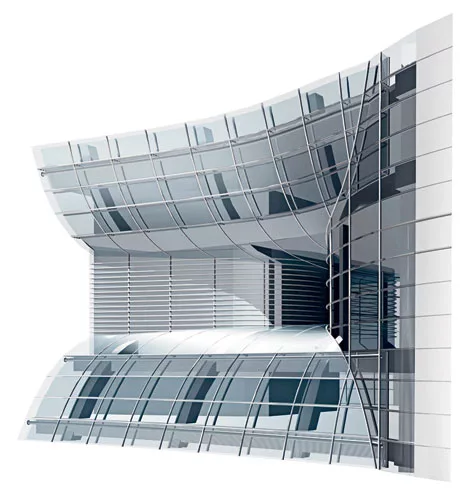
Following Strata, towers in China have seized the BIWP spotlight. The 1,014-foot-tall Pearl River Tower nearing completion in Guangzhou offers an intriguing response to shifting wind direction. As with Strata, its turbines spin within tunnels punched through the building. Pearl River, however, employs VAWTs to capture wind blowing through from either direction.
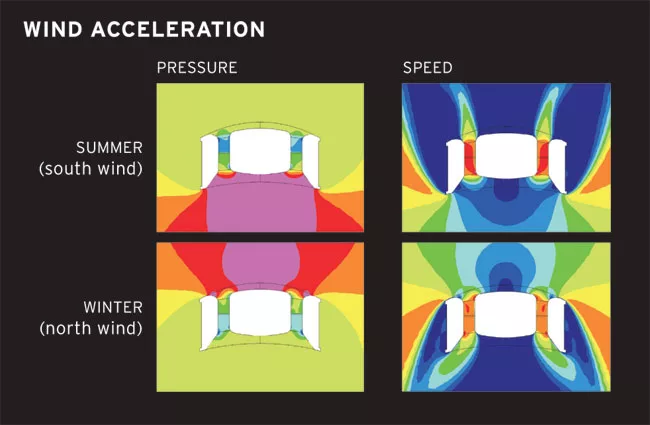
Pearl River’s designers in the Chicago office of Skidmore, Owings & Merrill (SOM) oriented the rectangular tower to face north-south, positioning the VAWTs for prevailing southerly winds, as well as winter northerlies. The drag-based VAWTs, produced by Finnish firm Windside, minimize vibration and noise.
Frechette, who was engineering lead for Pearl River before leaving SOM, says its envelope was crafted from the outset to exploit the immense force with which wind slams large buildings. “Wind forces almost always trump seismic needs,” he says, adding, “That’s tremendous force.”
Introducing ducts—two each one-third and two-thirds up the face—provided a means of both concentrating and utilizing that force. Frechette says wind accelerates as it’s “sucked through the holes” by the differential pressure on the windward and leeward faces. The ducts also act as pressure-relief valves, permitting a reduction in structural steel and concrete and a corresponding reduction in embodied carbon (the amount of carbon dioxide emitted during materials production and in construction).
SOM projected a payback of at least 15 years for the turbines, which was longer than most of the tower’s other sustainability features. The client, the China National Tobacco Company, kept them anyway to enhance awareness and complement less visible measures, such as radiant ceiling cooling. While only occupants in neighboring towers will see the turbines spinning in their tunnels, dynamic red and blue lighting will indicate turbine activity for all observers.
The BIWP will deliver 297 mWh per year, displacing about $47,000 of power, according to a recent projection. PVs on the roof and on exterior light shelves should add another 250 mWh per year.
Frechette says BIWP cost-effectiveness has improved since Pearl River’s design. Growing interest is driving down costs, he says, and grid prices are up: “What made marginal sense in 2006 makes a lot more sense in 2013.”
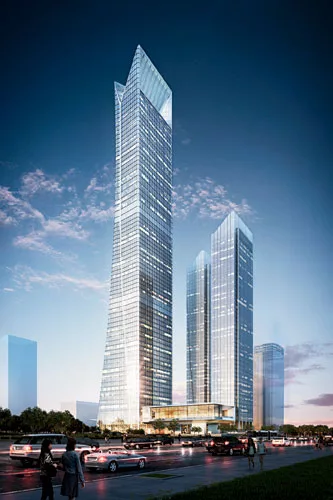
Faster paybacks are affirmed by SOM’s latest BIWP project, a 1,073-foot-tall mixed-use tower in the early stages of construction in Qingdao, on China’s northeast coast. In late February the developer, Hangzhou-based Greentown China Holdings, affirmed its intention to include four ducted Windside VAWTs in the building’s angular crown.
The tower faces the ocean and should have a strong pressure differential from onshore and offshore winds. SOM predicts that will suck a 25-meter-per-second wind through the ducts, yielding 322 mWh per year from the turbines. The projected 10-year payback is within the range sought by sustainability-minded clients, says Luke Leung, SOM’s director of sustainable engineering services.
ONGOING DEBATE
Is BIWP ready to take flight and move beyond niche status? Not quite yet, according to some practitioners. Paybacks like the one predicted in Qingdao are still rare, found only where wind and design align, says Leung. He notes that SOM is working on just one other BIWP tower among the more than 20 supertall buildings in its docket.
Some observers still take a distinctly harsh view of BIWP’s potential. One skeptic is Ralph Hammann, professor of design and sustainable building systems at the University of Illinois at Urbana-Champaign, who sees most BIWP as a form of greenwashing. He doubts that turbines in urban settings will ever deliver enough power to be justified on a “rational energy” basis. “In a whole-building analysis, compensation for the loss of usable space over the life span of the building cannot be achieved through the amount of generated energy,” he says.
Those who have designed BIWP systems, in contrast, tend to be optimistic, foreseeing that design and turbine innovations will progressively expand BIWP’s sweet spot. “There is a huge learning curve where this technology is being implemented,” says Gill, who led Pearl River’s design before cofounding his firm.
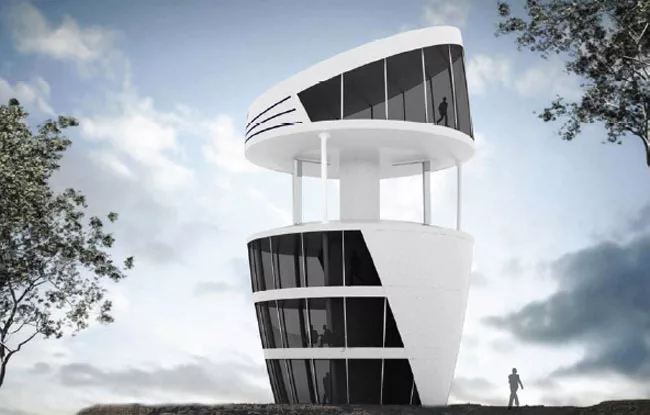
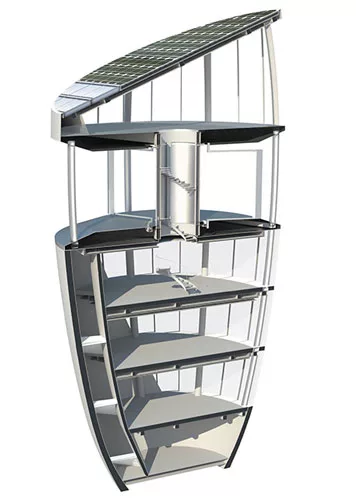
Bold sculpted designs could improve power output, as architects collaborate with aeronautical engineers and truly put CFD in the driver’s seat. Architect Michael Pelken and aeronautical engineer Thong Dang, both faculty members at Syracuse University, have patented a design principle for optimized integration of VAWTs at a building’s core. In the 6-story version of their cylindrical Turbine House, for example, the 5th floor serves as a large VAWT spinning about a narrow passage for stairs and piping.
Mertens is commercializing a novel three-bladed turbine that promises up to a 2.5-fold weight reduction from existing products, thanks to airfoil blades that swivel to slash drag in high winds. He envisions rooftop windfarms with 10-20 turbines arrayed across flat-topped commercial buildings producing about as much power as a solar array. In fact, Mertens says BIWP and PV could share the rooftop, thus doubling its power potential.
Frechette predicts that innovation will carry BIWP up the same curve that PV has traveled. He recalls two decades ago examining a PV system with a 100-year payback and thinking, “This is never going to catch on.” Now, he notes, it’s on the way to becoming an automatic building feature.
Peter Fairley is a journalist based in Paris and British Columbia who covers energy and the environment for Technology Review and Nature.
People | Products |
Looking for a reprint of this article?
From high-res PDFs to custom plaques, order your copy today!