Architectural Record
search
cart
facebook twitter linkedin youtube
  • Sign In
  • Subscribe
  • Sign Out
  • My Account
Architectural Record
  • NEWS
    • Latest News
    • Awards
    • Interviews
    • Obituaries
    • Podcasts
      • Design:Ed Podcast
      • Sponsored Podcasts
  • OPINION
    • Book Reviews / Excerpts
    • Exhibition Reviews
    • Forum
  • EXCLUSIVES
    • Videos
    • Design Vanguard
    • Top 300 Firms
    • Sponsored Content
    • Sponsored eBooks
    • From the Archives
  • CONTINUING ED
    • Editorial Continuing Ed
    • CE Center
    • CE Academies
  • PROJECTS
    • Buildings By Type
    • Reuse & Renovation
    • Museums & Arts Centers
    • Colleges & Universities
    • Multifamily Housing
    • Interiors
    • Lighting
    • Kitchen & Bath
  • HOUSES
    • Record Houses
    • House of the Month
    • Featured Houses
  • PRODUCTS
    • Products by Category
    • Record Products of the Year
    • Latest Products
  • EVENTS
    • Dates & Events
    • Record on the Road
    • Innovation Conference
    • Sustainability in Practice
    • Women In Architecture
    • Webinars
    • Ad Excellence Awards
    • Submit an Event
  • CONNECT
    • Ask RECORD AI
    • Newsletters
    • Contact
    • Advertise
    • Editorial Calendar
    • Store
    • Customer Service
  • SUBMIT
    • Submission Guidelines
    • RECORD Competitions
  • MAGAZINE
    • Subscribe
    • My Account
    • Digital Edition
    • Current Issue
    • Firm Pass
    • Historic Archive
Architectural Technology

Converging Networks

As building-control apps go mainstream, home-automation providers explore wireless options.
By Peter Fairley
Converging networks

Illustration: © Otto Steininger

April 16, 2014

As building-control apps go mainstream, home-automation providers explore wireless options.

The 26-acre Hudson Yards development, above, envisions 13 million square feet of commercial and residential space, plus shops, restaurants, a luxury hotel, a cultural venue, and a park on Manhattan's west side.
Illustration: © Otto Steininger

The Apple Store isn't a place you would typically look for residential building components. But you can find a new Wi-Fi-enabled lighting system from Philips called HUE there. This screw-in LED replacement for traditional bulbs can be easily controlled for color, color temperature, and intensity from a computer or smartphone. Google's recent $3.2 billion purchase of the Palo Alto, California–based Nest Labs and its web-accessible programmable thermostats, smoke detectors, and carbon monoxide detectors is yet another development turning the notion of home automation—often a complex configuration of wires and cables linked to devices with rigid protocols—into a viable option for new construction and also renovation projects.

“This is the advent of the 'Internet of Things'; everything is going to be controlled through Wi-Fi,” says lighting designer Christopher Thompson, who runs the Seattle design firm Studio Lux. As a result, says Thompson, “Home automation is undergoing a huge shift.”

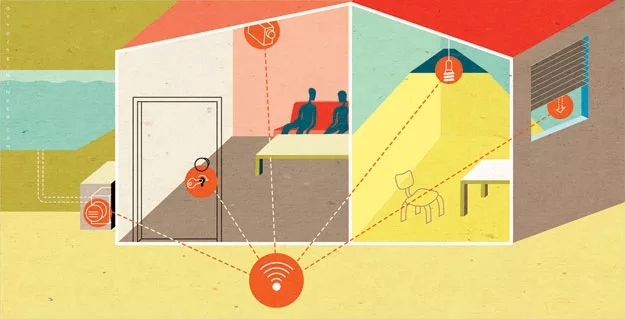
Improved wireless networks are enabling providers of whole-home systems to remotely control a wider array of devices and functions. Suppliers are also striving to simplify the operation of their systems to meet homeowner requests to control everything via smartphone and tablet—the new universal remotes.

Lutron was among the first to connect the whole house without wires in the mid-1990s, when it launched a radio-frequency (RF) system called RadioRA that relied on a rack-mounted central hub to relay messages between the wireless control units and light switches. At the time, it was developed to be a second-tier solution for retrofit jobs where running wires would be too costly.

Many home-control providers are moving beyond the fixed hub-and-spoke network model to manage more than lighting and shades, adding climate control, security, home entertainment, appliances, even locks to their offerings. According to Tom Barnett, the residential marketing director at building-controls solutions manufacturer Crestron, interference from neighboring wireless devices makes it difficult for hub-and-spoke configurations to deliver the uninterrupted bandwidth required to control a diverse array of devices. Barnett notes that the Wi-Fi networks used for home Internet connectivity, for example, offer great bandwidth but notoriously poor reliability.

As a solution, the Crestron InfiNET EX wireless system relies on a mesh network, which turns every automated component into a miniature hub. This is said to assure that the message will get through when the user presses a button on the remote control, explains Barnett, even if its signal can't reach the base station directly. For instance, a signal will be picked up and passed along by the controller on bedroom shades to whatever components the shade controller can reach, and the message will bounce to the base, kicking off a programmed set of actions. (Barnett claims that pressing a particular button even sends his dog upstairs because, when the lights and TV go off downstairs, it knows it's time for bed.)

Meanwhile, Lutron has developed a fifth-generation RF system, upgrading its fixed-hub network with what the company claims is an extremely stable and interference-resistant band frequency. According to engineering manager Matt Swatsky, the new technology, dubbed Clear Connect, can encompass more than 10,000 square feet as reliably as a wired system.

In a recent vote of confidence for remote accessibility, luxury homebuilder Toll Brothers announced it is offering the Control4 system—controllable from a variety of devices—as a buyer option.

Still, there are circumstances where some clients remain unwilling to cut the cord. When Portland, Oregon–based architects Allied Works designed a home (see RECORD Houses, page 74) in a rural New York State location for a couple with a substantial art collection, the design team decided to go with a wired system. The country home's sophisticated system operates, among other things, museum-grade climate controls that protect the art from temperature and humidity swings. Allied Works principal Kyle Lommen says they went with a wired system because technical support would be slow in coming if a wireless system went down.

Wired systems are already giving way to hybrid configurations, and Lommen predicts that, in the future, those will ultimately give way to completely wireless and Internet-based solutions. The firm is already considering a wire-free whole-building system for the 160,000-square-foot National Music Centre in Calgary, Alberta. The direction, says Lommen, is clear.

Journalist Peter Fairley focuses on energy and the environment.

Share This Story

Looking for a reprint of this article?
From high-res PDFs to custom plaques, order your copy today!
Peter Fairley, a journalist based in British Columbia, covers environmental issues for multiple publications including Technology Review and Nature.

Post a comment to this article

Report Abusive Comment

Subscription Center
  • Create an Account
  • Start a Subscription
  • Manage My Account
  • Sign Up for Newsletters
  • Visit Customer Service
  • Update Preferences

More Videos

Sponsored Content

Sponsored Content is a special paid section where industry companies provide high quality, objective, non-commercial content around topics of interest to the Architectural Record audience. All Sponsored Content is supplied by the advertising company and any opinions expressed in this article are those of the author and not necessarily reflect the views of Architectural Record or its parent company, BNP Media. Interested in participating in our Sponsored Content section? Contact your local rep!

close
  • TAMLYN XtremeTrim Exterior Trim
    Sponsored byTamlyn

    Designing Cleaner Panel Facades: Why Exterior Trim Details Matter

  • Building with Vapor Barriers
    Sponsored byReef Industries, Inc.

    Vapor Barriers Help Control Moisture in Tighter Building Designs

  • Duct Interior with Prodeq System
    Sponsored byHenry, a Carlisle Company

    Designing Resilient Water Containment Systems

DESIGN:ED Podcast
Listen to Architectural Record’s DESIGN:ED Podcast

Events

June 10, 2026

Rethinking Stormwater – The Power of Porous Paving

Credits: 1 AIA LU/HSW; 1 AIBD P-CE; 0.1 ICC CEU

Learn how porous paving systems support stormwater management, reduce heat island effects, and enhance sustainable site design performance.

June 11, 2026

Very Early Warning Fire Detection for Mission-Critical Facilities

Credits: 1 AIA LU/HSW; 1 AIBD P-CE; 0.1 ICC CEU

Examine advanced fire detection strategies that support uptime and enhance safety in data centers and other mission-critical facilities.

View All Submit An Event

Products

2026 Architect's Square Foot Costbook

2026 Architect's Square Foot Costbook

See More Products

Popular Stories

Coronado Bridge

The Architect’s Guide to San Diego

Practice Matters illustration

What’s in a (Firm’s) Name? Thinking About Succession and Legacy

Practice Matters illustration

By the Numbers: Counting America's Architects

Inward House

Inward House by VeeV Design Studio

Riverdale House by Studio Lau

Riverdale House by Studio Lau

Broader Sustainability of CMU - Free Webinar - May 21, 2026

Related Articles

  • Converging on China

    See More
  • A Force of Nature

    See More
  • Urban Agriculture Grows Up

    See More

Related Products

See More Products
  • book5.jpg

    Contemporary Market Architecture Planning and Design

  • image7.jpg

    Contemporary Architecture in China Towards A Critical Pragmatism

  • 1118522532.gif

    Future Details of Architecture

See More Products
×

The latest news and information

#1 Source for Architectural Design, News and Products

SUBSCRIBE
  • RESOURCES
    • Advertise
    • Contact Us
    • Submit
    • Store
  • ACCOUNT CENTER
    • Create an Account
    • Start a Subscription
    • Manage My Account
    • Sign Up for Newsletters
    • Visit Customer Service
    • Update Preferences
  • PRIVACY
    • PRIVACY POLICY
    • TERMS & CONDITIONS
    • DO NOT SELL MY PERSONAL INFORMATION
    • PRIVACY REQUEST
    • ACCESSIBILITY
  • SERVICES
    • Marketing Services
    • Reprints
    • Market Research
    • List Rental
    • Survey/Respondent Access
  • STAY CONNECTED
    • Linkedin
    • Facebook
    • Instagram
    • YouTube
    • X (Twitter)

Copyright ©2026. All Rights Reserved BNP Media, Inc. and BNP Media II, LLC.

Design, CMS, Hosting & Web Development :: ePublishing