Modern Architecture in Latin America: Art, Technology, and Utopia
Whose Continent Is It Anyway? Eurocentrism Is Hard to Break.
Whose Continent Is It Anyway? Eurocentrism Is Hard to Break.
Except for a handful of anthologies and books focusing on specific architects or events, Latin America has received little attention in English-language histories of architecture. The Museum of Modern Art, though, mounted three exhibitions (and published accompanying books) on the region in the 20th century—Brazil Builds in 1943, Latin American Architecture Since 1945 in 1955, and The Architecture of Luis Barragán in 1976—and is now showing Latin America in Construction: Architecture 1955'1980 through July 19th.
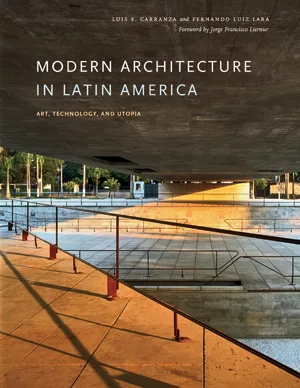
Luis E. Carranza and Fernando Luiz Lara try to fill the publishing gap with their new book, Modern Architecture in Latin America: Art, Technology, and Utopia, the first book in English to deal with the entire 20th century. This is a monumental task, for which the authors have relied chiefly on the existing historiography to identify key buildings and architects. So, in spite of the authors' avowed “commitment to write . . . from a Latin American perspective,” this dependence leads them to reproduce that historiography's Eurocentric bias, which is currently undergoing critical review by architectural historians in Latin America and elsewhere. That bias shows up in the book's index, where entries for Le Corbusier exceed those for Oscar Niemeyer, the most celebrated architect of Latin America. The book gives the impression that Le Corbusier and other European and American figures were the determining influence on Latin America's most significant designers and buildings, without acknowledging that the reverse also occurred. For example, Le Corbusier's 1956 design for the Maison de la Culture in Firminy, France, reflects the formal ideas of Affonso Reidy's 1953 design of the Museum of Modern Art in Rio de Janeiro.
Modernization of the built environment in Latin America began late in the 19th century, decades after the wars of independence from Spain (1810'1821) and Brazil's more peaceful separation from Portugal in 1822. During their 300 years of domination, the two Iberian powers imposed a common religion, related languages, uniform urban plans, and European building styles. Independence brought, first, the rejection and, later, the recovery of designs from Latin America's Spanish and Portuguese cultural past, while the economies of these new nations continued to rely on the export of raw materials to European and North American urban centers, which came to symbolize all that was new and prosperous. The construction and representation of modernity in the 20th century was therefore marked by the struggle of Latin American artists and intellectuals to create cultures of their own. To understand this struggle and the uneven and diverse “modernities” that emerged in these countries, we must acknowledge the importance of mestizaje (mixed blood), a term used today to refer to the cultural hybridization produced by contact between native populations and Europeans. This process was most clearly played out in the visual arts, literature, and music, but architecture was also influenced by an ambiguous, even conflictive, relationship with European cultures, building traditions, and styles. You will not find in this book a sense of how architects and designers in Latin America dealt with these issues, or with the limitations, contradictions, and paradoxes of their own place and time in relation to the dominant cultures and technologies of world powers. But you will find those large-scale projects that elicited the attention of American and European critics. They were the university campuses and huge blocks for public housing in Caracas and Mexico City, as well as Brasilia. They were all designed in a style supported by the state to broadcast to the world the modernity of their countries.
In lieu of an analytical structure, Carranza and Lara provide a “navigational system,” loosely defined by three themes: art, technology, and utopia. In addition, color-coded pages separate the historiography's “canonical” works from the “minor” ones. Many Latin American architectural historians will take issue with relegating to the category of “minor” such significant buildings as Rogelio Salmona's Torres del Parque in Bogota, Lina Bo Bardi's Museum of Modern Art in S'o Paulo and Eladio Dieste's Church in Atlántida, Uruguay. Other projects, like Cuba's Pavilion at the Montreal Expo of 1967, or that country's ambitious housing and school-building program after the revolution, are excluded completely, raising questions about the authors' selections. Carranza and Lara admit that they do not pretend to be inclusive, so this history must be taken as a provisional one. For faculty teaching courses on Latin American architecture, it will be important to identify the book's deficiencies, so additional research and analysis can rectify them.
Nonetheless, professors Carranza and Lara should be commended for trying to provide a wide-ranging guide, though it is limited to biographical sketches of architects, descriptions of buildings (often without images), and brief notes that simply locate the buildings in time and place. They have approached their complex subject by compiling and reading the relevant bibliography, most of it in Spanish, and organizing the selected buildings and events chronologically, as Ph.D. students must do. The really difficult work begins now, in crafting a conceptual structure for analysis and a narrative that transcends merely the facts of Latin America's past 100 years of architecture.
Looking for a reprint of this article?
From high-res PDFs to custom plaques, order your copy today!