Architectural Record
search
cart
facebook twitter linkedin youtube
  • Sign In
  • Subscribe
  • Sign Out
  • My Account
Architectural Record
  • NEWS
    • Latest News
    • Awards
    • Interviews
    • Obituaries
    • Podcasts
      • Design:Ed Podcast
      • Sponsored Podcasts
  • OPINION
    • Book Reviews / Excerpts
    • Exhibition Reviews
    • Forum
  • EXCLUSIVES
    • Videos
    • Design Vanguard
    • Top 300 Firms
    • Sponsored Content
    • Sponsored eBooks
    • From the Archives
  • CONTINUING ED
    • Editorial Continuing Ed
    • CE Center
    • CE Academies
  • PROJECTS
    • Buildings By Type
    • Reuse & Renovation
    • Museums & Arts Centers
    • Colleges & Universities
    • Multifamily Housing
    • Interiors
    • Lighting
    • Kitchen & Bath
  • HOUSES
    • Record Houses
    • House of the Month
    • Featured Houses
  • PRODUCTS
    • Products by Category
    • Record Products of the Year
    • Latest Products
  • EVENTS
    • Dates & Events
    • Record on the Road
    • Innovation Conference
    • Sustainability in Practice
    • Women In Architecture
    • Webinars
    • Ad Excellence Awards
    • Submit an Event
  • CONNECT
    • Ask RECORD AI
    • Newsletters
    • Contact
    • Advertise
    • Editorial Calendar
    • Store
    • Customer Service
  • SUBMIT
    • Submission Guidelines
    • RECORD Competitions
  • MAGAZINE
    • Subscribe
    • My Account
    • Digital Edition
    • Current Issue
    • Firm Pass
    • Historic Archive
Exclusives

A Love-Hate Relationship

Results of the Architectural Record/Van Alen Institute Design Competition Survey are in.

By David Sokol
Show the value of design - Imagine a design firm that routinely spends millions of dollars generating hundreds of proposals for a given competition. Ridiculous? Well, that's the collective effort desi
A Love-Hate Relationship
Show the value of design - Imagine a design firm that routinely spends millions of dollars generating hundreds of proposals for a given competition. Ridiculous? Well, that's the collective effort designers put into competitions. Let's recognize all this labor designers are creating annually in design competitions and put a dollar amount on it. Competition organizers should require designers to track the hours they spend on a proposal and the value of those hours, and include that as part of their entries. Organizers should then report how much work collectively was produced for the competition. This tracking system could help show how much value design creates.
Image: courtesy Van Alen Institute
It's not just about winning - Designers enter competitions to learn, build portfolios, experiment, push themselves, get seen, have fun, not just to win. So let's make competitions that aren't winner-t
A Love-Hate Relationship
It's not just about winning - Designers enter competitions to learn, build portfolios, experiment, push themselves, get seen, have fun, not just to win. So let's make competitions that aren't winner-take-all, but offer opportunities for anyone who enters. A competition to re-imagine hospitals could offer free online seminars from doctors, public health officials, health care administrators in conversation with designers on the jury to discuss new trends in the field. Entries could be exhibited at health care clinics or on the website of insurance company partners, bringing design ideas to new audiences. Competitions could then advance not just the careers of winning firms but design practice as a whole.
Image: courtesy Van Alen Institute
Let the jury speak - It's OK, we know jurors aren't perfect, and there's no such thing as a completely objective process. Once we let go of that illusion, we can free jurors to be the amazing resource
A Love-Hate Relationship
Let the jury speak - It's OK, we know jurors aren't perfect, and there's no such thing as a completely objective process. Once we let go of that illusion, we can free jurors to be the amazing resource that they are. Their expertise and exchange can be as valuable in generating ideas as the participants' work, but we treat it like a state secret. Let's open up and publish jury notes for every competition (don't worry, no direct quotes, no names named) so everyone can benefit from what jurors bring to the process. This will create more transparency and more substantive feedback to designers on their proposals.
Image: courtesy Van Alen Institute
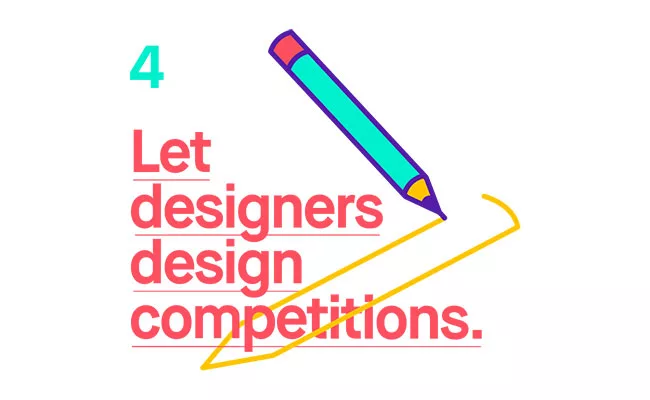
Let designers design competitions - A big secret about competitions is that designers don't need them. What they do need is a creative outlet, a chance to flex their muscles, a project they can sink t
A Love-Hate Relationship
Let designers design competitions - A big secret about competitions is that designers don't need them. What they do need is a creative outlet, a chance to flex their muscles, a project they can sink their teeth into when everyday practice is giving them scraps. To encourage designers to explore these kinds of opportunities, let's make competitions that ask designers to define their own brief, and identify an issue or frame a problem that they'd like to work on. The winners would get a stipend to develop solutions. Everyone else will have created the seeds of a project that they can continue to pursue outside the formal boundaries of a competition.
Image: courtesy Van Alen Institute
Go beyond beautiful objects - We urge all cultural institutions considering a competition for their next new building to just commission a designer from a shortlist, and to organize a competition addr
A Love-Hate Relationship
Go beyond beautiful objects - We urge all cultural institutions considering a competition for their next new building to just commission a designer from a shortlist, and to organize a competition addressing a pressing cultural, ecological, or social issue. They'll be putting their clout, intelligence, and money to good use, and will instantly raise the profile of whatever issue they decide to champion. (And they'll get a lot of good press themselves along the way.)
Image: courtesy Van Alen Institute
Show clients the way - Top Three Conventional Open Competition Rules for Designers:<br><br><strong>1</strong>&nbsp;&nbsp;Don't interact with the client or the public.<br><strong>2</strong>&nbsp;&nbsp;
A Love-Hate Relationship
Show clients the way - Top Three Conventional Open Competition Rules for Designers:

1  Don't interact with the client or the public.
2  Don't visit the site'Google Earth and internet research are good enough.
3   Mind-blowing renderings are the most important thing you can make.

We could go on, but you get the point. These kinds of assumptions not only make for bad competitions, but they have shaped clients' relationships to designers more broadly. It doesn't have to be this way. There are lots of competitions out there that have changed the rules. Why not establish a two-stage process: an open call to select a shortlist based on qualifications, not detailed proposals; and a longer process providing these finalists with a stipend to work through solutions in partnership with a broad range of stakeholders. Better competition processes can demonstrate to clients the best ways to work with designers.
Image: courtesy Van Alen Institute
No more lonely nights - Design practice can be isolating, even downright lonely. But the really difficult challenges our society faces, the ones that most need designers' skills and efforts, are also
A Love-Hate Relationship
No more lonely nights - Design practice can be isolating, even downright lonely. But the really difficult challenges our society faces, the ones that most need designers' skills and efforts, are also the ones that they can't tackle alone. Let's create more opportunities for designers to meet leading practitioners from other fields and work across disciplines with engineers and economists, artists and community organizers, sociologists and statisticians, and people from many other fields. And let's encourage organizers to partner across sectors, making possible new, synthetic approaches to problems.
Image: courtesy Van Alen Institute
Make it public - Everyone knows that public engagement, when structured well, helps produce better design. But when it comes to competitions, this knowledge tends to go out the window. While we're tal
A Love-Hate Relationship
Make it public - Everyone knows that public engagement, when structured well, helps produce better design. But when it comes to competitions, this knowledge tends to go out the window. While we're talking about better ways to engage designers and clients, let's also invite more local residents, business owners, government officials, and other stakeholders to participate in competitions. Organizers should spend more time building trust and relationships with these stakeholders before announcing a competition, and developing new forms of engagement ' parades, bike tours, design-build workshops, and others - that make design immediate and accessible, especially for people who normally wouldn't attend a charrette or planning workshop.
Image: courtesy Van Alen Institute
Give designers what they want - In general, emerging designers and design students are more likely than their more established counterparts to say they want to work on interdisciplinary teams, engage
A Love-Hate Relationship
Give designers what they want - In general, emerging designers and design students are more likely than their more established counterparts to say they want to work on interdisciplinary teams, engage the general public, and enter competitions that address underserved communities, all of which suggest a desire to expand the role of designers in the world, and tackle systemic societal challenges such as inequality. Let's cook up more competitions for students and emerging practitioners that encourage this kind of idealism, and also understand their audience (e.g. no entry fees, no deadlines that coincide with end-of-semester final reviews.)
Image: courtesy Van Alen Institute
Think big - The federal interstate highway system. Racial segregation in cities. Nursing homes and daycare. These are just a few topics for new competitions suggested by survey respondents for new com
A Love-Hate Relationship
Think big - The federal interstate highway system. Racial segregation in cities. Nursing homes and daycare. These are just a few topics for new competitions suggested by survey respondents for new competitions. There'll always be a need for competitions that define clear problems and produce implementable solutions. But designers should also take on more open-ended challenges, in which highlighting key issues, visualizing data, and asking the right big questions can be as valuable as delivering solutions.
Image: courtesy Van Alen Institute
Show the value of design - Imagine a design firm that routinely spends millions of dollars generating hundreds of proposals for a given competition. Ridiculous? Well, that's the collective effort desi
It's not just about winning - Designers enter competitions to learn, build portfolios, experiment, push themselves, get seen, have fun, not just to win. So let's make competitions that aren't winner-t
Let the jury speak - It's OK, we know jurors aren't perfect, and there's no such thing as a completely objective process. Once we let go of that illusion, we can free jurors to be the amazing resource
Let designers design competitions - A big secret about competitions is that designers don't need them. What they do need is a creative outlet, a chance to flex their muscles, a project they can sink t
Go beyond beautiful objects - We urge all cultural institutions considering a competition for their next new building to just commission a designer from a shortlist, and to organize a competition addr
Show clients the way - Top Three Conventional Open Competition Rules for Designers:<br><br><strong>1</strong>&nbsp;&nbsp;Don't interact with the client or the public.<br><strong>2</strong>&nbsp;&nbsp;
No more lonely nights - Design practice can be isolating, even downright lonely. But the really difficult challenges our society faces, the ones that most need designers' skills and efforts, are also
Make it public - Everyone knows that public engagement, when structured well, helps produce better design. But when it comes to competitions, this knowledge tends to go out the window. While we're tal
Give designers what they want - In general, emerging designers and design students are more likely than their more established counterparts to say they want to work on interdisciplinary teams, engage
Think big - The federal interstate highway system. Racial segregation in cities. Nursing homes and daycare. These are just a few topics for new competitions suggested by survey respondents for new com
May 16, 2015

Results of the Architectural Record/Van Alen Institute Design Competition Survey are in.

The Van Alen Institute proposes 10 reforms to the way design competitions are run. For all 10 proposals, click on slide show.

Architects starting their practices often see open design competitions as a stepping-stone to the next stage of their careers. A mechanism for advancement particularly abroad, this method of selection is less customary in the United States, owing to a variety of factors. Regardless of country, however, aspects of competitions can leave architects either frustrated or energized—or both.

As an organizer of competitions dedicated to improving the public realm, New York’s Van Alen Institute (VAI) has collected many anecdotes about the opportunities and abuses of this process. David van der Leer, executive director of VAI, says, “We hear from designers all the time that open competitions spread the perception that they will work for free.”

While that feedback has helped VAI with its own competitions, the nonprofit decided it could affect the marketplace of competitions by documenting opinions about advantages and pitfalls systematically. With RECORD as media sponsor and with support from the Graham Foundation, VAI recently created and administered a survey on the subject that elicited 1,414 responses internationally—approximately 79 percent from architects. It published the results of the architectural record/Van Alen Institute Design Competition Survey in mid-April and will present them as part of a Design Competition Conference at Harvard’s Graduate School of Design on April 23 and 24.

Responses to VAI’s survey—a combination of multiple-choice and open-ended questions— indicated mixed feelings. Two of the most popular reasons for entering competitions were the opportunity for design experimentation (57 percent) and a particular interest in the competition subject (55 percent). Publicity garnered as a winner or runner-up was the third reason cited, by 39 percent of those surveyed. VAI competitions director Jerome Chou says the findings indicating widespread appreciation for competition-related research and creativity were unexpected. “It was also surprising that so many designers said they want to collaborate with artists [47 percent],” he says, “perhaps a reflection of how designers see themselves.”

Nevertheless, the survey corroborates a common complaint that competitions provide insufficient compensation (79 percent of respondents). Also, 67 percent of respondents said that competitions do not directly yield new business. More than half noted that they draw no income as a result of competitions.

Whether survey participants view design competitions as a necessary evil or a welcome platform for artistic expression, they did have clear suggestions for improving the process.Providing adequate compensation is at the top of their list. Yet almost half also rallied behind measures that cannot be directly measured in dollars, such as receiving more feedback from jurors on both winning and losing proposals. Respondents championed greater exposure for their efforts as well, highlighting the value of competitions in drawing attention to their talents.

In a similar vein, survey takers reported that they rarely work with colleagues or non–design professionals, or with public stakeholders, on competition submissions. VAI is trying to rectify this absence of collaboration in its own competitions and is testing interdisciplinary involvement. It is also hoping to figure out ways to get the public more involved in the submission process too.

Inspired by the survey analysis, VAI also has incorporated public engagement, disclosure of jury comments, and exposure for all competition entries in a document that itemizes 10 reforms for all design competitions (see ). It has produced this list alongside the survey results.

Besides presenting at the Harvard conference and applying such propositions to its own competition processes, VAI will share the survey results and lobby for reforms in the design world, says van der Leer. “It’s not as if we’re calling for impossible changes,” he concludes. “Organizers, clients, and designers can and should act on our propositions.”

For full results of the survey, go to: https://vanalen.org/projects/architectural-record-van-alen-institute-competition-survey/

Share This Story

Looking for a reprint of this article?
From high-res PDFs to custom plaques, order your copy today!


David Sokol is a contributing editor to Architectural Record. 

Post a comment to this article

Report Abusive Comment

Subscription Center
  • Create an Account
  • Start a Subscription
  • Manage My Account
  • Sign Up for Newsletters
  • Visit Customer Service
  • Update Preferences

More Videos

Sponsored Content

Sponsored Content is a special paid section where industry companies provide high quality, objective, non-commercial content around topics of interest to the Architectural Record audience. All Sponsored Content is supplied by the advertising company and any opinions expressed in this article are those of the author and not necessarily reflect the views of Architectural Record or its parent company, BNP Media. Interested in participating in our Sponsored Content section? Contact your local rep!

close
  • TAMLYN XtremeTrim Exterior Trim
    Sponsored byTamlyn

    Designing Cleaner Panel Facades: Why Exterior Trim Details Matter

  • Building with Vapor Barriers
    Sponsored byReef Industries, Inc.

    Vapor Barriers Help Control Moisture in Tighter Building Designs

  • Duct Interior with Prodeq System
    Sponsored byHenry, a Carlisle Company

    Designing Resilient Water Containment Systems

DESIGN:ED Podcast
Listen to Architectural Record’s DESIGN:ED Podcast

Events

June 10, 2026

Rethinking Stormwater – The Power of Porous Paving

Credits: 1 AIA LU/HSW; 1 AIBD P-CE; 0.1 ICC CEU

Learn how porous paving systems support stormwater management, reduce heat island effects, and enhance sustainable site design performance.

June 11, 2026

Very Early Warning Fire Detection for Mission-Critical Facilities

Credits: 1 AIA LU/HSW; 1 AIBD P-CE; 0.1 ICC CEU

Examine advanced fire detection strategies that support uptime and enhance safety in data centers and other mission-critical facilities.

View All Submit An Event

Products

2026 Architect's Square Foot Costbook

2026 Architect's Square Foot Costbook

See More Products

Popular Stories

Practice Matters illustration

What’s in a (Firm’s) Name? Thinking About Succession and Legacy

Coronado Bridge

The Architect’s Guide to San Diego

Practice Matters illustration

By the Numbers: Counting America's Architects

House on a Hill

Design Vanguard 2026: Forma

Crane Cove, ONO

Design Vanguard 2026 Winners

Broader Sustainability of CMU - Free Webinar - May 21, 2026

Related Articles

  • Le Corbusier and New York City: A Love-Hate Relationship

    See More
  • Acts of Hate Highlight Architecture’s Role In Framing History

    Acts of Hate Highlight Architecture's Role in Framing History

    See More
  • Gensler Shanghai Studio

    Chinese and American Architects’ Shifting Relationship

    See More

Related Products

See More Products
  • book3.jpg

    If Architecture is a Language, Then a Building is a Story

  • 0470126736.gif

    Modern Sustainable Residential Design: A Guide for Design Professionals

  • image7.jpg

    Contemporary Architecture in China Towards A Critical Pragmatism

See More Products
×

The latest news and information

#1 Source for Architectural Design, News and Products

SUBSCRIBE
  • RESOURCES
    • Advertise
    • Contact Us
    • Submit
    • Store
  • ACCOUNT CENTER
    • Create an Account
    • Start a Subscription
    • Manage My Account
    • Sign Up for Newsletters
    • Visit Customer Service
    • Update Preferences
  • PRIVACY
    • PRIVACY POLICY
    • TERMS & CONDITIONS
    • DO NOT SELL MY PERSONAL INFORMATION
    • PRIVACY REQUEST
    • ACCESSIBILITY
  • SERVICES
    • Marketing Services
    • Reprints
    • Market Research
    • List Rental
    • Survey/Respondent Access
  • STAY CONNECTED
    • Linkedin
    • Facebook
    • Instagram
    • YouTube
    • X (Twitter)

Copyright ©2026. All Rights Reserved BNP Media, Inc. and BNP Media II, LLC.

Design, CMS, Hosting & Web Development :: ePublishing