Integrated practice in perspective: A new model for the architectural profession, part 2
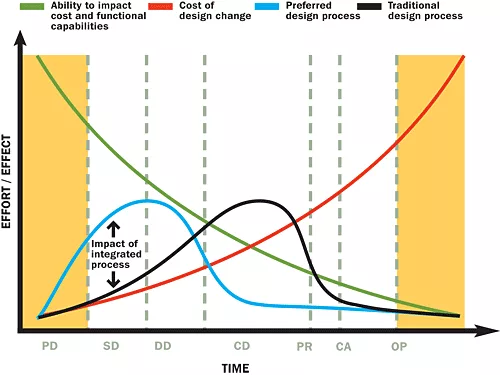
The inefficiencies inherent in the process of design and construction are necessitating a shift to greater multidisciplinary collaboration and information sharing among project team members
Contract documents
Integrated practice will drive changes to contracts in order to facilitate working in teams, sharing information, and fairly allocating liability risk, compensation, and responsibility. Changes will most likely occur incrementally with “the continued growth of design-build, tweaked conventional contracts, and increased experimentation with transformational methods like ‘project alliancing,’ ” according to Cambridge, Massachusetts, attorney Chris Noble, of Noble & Wickersham. In this transition period, Noble believes that “there will be increased use of project conditions that will be attached to various multiple contracts to create a projectwide legal system to regulate intellectual property rights, resolve intra-project disputes, establish communication protocols, and allocate rewards commensurate with risks.”
According to Suzanne Harness, AIA, managing director and counsel for contract documents at the American Institute of Architects, the AIA Documents Committee is in a “research stage” regarding IP and is evaluating the risk-sharing and risk-allocation provisions in alliancing contracts, and a few domestic private contracts, as well. “We are looking at the design process as a continuum from no integration at one end to full integration at the other, and trying to identify the contracting needs at intervals along the way,” she says. She emphasizes that while there is an understandable outcry for the AIA to issue integrated practice documents immediately, it takes time to “get it right, and to act in concert with other stakeholders.”
Of course, there is no legal expectation that construction documents will be perfect; there are invariably a few errors and omissions. In general, the “standard of care” suggests that an architect must exercise the degree of skill and care other architects in the community ordinarily exercise under similar circumstances. As BIM becomes the prevailing method for project execution, its ability to detect conflicts and mistakes in the 3D model will cause the standard of care to evolve. Adam T. Mow, AIA, attorney at Babcock Scott & Babcock, predicts, “Professional liability claims against architects are unlikely to decrease with BIM because clients will have higher expectations of the skill and care to be exercised.”
“Choose your partner carefully!” underscores David W. Hinson, FAIA, program chair of the School of Architecture at Alabama’s Auburn University, in describing a formula for success for design-build projects. This advice could not be more salient for IP, particularly if the architect remains the legal entity for delivering the project using BIM. Assuming the highest levels of expertise, trust, respect, and shared values among team members is still an essential component of managing risk in the context of full collaboration and blurring of responsibilities.Liability and risk management
Echoing Bill Lam’s comments about squatters, Joseph H. Jones, Jr., AIA, director of A/E/C risk management services at Victor O. Schinnerer & Company, says that IP team members will have to surrender their individual identities as the success or failure of the project will belong to the new entity. He says that since most claims originate from the client, getting team composition right—choosing the right clients and project—is a project-management strategy that will never go out of style.
Lorna Parsons, the managing director at Schinnerer, elaborates: “Working collaboratively and on the Internet can expose firms to Internet, technology, sometimes media liability claims, or even copyright or libel claims.” But that at this stage she notes that her firm will not do much to dictate how IP teams work. “The insurance industry should not decide how to implement collaborative design because it is generally risk-adverse, and that inclination would be reflected in their decisions about how collaborative teams should practice.”
It is interesting to speculate about whether a 3D model will one day be seen as a document of record, to which a “seal” will be affixed, and used for construction in lieu of drawings. But no matter what technology is used, making sure that the firm continually gives its clients frequent, careful, and sensitive attention will always be one of the best strategies to avoid claims. It is too early for IP and BIM to have had an influence on developing model legislation for states, says NCARB executive vice president Lenore M. Lucey, FAIA. NCARB has recently established the BIM Task Force, which is expected to issue a report to its board in the spring of 2008.
Compensation
Few firms are tipping their hands about whether they see IP changing the way they negotiate fees with their clients and consultants. But surely new fee arrangements will align the collaborative effort, inherent risk, and whether there is added value in leading this team-based design process. At the very least, all the front-end work associated with BIM suggests a reallocation of fee by phase—assuming traditional phases in this transition period.
James R. Brogan, AIA, senior associate principal at Kohn Pedersen Fox Associates and director of the firm’s IT, claims that the clearly articulated lines between traditional phases of design will blur, and the way they are codified in standard AIA contracts will eventually be restructured. Business terms between owner, architect, and all stakeholders will reflect the new relationships and responsibilities among the design teams. It is even possible that the project-alliance system gaining acceptance in other parts of the world, in which bonuses or penalties are awarded or assessed based on overall team performance relative to specific outcomes, will gain acceptance here.
Notwithstanding competition and an awareness of what the market will bear, a fee for services based on value to the owner is perhaps a more salient method than ever with IP. Scott Simpson implores architects to be “more articulate about explaining their value propositions—what we do for clients that is worth real money.” If that can be set forth, he says, “in ways that clients can relate to, the fees will take care of themselves.” Certainly design efficiency and construction cost savings are factors that could contribute to value for the owner. Brogan agrees, noting, “The potential of fewer change orders and generally a smoother construction process would translate to better value.” On the other hand, some people believe that it will be hard to convert this enhanced value for the owner into better fees in the long term: As more firms adopt an integrated-practice model, what has begun as an advantage for early adopters will simply become standard practice for the profession.
Looking for a reprint of this article?
From high-res PDFs to custom plaques, order your copy today!