Architectural Record
search
cart
facebook twitter linkedin youtube
  • Sign In
  • Subscribe
  • Sign Out
  • My Account
Architectural Record
  • NEWS
    • Latest News
    • Awards
    • Interviews
    • Obituaries
    • Podcasts
      • Design:Ed Podcast
      • Sponsored Podcasts
  • OPINION
    • Book Reviews / Excerpts
    • Exhibition Reviews
    • Forum
  • EXCLUSIVES
    • Videos
    • Design Vanguard
    • Top 300 Firms
    • Sponsored Content
    • Sponsored eBooks
    • From the Archives
  • CONTINUING ED
    • Editorial Continuing Ed
    • CE Center
    • CE Academies
  • PROJECTS
    • Buildings By Type
    • Reuse & Renovation
    • Museums & Arts Centers
    • Colleges & Universities
    • Multifamily Housing
    • Interiors
    • Lighting
    • Kitchen & Bath
  • HOUSES
    • Record Houses
    • House of the Month
    • Featured Houses
  • PRODUCTS
    • Products by Category
    • Record Products of the Year
    • Latest Products
  • EVENTS
    • Dates & Events
    • Record on the Road
    • Innovation Conference
    • Sustainability in Practice
    • Women In Architecture
    • Webinars
    • Ad Excellence Awards
    • Submit an Event
  • CONNECT
    • Ask RECORD AI
    • Newsletters
    • Contact
    • Advertise
    • Editorial Calendar
    • Store
    • Customer Service
  • SUBMIT
    • Submission Guidelines
    • RECORD Competitions
  • MAGAZINE
    • Subscribe
    • My Account
    • Digital Edition
    • Current Issue
    • Firm Pass
    • Historic Archive
ProjectsBuildings by TypeMultifamily Housing Architecture

Nishinoyama House

Working All the Angles: Kazuyo Sejima designs 10 apartments united by a sequence of overlapping roof planes in Kyoto.
By Naomi Pollock, FAIA
Nishinoyama House
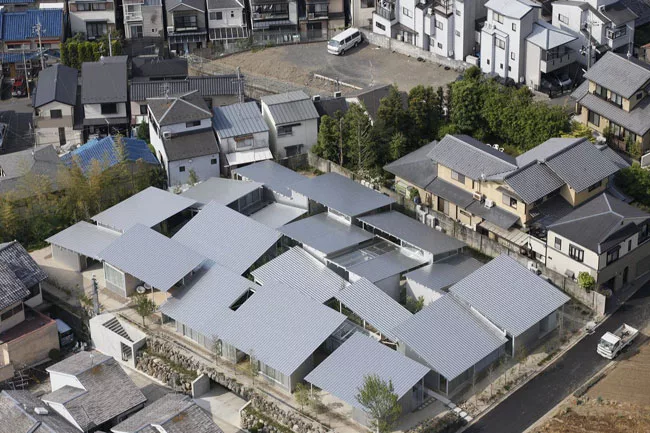
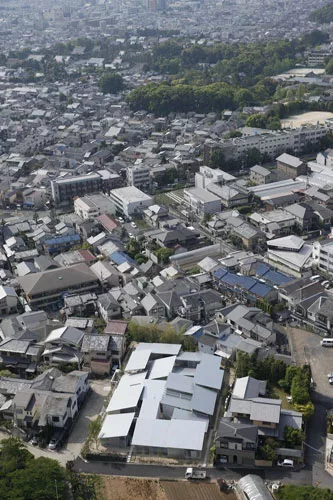
View of the project from the air.
 
Photo © Iwan Baan
Nishinoyama House
View of the project from the air.
 
Photo © Iwan Baan
Nishinoyama House
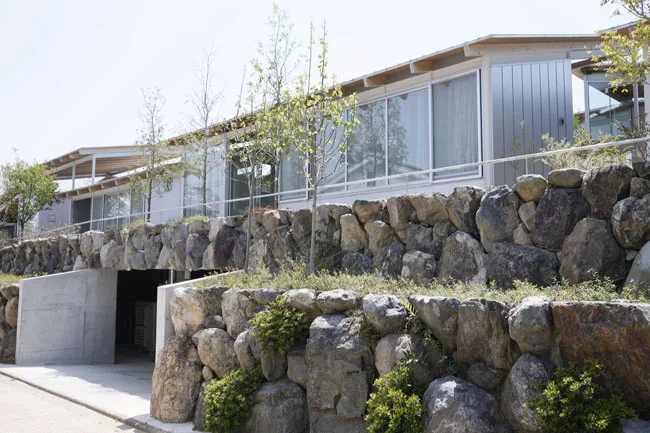
Perimeter of the project with entrance for parking.
 
Photo © Iwan Baan
Nishinoyama House
A second pedestrian entry.
 
Photo © Iwan Baan
Nishinoyama House
Angled roofs cover some outdoor spaces and circulation areas.
 
Photo © Iwan Baan
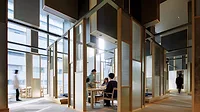
Nishinoyama House
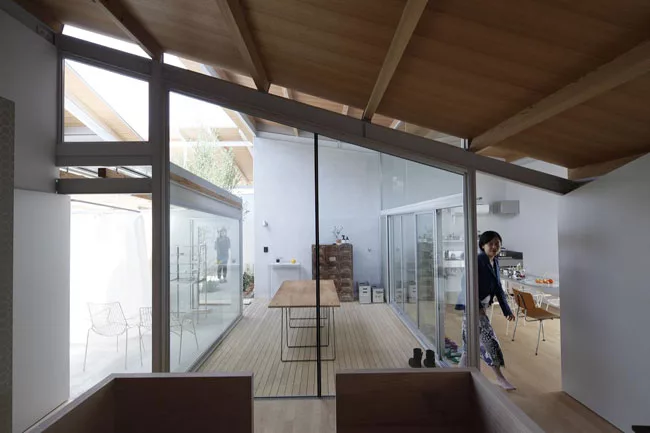
Inside one apartment.
 
Photo © Iwan Baan
Nishinoyama House
Take your shoes off before coming indoors.
 
Photo © Iwan Baan
Nishinoyama House
The project sits near agricultural plots on the outskirts of Kyoto.
 
Photo © Iwan Baan
Nishinoyama House
Nishinoyama House
Nishinoyama House
Nishinoyama House
Nishinoyama House
Nishinoyama House
Nishinoyama House
Nishinoyama House
October 16, 2014

Architects & Firms

Kazuyo Sejima & Associates

Kyoto, Japan

People/Products

Far from Kyoto’s temples and tourist attractions, the Nishinoyama House sits at the edge of the city surrounded by single-family homes and small agricultural plots. The latest project from the Tokyo architect Kazuyo Sejima, the building contains 10 unique apartments unified by a gridded ground plan and a sequence of overlapping, pitched roofs. Pointing inward and upward, the slanted planes reach their pinnacle at the center of the site. Harmonizing with the architectural vernacular as well as the hilly landscape, they unite the building’s disparate parts into a man-made mound of wood, glass, and steel.

The project began when the client inherited the parcel from his father and decided to replace the existing house with housing. Today the only remnants of the old building are the boulders that form the base of the new one and conceal its below-grade parking. In contrast to the heavy rocks, the architecture consists of a light assemblage of airy boxes interspersed with courtyards and narrow pathways that evoke the intricacy of a traditional Japanese neighborhood.

As in many an old community, the dwelling units are both close together and independent of each other. Some of the Nishinoyama apartments share internal walls, roofs and courtyards—Sejima likens them to “communal backyards”—but every home has its own access directly from the site perimeter and some from the underground garage as well. Inside, each apartment is a free-flowing, single-story sequence of multipurpose spaces that connect room to rectilinear room as in a historic Japanese house. Though corridors are absent, some of the apartments include stairs down to a cellar, up to a loft or, in one case, both. While Sejima supplied minimal kitchen accouterments and bathroom fixtures, these elements do not fully dictate room function. In lieu of bathrooms, a few units sequester the tub or toilet in individual enclosures. Elsewhere, the washroom is big enough for chairs and a table as well. “It should be a place to relax,” explains Sejima. (In addition to SANAA, her partnership with Ryue Nishizawa, the architect maintains her independent firm, Kazuyo Sejima & Associates.)

To a large extent the apartment layouts were determined by the 3.28-feet (1-meter) by 2.46-feet (750-centimeter) grid that Sejima applied to the site at the outset of design. Based on the maximum size of a plywood sheet, the grid corresponds with the building’s structure. Instead of supporting the entire complex with a single structural frame, Sejima supplied each apartment with its own localized framing and linked them all together. The result is a unified system composed of discrete parts, each one made up of 3-inch (75-millimeter-square), solid-section steel columns and H-beams that support the wood members securing the plywood roofs. Coupled with steel cross bracing concealed within the building’s mortar walls, the rigid wood sheets counter lateral forces.

In compliance with the municipal code, the 40-room building is capped with 21 slanted planes—Sejima’s first use of pitched roofs. Intended to preserve Kyoto’s picturesque scenery, the regulations also called for 16-inch and 24-inch (40 and 60-cm) deep eaves at the building’s sides and front respectively. Yet, unlike the city’s traditional homes, the Nishinoyama House presents a disjuncture between the housing’s top and bottom. Utilizing a combination of the city’s three acceptable slopes, Sejima covered each unit with three roofs, two shared with the adjacent apartments. “If there were 10 roofs, the project might seem like 10 independent houses, but this is [one] housing [project],” explains the architect. So she connected all of the units with a continuous set of slanted planes.  

Similarly, at ground level the floor surface reads as continuous throughout but is composed of stepped planes. Designed to mitigate the site’s 3.3-foot (one-meter) drop spread out along its north-south axis, the floors descend in six-inch (15-centimeter) increments between apartments. Though a construction headache that had to be meticulously worked out in the field, the shifts are barely perceptible. Made of wood, mortar, and tatami, the simple floors complement the galvanized steel cladding the building’s exterior walls as well as the full-height glass and mortar panels serving as its inner faces and interior partitions. While the glass walls, sliding doors, and transom windows enable a close relationship between inside and out, careful positioning of the opaque surfaces minimize direct views between apartments. An abundance of oblique views through the complex, though, enable tenants to sense the presence of others, a desirable feature to many in Japan.

By using elegant and thin components, Sejima has once again succeeded in creating an ethereal work that bears her distinctly light touch. But this building is more than just a sum of clearly articulated parts. As its additive architecture suggests, it is as much a community as it is a housing development.


People

Size:

13,563 square feet

Construction cost:

withheld

Completion date:

October 2013


Products

 
KEYWORDS: Japan

Share This Story

Looking for a reprint of this article?
From high-res PDFs to custom plaques, order your copy today!

Contributing Editor Naomi Pollock, FAIA, is the author of Japanese Design Since 1945: A Complete Sourcebook and the forthcoming Vanishing Japan: Modern Architecture Gone But Not Forgotten,

Post a comment to this article

Report Abusive Comment

Subscription Center
  • Create an Account
  • Start a Subscription
  • Manage My Account
  • Sign Up for Newsletters
  • Visit Customer Service
  • Update Preferences

More Videos

Sponsored Content

Sponsored Content is a special paid section where industry companies provide high quality, objective, non-commercial content around topics of interest to the Architectural Record audience. All Sponsored Content is supplied by the advertising company and any opinions expressed in this article are those of the author and not necessarily reflect the views of Architectural Record or its parent company, BNP Media. Interested in participating in our Sponsored Content section? Contact your local rep!

close
  • TAMLYN XtremeTrim Exterior Trim
    Sponsored byTamlyn

    Designing Cleaner Panel Facades: Why Exterior Trim Details Matter

  • Building with Vapor Barriers
    Sponsored byReef Industries, Inc.

    Vapor Barriers Help Control Moisture in Tighter Building Designs

  • Duct Interior with Prodeq System
    Sponsored byHenry, a Carlisle Company

    Designing Resilient Water Containment Systems

DESIGN:ED Podcast
Listen to Architectural Record’s DESIGN:ED Podcast

Events

June 18, 2026

Rebooting the Aging Office Building

Credits: 1 AIA LU/HSW; 1 AIBD P-CE; 0.1 ICC CEU; 1 PDH

Explore façade retrofit strategies and award-winning design concepts that can transform aging office buildings into healthier, higher-performing workplaces for today’s hybrid workforce.

June 23, 2026

Enhancing Fire Resistance with Advanced PVC Solutions

Credits: 1 AIA LU/HSW; 1 AIBD P-CE; 0.1 ICC CEU; 1 IIBEC CEH

Evaluate advanced PVC solutions that improve fire resistance, support WUI compliance, and enhance resilience in residential and commercial building design.

View All Submit An Event

Products

2026 Architect's Square Foot Costbook

2026 Architect's Square Foot Costbook

See More Products

Popular Stories

SanDiegoAirport

Top 300 Architecture Firms of 2026

Coronado Bridge

The Architect’s Guide to San Diego

Lorcan O' Herilhy

California Architect Lorcan O’Herlihy Has Died, Age 66

CCA, Studio Gang

The Winners of the AIA’s 2026 Architecture Award Range from Collegiate Rowing Hubs to Housing for the Homeless

Dusk House

Design Vanguard 2026: ONO

Rebooting the Aging Office Building - Free Webinar - June 18, 2026

Related Articles

  • Ando Museum

    See More
  • Kyoto Hyoto

    An Elaborate Array of Wood and Aluminum-Mesh Panels Fills a Soaring Eatery in Osaka

    See More
  • Corner House

    Corner House by DSDHA

    See More

Related Products

See More Products
  • biogenic.jpg

    Manual of Biogenic House Sections

  • iconic house.jpg

    The Iconic House

See More Products
×

The latest news and information

#1 Source for Architectural Design, News and Products

SUBSCRIBE
  • RESOURCES
    • Advertise
    • Contact Us
    • Submit
    • Store
  • ACCOUNT CENTER
    • Create an Account
    • Start a Subscription
    • Manage My Account
    • Sign Up for Newsletters
    • Visit Customer Service
    • Update Preferences
  • PRIVACY
    • PRIVACY POLICY
    • TERMS & CONDITIONS
    • DO NOT SELL MY PERSONAL INFORMATION
    • PRIVACY REQUEST
    • ACCESSIBILITY
  • SERVICES
    • Marketing Services
    • Reprints
    • Market Research
    • List Rental
    • Survey/Respondent Access
  • STAY CONNECTED
    • Linkedin
    • Facebook
    • Instagram
    • YouTube
    • X (Twitter)

Copyright ©2026. All Rights Reserved BNP Media, Inc. and BNP Media II, LLC.

Design, CMS, Hosting & Web Development :: ePublishing