Architectural Record
search
cart
facebook twitter linkedin youtube
  • Sign In
  • Subscribe
  • Sign Out
  • My Account
Architectural Record
  • NEWS
    • Latest News
    • Awards
    • Interviews
    • Obituaries
    • Podcasts
      • Design:Ed Podcast
      • Sponsored Podcasts
  • OPINION
    • Book Reviews / Excerpts
    • Exhibition Reviews
    • Forum
  • EXCLUSIVES
    • Videos
    • Design Vanguard
    • Top 300 Firms
    • Sponsored Content
    • Sponsored eBooks
    • From the Archives
  • CONTINUING ED
    • Editorial Continuing Ed
    • CE Center
    • CE Academies
  • PROJECTS
    • Buildings By Type
    • Reuse & Renovation
    • Museums & Arts Centers
    • Colleges & Universities
    • Multifamily Housing
    • Interiors
    • Lighting
    • Kitchen & Bath
  • HOUSES
    • Record Houses
    • House of the Month
    • Featured Houses
  • PRODUCTS
    • Products by Category
    • Record Products of the Year
    • Latest Products
  • EVENTS
    • Dates & Events
    • Record on the Road
    • Innovation Conference
    • Sustainability in Practice
    • Women In Architecture
    • Webinars
    • Ad Excellence Awards
    • Submit an Event
  • CONNECT
    • Ask RECORD AI
    • Newsletters
    • Contact
    • Advertise
    • Editorial Calendar
    • Store
    • Customer Service
  • SUBMIT
    • Submission Guidelines
    • RECORD Competitions
  • MAGAZINE
    • Subscribe
    • My Account
    • Digital Edition
    • Current Issue
    • Firm Pass
    • Historic Archive
ProjectsBuildings by TypeWorkplace Design

GL Events Headquarters

A Steely Gaze: Odile Decq draws from Lyon’s industrial context to project the waterfront’s new identity.

By Chris Foges
GL Events Headquarters
Located on the bank of the Saône River, the building is covered with photographic abstractions of the immediate surround­ings created by artist Felice Varini. Next door is the green Euronews Head­quarters by Jakob + MacFarlane; nearby is their Orange Cube. Floors suspended from the steel trusses at the top are laterally stabilized by a concrete core at the southeast corner.
 
Photo © Roland Halbe
GL Events Headquarters
Cantilevered to the east, the spaces within the four-story portion are enclosed by spider glass layered with Varini’s photographic images on the ethyl vinyl acetate (EVA) layer. Temporary exhibition space on the ground floor is served by a secondary riverside entrance. A glazed panel in the red soffit of the cantilevered volume admits views upwards into the atrium.
 
Photo © Roland Halbe
GL Events Headquarters
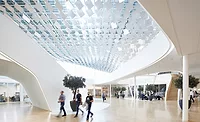
The concentration of vertical structure in the atrium helps facilitate views through the building, as does the transparency of fully glazed meeting rooms on the open-plan office floors.
 
Photo © Roland Halbe
GL Events Headquarters
Less formal meeting areas include the double-height foyer on the ground floor, which features furniture and lighting designed by Odile Decq.
 
Photo © Roland Halbe
GL Events Headquarters
Two roof terraces linked by external stairs provide additional social space.
 
Photo © Roland Halbe
GL Events Headquarters
Image courtesy Studio Odile Decq
GL Events Headquarters
Image courtesy Studio Odile Decq
GL Events Headquarters
Image courtesy Studio Odile Decq
GL Events Headquarters
Image courtesy Studio Odile Decq
GL Events Headquarters
July 16, 2014

Architects & Firms

Studio Odile Decq

Lyon, France

People/Products

From Oslo and Lisbon to Hamburg and Amsterdam, the last 20 years have seen many of Europe’s redundant urban dockyards transformed into architectural zoos, peppered with signature structures by top-tier architects, often with greater regard for novelty than for the particularities of history or place. In Lyon—France’s affluent second city—derelict wharves on a narrow peninsula between the Rhône and Saône rivers are rapidly metamorphosing into a residential, cultural, and business district called Confluence. Among the renovated warehouses at its southern tip, new offices in eye-watering colors and a self-consciously iconic museum vie for attention.

The latest addition is a headquarters building for GL Events, designed by Studio Odile Decq. The Paris-based architect won a competition for a speculative office building on the site, which was acquired by the global event-staging and venue-management company early in the design-development process. Sheathed in a crisp glass skin imprinted with smudgy black-and-white photographs by artist Felice Varini, it comprises two rectangular blocks stacked so that they sit almost at right angles in plan. A two-story lower volume housing exhibition space presents its long side to the Saône. Above, four stories of offices for 300 staff members cantilever 80 feet over a riverside walkway.

With its decorative envelope and gravity-defying form, GL Events might at first glance appear to share the exhibitionist tendencies of its newer neighbors, which include the zesty Orange Cube by Jakob + MacFarlane and the Musée des Confluences by Coop Himmelb(l)au, but a closer look reveals a building attuned to its setting. Reasoning that the presence of a new structure erases an existing view, Varini photographed the site from all four sides and applied the ghostly prospect of roads, railway lines, and bridges to the facades. Likewise, the heroic projection is a conscious echo of the gantry cranes that still dot the quayside, and the nonorthogonal arrangement of the two volumes in plan—they are at 86 rather than 90 degrees—also draws on the character of the place. “We didn’t want the building to appear completely static,” says project leader Peter Baalman. “When you walk in a harbor, cranes are always moving. The play of volumes reflects that.”

Once inside the building you find its debt to the imagery of industry unmistakable. Beyond the double-height foyer, a 90-foot-high atrium rises through the middle of the plan, overlooked by glass-balustraded offices. This lofty space is dominated by three exposed steel pylons incorporating stairs and elevators, from which aerial walkways extend to the offices. Crowning the close-spaced and heavily cross-braced towers is a dense matrix of superscaled steelwork: 16-foot-deep trusses diagonally span the atrium and gird the perimeter, acting as a giant box beam from which the floors below are suspended.

You can’t go by first impressions: the great weight of steel overhead is immediately evident, but at its edges the building appears to rest on nothing more substantial than glass. Ascending to the upper floors provides further disconcerting experiences; it takes a moment to process the scene from a fourth-floor walkway, for example, where an oblique view through a glazed panel in the bottom of the cantilevered volume seems to show the river flowing beneath three tiers of open-plan workspace. At the top, where glass-walled directors’ offices are inserted into the interstices between steel members, the scale of the structure makes the occupants seem like Lilliputians.

Though this results in an unorthodox office building, the design has a rational basis, since the cantilever provides more usable floor space than could otherwise be achieved on the plot. The plan and section are also closely tailored to the client’s requirements, notably in allowing managers to take in at a glance what is happening throughout the building. This was complicated by fire regulations that usually preclude offices’ opening directly onto atria, but the architects were able negotiate a workable combination of measures, including discreet glass skirts on each floor edge that limit the spread of smoke. “That is characteristic of many of our projects,” says Baalman. “The concepts look simple, but technically they are very sophisticated.”

Further evidence of this refinement is found in the facade. In winter the gap between the double-glazed inner skin and outer rainscreen is used to warm incoming air, while in summer the large-scale images laminated into the glass rainscreen help to alleviate glare.

From within the building, this photographic interlayer acts like a diaphanous veil; it is possible to see out, but attention is subtly directed inward to an interior more akin to a sybaritic nightclub than a conventional cubicle farm. Black carpet amplifies the darkness of the silver-gray steelwork. Soft light bounces off crystalline glass partitions and balustrades. Bespoke seating and storage units are in vivid red, which by happy coincidence is both GL Events’ corporate color and a hallmark of Decq’s work.

The architects’ well-honed aesthetic is all-pervasive— indeed, the scheme incorporates numerous Decq-designed products, from aluminum stair profiles to purpose-made hardware and amoebic light fittings, whose soft forms counterpoint the hardness of steel, just as the spiky javelin-shaped door-handles find their obverse in amorphous blobs containing refreshment counters. The building slips easily between two identities, the somber and the sensuous.

Another kind of mutability is represented in the photographic facades’ RECORD of the neighborhood at a particular moment in time. As the surroundings are further overwritten by new development—a process already under way—the connection of Decq’s building to its place will perhaps seem stronger still.


People

Owner:
SCI Polygone Confluence

Architect:
Studio Odile Decq
11, rue des Arquebusiers
75003 Paris FRANCE
T +33 142 712 741;
F +33 142 712 742

Personnel in architect's firm who should receive special credit:
Design Director:
Odile Decq

Project Principal & Manager:
Odile Decq

Lead Project Designer:
Peter Baalman

Project Assistants:
Mathieu Roguet

Interior designer:
Odile Decq

Engineer(s):
Structural:
BATISERF

Mechanical, Electric, and Plumbing:
AXESS

Consultant(s):
Lighting:
Studio Odile Decq

Acoustical:
DAP

Other:
ILIADE and MB&Co (Economists);
ACCES (Fire engineering)

Contractors:
SOLETANCHE BACHY, BLB, RENAUDAT, SMB, HEFI FISCHER, CORONA, SIMETAL FORMES, TAPIS FRANCOIS, MENUISIERS DU RHONE, PALATIN, SAPE, COTE, EIFFAGE, ARALEC, CABSYSTEMES, ENODIS, CHARBONNEL, BRUYNZEEL, THYSSEN, COMEY, WEREY STENGER, BLANCHARD BLAZQUEZ, BANGUI.

Photographer(s):
Roland Halbe Fotografie
tel +49 711 6074073
credits: Roland Halbe
Odile Decq
T +33 142 712 741
credits Odile Decq

Renderer(s):
Studio Odile Decq

CAD system, project management, or other software used:
Archicad and Rhino

Size:

89,300 square feet

Construction cost:

$33 million

Completion date:

January 2014


Products

Structural system
Manufacturer of any structural components unique to this project:
Steel structure

Exterior cladding
Metal/glass curtain wall:
AGC

Curtain wall:
outer facade: spider glass layered with image included on EVA layer; inner facade in insulating double glass

Built-up roofing:
Profiled steel + glass foam insulation + PVC membrane + wooden terrace on pedestals
Glass roof of AGC glass beams and AGC double insulating glass including photovoltaic cells

Doors
Entrances:
cylindrical automatic glass doors PORTALP and GEZE

Glass Doors:
inside fire proof glass doors FORSTER/BOULLET

Metal doors:
fire proof doors MALERBA

Wood doors:
MALERBA

Hardware
Locksets:
ASSA ABLOY/VACHETTE

Closers:
DORMA

Pulls:
VALLI VALLI

Interior finishes
Acoustical ceilings:
No false ceiling, acoustical light fixtures LUCEPLAN Petale, designed by Odile Decq

Paints:
inside paints: PLASDOX/
outside paints: GUITTET/
ground paints: CIMENTOL

Paneling:
fire proof glass partition and stainless steel panel

Solid surfacing:
resin STOCKMEIER

Carpet:
OBJECT CARPET

Raised flooring:
COMEY/LAMIFLOOR

Furnishings
Office furniture:
Vitra

Reception furniture:
Vitra

Chairs:
Vitra, Chair Phantom: Poltrona Frau, designed by Odile Decq

Tables:
Table Petale, designed by Odile Decq, realized by Menuisiers du Rhone

Other furniture:
Doorhandle Duemiladue: Valli Valli, designed by Odile Decq
Doorhandle Javelot: Studio Odile Decq, designed by Odile Decq

Lighting
Interior ambient lighting:
-Lighting fixture Luceplan Petale, designed by Odile Decq; Luceplan Javelot, designed by Odile Decq
- Downut, by Modular

Conveyance
Elevators/Escalators:
THYSSEN KRUPP

Plumbing
Water Fountains, designed by Odile Decq; realized by ESPACE

Energy
Photovoltaic system:
glass roof with photovoltaic cells.

 
KEYWORDS: France

Share This Story

Looking for a reprint of this article?
From high-res PDFs to custom plaques, order your copy today!

Chris Foges is a writer and editor working in architecture and the built environment, based in London. He is contributing editor at the RIBA Journal and was formerly editor of Architecture Today magazine. His books include Imagination and The City Works.

Post a comment to this article

Report Abusive Comment

Subscription Center
  • Create an Account
  • Start a Subscription
  • Manage My Account
  • Sign Up for Newsletters
  • Visit Customer Service
  • Update Preferences

More Videos

Sponsored Content

Sponsored Content is a special paid section where industry companies provide high quality, objective, non-commercial content around topics of interest to the Architectural Record audience. All Sponsored Content is supplied by the advertising company and any opinions expressed in this article are those of the author and not necessarily reflect the views of Architectural Record or its parent company, BNP Media. Interested in participating in our Sponsored Content section? Contact your local rep!

close
  • TAMLYN XtremeTrim Exterior Trim
    Sponsored byTamlyn

    Designing Cleaner Panel Facades: Why Exterior Trim Details Matter

  • Building with Vapor Barriers
    Sponsored byReef Industries, Inc.

    Vapor Barriers Help Control Moisture in Tighter Building Designs

  • Duct Interior with Prodeq System
    Sponsored byHenry, a Carlisle Company

    Designing Resilient Water Containment Systems

DESIGN:ED Podcast
Listen to Architectural Record’s DESIGN:ED Podcast

Events

June 10, 2026

Rethinking Stormwater – The Power of Porous Paving

Credits: 1 AIA LU/HSW; 1 AIBD P-CE; 0.1 ICC CEU

Learn how porous paving systems support stormwater management, reduce heat island effects, and enhance sustainable site design performance.

June 11, 2026

Very Early Warning Fire Detection for Mission-Critical Facilities

Credits: 1 AIA LU/HSW; 1 AIBD P-CE; 0.1 ICC CEU

Examine advanced fire detection strategies that support uptime and enhance safety in data centers and other mission-critical facilities.

View All Submit An Event

Products

2026 Architect's Square Foot Costbook

2026 Architect's Square Foot Costbook

See More Products

Popular Stories

Practice Matters illustration

What’s in a (Firm’s) Name? Thinking About Succession and Legacy

Coronado Bridge

The Architect’s Guide to San Diego

Practice Matters illustration

By the Numbers: Counting America's Architects

Riverdale House by Studio Lau

Riverdale House by Studio Lau

KRESA by DLR

In Kalamazoo, DLR Group Completes a Mass-Timber Hub for Career and Technical Education Programs

Broader Sustainability of CMU - Free Webinar - May 21, 2026

Related Articles

  • Banham Headquarters

    Banham Headquarters by Allies and Morrison

    See More
  • Philips Lighting Headquarters

    Philips Lighting Headquarters by LAVA

    See More
  • Standouts: London Design Festival 2014

    See More
×

The latest news and information

#1 Source for Architectural Design, News and Products

SUBSCRIBE
  • RESOURCES
    • Advertise
    • Contact Us
    • Submit
    • Store
  • ACCOUNT CENTER
    • Create an Account
    • Start a Subscription
    • Manage My Account
    • Sign Up for Newsletters
    • Visit Customer Service
    • Update Preferences
  • PRIVACY
    • PRIVACY POLICY
    • TERMS & CONDITIONS
    • DO NOT SELL MY PERSONAL INFORMATION
    • PRIVACY REQUEST
    • ACCESSIBILITY
  • SERVICES
    • Marketing Services
    • Reprints
    • Market Research
    • List Rental
    • Survey/Respondent Access
  • STAY CONNECTED
    • Linkedin
    • Facebook
    • Instagram
    • YouTube
    • X (Twitter)

Copyright ©2026. All Rights Reserved BNP Media, Inc. and BNP Media II, LLC.

Design, CMS, Hosting & Web Development :: ePublishing