Architectural Record
search
cart
facebook twitter linkedin youtube
  • Sign In
  • Subscribe
  • Sign Out
  • My Account
Architectural Record
  • NEWS
    • Latest News
    • Awards
    • Interviews
    • Obituaries
    • Podcasts
      • Design:Ed Podcast
      • Sponsored Podcasts
  • OPINION
    • Book Reviews / Excerpts
    • Exhibition Reviews
    • Forum
  • EXCLUSIVES
    • Videos
    • Design Vanguard
    • Top 300 Firms
    • Sponsored Content
    • Sponsored eBooks
    • From the Archives
  • CONTINUING ED
    • Editorial Continuing Ed
    • CE Center
    • CE Academies
  • PROJECTS
    • Buildings By Type
    • Reuse & Renovation
    • Museums & Arts Centers
    • Colleges & Universities
    • Multifamily Housing
    • Interiors
    • Lighting
    • Kitchen & Bath
  • HOUSES
    • Record Houses
    • House of the Month
    • Featured Houses
  • PRODUCTS
    • Products by Category
    • Record Products of the Year
    • Latest Products
  • EVENTS
    • Dates & Events
    • Record on the Road
    • Innovation Conference
    • Sustainability in Practice
    • Women In Architecture
    • Webinars
    • Ad Excellence Awards
    • Submit an Event
  • CONNECT
    • Ask RECORD AI
    • Newsletters
    • Contact
    • Advertise
    • Editorial Calendar
    • Store
    • Customer Service
  • SUBMIT
    • Submission Guidelines
    • RECORD Competitions
  • MAGAZINE
    • Subscribe
    • My Account
    • Digital Edition
    • Current Issue
    • Firm Pass
    • Historic Archive
ProjectsBuildings by TypeCivic ArchitectureWorkplace Design

Bruce C. Bolling Municipal Building

A home for Boston's school district preserves historic facades and breathes new life into a corner of the city's Roxbury neighborhood.
By Joann Gonchar, FAIA
Bruce C. Bolling Municipal Building
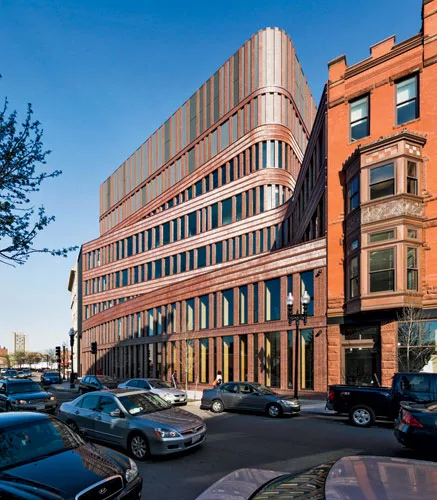
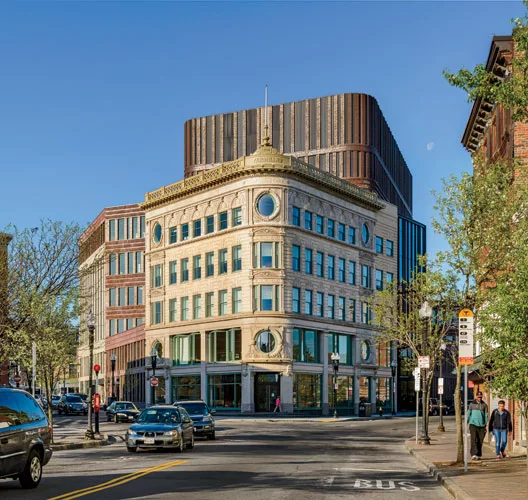
The new BPS headquarters incorporates the facades of three late 19th-century structures, including the graceful bowed face of the Ferdinand Building.
 
Photo © Anton Grassl
Bruce C. Bolling Municipal Building
The headquarters' main entrance sits where an elevated train once turned to cross the site. Its path is marked by lighting recessed in the lobby ceiling and above the entry.

Photo © Anton Grassl/Esto

Bruce C. Bolling Municipal Building
The architects chose brown iron-spot brick for most of the building's cladding. The subtly light-reflective bricks are laid in a variety of patterns, including stacked, running, and soldier bond. These new facades meet the historic ones, including the red brick face of the Curtis Building, but step back at angles and curve around corners as the building rises.

Photo © Anton Grassl/Esto

Bruce C. Bolling Municipal Building
In order to assert or, as Mecanoo's Houben says, 'grab' the building's south and southwest corners, the architects chose another material'rough ashlar granite.
 

Photo © Anton Grassl/Esto

Bruce C. Bolling Municipal Building
In order to assert or, as Mecanoo's Houben says, 'grab' the building's south and southwest corners, the architects chose another material'rough ashlar granite.

Photo © Anton Grassl/Esto

Bruce C. Bolling Municipal Building
The double-story lobby has warm finishes that include dark terrazzo and birch.

Photo © Anton Grassl/Esto

Bruce C. Bolling Municipal Building
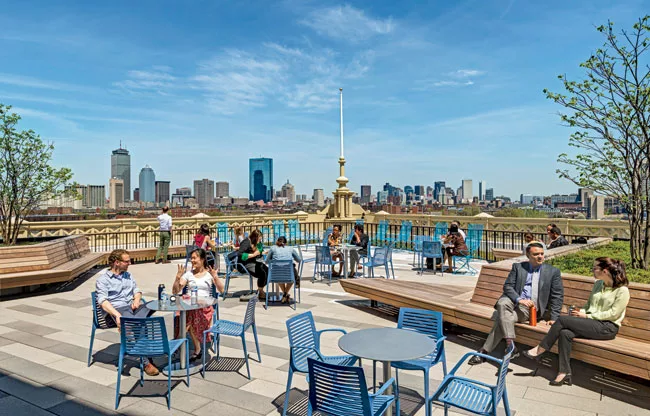
The sixth floor's publicly accessible roof deck, positioned at the prow of the Ferdinand Building, affords a stunning view of Boston's skyline.

Photo © Anton Grassl/Esto

Bruce C. Bolling Municipal Building
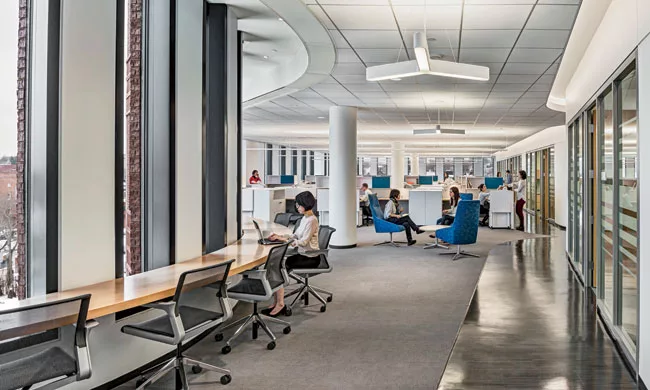
The BPS offices are flexible, daylight-filled, and sensibly laid out.

Photo © Anton Grassl/Esto

Bruce C. Bolling Municipal Building
Mecanoo and Sasaki Associates
Boston
The project team decided to save only the facades of the late 19th century buildings on the site including that of the landmarked Ferdinand.
Photo courtesy Mecanoo and Sasaki Associates
Bruce C. Bolling Municipal Building
Saving Ferdinand's facade required maintaining its stability during demolition and carefully weaving in a new permanent structure of steel framing and composite slabs on metal deck.
 
Photo courtesy Arup
Bruce C. Bolling Municipal Building
Bolling's new brickwork is laid in several patterns, included stacked bond between the windows and subtly corbeled spandrels of running bond and angled solider courses.
 
Photo courtesy Mecanoo and Sasaki Associates
Second Floor
Image courtesy Mecanoo and Sasaki Associates
Second Floor
Image courtesy Mecanoo and Sasaki Associates
Fourth Floor
Image courtesy Mecanoo and Sasaki Associates
Fourth Floor
Image courtesy Mecanoo and Sasaki Associates
Fifth Floor
Image courtesy Mecanoo and Sasaki Associates
Sixth Floor
Image courtesy Mecanoo and Sasaki Associates
Bruce C. Bolling Municipal Building
Image courtesy Mecanoo and Sasaki Associates
Bruce C. Bolling Municipal Building
Second Floor
Second Floor
Fourth Floor
Fourth Floor
Fifth Floor
Sixth Floor
Bruce C. Bolling Municipal Building
August 16, 2015

Architects & Firms

Mecanoo
Sasaki

Boston

Video

People/Products

A sign on the door of Dudley Dough, a soon-to-be opened cafe on the ground floor of Boston's recently inaugurated Bruce C. Bolling Municipal Building, advertises 'pizza, coffee, and economic justice.' This improbable menu gives a clue to the larger goals behind the construction of the 215,000-square-foot, six-story structure completed this past spring. The $96 million building, which is the administrative headquarters for Boston Public Schools (BPS), was first conceived about a decade ago by the late mayor Thomas Menino to help rejuvenate Dudley Square—the once-thriving commercial center of the city's Roxbury neighborhood.

One could hardly imagine a more challenging spot for such an urban-revitalization project. The client's roughly triangular block is bordered on two sides by traffic-filled streets and by a busy bus station on the third. And until it was rerouted in the late 1980s, an elevated train rumbled through the site. Although the tracks had been demolished long before Netherlands-based Mecanoo and local firm Sasaki Associates were hired as the architects in 2011, leaving the lot largely open, it was not a clean slate. Three late 19th-century structures occupied the property. At the northern corner was the five-story Ferdinand Building'a landmarked former furniture store with a graceful, but severely deteriorated, bowed facade of blond brick, granite, and terra-cotta confections. Two more modest four-story storefronts'the red brick Curtis Building and the granite Waterman Building'sat at the southwest corner.

Originally, the Bolling project, named after the first black president of the city council'a champion of investment in Roxbury'encompassed only the Ferdinand. But the team convinced the city that, in order to achieve the kind of transformation it envisioned, it was important to incorporate the other two.

The team opted to retain only the facades of the three historic buildings, in part to satisfy BPS's desire for open and flexible interiors but also because the structures were in very poor condition. At the Ferdinand, for example, stomping hard enough could have created holes in its shallow-arched floor slabs, says Jimmy Su, senior structural engineer with Arup. Saving the facades meant maintaining their stability during demolition and carefully weaving in a new permanent structure of steel framing and composite slabs on metal deck. The restoration work also entailed removing decades of grime, matching mortar, and recreating or repairing damaged ornamentation.

As the primary material for the new parts of the building skin, the architects chose a subtly reflective brown iron-spot brick in three different textures'smooth, a rough wirecut, and an almost bumpy artisan.

The new brick meets the old facades but steps back at angles, curving around corners as the building rises and culminating in a mechanical penthouse that is dramatically illuminated at night. This brick is laid in several patterns, including stacked bond between the windows and subtly corbeled spandrels of running bond and angled soldier courses. 'The older buildings have a tremendous amount of detail,' says Victor Vizgaitis, a Sasaki principal. 'We wanted to respect that idea of craft.'

Given the brickwork's complexity, the team placed relieving angles at each floor. The strategy provided bricklayers with much-needed adjustability. It also allowed the architects to stagger the windows'which range in width from 16 to 40 inches'so that neither the windows nor the two-brick-wide piers between them line up from level to level. The resulting skin has a delicacy sympathetic to the historic facades but with a 'jazzy' rhythm, says Francine Houben, Mecanoo's creative director.

Less successful is the treatment of the building's south and southwest corners. There the architects chose rough ashlar granite from the same quarry that the 19th-century craftsmen used on the Waterman. Sasaki and Mecanoo combined the stone with large glazed openings and smaller ones that mimic the rhythm of the windows on the new brick portions of Bolling. The intent was to assert, or 'grab,' the site's three corners and then tie them together 'in a sculptural way, with the brick as cement,' explains Houben. However, the new stone facades look like a mash-up of traditional load-bearing masonry and Modernist fenestration.

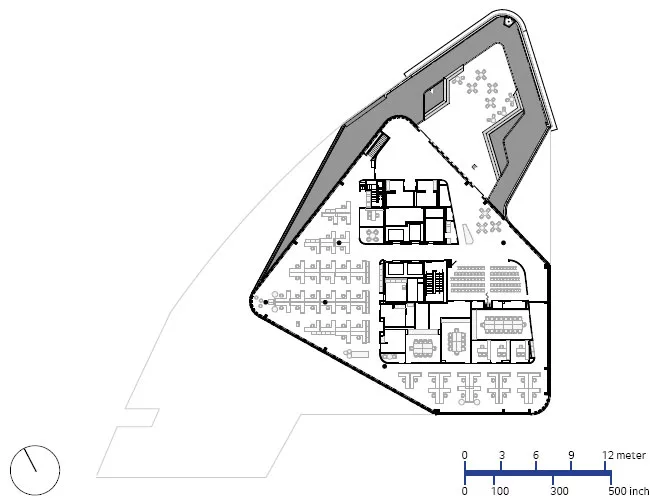
These caveats shouldn't detract from the design team's considerable accomplishments, including creating flexible and comfortable workspace for the BPS staff. The offices have basic finishes, like carpet tile and suspended ceilings, but are intelligently laid out to make the most of the odd-shaped footprint: easily reconfigurable cubicles are placed near the building perimeter, while conference rooms, private offices, and small enclosed spaces for collaborative work are located within cores. Cove lighting washes the walls'enlivening the few areas with little access to daylight.

The office floors, on levels three through six, are reached through the handsome double-story lobby, with its black terrazzo floor and a ceiling of birch-wood slats. A generously proportioned stair that doubles as informal seating leads to a mezzanine level with a school-committee room that can be reserved for cultural and community activities, as well as to the Roxbury Innovation Center, a business incubator. The top floor also features spaces for both the public and BPS staff, including meeting rooms and, at the prow of Ferdinand, a roof deck with a view of downtown Boston.

Arguably, the public amenity that has the potential to make the biggest impact on the vibrancy of Bolling's surroundings is its street-level retail. So far, five of the six spaces have been leased to businesses that include an optician, a clothing store, and Dudley Dough. This caf' will be run by Haley House'a nonprofit with a bakery training program for underemployed men and women. Houben says she was worried at first that Bolling would be 'just an office building.' But with its social justice goals, preservation of history, and revival of craft, it appears poised to become much more.

Boston Bricks with a Dutch Touch

Courtesy Mecanoo


People

Client/User: Boston Public Schools

Client/Owner: Property & Construction Management Department, City of Boston

Architect:
Sasaki Associates, Inc.
64 Pleasant Street
Watertown MA 02472 USA
t: 1.617.926.3300
f: 1.617.924.2748

Mecanoo architecten
Oude Delft 203, 2611HD
Delft, The Netherlands
T. +31 15 279 8100

Personnel in architect's firm who should receive special credit: Francine M. J. Houben, Friso van der Steen, Fedele Canosa, Marta Maria Roy Torrecilla, Luuk van Wijlick, Richard Hagg, Louise Bjørk, Eduardo Garcia Diaz, Conxa Gene Garcia, Ines De Almeida Lourenco, Alberto Seller, Mecanoo project team; Fiske Crowell, Victor Vizgaitis, Elizabeth Meek, Steve Hamwey, Sasaki project team

Architect of record: Sasaki Associates, Inc.

Associate architect(s): Mecanoo architecten

Interior designer: Sasaki Associates, Inc.

Engineers
Civil: Sasaki Associates, Inc.

Structural: ARUP

MEP/FP: ARUP

Geotechnical: McPhail Associates

Consultant(s):
Landscape: Sasaki Associates, Inc.

Historic Preservation: Building Conservation Associates

Environmental: Weston & Sampson

Lighting: LAM Partners

Acoustical: Cavanaugh Tocci Associates

AV: ACT Associates

Construction Manager at Risk/General Contractor: Shawmut Design and Construction

Photographer(s):
Anton Grassl/ESTO
PH: 914-698-4060

Size: 215,000 square feet

Construction cost: $96 million

Completion date: March 2015


Products

Structural system
Steel frame with composite concrete deck

Exterior cladding
Masonry: Endicott Medium Ironspot #46

Metal/glass curtain wall:
Historic Façade: EFCO System 5900
New Façade: Kawneer 1600 Wall System, Kawneer Clearwall

Moisture barrier: Carlisle Fire Resist 705FR

Other cladding unique to this project:
GFRP Cornice on Historic Facade: Duro Fiber Company, Inc.

Roofing
Elastomeric:
Versico VersiFlex PVC Membrane
LiveRoof Vegetated Roof Modules

Windows
Wood frame:
Curved Round Windows in Historic Facade: Duratherm Window Corporation.

Metal frame:
Windows in Historic Façade: Graham Architectural Products Series 1500/S1500

Glazing
Glass: Guardian SunGuard

Doors
Entrances:
Historic Façade: EFCO D500
New Façade: Kawneer 500

Metal doors: Curries

Wood doors: Eggers Industries

Sliding doors: Stanley Dura-Glide 3000

Fire-control doors: Won-Door Fireguard 90

Security grilles: Wayne-Dalton

Overhead Doors: Cornell

Folding Partitions: Hufcor

Hardware
Locksets: Sargent

Closers: Sargent

Exit devices: Sargent

Pulls: Rockwood Manufacturing

Security devices: Continental Access w/ HID Card Readers

Interior finishes
Acoustical ceilings: Armstrong Ultima Tegular

Suspension grid: Armstrong Silhouette XL ¼” Reveal 9/16” Bolt Slot

Demountable partitions: KI Genius Walls

Cabinetwork and custom woodwork: Beech finish, millwork manufactured by Legere Woodworking

Paints and stains: Sherwin Williams

Paneling: Beech finish, millwork manufactured by Legere Woodworking

Plastic laminate: Pionite

Solid surfacing: LG Hi-Macs (in open office); Formica (in bathrooms); HanStone Contempo (in pantries)

Floor and wall tile (cite where used): Casalgrande (Bathroom floors and accent wall); Daltile (Bathroom walls, Pantry wet walls; upper public floor); Crossville Laminam (elevator lobby walls)

Resilient flooring: Forbo Flotex (open and private offices, conference rooms) Armstrong Bio Based Tile (circulation spaces); Johnonsite Slimline + Roppe Pinnacle (wall base)

Terrazzo: DePaoli Mosaic Company

Furnishings
Office furniture: Knoll Dividends and Knoll Reff

Reception furniture: Landscape Forms – Chipman Chair and Parc Centre Table

Chairs:
Task Chair – Knoll Generation and Regeneration
Stacking Chair – Hightower Four Cast
Conference Chair – Allsteel Clarity

Tables:
Prismatique – 2Merge
Falcon – Symetris and 800 Series
Herman Miller – Everywhere Table, Tavolo Table
Tuohy – Zi Custom

Upholstery:
Bernhardt – Mirador Sofa, Apel Ottoman
Andreu World – Agora, RDL Lounge Chair
Keilhauer – Celia
Davis – Radius

Lighting
Interior ambient lighting: Corelite Jaylum; SSL eCOVELINE; Neo-Ray

Downlights: BASYS LED; Bruck Track lighting

Accent Rails: Architectural Lighting Works

Task lighting: Knoll Copeland Light

Exterior: Bega; Lumenpulse Lumenfacade

Conveyance
Elevators: Delta Beckwith Elevator Company
Controller:  Motion Control Engineering Inc.
Power Unit:  Hollister Whitney Elevator Corp.
Fixtures:  Monitor Controls
Door Equipment:  GAL Manufacturing
Cab: Elevator Interior Design Inc.
Entrances: Gunderlin

Plumbing
Kohler Bannon Service Sink
Fiat Mop Service Basin
Kohler Bardon
Undermount Group SS Sink
Congeniality Group SS Sink
Kohler Kingston
Kohler Brenham
Halsey Taylor Water Cooler
Oasis Water Cooler
Temptroll II Shower
Sloan Solis solar powered hand washing faucets

Energy
Energy management or building automation system: Siemens

 
KEYWORDS: Boston

Share This Story

Looking for a reprint of this article?
From high-res PDFs to custom plaques, order your copy today!

Joann gonchar

Joann Gonchar, FAIA, LEED AP, is deputy editor at Architectural Record. She joined RECORD in 2006, after working for eight years at its sister publication, Engineering News-Record. Before starting her career as a journalist, Joann worked for several architecture firms and spent three years in Kobe, Japan, with the firm Team Zoo, Atelier Iruka. She earned a Master of Architecture degree from the University of Pennsylvania and a Bachelor of Arts from Brown University. She is licensed to practice architecture in New York State.

Post a comment to this article

Report Abusive Comment

Subscription Center
  • Create an Account
  • Start a Subscription
  • Manage My Account
  • Sign Up for Newsletters
  • Visit Customer Service
  • Update Preferences

More Videos

Sponsored Content

Sponsored Content is a special paid section where industry companies provide high quality, objective, non-commercial content around topics of interest to the Architectural Record audience. All Sponsored Content is supplied by the advertising company and any opinions expressed in this article are those of the author and not necessarily reflect the views of Architectural Record or its parent company, BNP Media. Interested in participating in our Sponsored Content section? Contact your local rep!

close
  • TAMLYN XtremeTrim Exterior Trim
    Sponsored byTamlyn

    Designing Cleaner Panel Facades: Why Exterior Trim Details Matter

  • Building with Vapor Barriers
    Sponsored byReef Industries, Inc.

    Vapor Barriers Help Control Moisture in Tighter Building Designs

  • Duct Interior with Prodeq System
    Sponsored byHenry, a Carlisle Company

    Designing Resilient Water Containment Systems

DESIGN:ED Podcast
Listen to Architectural Record’s DESIGN:ED Podcast

Events

June 18, 2026

Rebooting the Aging Office Building

Credits: 1 AIA LU/HSW; 1 AIBD P-CE; 0.1 ICC CEU; 1 PDH

Explore façade retrofit strategies and award-winning design concepts that can transform aging office buildings into healthier, higher-performing workplaces for today’s hybrid workforce.

June 23, 2026

Enhancing Fire Resistance with Advanced PVC Solutions

Credits: 1 AIA LU/HSW; 1 AIBD P-CE; 0.1 ICC CEU; 1 IIBEC CEH

Evaluate advanced PVC solutions that improve fire resistance, support WUI compliance, and enhance resilience in residential and commercial building design.

View All Submit An Event

Products

2026 Architect's Square Foot Costbook

2026 Architect's Square Foot Costbook

See More Products

Popular Stories

SanDiegoAirport

Top 300 Architecture Firms of 2026

Coronado Bridge

The Architect’s Guide to San Diego

Lorcan O' Herilhy

California Architect Lorcan O’Herlihy Has Died, Age 66

CCA, Studio Gang

The Winners of the AIA’s 2026 Architecture Award Range from Collegiate Rowing Hubs to Housing for the Homeless

Dusk House

Design Vanguard 2026: ONO

Rebooting the Aging Office Building - Free Webinar - June 18, 2026

Related Articles

  • 49 South Van Ness

    SOM Integrates a City Office Building into San Francisco's Urban Fabric

    See More
  • Yale University Art Gallery

    Yale University Art Gallery, Kahn Building

    See More
  • Merdeka 118 and Jeddah Tower

    Enthusiasm for Building Tall Endures

    See More

Related Products

See More Products
  • facade.jpg

    Sustainable Facades: Design Methods for High-Performance Building Envelopes

  • manual

    2026 National Building Cost Manual

See More Products
×

The latest news and information

#1 Source for Architectural Design, News and Products

SUBSCRIBE
  • RESOURCES
    • Advertise
    • Contact Us
    • Submit
    • Store
  • ACCOUNT CENTER
    • Create an Account
    • Start a Subscription
    • Manage My Account
    • Sign Up for Newsletters
    • Visit Customer Service
    • Update Preferences
  • PRIVACY
    • PRIVACY POLICY
    • TERMS & CONDITIONS
    • DO NOT SELL MY PERSONAL INFORMATION
    • PRIVACY REQUEST
    • ACCESSIBILITY
  • SERVICES
    • Marketing Services
    • Reprints
    • Market Research
    • List Rental
    • Survey/Respondent Access
  • STAY CONNECTED
    • Linkedin
    • Facebook
    • Instagram
    • YouTube
    • X (Twitter)

Copyright ©2026. All Rights Reserved BNP Media, Inc. and BNP Media II, LLC.

Design, CMS, Hosting & Web Development :: ePublishing