Architectural Record
search
cart
facebook twitter linkedin youtube
  • Sign In
  • Subscribe
  • Sign Out
  • My Account
Architectural Record
  • NEWS
    • Latest News
    • Awards
    • Interviews
    • Obituaries
    • Podcasts
      • Design:Ed Podcast
      • Sponsored Podcasts
  • OPINION
    • Book Reviews / Excerpts
    • Exhibition Reviews
    • Forum
  • EXCLUSIVES
    • Videos
    • Design Vanguard
    • Top 300 Firms
    • Sponsored Content
    • Sponsored eBooks
    • From the Archives
  • CONTINUING ED
    • Editorial Continuing Ed
    • CE Center
    • CE Academies
  • PROJECTS
    • Buildings By Type
    • Reuse & Renovation
    • Museums & Arts Centers
    • Colleges & Universities
    • Multifamily Housing
    • Interiors
    • Lighting
    • Kitchen & Bath
  • HOUSES
    • Record Houses
    • House of the Month
    • Featured Houses
  • PRODUCTS
    • Products by Category
    • Record Products of the Year
    • Latest Products
  • EVENTS
    • Dates & Events
    • Record on the Road
    • Innovation Conference
    • Sustainability in Practice
    • Women In Architecture
    • Webinars
    • Ad Excellence Awards
    • Submit an Event
  • CONNECT
    • Ask RECORD AI
    • Newsletters
    • Contact
    • Advertise
    • Editorial Calendar
    • Store
    • Customer Service
  • SUBMIT
    • Submission Guidelines
    • RECORD Competitions
  • MAGAZINE
    • Subscribe
    • My Account
    • Digital Edition
    • Current Issue
    • Firm Pass
    • Historic Archive
ProjectsBuildings by TypePerforming Arts Center Projects

Everyman Theatre by Haworth Tompkins Architects

London

By Hugh Pearman
Everyman Theatre
The front facade contains aluminum sun-shading shutters water-jet cut with portraits of everyday Liverpudlians.
 
Photo © Philip Vile
Everyman Theatre
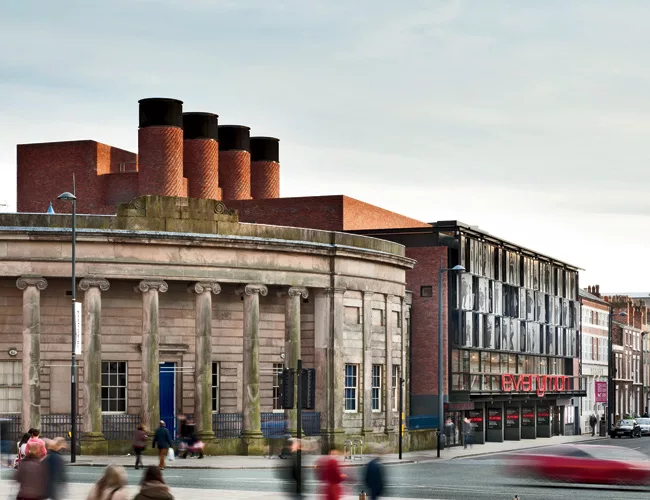
The new Everyman Theatre replaces its former home, a 19th-century church on Liverpool’s Hope Street. Stack-effect chimneys and the building’s rear and side elevations are clad in a hard red brick—a familiar material in Liverpool.
 
Photo © Philip Vile
Everyman Theatre
The basement bistro recalls the old theater’s subterranean bar.
 
Photo © Philip Vile
Everyman Theatre
Stack-effect chimneys and the building’s rear and side elevations are clad in a hard red brick—a familiar material in Liverpool.
 
Photo © Philip Vile
Everyman Theatre
The public spaces had a lived-in feel even before they opened.
 
Photo © Philip Vile
Everyman Theatre
New backstage areas, workshops, and dressing rooms face a narrow street, some looking out through a row of protruding angled windows.
 
Photo © Philip Vile
Everyman Theatre
Lining the auditorium are bricks salvaged from the demolished 1837 building.
 
Photo © Philip Vile
Everyman Theatre
Image courtesy Haworth Tompkins Architects
Everyman Theatre
Image courtesy Haworth Tompkins Architects
Everyman Theatre
Image courtesy Haworth Tompkins Architects
Everyman Theatre
Everyman Theatre
Everyman Theatre
Everyman Theatre
Everyman Theatre
Everyman Theatre
Everyman Theatre
Everyman Theatre
Everyman Theatre
Everyman Theatre
December 16, 2014

Architects & Firms

Haworth Tompkins Architects

Liverpool, United Kingdom

People/Products

Liverpool’s new Everyman Theatre, which just won this year’s Stirling Prize for the top building in the UK, shows Haworth Tompkins Architects doing what it does best. The London-based firm excels at theater renovations in which the distinction between new and old becomes happily blurred rather than sharply defined. But with the Everyman, the architects applied their approach to an entirely new building, managing to make a modern theater feel long established.

Partner Steve Tompkins understands the dark arts involved in designing a theater building, the need to let the drama inform the architecture rather than vice-versa. “It’s about the language of shadows, the glint in the darkness,” he says, and he approached this commission by summoning up ghosts. The first of these was the previous theater on the site—a unique location, on Liverpool’s long and lofty Hope Street. The original Everyman, with its spacious open stage and intimate dive-bar basement café was founded in 1964, right at the start of Beatlemania, in what was then a bohemian area of the city. A nucleus of writers and poets had taken to meeting in the former Hope Hall cinema there, and the theater was a natural progression. But the building hid other spirits: before its cinema phase, Hope Hall had been a church and—as built in 1837—a chapel for Roman Catholic Dissenters.

The Everyman was updated in the mid-1970s, but by the early 21st century, the facilities were inadequate (especially deficient in backstage areas) and structurally dubious. In 2007, Haworth Tompkins won a competition to rebuild it from scratch. The brief from the client, artistic director Gemma Bodinetz, was consciously paradoxical: she wanted a total transformation of what the theater could do, but she also wanted her loyal patrons to feel that they recognized the place.

The theater acquired two adjoining sites, and from the exterior, you feel as if somehow the old theater has just been expanded into the new 50,500-square-foot, concrete-and-steel building. Even the former 1970s sign displaying its name in lowercase red letters appears to be present and intact, though neon has been replaced with LEDs and it is much larger, subtly tweaked by artist and typographer Jake Tillson. Above that is the key facade move, in which each of the 105 cast-aluminium sun-shading shutters on this west-facing building is adorned with a water-jet-cut image of a person. These are the everyfolk of Liverpool, the result of drop-in photo sessions open to the public, from which a selection of images was made. Each shutter is manually operable from inside, which randomizes the appearance of the facade according to weather and pattern of use. Above the shutters, a row of brick cylinders rises above the roof like a ship’s smokestacks. Stack-effect chimneys for the auditorium’s natural ventilation system, which promises to keep the space comfortable for most of the year, they helped the project achieve a BREEAM Excellent rating.

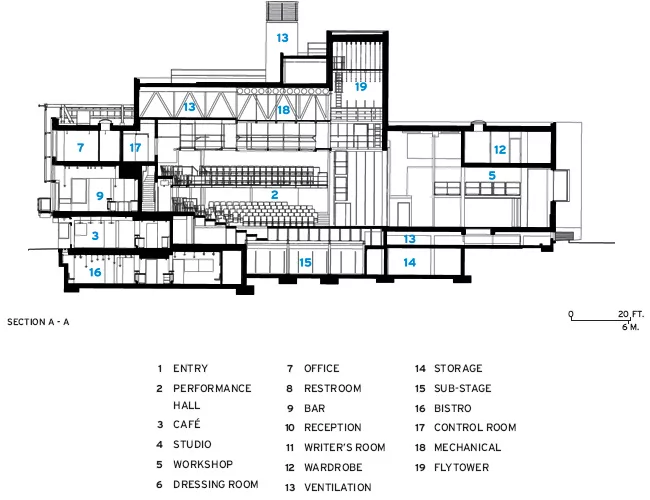
Inside, the public spaces felt used, familiar, even before they opened. On the street side is the main lobby and café, which open up via a double-height entrance space to a large upstairs bar on one side and a writers’ studio on the other. The pale, board-marked concrete of the structural beams and columns has an industrial quality—and it contains a high proportion of cement-replacing slag, which helps the building’s sustainability credentials. In the center of the plan, a steel frame allows for the large span required by the 400-seat theater and fly tower above it. The thrust stage juts into two horseshoe-shaped levels of seating.

The firm’s most dramatic act of resurrection involved salvaging 177-year-old bricks, 25,000 of them, from original chapel walls and reusing them in plain sight. They are especially effective where they form the back wall of the auditorium—again, you could easily think you were in a converted building, not a new one. “There was a strong public attachment to the Everyman as a carrier of cultural memory, and a consequent urge to maintain some physical manifestation of the old theater,” says Tompkins. “Our task was to find the right opportunity to achieve this without resorting to sentimentality.” The dull gold fabric used in the auditorium seats also recalls the color of the seating in the previous theater.

Balancing the auditorium, on the opposite side of the plan, is a full-size rehearsal stage on the ground floor and a reception area above—all vast improvements on the previous facility’s cramped quarters. At one point, more land became available, and the theater could have grown still bigger. Tompkins persuaded his client to keep things compact. As it was, he set back a portion of the main frontage lest the facade appear disproportionately long.

This, then, is a relatively small theater with a high profile —all the more so now that it has won the UK’s top architecture prize, against stiff competition. The Stirling citation summed it up well, calling the Everyman “groundbreaking as a truly public building” and “an extraordinary contribution to both theater and the city.”


People

Owner:
Liverpool and Merseyside Theatres Trust

Architect:
Haworth Tompkins
33 Greenwood Place
London NW5 1LB
Tel: +44 (0) 207 250 3225
Fax: +44 (0) 207 267 1391

Personnel in architect's firm who should receive special credit:
Steve Tompkins ' Creative Director
Roger Watts ' Associate Director
Will Mesher ' Project Architect

Interior designer:
Haworth Tompkins with citizens design bureau

Engineer(s):
Alan Baxter & Associates (Structural Engineer)
Watermans Building Services (Services Engineers)

Consultant(s):
Acoustic consultant:
Gillieron Scott Acoustic Design

Other:
Project Manager:
GVA Acuity
Quantity Surveyor:
Gardiner & Theobald
Theatre consultants:
Charcoalblue
CDM Coordinator:
Turner and Townsend
Catering Consultant:
Keith Winton Design
Access Consultant:
Earnscliffe Davies Associates
Collaborating Artist:
Antoni Malinowski
Typographer:
Jake Tilson
Portrait Photographer (Fa'ade portraits):
Dan Kenyon

General contractor:
Gilbert-Ash

Photographer(s):
Philip Vile
07779 657 672
info@philipvile.com

H'l'ne Binet
helenebinet@gmail.com
www.helenebinet.com
020 7209 95 96

CAD system, project management, or other software used:
Bentley Microstation

Other Information if required
Auditorium:
406 seats in standard thrust format
Portrait panels on the facade:
105 (Etched, anodised and water jet cut 10mm aluminium sheet)
Bricks reclaimed from the old everyman:
25,000
Sustainability:
BREEAM Excellent

Size:

50,500 square feet

Construction cost:

$21 million

Completion date:

December 2013


Products

Structural system
In-situ concrete generally.
Steel to auditorium area.

Manufacturer of any structural components unique to this project:
Concrete formwork including boardmarking - Mastercraft
Steelwork fabricator ' Pudsey Steel

Exterior cladding
Masonry:
Brickwork ' Daas Baksteen ((Modular Clay Products ' brick factor)

Other cladding unique to this project:
Portrait screen fabricator ' James & Taylor

Roofing
Other:
Single membrane roofing ' Sika Sarnafil

Windows
Metal frame:
Schucco / installer - GFS

Glazing
Skylights:
Schucco / installer - GFS

Doors
Metal doors:
Schucco / installer - GFS

Sliding doors:
Glazed aluminium framed to first floor bar - Fineline

Special doors:
Large acoustic doors ' Clark Door

Hardware
Locksets:
Yannadis

Closers:
Yannadis

Pulls:
Yannadis

Other special hardware:
Yannadis

Interior finishes
Acoustical ceilings:
Quietstone acoustic plaster

Suspension grid:
British Gypsum

Cabinetwork and custom woodwork:
Specialist Joinery Group

Paneling:
Internal slatted and plywood lining ' Mastercraft.

Floor and wall tile:
Wall tiles to behind bars ' Pewter glazed tiles by E H Smith Architectural Clay Products

Timber flooring:
Engineered Oak floor boards to front of house areas - Hakwood

Special interior finishes unique to this project:
Steel stairs and architectural metalwork ' Metaltech
Stainless steel mesh balusdrade infills ' 'web-net', Jacob
Internal brickwork ' reclaimed bricks from former chapel on site.

Furnishings
Fixed seating:
Theatre seats ' Kirwin and Simpson

Chairs:
To Bistro, Cafe etc - Geometric Furniture

Tables:
To Bistro, Cafe etc - Geometric Furniture

Lighting
Interior ambient lighting:
Bespoke copper light fittings to front of house ' Mike Stoane Lighting
First floor bar ' vintage theatre lanterns refurbished by the Everyman

Downlights:
Auditorium led house light system - GDS

Dimming System or other lighting controls:
Front of house dimming - Lutron

Conveyance
Elevators/Escalators:
Knowsley Lift Services

Add any additional building components or special equipment that made a significant contribution to this project:
Stage Lighting and AV - Northern Stage
Stage Engineering and rostra - Stage Technologies
Internal enamel signage - A.J Wells & Sons

 
KEYWORDS: RIBA Stirling Prize United Kingdom

Share This Story

Looking for a reprint of this article?
From high-res PDFs to custom plaques, order your copy today!

London-based Hugh Pearman is the editor of the RIBA Journal.

Post a comment to this article

Report Abusive Comment

Subscription Center
  • Create an Account
  • Start a Subscription
  • Manage My Account
  • Sign Up for Newsletters
  • Visit Customer Service
  • Update Preferences

More Videos

Sponsored Content

Sponsored Content is a special paid section where industry companies provide high quality, objective, non-commercial content around topics of interest to the Architectural Record audience. All Sponsored Content is supplied by the advertising company and any opinions expressed in this article are those of the author and not necessarily reflect the views of Architectural Record or its parent company, BNP Media. Interested in participating in our Sponsored Content section? Contact your local rep!

close
  • cold storage facility
    Sponsored byCarlisle SynTec Systems

    How Architects Can Design More Continuous Cold Storage Envelopes

  • TAMLYN XtremeTrim Exterior Trim
    Sponsored byTamlyn

    Designing Cleaner Panel Facades: Why Exterior Trim Details Matter

  • Building with Vapor Barriers
    Sponsored byReef Industries, Inc.

    Vapor Barriers Help Control Moisture in Tighter Building Designs

DESIGN:ED Podcast
Listen to Architectural Record’s DESIGN:ED Podcast

Events

June 18, 2026

Rebooting the Aging Office Building

Credits: 1 AIA LU/HSW; 1 AIBD P-CE; 0.1 ICC CEU; 1 PDH

Explore façade retrofit strategies and award-winning design concepts that can transform aging office buildings into healthier, higher-performing workplaces for today’s hybrid workforce.

June 23, 2026

Enhancing Fire Resistance with Advanced PVC Solutions

Credits: 1 AIA LU/HSW; 1 AIBD P-CE; 0.1 ICC CEU; 1 IIBEC CEH

Evaluate advanced PVC solutions that improve fire resistance, support WUI compliance, and enhance resilience in residential and commercial building design.

View All Submit An Event

Products

2026 Architect's Square Foot Costbook

2026 Architect's Square Foot Costbook

See More Products

Popular Stories

SanDiegoAirport

Top 300 Architecture Firms of 2026

Lorcan O' Herilhy

California Architect Lorcan O’Herlihy Has Died, Age 66

Coronado Bridge

The Architect’s Guide to San Diego

CCA, Studio Gang

The Winners of the AIA’s 2026 Architecture Award Range from Collegiate Rowing Hubs to Housing for the Homeless

Dusk House

Design Vanguard 2026: ONO

Rebooting the Aging Office Building - Free Webinar - June 18, 2026

Related Articles

  • RIBA Awards 2014 Stirling Prize to the Everyman Theatre by Haworth Tompkins

    See More
  • a timber gridshell roof in a theater

    A Malmö Theater Basks in the Limelight Following a Revamp by Haworth Tompkins and White Arkitekter

    See More
  • W Austin Hotel and Residences with Austin City Limits Live at Moody Theatre

    W Austin Hotel and Residences with Austin City Limits Live at Moody Theatre by Andersson-Wise Architects

    See More

Related Products

See More Products
  • 3dthinking.jpg

    3D Thinking in Design and Architecture: From Antiquity to the Future

  • american arch.jpg

    American Architecture: An Illustrated Encyclopedia

See More Products
×

The latest news and information

#1 Source for Architectural Design, News and Products

SUBSCRIBE
  • RESOURCES
    • Advertise
    • Contact Us
    • Submit
    • Store
  • ACCOUNT CENTER
    • Create an Account
    • Start a Subscription
    • Manage My Account
    • Sign Up for Newsletters
    • Visit Customer Service
    • Update Preferences
  • PRIVACY
    • PRIVACY POLICY
    • TERMS & CONDITIONS
    • DO NOT SELL MY PERSONAL INFORMATION
    • PRIVACY REQUEST
    • ACCESSIBILITY
  • SERVICES
    • Marketing Services
    • Reprints
    • Market Research
    • List Rental
    • Survey/Respondent Access
  • STAY CONNECTED
    • Linkedin
    • Facebook
    • Instagram
    • YouTube
    • X (Twitter)

Copyright ©2026. All Rights Reserved BNP Media, Inc. and BNP Media II, LLC.

Design, CMS, Hosting & Web Development :: ePublishing