Architectural Record
search
cart
facebook twitter linkedin youtube
  • Sign In
  • Subscribe
  • Sign Out
  • My Account
Architectural Record
  • NEWS
    • Latest News
    • Awards
    • Interviews
    • Obituaries
    • Podcasts
      • Design:Ed Podcast
      • Sponsored Podcasts
  • OPINION
    • Book Reviews / Excerpts
    • Exhibition Reviews
    • Forum
  • EXCLUSIVES
    • Videos
    • Design Vanguard
    • Top 300 Firms
    • Sponsored Content
    • Sponsored eBooks
    • From the Archives
  • CONTINUING ED
    • Editorial Continuing Ed
    • CE Center
    • CE Academies
  • PROJECTS
    • Buildings By Type
    • Reuse & Renovation
    • Museums & Arts Centers
    • Colleges & Universities
    • Multifamily Housing
    • Interiors
    • Lighting
    • Kitchen & Bath
  • HOUSES
    • Record Houses
    • House of the Month
    • Featured Houses
  • PRODUCTS
    • Products by Category
    • Record Products of the Year
    • Latest Products
  • EVENTS
    • Dates & Events
    • Record on the Road
    • Innovation Conference
    • Sustainability in Practice
    • Women In Architecture
    • Webinars
    • Ad Excellence Awards
    • Submit an Event
  • CONNECT
    • Ask RECORD AI
    • Newsletters
    • Contact
    • Advertise
    • Editorial Calendar
    • Store
    • Customer Service
  • SUBMIT
    • Submission Guidelines
    • RECORD Competitions
  • MAGAZINE
    • Subscribe
    • My Account
    • Digital Edition
    • Current Issue
    • Firm Pass
    • Historic Archive
ProjectsBuildings by TypeCivic Architecture

United States Consulate General, Guangzhou

Diplomatic Position: In the midst of the visual hubbub of China's third-largest city, Skidmore, Owings & Merrill creates an understated ensemble of buildings for the U.S. Consulate General.

By Clare Jacobson
United States Consulate General
The complex has several site-specific pieces by contemporary American artists, including a monumental steel sculpture by Joel Shapiro, which dominates a plaza in front of the main Consulate Building’s entrance for dignitaries.
 
Photo © Bruce Damonte
United States Consulate General
The consulate’s seven low-rise buildings, which dot a parklike 7.4-acre site, are dwarfed by their surroundings in Guangzhou’s burgeoning central business district.
 
Photo © Bruce Damonte
United States Consulate General
Applicants for non-immigrant visas wait in the double-story Lincoln Hall. The room’s defining feature is louverlike teak slats hung from the walls and ceiling. Several types of stone from southern China, set in a variety of patterns, stripe the floor. These patterns continue in the paving for the outdoor public spaces.
 
Photo © Bruce Damonte
United States Consulate General
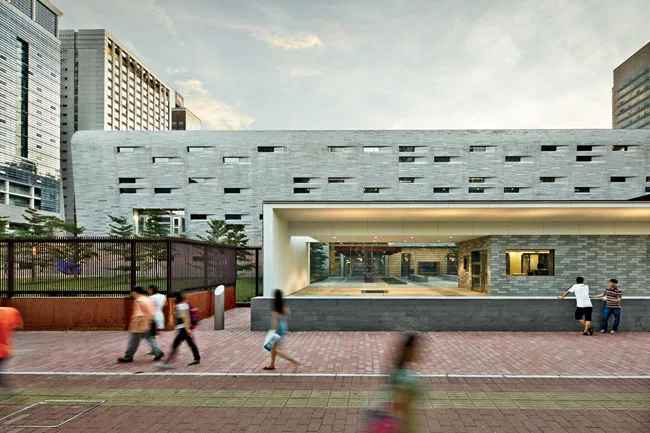
The complex’s front door is a low-slung structure for security screening at the eastern edge of the site. A glass wall incorporated into the screening facility and an openwork fence of weathering steel allow passersby to see the main Consulate Building beyond.
 
Photo © Bruce Damonte
United States Consulate General
Image courtesy SOM
United States Consulate General
Image courtesy SOM
United States Consulate General
Image courtesy SOM
United States Consulate General
March 16, 2014

Architects & Firms

Skidmore, Owings & Merrill

Guangzhou, China

People/Products

The U.S. Consulate General in Guangzhou, China, makes only the quietest of claims within the city's noisy new business district. Designed by Skidmore, Owings & Merrill (SOM), its seven low-rise buildings—offices, screening facilities, a warehouse, and a residence for Marines—dot a 7.4-acre site in the burgeoning Pearl River New Town. Zaha Hadid's opera house lies catercorner to it, and Wilkinson Eyre's supertall IFC Guangzhou and KPF's soon-to-be-supertaller CTF Guangzhou are close by. China's tallest structure, the Canton Tower, for telecommunications equipment, looms across the river. The consulate—built with a warm palette of stone, wood, glass, and weathering steel—is, by comparison, subdued.

Much of the complex's humility has to do with its scale. With its tallest buildings a mere four stories—the maximum allowed for the consulate by Chinese authorities —it is dwarfed by the surroundings. Adding to this modesty is its parklike atmosphere. Though setbacks for security are part of the reason for all the green space, the effect, ironically, is of an open enclave landscaped with lush indigenous plants. “We are an oasis in the middle of a bustling central business district,” says Consul General Jennifer Zimdahl Galt. The greening, along with similarly low-key sustainability measures, helped the project achieve LEED Silver certification.

The complex replaces five leased spaces scattered throughout Guangzhou, allowing the consulate to make a unified statement within the city. The general public, diplomats, and staff each enter the site at three dedicated one-story security screening facilities, each clad in local granite and topped with a green roof. The pavilion at the site's eastern edge serves as the public entrance and as the consulate's front door, says San Francisco–based Craig Hartman, SOM design partner for the Guangzhou project and for the firm's U.S. Embassy in Beijing, completed in 2008.

The main building on the lot is the Consulate Building. Granite-clad concrete wraps four stories in an inverted U, forming both roof and facade. Rounded roof corners allow Guangzhou's heavy rains to roll down into the landscape. Horizontal windows dot the stone facade. Some are positioned low to provide views for workers sitting at their desks. Others are set high to help bring light deep into the interior.

The public enters the building through the double-story Lincoln Hall, which has louverlike teak slats hung from its walls and ceiling. Daylight penetrates through them and also through deep-set windows. Several types of local stone stripe the floor, and an installation by video artist Jennifer Steinkamp brightens one wall.

The hall is a lively place, hosting up to 2,500 consular visits each day and as many as 200 people for evening lectures and other events. Applicants for non-immigrant visas wait here. Visitors for other services—the Guangzhou Consulate is the only place in China that processes adoptions and immigrant visas—take a glass elevator to more typical upper-floor offices. It seems generous—in a friendly American kind of way—that the consulate offers its grandest space to its Chinese guests.

A sense of approachability pervades the project. While the concrete wall on the north perimeter does not exactly say, “Come on in!” the public eastern entrance is more inviting. It has an openwork fence of weathering steel (Hartman refers to it as a “picket fence”), and its security-screening facility incorporates a glass wall so that passersby can see the Consulate Building. Galt says this transparency sends a “powerful message about . . . how we are open and welcoming.”

The U.S. has had a varying history with its buildings abroad. The modern designs of the 1950s and '60s, by some of America's leading architects, were meant to symbolize democracy through their openness. A security-led approach prevailed in the 1970s and '80s. The Standard Embassy Design program, using stock designs, began in 1999. In 2010, the Bureau of Overseas Buildings Operations (OBO) announced the Excellence in Diplomatic Facilities program, which put quality architecture back in the mix. Projects by Morphosis for Beirut and Tod Williams Billie Tsien Architects for Mexico City are under way. “Representing the U.S. is not just about representing U.S. policy,” says Lydia Muniz, OBO's director. “It's about representing American ingenuity and creativity.”

Of all the responsibilities—including functionality, security, and sustainability—that the U.S. Consulate General in Guangzhou bears on its rounded shoulders, the one most difficult to assess is how well it conveys a national identity. There is no iconic feature such as the grand colonnades of so many classic U.S. embassies (and even SOM's Beijing Embassy) to suggest its civic purpose. In fact, this consulate is so unobtrusive it could be mistaken for a school. Hartman admits that the subtlety of the design is in part a reflection of his personal ethos. But he also suggests that the building is intentionally self-deprecating. “When we build representations of our values, the architecture should reflect a certain level of modesty,” he says. “It shouldn't be a spectacle.” This attitude toward its Guangzhou neighbors is understandable, even laudable. But to represent the diversity of America, being benign yet bold might be better. Still, opting for quiet amid the noise of Guangzhou may be the boldest statement of all.


People

Owner:  United States Government

Architect:
Skidmore, Owings & Merrill LLP
One Front Street, Suite 2400
San Francisco, California 94111
Tel: 415-981-1555
Fax: 415-352-3214

Personnel in architect's firm who should receive special credit:
Architect:  Skidmore, Owings & Merrill LLP (SOM)
Craig Hartman, FAIA, Design Partner
Gene Schnair, FAIA, Managing Partner
Keith Boswell, FAIA, Technical Director
Eric Keune, AIA, LEED AP, Project Architect, Design
Kye Archuleta, AIA, Project Architect, Design
Kevin Krage, AIA, NCIDQ, Project Manager
David Diamond, AIA, Senior Technical Designer
Carlos Gonzalez, Security Officer
John Kuchen, AIA, LEED AP BD+C, Technical Designer
Sandy Greig, AIA, LEED AP BD+C, Technical Designer

Chinese Architect and Engineering Firm:  GZDI – Guangzhou Design Institute

Interior designer:  Skidmore, Owings & Merrill LLP (SOM)
Tamara Dinsmore, AIA, IIDA, LEED AP, Senior Interior Designer
Chanda Capelli, IIDA, NCIDQ, Interior Designer
Mary Liboro, Interior Designer

Graphics: Skidmore, Owings & Merrill LLP (SOM)
Lonny Israel, Senior Graphic Designer

Engineer(s):    Structural - Skidmore, Owings & Merrill LLP (SOM)

Mark Sarkisian, PE, SE, LEED AP, Structural Engineering Partner

Peter Lee, PE, SE, LEED AP, Senior Structural Engineer

Eric Long, PE, SE, LEED AP, Project Structural Engineer

Lindsay Hu, PE, LEED AP BD+C, Structural Engineer

Civil - Skidmore, Owings & Merrill LLP (SOM)
Brian Shirmer, PE, LEED AP, Civil Engineer

Mechanical - Skidmore, Owings & Merrill LLP (SOM)
Luke Leung, PE LEED AP, Director of Engineering
Miguel Gonzalez, Senior Mechanical Engineer

Electrical - Skidmore, Owings & Merrill LLP (SOM)
Michael Filar, PE LEED AP, Electrical Engineering Lead

Plumbing/Fire Protection - Skidmore, Owings & Merrill LLP (SOM)

Marion Wnuk, PE, LEED AP, Plumbing and Fire Protection Lead

Specifications – Skidmore, Owings & Merrill LLP (SOM)
Emily Borland, Specifications

Consultant(s):
Landscape: Tom Leader Studio

Lighting: Claude R. Engle Lighting Consultants PC

Acoustical:   Cerami & Associates

Other:  
Audio Visual: Shen Milsom & Wilke LLC
Blast Engineering: Weidlinger Associates, Inc.
Cost Estimation: Project Cost Government Service, LLC
Food Service: Cini Little International, Inc.
Furniture Integration: MOI
Geotechnical: Schnabel Engineering, LLC
IT/Telecommunications: WSP Flack + Kurtz
Physical Security: Woods Peacock Engineering Consultants
Site Lighting: Archiluce International Inc.
Vertical Transportation: Edgett Williams Consulting Group, Inc.
Fire/Life Safety: Rolf Jensen & Associates

General Contractor: B.L. Harbert International / China Huashi Enterprises Co., Ltd.

Photographer(s):
Bruce Damonte Photography
San Francisco, CA
415-845-6919

© Skidmore, Owings & Merrill LLP | Bruce Damonte, 2013. All rights reserved.


CAD system, project management, or other software used:
Rhinoceros, Autodesk Autocad

Size:

150,000 square feet

Cost:

$256 million

Completion date:

June 2013


Products

Structural system
Steel Reinforced Concrete

Exterior cladding
Masonry: 
Locally sourced individual handset custom granite panels on extruded aluminum anchors.  Granite panels are a rainscreen system over waterproofed concrete structure. Handset cubic granite at window sills and jambs.

Metal Panels:
Handset 5mm thick aluminum plate on extruded aluminum sub-girts over waterproofed concrete structure. Handset 10mm thick weathering steel plates on 10mm thick weather steel plate and sub-girt system over waterproofed concrete.

Metal/glass curtain wall:
Windows in Public Spaces in Consular Building:  Custom steel framed windows with insulated laminated glass with exterior and interior custom extruded aluminum cladding with high performance coating. Frames of recycled steel are anchored to architectural exposed steel in a two-story storefront configuration.

Windows in Office Space in Consulate Building:
Steel framed windows with insulated laminated glass with blackened stainless steel exterior cladding and custom extracted aluminum interior cladding.

Rainscreen: 
Custom individual handset granite panels on extruded aluminum anchors.  Granite panels are a rainscreen system over waterproofed concrete structure.

Wood: 
Locally sourced dimensional teak wood slats, stained and sealed, on custom adjustable extruded aluminum supports over painted steel verticals in the Consular Great Hall.

Moisture barrier:  Fluid applied waterproofing.

Curtain wall: See above

Roofing
Built-up roofing: 
Sheet membrane roofing system with continuous exterior insulation with either stone ballast or vegetated exterior layer. 

Other:  
Semper Green “Extensive Living Green Roof System”

Windows
Metal frame:
Custom Individual steel framed windows with insulated/laminated glass with blackened stainless steel cladding on the exterior and custom extruded aluminum interior cladding set into concrete openings. All window frames are flashed to the waterproofed concrete structure.

Glazing
Glass:
Custom insulated laminated assemblies.

Skylights: 
Super Sky “Basic Glazing System”

Doors
Entrances: Custom

Metal doors: Custom

Wood doors: Manufacturer not known

Fire-control doors, security grilles: Custom

Special doors:Custom

Hardware
Locksets:
Corbin – Russwin, Schlage

Closers: LCN, Rixson

Exit devices: Von Duprin

Pulls: Ives, Trimco

Security devices:
Dynalock, Medeco, Sargent, Simplex

Other special hardware:
Adams Rite Manufacturing, National Guard Products

 
Interior finishes
Acoustical ceilings:  
Armstrong World Industries:  “Ultima Beveled Tegular”   
Ceilings Plus

Suspension grid:
Armstrong World Industries: “Silhouette XL”
Ceilings Plus

Cabinetwork and custom woodwork:
Custom by general contractor

Paints and stains: Manufacturers unknown

Wall coverings: Maharam

Acoustic Paneling: Stretchwall

Plastic laminate: Wilsonart

Solid surfacing: Dupont - “Zodiaq Quartz Surfaces”

Floor and wall tile: Daltile – Toilet Rooms, pantries, kitchen

Resilient flooring:
Armstrong World Industries
Dinoflex Manufacturing LTD,
Marmoleum

Carpet: Masland Contract,Miliken

Special interior finishes unique to this project:
Local stone paving

Furnishings
Office furniture: Knoll Office

Reception furniture: Knoll Studio

Chairs:  Knoll Studio

Tables: Knoll Studio

Upholstery: Knoll Textiles

Other furniture: Knoll Studio

Lighting
Interior ambient lighting:
Open office spaces primarily served by Lightolier Lytespread LSC pendant mount Indirect Linear Fluorescent T5

Downlights:
Lithonia 6” AF  Compact Fluorescent downlights

Task lighting: Knoll Office

Exterior:
Combination of Edison Price, Erco, Bega, Hydrel and Gardco Fluorescent, Metal Halide and LED fixtures as appropriate.

Dimming System or other lighting controls:
Central lighting control system consisting of relay control panels, low voltage switches, occupancy and daylight sensors integrated with multi-occupant controls and local dimming controls.

Conveyance
Elevators/Escalators: OTIS

Plumbing
Water saving local fixtures were used

Energy
Energy management or building automation system:
The building automation system interfaces with the heating, ventilation, air conditioning, lights, and safety equipment of the entire compound. The system is designed to manage and optimize the efficiency and interaction of all the system components to achieve significant cost and energy savings. 

Other unique products that contribute to sustainability:
A heat recovery chiller (DHRC) is included to provide an enhancement to the heating and air conditioning central plants. The DHRC provides chilled water, which is used to pre-cool the buildings return chilled water before entering the central air cooled chillers. This arrangement allows the air cooled chillers to work more efficiently by reducing the lift of the compressors, essentially operating the air cooled chillers at a more effective set point. The second benefit to the DHRC is the hot water by product produced by the chillers compressors, this hot water is used to heat the domestic hot water, reducing the runtime of the buildings boiler system.

 
KEYWORDS: China

Share This Story

Looking for a reprint of this article?
From high-res PDFs to custom plaques, order your copy today!

Clare Jacobson is a San Francisco-based contributor to Architectural Record.

Post a comment to this article

Report Abusive Comment

Subscription Center
  • Create an Account
  • Start a Subscription
  • Manage My Account
  • Sign Up for Newsletters
  • Visit Customer Service
  • Update Preferences

More Videos

Sponsored Content

Sponsored Content is a special paid section where industry companies provide high quality, objective, non-commercial content around topics of interest to the Architectural Record audience. All Sponsored Content is supplied by the advertising company and any opinions expressed in this article are those of the author and not necessarily reflect the views of Architectural Record or its parent company, BNP Media. Interested in participating in our Sponsored Content section? Contact your local rep!

close
  • cold storage facility
    Sponsored byCarlisle SynTec Systems

    How Architects Can Design More Continuous Cold Storage Envelopes

  • TAMLYN XtremeTrim Exterior Trim
    Sponsored byTamlyn

    Designing Cleaner Panel Facades: Why Exterior Trim Details Matter

  • Building with Vapor Barriers
    Sponsored byReef Industries, Inc.

    Vapor Barriers Help Control Moisture in Tighter Building Designs

DESIGN:ED Podcast
Listen to Architectural Record’s DESIGN:ED Podcast

Events

June 25, 2026

Designing Glass Railing Systems that Enhance Aesthetics and Meet Code

Credits: 1 AIA LU/HSW; 1 AIBD P-CE; 0.1 ICC CEU

Upon course completion, participants will possess a deeper understanding of glass railings to help ensure that safety, aesthetic, and performance objectives are achieved.

June 30, 2026

Generator Selection and Sizing for Outage-Ready Homes

Credits: 1 AIA LU/HSW; 1 AIBD P-CE; 0.1 ICC CEU

Explore how propane-powered systems and whole-home generators can improve energy resilience, reduce electrical loads, and lower long-term residential costs.

View All Submit An Event

Products

2026 Architect's Square Foot Costbook

2026 Architect's Square Foot Costbook

See More Products

Popular Stories

Lorcan O' Herilhy

California Architect Lorcan O’Herlihy Has Died, Age 66

Obama Presidential Center, Chicago

The Obama Presidential Center Opens on Chicago’s South Side

Spoonbill Ranch

Johnsen Schmaling Architects Integrates Spoonbill Ranch into a Pristine Landscape

Image of Bruce Springsteen Center for American Music

The CookFox-designed Bruce Springsteen Center for American Music Opens in New Jersey

Three Courtyards House

Design Vanguard 2026: Balsa Crosetto Piazzi

Designing Glass Railing Systems that Enhance Aesthetics and Meet Code - Free Webinar - June 25, 2026

Related Articles

  • World Expo 2010 Shanghai: United States Pavilion

    See More
  • US Consulate General Nogales, Mexico

    Ennead Debuts Newest Diplomatic Project, the U.S. Consulate General in Nogales, Mexico

    See More
  • China Awards 2010: United States Embassy in Beijing

    See More

Related Products

See More Products
  • bni book

    BNi General Construction Costbook 2026 (Print Edition)

  • BNi REFERENCE™

See More Products

Events

View AllSubmit An Event
  • March 30, 2016

    Sean Corcorran: Design for Learning Spaces

    Sean Corcorran, general manager of Steelcase Education Solutions, will discuss how space impacts behavior and how design thinking is transforming classrooms and learning spaces. In the United States the average “functional age” of a school building is more than 40 years.
View AllSubmit An Event
×

The latest news and information

#1 Source for Architectural Design, News and Products

SUBSCRIBE
  • RESOURCES
    • Advertise
    • Contact Us
    • Submit
    • Store
  • ACCOUNT CENTER
    • Create an Account
    • Start a Subscription
    • Manage My Account
    • Sign Up for Newsletters
    • Visit Customer Service
    • Update Preferences
  • PRIVACY
    • PRIVACY POLICY
    • TERMS & CONDITIONS
    • DO NOT SELL MY PERSONAL INFORMATION
    • PRIVACY REQUEST
    • ACCESSIBILITY
  • SERVICES
    • Marketing Services
    • Reprints
    • Market Research
    • List Rental
    • Survey/Respondent Access
  • STAY CONNECTED
    • Linkedin
    • Facebook
    • Instagram
    • YouTube
    • X (Twitter)

Copyright ©2026. All Rights Reserved BNP Media, Inc. and BNP Media II, LLC.

Design, CMS, Hosting & Web Development :: ePublishing