Architectural Record
search
cart
facebook twitter linkedin youtube
  • Sign In
  • Subscribe
  • Sign Out
  • My Account
Architectural Record
  • NEWS
    • Latest News
    • Awards
    • Interviews
    • Obituaries
    • Podcasts
      • Design:Ed Podcast
      • Sponsored Podcasts
  • OPINION
    • Book Reviews / Excerpts
    • Exhibition Reviews
    • Forum
  • EXCLUSIVES
    • Videos
    • Design Vanguard
    • Top 300 Firms
    • Sponsored Content
    • Sponsored eBooks
    • From the Archives
  • CONTINUING ED
    • Editorial Continuing Ed
    • CE Center
    • CE Academies
  • PROJECTS
    • Buildings By Type
    • Reuse & Renovation
    • Museums & Arts Centers
    • Colleges & Universities
    • Multifamily Housing
    • Interiors
    • Lighting
    • Kitchen & Bath
  • HOUSES
    • Record Houses
    • House of the Month
    • Featured Houses
  • PRODUCTS
    • Products by Category
    • Record Products of the Year
    • Latest Products
  • EVENTS
    • Dates & Events
    • Record on the Road
    • Innovation Conference
    • Sustainability in Practice
    • Women In Architecture
    • Webinars
    • Ad Excellence Awards
    • Submit an Event
  • CONNECT
    • Ask RECORD AI
    • Newsletters
    • Contact
    • Advertise
    • Editorial Calendar
    • Store
    • Customer Service
  • SUBMIT
    • Submission Guidelines
    • RECORD Competitions
  • MAGAZINE
    • Subscribe
    • My Account
    • Digital Edition
    • Current Issue
    • Firm Pass
    • Historic Archive
ProjectsBuildings by TypeMuseums & Art Centers

Museum of Contemporary Art of Rome (MACRO)

By Paul Bennett
Decq and her team gutted the interior of an old Peroni brewery, cleaned up a pair of corner facades, and inserted their glass-and-steel structure within the existing fabric. Visitors enter the museum
Museum of Contemporary Art of Rome (MACRO )
Odile Decq & Benoit Cornette Architectes Urbanistes
Rome, Italy
Decq and her team gutted the interior of an old Peroni brewery, cleaned up a pair of corner facades, and inserted their glass-and-steel structure within the existing fabric. Visitors enter the museum under the new raised glass box, through a small courtyard, and then into the grand atrium.
Photo © Roland Halbe
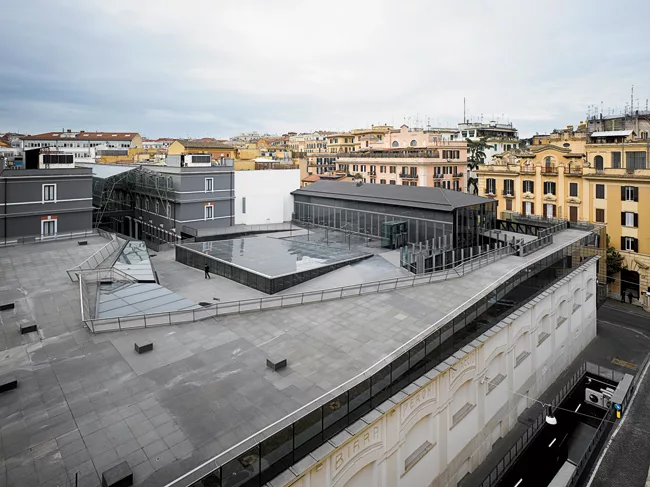
The architects created an artificial landscape on the museum's roof, placing a piazza there to connect the building to its historic context. The large skylight in the center of the piazza was designed
Museum of Contemporary Art of Rome (MACRO )
Odile Decq & Benoit Cornette Architectes Urbanistes
Rome, Italy
The architects created an artificial landscape on the museum's roof, placing a piazza there to connect the building to its historic context. The large skylight in the center of the piazza was designed to serve as a fountain with a sheet of water sliding over its surface, but it does not always work.
Photo © Roland Halbe
The architects created an artificial landscape on the museum's roof, placing a piazza there to connect the building to its historic context. The large skylight in the center of the piazza was designed
Museum of Contemporary Art of Rome (MACRO )
Odile Decq & Benoit Cornette Architectes Urbanistes
Rome, Italy
The architects created an artificial landscape on the museum's roof, placing a piazza there to connect the building to its historic context. The large skylight in the center of the piazza was designed to serve as a fountain with a sheet of water sliding over its surface, but it does not always work.
Photo © Roland Halbe
Decq's expansion adds 31,000 square feet of new exhibition space to the 16,000 square feet of galleries in the existing museum. Visitors enter the addition from Via Nizza, one level below the entrance
Museum of Contemporary Art of Rome (MACRO )
Odile Decq & Benoit Cornette Architectes Urbanistes
Rome, Italy
Decq's expansion adds 31,000 square feet of new exhibition space to the 16,000 square feet of galleries in the existing museum. Visitors enter the addition from Via Nizza, one level below the entrance to the existing museum on Via Reggio Emilia. Decq fixed up, but did not radically alter, the entry hall to the existing museum.
Photo © Roland Halbe
A bright red faceted polygon houses an auditorium and serves as the vibrant heart of the 108,000-square-foot expansion of the museum.
Museum of Contemporary Art of Rome (MACRO )
Odile Decq & Benoit Cornette Architectes Urbanistes
Rome, Italy
A bright red faceted polygon houses an auditorium and serves as the vibrant heart of the 108,000-square-foot expansion of the museum.
Photo © Roland Halbe
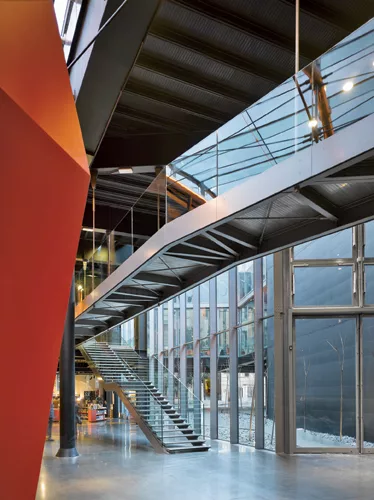
A suspended walkway zigzags through the main atrium, taking visitors on a journey that ends on the building's roof.
Museum of Contemporary Art of Rome (MACRO )
Odile Decq & Benoit Cornette Architectes Urbanistes
Rome, Italy
A suspended walkway zigzags through the main atrium, taking visitors on a journey that ends on the building's roof.
Photo © Roland Halbe
Moving through and around the atrium on the suspended walkways is an important part of the visitor experience, with the auditorium serving as a bold orienting device.
Museum of Contemporary Art of Rome (MACRO )
Odile Decq & Benoit Cornette Architectes Urbanistes
Rome, Italy
Moving through and around the atrium on the suspended walkways is an important part of the visitor experience, with the auditorium serving as a bold orienting device.
Photo © Roland Halbe
Inside the auditorium.
Museum of Contemporary Art of Rome (MACRO )
Odile Decq & Benoit Cornette Architectes Urbanistes
Rome, Italy
Inside the auditorium.
Photo © Roland Halbe
Translucent lavatories in the restrooms glow from within and can change color, making the simple act of washing one's hands a memorable experience.
Museum of Contemporary Art of Rome (MACRO )
Odile Decq & Benoit Cornette Architectes Urbanistes
Rome, Italy
Translucent lavatories in the restrooms glow from within and can change color, making the simple act of washing one's hands a memorable experience.
Photo © Roland Halbe
A caf' on the upper level offers views of the Via Nizza and Via Cagliari, the corner where people enter the museum addition.
Museum of Contemporary Art of Rome (MACRO )
Odile Decq & Benoit Cornette Architectes Urbanistes
Rome, Italy
A café on the upper level offers views of the Via Nizza and Via Cagliari, the corner where people enter the museum addition.
Photo © Roland Halbe
A large space occupying the southeast corner of the addition serves as the main exhibition area for temporary shows and large pieces of art.
Museum of Contemporary Art of Rome (MACRO )
Odile Decq & Benoit Cornette Architectes Urbanistes
Rome, Italy
A large space occupying the southeast corner of the addition serves as the main exhibition area for temporary shows and large pieces of art.
Photo © Roland Halbe
Galleries in the existing museum provide a neutral backdrop for a range of contemporary art.
Museum of Contemporary Art of Rome (MACRO )
Odile Decq & Benoit Cornette Architectes Urbanistes
Rome, Italy
Galleries in the existing museum provide a neutral backdrop for a range of contemporary art.
Photo © Roland Halbe
The roof of the lacquered-wood auditorium structure serves as a small sculpture gallery with built-in seating along the perimeter.
Museum of Contemporary Art of Rome (MACRO )
Odile Decq & Benoit Cornette Architectes Urbanistes
Rome, Italy
The roof of the lacquered-wood auditorium structure serves as a small sculpture gallery with built-in seating along the perimeter.
Photo © Roland Halbe
Museum of Contemporary Art of Rome (MACRO)
Museum of Contemporary Art of Rome (MACRO )
Odile Decq & Benoit Cornette Architectes Urbanistes
Rome, Italy
Image courtesy ODBC
Museum of Contemporary Art of Rome (MACRO)
Museum of Contemporary Art of Rome (MACRO )
Odile Decq & Benoit Cornette Architectes Urbanistes
Rome, Italy
Image courtesy ODBC
Museum of Contemporary Art of Rome (MACRO)
Museum of Contemporary Art of Rome (MACRO )
Odile Decq & Benoit Cornette Architectes Urbanistes
Rome, Italy
Image courtesy ODBC
Museum of Contemporary Art of Rome (MACRO)
Museum of Contemporary Art of Rome (MACRO )
Odile Decq & Benoit Cornette Architectes Urbanistes
Rome, Italy
Image courtesy ODBC
Decq and her team gutted the interior of an old Peroni brewery, cleaned up a pair of corner facades, and inserted their glass-and-steel structure within the existing fabric. Visitors enter the museum
The architects created an artificial landscape on the museum's roof, placing a piazza there to connect the building to its historic context. The large skylight in the center of the piazza was designed
Decq's expansion adds 31,000 square feet of new exhibition space to the 16,000 square feet of galleries in the existing museum. Visitors enter the addition from Via Nizza, one level below the entrance
A bright red faceted polygon houses an auditorium and serves as the vibrant heart of the 108,000-square-foot expansion of the museum.
A suspended walkway zigzags through the main atrium, taking visitors on a journey that ends on the building's roof.
Moving through and around the atrium on the suspended walkways is an important part of the visitor experience, with the auditorium serving as a bold orienting device.
Inside the auditorium.
Translucent lavatories in the restrooms glow from within and can change color, making the simple act of washing one's hands a memorable experience.
A caf' on the upper level offers views of the Via Nizza and Via Cagliari, the corner where people enter the museum addition.
A large space occupying the southeast corner of the addition serves as the main exhibition area for temporary shows and large pieces of art.
Galleries in the existing museum provide a neutral backdrop for a range of contemporary art.
The roof of the lacquered-wood auditorium structure serves as a small sculpture gallery with built-in seating along the perimeter.
Museum of Contemporary Art of Rome (MACRO)
July 16, 2011

Architects & Firms

Odile Decq Benoit Cornette Architects

Rome, Italy

For the hordes of tourists stuck in lines for the Colosseum or queuing up to enter the Sistine Chapel, Rome’s 2,000-year history acts as a powerful magnet. But for contemporary architects working in the city, this same history can be a heavy weight. Purveyors of the new quickly feel hamstrung and defeated, with old battles between modernity and tradition waging on forever.

Odile Decq & Benoit Cornette’s extension of the Museo d’Arte Contemporanea di Roma (MACRO), one of the city’s two contemporary art museums (along with Zaha Hadid’s MAXXI [record, October 2010, page 82]), enters this conversation very much on the side of the modernists.

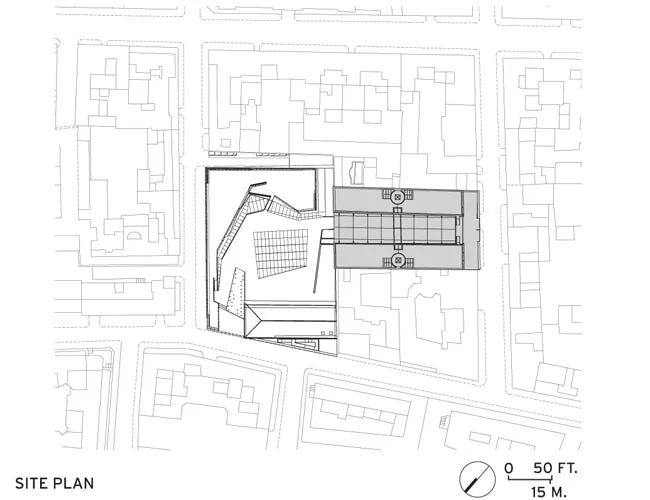
Set in a converted 19th-century Peroni brewery in the Via Nomentana area, MACRO occupies a significant piece of the city’s industrial archaeology. (Part of Decq’s mandate was to leave the exterior walls untouched.) But once inside the building, Decq turns her back on history, not deeply engaging the past nor the specific context of the conserved structure.

From the street, the museum addition appears as a glass box suspended within the old industrial building and set one story above ground. Visitors enter under a raised glass corner, through a small outdoor courtyard, then into a grand atrium sheathed in glass and black-painted masonry and framed by an elevated walkway that zigzags through the building on its way to the roof. Decq’s main move was carving out a series of twisting voids in the center of the building, having gutted the old interior and cleaned and stabilized the corner facades. “We did tests with gray during construction but chose black [for the interior walls],” says Decq. “For a museum you always think of white. But black is truly neutral.”

In the middle of the atrium, a bright red (nearly orange) polygon houses a small auditorium. With its lacquered-wood envelope cut into large facets and a red entry ramp extended like a tongue, this structure within a structure has a kinetic quality that animates the entire project. Decq admits to literalism: The color of blood, the auditorium is the pulsing heart of the building.

Despite the focus on unusual geometries and modern forms, Decq displays an interest in Rome and its architectural traditions. Her use of basalt pavers on the walkway through the structure refers obviously to the cobblestones, called san pietrini (little Saint Peter’s), that define the cityscape of Rome. But it’s the roof, an elevated piazza accessible to visitors, that truly connects to the city. Here we find the archetypal Italian space, wrought in hardscape and arranged around a fountain. Decq’s fountain is, in theory, an interpretation of this Roman symbol: a slightly inclined plane of glass over which a thin sheath of water runs — reflecting the sky, the light, and the surrounding buildings. The glass is also a skylight for the cavernous atrium below and refracts daylight into this large, black space. Unfortunately, after half a year, the water doesn’t run, much to the chagrin of the architect. The horizontal glazing is left to gather the red dust of Rome’s scirroco winds.

Inside the 108,000-square-foot addition, the architects surrounded the atrium with a ring of rooms, beginning with a café and proceeding through a series of orthogonal galleries that were renovated from the original 19th-century structure. These spaces connect visually and conceptually with the areas that were restored when the museum first opened in the 1990s in an adjacent building. However, while those spaces work as generic galleries, Decq kept the industrial remnants of the old brewery in place. Exposed concrete beams and pillars in the 31,000 square feet of new galleries establish a stronger connection to the past, though the white walls and ceilings bring us back to the modern era. The gallery expansion provides much-needed space for the museum’s collection of postwar Italian art.Perhaps the most exciting part of the entire building — save the fountain should it ever run again — is the walkway that hangs from the atrium roof. Critics have mused about the similarity with Hadid’s design for MAXXI, which opened shortly before MACRO and also features myriad elevated walkways.

But Decq’s scheme holds a surprise: visitors zigzag through the foyer, catching views of artwork and the red auditorium from different perspectives, until stepping around a sharp corner and through a massive door into a giant back room, which is actually the main exhibition space for major installations. Though large, the space defies regularity as it wraps around the outside of the foyer, giving us the impression we’ve discovered something hidden.

Decq’s expansion of MACRO is the latest in a string of major projects that the government of Rome hopes will breathe new life into the Eternal City. The trend began a decade ago with Richard Meier’s Jubilee Church built for the millennium, and continues now with Rem Koolhaas’s plan for the Mercati Generali, Massimilliano Fuksas’s Congress Center Rome-EUR, and Renzo Piano’s EUR housing. With Rome launching an active bid for the 2020 Olympics, these projects represent a desire for big-name, big-budget works to make a statement about Rome in the 21st century.

Decq’s work is certainly big and important. But its budget was modest: about $34 million. In fact, a proletarian element runs through the project and grounds it. Nearly half of the new structure is open space that, although architecturally part of the museum, is accessible to the public and belongs to the city. Symbolically, at the entry courtyard we thread between a grove of scraggly trees. These are paradise trees, an invasive weed that crowds Rome’s abandoned spaces, but arrayed here in a grid and given pride of place. They’re a gesture to the everyday and the public and they stabilize an otherwise soaring work.

Total construction cost: $34 million

Size: 108,000 square feet (addition); 42,000 square feet (existing)

Completion date: December 2010

People

Owner: City of Rome

Architect
Odile Decq & Benoit Cornette
Architectes Urbanistes
11 Rue Des Arquebusiers 75003
Paris
+33 (1) 42 71 27 41

Personnel in architect's firm who should receive special credit:

Architect of record: Odile Decq

Project architect: Giuseppe Savarese

Interior designer: ODBC

Consultant(s)
Lighting: I Guzzini

General contractor
1 : CCC, Consorzo Cooperative Costruzioni

2 : CLM, Centro Lavorazioni Metalli ( Roma Italy)
( Modena Italia)

Photographer(s)
Ronald Halbe

Renderer(s)
Thomas series for Labtop


Products

Glazing
Glass: Vuelle ( Rimini – Italy)

Doors
Entrances:
Metal doors: Vuelle ( Rimini Italy )

Interior finishes
Solid surfacing: Maille Inox / Stainless Stell Net : Gkd-Lanz ( Bolzano Italy )

Furnishings
Chairs: Poltrona Frau

Tables: Poltrona Frau

Upholstery: Gum floor : Dalsouple

Other furniture:
Doors Handles : Valli Valli

Wash Bassin : Ronchetti

Plumbing Fixtures: Franke

Special Lighting: Luce Plan

Lighting
Interior ambient lighting: I Guzzini & Luce Plan

Exterior: Luceplan

 
KEYWORDS: Rome

Share This Story

Looking for a reprint of this article?
From high-res PDFs to custom plaques, order your copy today!
Post a comment to this article

Report Abusive Comment

Subscription Center
  • Create an Account
  • Start a Subscription
  • Manage My Account
  • Sign Up for Newsletters
  • Visit Customer Service
  • Update Preferences

More Videos

Sponsored Content

Sponsored Content is a special paid section where industry companies provide high quality, objective, non-commercial content around topics of interest to the Architectural Record audience. All Sponsored Content is supplied by the advertising company and any opinions expressed in this article are those of the author and not necessarily reflect the views of Architectural Record or its parent company, BNP Media. Interested in participating in our Sponsored Content section? Contact your local rep!

close
  • TAMLYN XtremeTrim Exterior Trim
    Sponsored byTamlyn

    Designing Cleaner Panel Facades: Why Exterior Trim Details Matter

  • Building with Vapor Barriers
    Sponsored byReef Industries, Inc.

    Vapor Barriers Help Control Moisture in Tighter Building Designs

  • Duct Interior with Prodeq System
    Sponsored byHenry, a Carlisle Company

    Designing Resilient Water Containment Systems

DESIGN:ED Podcast
Listen to Architectural Record’s DESIGN:ED Podcast

Events

June 16, 2026

Focus on the Façade: Exploring Steel, Timber & Fire-Rated Curtain Walls and Channel Glass Systems

Credits: 1 AIA LU/HSW; 1 AIBD P-CE; 0.1 ICC CEU

Explore modern façade and glazing systems that enhance daylighting, fire safety, and thermal performance while expanding architectural design possibilities.

June 18, 2026

Rebooting the Aging Office Building

Credits: 1 AIA LU/HSW; 1 AIBD P-CE; 0.1 ICC CEU; 1 PDH

Explore façade retrofit strategies and award-winning design concepts that can transform aging office buildings into healthier, higher-performing workplaces for today’s hybrid workforce.

View All Submit An Event

Products

2026 Architect's Square Foot Costbook

2026 Architect's Square Foot Costbook

See More Products

Popular Stories

Coronado Bridge

The Architect’s Guide to San Diego

SanDiegoAirport

Top 300 Architecture Firms of 2026

Crane Cove, ONO

Design Vanguard 2026 Winners

House on a Hill

Design Vanguard 2026: Forma

House A on a Hill

Design Vanguard 2026: Santiago Valdivieso

Focus on the Facade - Free Webinar - June 16, 2026

Related Articles

  • New Museum

    New Museum of Contemporary Art by SANAA

    See More
  • Museum of Contemporary Art San Diego.

    Museum of Contemporary Art San Diego by Selldorf Architects

    See More
  • Garage Museum of Contemporary Art by OMA

    See More

Related Products

See More Products
  • Architectural Record - February 2026

    Architectural Record February 2026 Issue

  • image7.jpg

    Contemporary Architecture in China Towards A Critical Pragmatism

See More Products
×

The latest news and information

#1 Source for Architectural Design, News and Products

SUBSCRIBE
  • RESOURCES
    • Advertise
    • Contact Us
    • Submit
    • Store
  • ACCOUNT CENTER
    • Create an Account
    • Start a Subscription
    • Manage My Account
    • Sign Up for Newsletters
    • Visit Customer Service
    • Update Preferences
  • PRIVACY
    • PRIVACY POLICY
    • TERMS & CONDITIONS
    • DO NOT SELL MY PERSONAL INFORMATION
    • PRIVACY REQUEST
    • ACCESSIBILITY
  • SERVICES
    • Marketing Services
    • Reprints
    • Market Research
    • List Rental
    • Survey/Respondent Access
  • STAY CONNECTED
    • Linkedin
    • Facebook
    • Instagram
    • YouTube
    • X (Twitter)

Copyright ©2026. All Rights Reserved BNP Media, Inc. and BNP Media II, LLC.

Design, CMS, Hosting & Web Development :: ePublishing