Architectural Record
search
cart
facebook twitter linkedin youtube
  • Sign In
  • Subscribe
  • Sign Out
  • My Account
Architectural Record
  • NEWS
    • Latest News
    • Awards
    • Interviews
    • Obituaries
    • Podcasts
      • Design:Ed Podcast
      • Sponsored Podcasts
  • OPINION
    • Book Reviews / Excerpts
    • Exhibition Reviews
    • Forum
  • EXCLUSIVES
    • Videos
    • Design Vanguard
    • Top 300 Firms
    • Sponsored Content
    • Sponsored eBooks
    • From the Archives
  • CONTINUING ED
    • Editorial Continuing Ed
    • CE Center
    • CE Academies
  • PROJECTS
    • Buildings By Type
    • Reuse & Renovation
    • Museums & Arts Centers
    • Colleges & Universities
    • Multifamily Housing
    • Interiors
    • Lighting
    • Kitchen & Bath
  • HOUSES
    • Record Houses
    • House of the Month
    • Featured Houses
  • PRODUCTS
    • Products by Category
    • Record Products of the Year
    • Latest Products
  • EVENTS
    • Dates & Events
    • Record on the Road
    • Innovation Conference
    • Sustainability in Practice
    • Women In Architecture
    • Webinars
    • Ad Excellence Awards
    • Submit an Event
  • CONNECT
    • Ask RECORD AI
    • Newsletters
    • Contact
    • Advertise
    • Editorial Calendar
    • Store
    • Customer Service
  • SUBMIT
    • Submission Guidelines
    • RECORD Competitions
  • MAGAZINE
    • Subscribe
    • My Account
    • Digital Edition
    • Current Issue
    • Firm Pass
    • Historic Archive
ProjectsBuildings by TypeMuseums & Art Centers

Museum of the History of Polish Jews

A Monument to Tragedy and Heroism: In the heart of the former Warsaw Ghetto, a museum honors and celebrates the culture and long history of Polish Jews, which stretches far back beyond the tragic events of World War II.
By Peter MacKeith
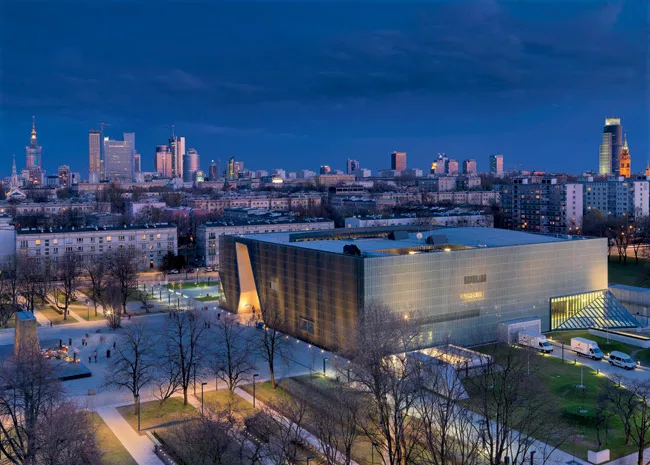
The museum is located in what was the heart of Jewish Warsaw during World War II, across a plaza from a memorial commemorating the 1943 Warsaw Ghetto Uprising.
Museum of the History of Polish Jews
Lahdelma & Mahlamäki Architects
Warsaw
The museum is located in what was the heart of Jewish Warsaw during World War II, across a plaza from a memorial commemorating the 1943 Warsaw Ghetto Uprising.
Photo © Iñigo Bujedo Aguirre
The boxy museum, which is clad in angled fritted-glass panels separated by strips of perforated copper, conceals a cavernous entrance hall with curving concrete walls and a travertine floor.
Museum of the History of Polish Jews
Lahdelma & Mahlamäki Architects
Warsaw
The boxy museum, which is clad in angled fritted-glass panels separated by strips of perforated copper, conceals a cavernous entrance hall with curving concrete walls and a travertine floor.
Photo © Iñigo Bujedo Aguirre
The boxy museum, which is clad in angled fritted-glass panels separated by strips of perforated copper, conceals a cavernous entrance hall with curving concrete walls and a travertine floor.
Museum of the History of Polish Jews
Lahdelma & Mahlamäki Architects
Warsaw
The boxy museum, which is clad in angled fritted-glass panels separated by strips of perforated copper, conceals a cavernous entrance hall with curving concrete walls and a travertine floor.
Photo © Iñigo Bujedo Aguirre
The exterior glass panels are silk-screened with the Latin and Hebrew letters for the word “Polin,” Hebrew for “Poland” or “rest here”.
Museum of the History of Polish Jews
Lahdelma & Mahlamäki Architects
Warsaw
The exterior glass panels are silk-screened with the Latin and Hebrew letters for the word “Polin,” Hebrew for “Poland” or “rest here”.
Photo © Iñigo Bujedo Aguirre
The exterior glass panels are silk-screened with the Latin and Hebrew letters for the word “Polin,” Hebrew for “Poland” or “rest here”.
Museum of the History of Polish Jews
Lahdelma & Mahlamäki Architects
Warsaw
The exterior glass panels are silk-screened with the Latin and Hebrew letters for the word “Polin,” Hebrew for “Poland” or “rest here”.
Photo © Iñigo Bujedo Aguirre
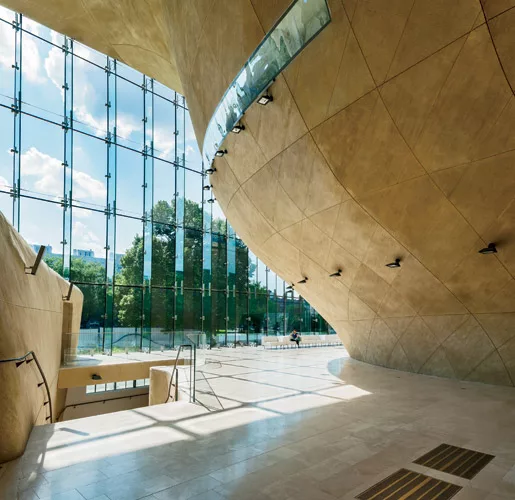
The entrance atrium —a textured concrete layer sprayed onto a complex double-curved steel backing frame—was developed with software specially designed by the architect for the project.
Museum of the History of Polish Jews
Lahdelma & Mahlamäki Architects
Warsaw
The entrance atrium —a textured concrete layer sprayed onto a complex double-curved steel backing frame—was developed with software specially designed by the architect for the project.
Photo © Iñigo Bujedo Aguirre
The presence of the permanent exhibitions on the museum’s lower level is signaled by a replica of the roof of Gwozdziec Synagogue, built in the 17th century and destroyed by the Nazis in World W
Museum of the History of Polish Jews
Lahdelma & Mahlamäki Architects
Warsaw
The presence of the permanent exhibitions on the museum’s lower level is signaled by a replica of the roof of Gwozdziec Synagogue, built in the 17th century and destroyed by the Nazis in World War II.
Photo © Iñigo Bujedo Aguirre
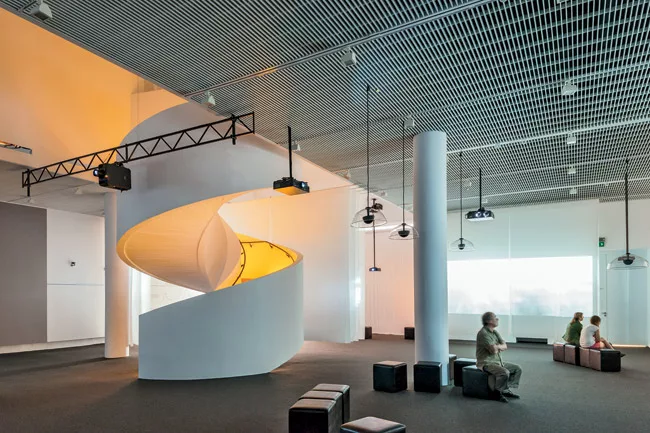
A glowing spiral stair, made of poured-in-place concrete, connects the permanent-exhibition level, temporary exhibitions, and staff offices and conference areas.
Museum of the History of Polish Jews
Lahdelma & Mahlamäki Architects
Warsaw
A glowing spiral stair, made of poured-in-place concrete, connects the permanent-exhibition level, temporary exhibitions, and staff offices and conference areas.
Photo © Iñigo Bujedo Aguirre
Museum of the History of Polish Jews
Lahdelma & Mahlamäki Architects
Warsaw
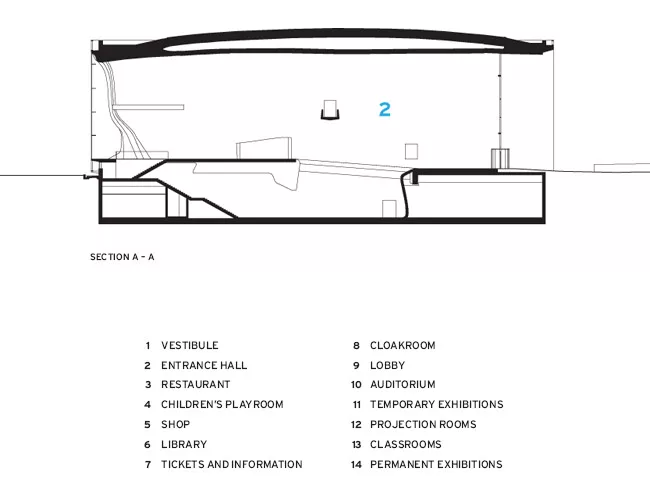
Image courtesy Lahdelma & Mahlamäki Architects
Museum of the History of Polish Jews
Lahdelma & Mahlamäki Architects
Warsaw
Image courtesy Lahdelma & Mahlamäki Architects
Museum of the History of Polish Jews
Lahdelma & Mahlamäki Architects
Warsaw
Image courtesy Lahdelma & Mahlamäki Architects
Museum of the History of Polish Jews
Lahdelma & Mahlamäki Architects
Warsaw
Image courtesy Lahdelma & Mahlamäki Architects
Museum of the History of Polish Jews
Lahdelma & Mahlamäki Architects
Warsaw
Image courtesy Lahdelma & Mahlamäki Architects
The museum is located in what was the heart of Jewish Warsaw during World War II, across a plaza from a memorial commemorating the 1943 Warsaw Ghetto Uprising.
The boxy museum, which is clad in angled fritted-glass panels separated by strips of perforated copper, conceals a cavernous entrance hall with curving concrete walls and a travertine floor.
The exterior glass panels are silk-screened with the Latin and Hebrew letters for the word “Polin,” Hebrew for “Poland” or “rest here”.
The entrance atrium —a textured concrete layer sprayed onto a complex double-curved steel backing frame—was developed with software specially designed by the architect for the project.
The presence of the permanent exhibitions on the museum’s lower level is signaled by a replica of the roof of Gwozdziec Synagogue, built in the 17th century and destroyed by the Nazis in World W
A glowing spiral stair, made of poured-in-place concrete, connects the permanent-exhibition level, temporary exhibitions, and staff offices and conference areas.
Museum of the History of Polish Jews
December 16, 2013

Architects & Firms

Lahdelma & Mahlamäki Architects

Warsaw

People/Products

For 70 years, a square in the northern quarter of Warsaw has been a site of strife and conflict, memory and mourning. In 1943, the Warsaw Ghetto Uprising emerged from the streets around it, as Polish Jewish partisans fought the Nazi occupiers bent on their extermination. Following the liberation of Poland, and the more complete comprehension of the Holocaust, a monument to that heroic resistance effort was built in the square in 1948, from stones the Nazi architect Albert Speer had sent to Warsaw.

This April, the square was newly framed against the backdrop of the long-awaited Museum of the History of Polish Jews. The museum’s strongly delineated rectilinear volume glows in its pale-green screen-wall enclosure of fritted glass panels. A monumental concrete entrance portal is sinuously carved into the eastern facade, facing the monument. Even ahead of the completion of permanent exhibitions and an official inauguration (2014), throngs of visitors have streamed across the square’s renewed and planted landscape toward that portal’s spatial drama and the museum’s superbly organized facilities.

Late this summer, Finnish architect Rainer Mahlamäki, one-half of the Helsinki-based design practice of Lahdelma & Mahlamäki Architects, stood in the museum’s sublimely high entrance hall. The building’s design and construction had consumed Mahlamäki’s days since his partnership won (to the surprise of many, given that the other invited competitors included Peter Eisenman and Daniel Libeskind) an international competition for the commission in 2005. “The proponents of the museum wanted a monument to recognize the long, tragic, heroic, and now revitalized presence of the Jewish people in Poland,” Mahlamäki says. “In particular, the site of the museum–in the center of the former Warsaw Ghetto–necessitated a building of monumental character to honor the events of World War II that occurred there, as well as that political, social, and cultural history.”

The commission is the first for the partnership outside of Finland, despite 20 years of designing highly regarded public and buildings throughout that Nordic nation. Aware of the history of culturally responsible architecture without being weighed down by a compulsion to overtly signify through form, the architect designed the museum on more restrained terms: “In our view, such a monument could only be approached with quiet dignity rather than with too-confident formal expressiveness or flamboyant material pyrotechnics. We won the competition, we think, by virtue of our more modest Nordic sensibility, in which the drama of the design, and indeed the drama of the museum’s contents and purposes, are concealed within an elegant exterior.”

The strategy has paid off. The museum’s glowing presence in the square compels attention, and the institution has already hosted a broad range of public performances, temporary exhibitions, and discussions, promoting it as an important cultural actor in Warsaw.

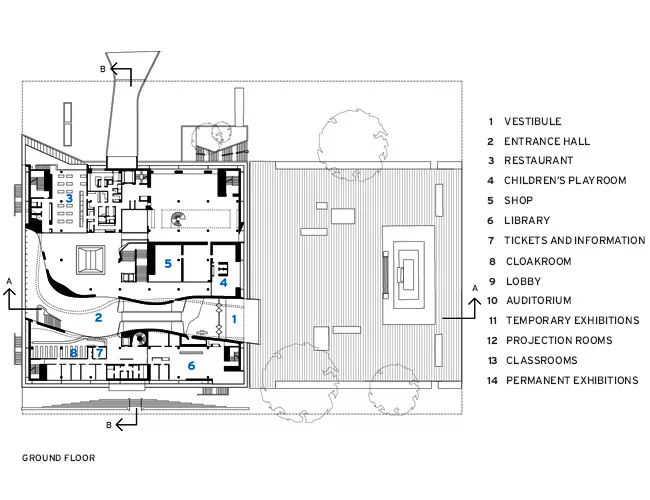
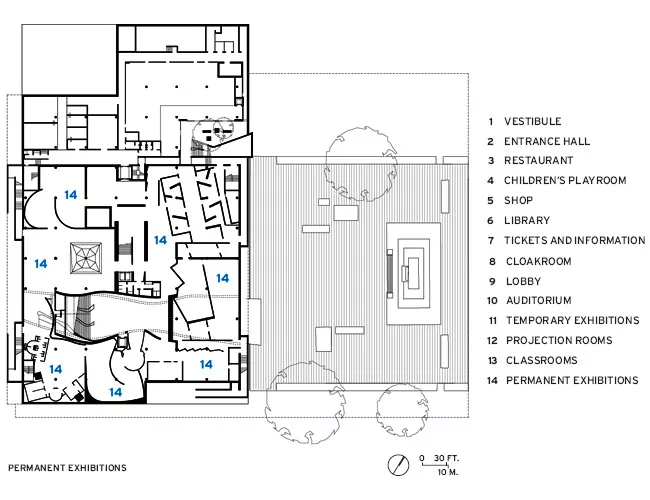
At 197,000 square feet and with six levels, the museum’s scale against the square is aided by the placement of its permanent exhibition space below grade, in a “black box” now a common element for many museums. Above-grade floors contain galleries for changing exhibitions, an auditorium, conference facilities, cafeterias, a restaurant, library and bookstore, staff offices, and exhibition-preparation areas—all within a tightly controlled perimeter. Conventional tectonic systems informed construction and modulate the disposition of the program: a column grid laces through the largely concrete bearing wall. But the entrance atrium was a complex engineering and construction feat: the geometries of the space were eventually rendered into a textured concrete layer sprayed onto a complex double-curved steel backing frame. The museum’s glazed western facade—a spider-system curtain wall—also strained structural and material limits. Throughout the building, the architects made an effort to use some locally crafted materials to give the museum a more personal touch.

A project of such cultural significance poses an essential question: Can architecture communicate cultural meaning and historical understanding? As the art historian James E. Young has poignantly asked of museum designs devoted to Jewish culture, “Can the construction of a contemporary architecture remain entirely distinct from, even oblivious of, the history it shelters? Is its spatial existence ever really independent of its contents?”

The wisdom of the architect’s approach to these questions is evident in the Warsaw museum, through methods more subtle and substantial than those employed in the Jewish or Holocaust history museums in Berlin or Washington, D.C., or San Francisco. The complementary relationships of orthogonal external geometries and expressive interiors evoke multiple images of a wave, a cave, a canyon, a crevasse. Those analogies refer to reconciliation–a temporary parting of the seas, a tectonic shift of cultures, a temporal chasm of history–but without simple one-to-one symbolism. To the contrary: if architecture can have a representational capacity in our culture, the designers articulate a distinctly quiet but still deeply felt language.


People

Owner: City of Warsaw and State of Poland

Architect(s):
Architects Lahdelma & Mahlam'ki Oy
Tehtaankatu 29 A, 00150 Helsinki, Finland
phone +35892511020,
fax +358925110210

Local partner in Poland:
Kyrolowicz & Associates, ul. Berezynska 25, 03-908 Warsaw, Poland
phone +4822 6163798,
fax +48226163799

Personnel in architect's firm who should receive special credit:
Principals in charge of the project (Finland):
Architect Riitta-Liisa Id (-design phase), Architect Maritta Kukkonen (design phase-); Collaborators: Architect Jukka Savolainen, Architect Miguel Freitas Silva

Principals in charge of the project (Poland):
Architect, Prof. Stefan Kyrolowicz (until 2011), Architect, Prof. Eva Kyrolowicz, Architect Pawel Grodzicki (-design phase), Architect Marcin Ferenc

Architect of record:
Rainer Mahlam'ki, architect, Professor

Associate architect:
Ilmari Lahdelma, architect, Professor

Geometry of the curved wall:
Markus Wikar, architect

Interior designer:
Interior architect Mirja Sillanp'' (built-in furniture), Architects Lahdelma & Mahlam'ki

Engineer(s):
Structural Engineering:
Arbo Projekt, Poland

HVAC Engineering:
Pol-Con Consulting, Poland

Electr. Engineering:
Elektroprojekt SA, Poland

Consultant(s):
Acoustical:
Akukon Oy, Finland (auditorium)

General contractor:
Polimex ' Mostostal, Poland

Photographer(s):
Juha Salminen: +358 405174713
Markus Wikar: +358 505527427
Wojciech Krynski: phone:+48 22601371929
Photoroom.pl: phone: +48 501362566

Renderer(s):
Architects Lahdelma & Mahlam'ki:
Ext: Jukka Savolainen, architect
Int: Risto Wikberg, Interior architect

CAD system, project management, or other software used:
Autocad, Rhinoceros

Size:

197,000 square feet

Cost:

$48 million

Completion date:

May 2013


Products

Structural system
Cast-in-situ concrete; steel + sprayed concrete (curved wall)

Manufacturer of any structural components unique to this project:
Sprayed concrete walls: Torkret, Poland

Exterior cladding
Metal/glass curtain wall:
Metalplast-Stolarka, Poland

Other cladding unique to this project:
Copper- Aurubis Finland

Glazing
Other: Large glass wall-
AGC Flat Glass Czech Republic

Interior finishes
Paneling: Oak panels- Gustafs

Special interior finishes unique to this project:
Main hall floor- travertine

Furnishings
Other furniture: Built-in furniture- Martela Poland

Conveyance
Elevators / Escalators:
Kone

 
KEYWORDS: Poland

Share This Story

Looking for a reprint of this article?
From high-res PDFs to custom plaques, order your copy today!

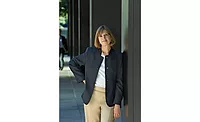
Peter MacKeith is Dean of the Fay Jones School of Architecture and Design, University of Arkansas, and Knight, First Class, of the Order of the Lion of Finland.

Post a comment to this article

Report Abusive Comment

Subscription Center
  • Create an Account
  • Start a Subscription
  • Manage My Account
  • Sign Up for Newsletters
  • Visit Customer Service
  • Update Preferences

More Videos

Sponsored Content

Sponsored Content is a special paid section where industry companies provide high quality, objective, non-commercial content around topics of interest to the Architectural Record audience. All Sponsored Content is supplied by the advertising company and any opinions expressed in this article are those of the author and not necessarily reflect the views of Architectural Record or its parent company, BNP Media. Interested in participating in our Sponsored Content section? Contact your local rep!

close
  • TAMLYN XtremeTrim Exterior Trim
    Sponsored byTamlyn

    Designing Cleaner Panel Facades: Why Exterior Trim Details Matter

  • Building with Vapor Barriers
    Sponsored byReef Industries, Inc.

    Vapor Barriers Help Control Moisture in Tighter Building Designs

  • Duct Interior with Prodeq System
    Sponsored byHenry, a Carlisle Company

    Designing Resilient Water Containment Systems

DESIGN:ED Podcast
Listen to Architectural Record’s DESIGN:ED Podcast

Events

June 10, 2026

Rethinking Stormwater – The Power of Porous Paving

Credits: 1 AIA LU/HSW; 1 AIBD P-CE; 0.1 ICC CEU

Learn how porous paving systems support stormwater management, reduce heat island effects, and enhance sustainable site design performance.

June 11, 2026

Very Early Warning Fire Detection for Mission-Critical Facilities

Credits: 1 AIA LU/HSW; 1 AIBD P-CE; 0.1 ICC CEU

Examine advanced fire detection strategies that support uptime and enhance safety in data centers and other mission-critical facilities.

View All Submit An Event

Products

2026 Architect's Square Foot Costbook

2026 Architect's Square Foot Costbook

See More Products

Popular Stories

Practice Matters illustration

What’s in a (Firm’s) Name? Thinking About Succession and Legacy

Coronado Bridge

The Architect’s Guide to San Diego

Practice Matters illustration

By the Numbers: Counting America's Architects

Riverdale House by Studio Lau

Riverdale House by Studio Lau

House on a Hill

Design Vanguard 2026: Forma

Broader Sustainability of CMU - Free Webinar - May 21, 2026

Related Articles

  • Fort Fisher Visitor Center

    At North Carolina’s Fort Fisher, a New Visitor Center Delves into the History of the Site While Bracing for the Future

    See More
  • Cathleen McGuigan

    Architecture and the History of Race

    See More
  • Paul Rudolph Hall and Jeffery H. Loria Center for the History of Art, Project Portfolio

    See More

Related Products

See More Products
  • 1444336282.gif

    The Handbook of Interior Design

  • 0470130628.gif

    Sustainable Design: The Science of Sustainability and Green Engineering

See More Products
×

The latest news and information

#1 Source for Architectural Design, News and Products

SUBSCRIBE
  • RESOURCES
    • Advertise
    • Contact Us
    • Submit
    • Store
  • ACCOUNT CENTER
    • Create an Account
    • Start a Subscription
    • Manage My Account
    • Sign Up for Newsletters
    • Visit Customer Service
    • Update Preferences
  • PRIVACY
    • PRIVACY POLICY
    • TERMS & CONDITIONS
    • DO NOT SELL MY PERSONAL INFORMATION
    • PRIVACY REQUEST
    • ACCESSIBILITY
  • SERVICES
    • Marketing Services
    • Reprints
    • Market Research
    • List Rental
    • Survey/Respondent Access
  • STAY CONNECTED
    • Linkedin
    • Facebook
    • Instagram
    • YouTube
    • X (Twitter)

Copyright ©2026. All Rights Reserved BNP Media, Inc. and BNP Media II, LLC.

Design, CMS, Hosting & Web Development :: ePublishing