Architectural Record
search
cart
facebook twitter linkedin youtube
  • Sign In
  • Subscribe
  • Sign Out
  • My Account
Architectural Record
  • NEWS
    • Latest News
    • Awards
    • Interviews
    • Obituaries
    • Podcasts
      • Design:Ed Podcast
      • Sponsored Podcasts
  • OPINION
    • Book Reviews / Excerpts
    • Exhibition Reviews
    • Forum
  • EXCLUSIVES
    • Videos
    • Design Vanguard
    • Top 300 Firms
    • Sponsored Content
    • Sponsored eBooks
    • From the Archives
  • CONTINUING ED
    • Editorial Continuing Ed
    • CE Center
    • CE Academies
  • PROJECTS
    • Buildings By Type
    • Reuse & Renovation
    • Museums & Arts Centers
    • Colleges & Universities
    • Multifamily Housing
    • Interiors
    • Lighting
    • Kitchen & Bath
  • HOUSES
    • Record Houses
    • House of the Month
    • Featured Houses
  • PRODUCTS
    • Products by Category
    • Record Products of the Year
    • Latest Products
  • EVENTS
    • Dates & Events
    • Record on the Road
    • Innovation Conference
    • Sustainability in Practice
    • Women In Architecture
    • Webinars
    • Ad Excellence Awards
    • Submit an Event
  • CONNECT
    • Ask RECORD AI
    • Newsletters
    • Contact
    • Advertise
    • Editorial Calendar
    • Store
    • Customer Service
  • SUBMIT
    • Submission Guidelines
    • RECORD Competitions
  • MAGAZINE
    • Subscribe
    • My Account
    • Digital Edition
    • Current Issue
    • Firm Pass
    • Historic Archive
ProjectsLighting Design

FUEL Caf' at Chesapeake

Elliott + Associates infuses FUEL Caf' with a colorful vibe for an Oklahoma energy company.

By David Dillon
November 19, 2008

Architects & Firms

Elliott + Associates Architects

Oklahoma City, Oklahoma

Chesapeake Energy is the largest natural gas producer in the United States, yet when the time came to name the new company café, Gas was obviously not an option. So Chesapeake defaulted to FUEL, and then hired Oklahoma City architect Rand Elliott to come up with a design that fit the name.
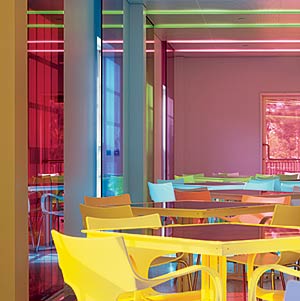
FUEL Caf' at Chesapeake

“The goal was to spice things up by creating a hip, high-energy place that could compete with the other restaurants in the area,” says Elliott, principal at Elliott + Associates Architects.

Hip and high energy are the key words here. James Dean and Giant notwithstanding, the energy business is no longer a bastion of swaggering wildcatters in splattered jeans and cowboy boots. It is a high-tech industry that attracts young, well-educated men and women who know how to spell sophisticated. Of the 2,700 employees at Chesapeake’s Oklahoma City headquarters, 45 percent are women and 55 percent are under 35. This youth culture also happens to be a keen health-and-fitness culture that checks the nutritional value of every chicken wing and granola bar it eats. Chesapeake already had a comfort-food cafeteria called Wildcat—designed several years ago by Elliott + Associates—and was looking for a smarter, more adventurous alternative with, say, a Mexican-Mediterranean, Asian-fusion twist.

Elliott and his team started out with a bland, 4,000-square-foot space that used to house Chesapeake’s accounting department. It had natural light on three sides, but that was it for visual excitement. The ceilings were low, the floors gray, and the general atmosphere gloomy. The architects gutted it to create a clean, white space, essentially a large reflector, to which they added T8 fluorescents with color gels, LED lamps, and laminated-glass panels with polyester film. There are no computers, fancy fixtures, or any sophisticated dimmers. Yet from this bare-bones technology comes a stunning range of intense color that complements the food being served: banana yellow and chili-pepper red, the cool pink of watermelon, and the deep purple of eggplant. The cooking island in the center of the restaurant is covered in red and green resin panels, like a floating Italian salad.

“It’s a cliché that you need white light in a restaurant so you can see your food,” Elliott explains. “Maybe for fine dining, but FUEL is not a white-linen and cut-crystal sort of place. Employees pop in for breakfast and lunch and then go back to work. It needed to be fiesta-like.”

FUEL celebrates the interplay of color and daylight, with color being a starting point and first principle for Elliott instead of a decorative afterthought. He doesn’t start out thinking, “I will make a red wall,” but rather, “I will make something red and it may be a wall.” Technology follows concept, in other words, and if it were up to him, all the light sources would be invisible. “It’s all about results, not gizmos,” he says.

The café has as many moods as the day: soft and welcoming in the morning, bright and upbeat at lunch, subdued in the late afternoon. And the light is multidirectional. It streams through laminated-glass panels, bounces off walls and floors, and zips across ceilings in vibrant fluorescent stripes. Even mechanical chases are light sources. The glowing rectangular boxes at opposite ends of the café, with their green and blue LED lights, hide the exhausts from the prep kitchen below. Everywhere colors intersect and overlap, turning the interior into a Fauve painting.

But FUEL is more than a hip design statement; it is part of a strategy to enrich the corporate culture. By providing fresh, healthful, cooked-to-order food, Chesapeake encourages employees to stick around at lunch instead of running off to Chili’s or T.G.I. Friday’s, with stops at the bank, dry cleaners, or drugstore in between. It is a way to boost productivity and promote in-house socializing without making employees feel that they’re settling for less. Research institutions discovered long ago that the most important work often gets done in the in-between spaces: Cavendish Laboratory at the University of Cambridge, England, birthplace of modern physics, was primitive at best, but the lounges and tearooms were superb.

“FUEL has had a huge impact,” says Lisa Phelps, Chesapeake’s vice president for human resources. “This is a hard-driving, innovative organization, and the café, with its high-tech energy, reinforces that spirit.”

FUEL now serves 250 meals a day, which is close to capacity. Moreover, Phelps says that some days it is so crowded, she can’t find a table. Success with a twist, perhaps, but success nonetheless.


KEYWORDS: Oklahoma City

Share This Story

Looking for a reprint of this article?
From high-res PDFs to custom plaques, order your copy today!

Post a comment to this article

Report Abusive Comment

Subscription Center
  • Create an Account
  • Start a Subscription
  • Manage My Account
  • Sign Up for Newsletters
  • Visit Customer Service
  • Update Preferences

More Videos

Sponsored Content

Sponsored Content is a special paid section where industry companies provide high quality, objective, non-commercial content around topics of interest to the Architectural Record audience. All Sponsored Content is supplied by the advertising company and any opinions expressed in this article are those of the author and not necessarily reflect the views of Architectural Record or its parent company, BNP Media. Interested in participating in our Sponsored Content section? Contact your local rep!

close
  • TAMLYN XtremeTrim Exterior Trim
    Sponsored byTamlyn

    Designing Cleaner Panel Facades: Why Exterior Trim Details Matter

  • Building with Vapor Barriers
    Sponsored byReef Industries, Inc.

    Vapor Barriers Help Control Moisture in Tighter Building Designs

  • Duct Interior with Prodeq System
    Sponsored byHenry, a Carlisle Company

    Designing Resilient Water Containment Systems

DESIGN:ED Podcast
Listen to Architectural Record’s DESIGN:ED Podcast

Events

June 10, 2026

Rethinking Stormwater – The Power of Porous Paving

Credits: 1 AIA LU/HSW; 1 AIBD P-CE; 0.1 ICC CEU

Learn how porous paving systems support stormwater management, reduce heat island effects, and enhance sustainable site design performance.

June 11, 2026

Very Early Warning Fire Detection for Mission-Critical Facilities

Credits: 1 AIA LU/HSW; 1 AIBD P-CE; 0.1 ICC CEU

Examine advanced fire detection strategies that support uptime and enhance safety in data centers and other mission-critical facilities.

View All Submit An Event

Products

2026 Architect's Square Foot Costbook

2026 Architect's Square Foot Costbook

See More Products

Popular Stories

Practice Matters illustration

What’s in a (Firm’s) Name? Thinking About Succession and Legacy

Practice Matters illustration

By the Numbers: Counting America's Architects

Riverdale House by Studio Lau

Riverdale House by Studio Lau

House on a Hill

Design Vanguard 2026: Forma

Crane Cove, ONO

Design Vanguard 2026 Winners

Broader Sustainability of CMU - Free Webinar - May 21, 2026

Related Articles

  • FUEL Caf' at Chesapeake Lighting Projects

    See More
  • Chesapeake Boathouse

    See More

Related Products

See More Products
  • bim design firms.jpg

    BIM for Design Firms: Data Rich Architecture at Small and Medium Scales

See More Products
×

The latest news and information

#1 Source for Architectural Design, News and Products

SUBSCRIBE
  • RESOURCES
    • Advertise
    • Contact Us
    • Submit
    • Store
  • ACCOUNT CENTER
    • Create an Account
    • Start a Subscription
    • Manage My Account
    • Sign Up for Newsletters
    • Visit Customer Service
    • Update Preferences
  • PRIVACY
    • PRIVACY POLICY
    • TERMS & CONDITIONS
    • DO NOT SELL MY PERSONAL INFORMATION
    • PRIVACY REQUEST
    • ACCESSIBILITY
  • SERVICES
    • Marketing Services
    • Reprints
    • Market Research
    • List Rental
    • Survey/Respondent Access
  • STAY CONNECTED
    • Linkedin
    • Facebook
    • Instagram
    • YouTube
    • X (Twitter)

Copyright ©2026. All Rights Reserved BNP Media, Inc. and BNP Media II, LLC.

Design, CMS, Hosting & Web Development :: ePublishing