Architectural Record
search
cart
facebook twitter linkedin youtube
  • Sign In
  • Subscribe
  • Sign Out
  • My Account
Architectural Record
  • NEWS
    • Latest News
    • Awards
    • Interviews
    • Obituaries
    • Podcasts
      • Design:Ed Podcast
      • Sponsored Podcasts
  • OPINION
    • Book Reviews / Excerpts
    • Exhibition Reviews
    • Forum
  • EXCLUSIVES
    • Videos
    • Design Vanguard
    • Top 300 Firms
    • Sponsored Content
    • Sponsored eBooks
    • From the Archives
  • CONTINUING ED
    • Editorial Continuing Ed
    • CE Center
    • CE Academies
  • PROJECTS
    • Buildings By Type
    • Reuse & Renovation
    • Museums & Arts Centers
    • Colleges & Universities
    • Multifamily Housing
    • Interiors
    • Lighting
    • Kitchen & Bath
  • HOUSES
    • Record Houses
    • House of the Month
    • Featured Houses
  • PRODUCTS
    • Products by Category
    • Record Products of the Year
    • Latest Products
  • EVENTS
    • Dates & Events
    • Record on the Road
    • Innovation Conference
    • Sustainability in Practice
    • Women In Architecture
    • Webinars
    • Ad Excellence Awards
    • Submit an Event
  • CONNECT
    • Ask RECORD AI
    • Newsletters
    • Contact
    • Advertise
    • Editorial Calendar
    • Store
    • Customer Service
  • SUBMIT
    • Submission Guidelines
    • RECORD Competitions
  • MAGAZINE
    • Subscribe
    • My Account
    • Digital Edition
    • Current Issue
    • Firm Pass
    • Historic Archive
Projects

Natural History Museum of Utah

An elegantly powerful structure reflects its dramatic natural setting and the mission of the institution housed within.
By Joann Gonchar, FAIA
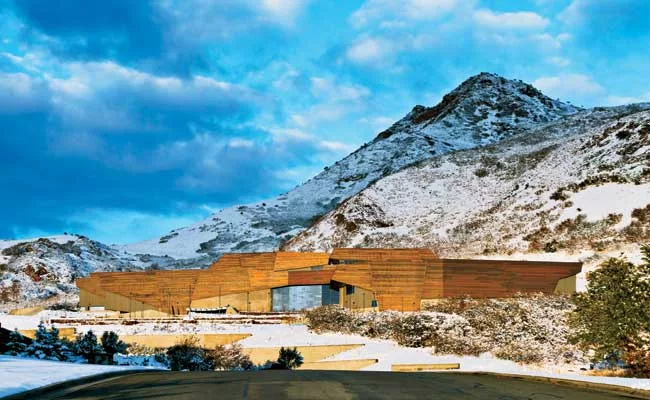
The museum, which sits in the foothills of the Wasatch Mountains at the edge of the University of Utah campus, is clad in panels made of three different copper alloys. Each is patinating differently,
Natural History Museum of Utah
Ennead Architects
Salt Lake City
The museum, which sits in the foothills of the Wasatch Mountains at the edge of the University of Utah campus, is clad in panels made of three different copper alloys. Each is patinating differently, creating an effect that resembles sedimentary rock.
Photo © Jeff Goldberg / Esto
A 60-foot-tall, cathedral-like lobby dubbed the “canyon” is enclosed by faceted drywall planes, joining the museum’s two wings—one for exhibitions and one for research faciliti
Natural History Museum of Utah
Ennead Architects
Salt Lake City
A 60-foot-tall, cathedral-like lobby dubbed the “canyon” is enclosed by faceted drywall planes, joining the museum’s two wings—one for exhibitions and one for research facilities, collections storage, and administration.
Photo © Jeff Goldberg / Esto
A sculptural stair of board-formed concrete provides a vantage point for activity in the canyon—the museum’s main social space.
Natural History Museum of Utah
Ennead Architects
Salt Lake City
A sculptural stair of board-formed concrete provides a vantage point for activity in the canyon—the museum’s main social space.
Photo © Jeff Goldberg / Esto
The canyon includes one glazed wall that allows visitors to take in sweeping views of Salt Lake City and the Salt Lake Valley.
Natural History Museum of Utah
Ennead Architects
Salt Lake City
The canyon includes one glazed wall that allows visitors to take in sweeping views of Salt Lake City and the Salt Lake Valley.
Photo © Jeff Goldberg / Esto
Ramped walkways with ipé-plank decks and glass balustrades trace a gently ascending route through the museum’s 10 thematic galleries.
Natural History Museum of Utah
Ennead Architects
Salt Lake City
Ramped walkways with ipé-plank decks and glass balustrades trace a gently ascending route through the museum’s 10 thematic galleries.
Photo © Jeff Goldberg / Esto
Although most of the galleries are inwardly focused, a few contain windows so that museumgoers can make connections between the objects on display and the building’s surroundings.
Natural History Museum of Utah
Ennead Architects
Salt Lake City
Although most of the galleries are inwardly focused, a few contain windows so that museumgoers can make connections between the objects on display and the building’s surroundings.
Photo © Jeff Goldberg / Esto
The glazing, which has a frit and a low-e coating, mirrors the sky and the museum's environs.
Natural History Museum of Utah
Ennead Architects
Salt Lake City
The glazing, which has a frit and a low-e coating, mirrors the sky and the museum's environs.
Photo © Jeff Goldberg / Esto
The glazing, which has a frit and a low-e coating, mirrors the sky and the museum's environs.
Natural History Museum of Utah
Ennead Architects
Salt Lake City
The glazing, which has a frit and a low-e coating, mirrors the sky and the museum's environs.
Photo © Jeff Goldberg / Esto
The glazing, which has a frit and a low-e coating, mirrors the sky and the museum's environs.
Natural History Museum of Utah
Ennead Architects
Salt Lake City
The glazing, which has a frit and a low-e coating, mirrors the sky and the museum's environs.
Photo © Joann Gonchar
The building's site includes a trailhead for a popular mountain biking, hiking, and running path.
Natural History Museum of Utah
Ennead Architects
Salt Lake City
The building's site includes a trailhead for a popular mountain biking, hiking, and running path.
Photo © Takayuki Murakami
The museum is configured as a three-bar form that steps up with the terrain.
Natural History Museum of Utah
Ennead Architects
Salt Lake City
The museum is configured as a three-bar form that steps up with the terrain.
Photo © Joann Gonchar
The canyon includes a floor-to-ceiling case displaying 600 representative objects from the museum's collection and a topographical map of the Intermountain Region.
Natural History Museum of Utah
Ennead Architects
Salt Lake City
The canyon includes a floor-to-ceiling case displaying 600 representative objects from the museum's collection and a topographical map of the Intermountain Region.
Photo © NHMU/Tom Smart
The museum commissioned media artist Simon Heijdens to create an interactive exhibit that projects silhouettes of native Utah plants on the canyon walls.
Natural History Museum of Utah
Ennead Architects
Salt Lake City
The museum commissioned media artist Simon Heijdens to create an interactive exhibit that projects silhouettes of native Utah plants on the canyon walls.
Photo © Joann Gonchar
The folded planes found in the canyon are reminiscent of a set from the Cabinet of Dr. Caligari, but without the sinister overtones.
Natural History Museum of Utah
Ennead Architects
Salt Lake City
The folded planes found in the canyon are reminiscent of a set from the Cabinet of Dr. Caligari, but without the sinister overtones.
Photo © Takayuki Murakami
Natural History Museum of Utah
Ennead Architects
Salt Lake City
The folded planes found in the canyon are reminiscent of a set from the Cabinet of Dr. Caligari, but without the sinister overtones.
Photo © Takayuki Murakami
The exhibitions were designed by Ralph Appelbaum Associates and include a Past Worlds gallery that covers 225 million years of Utah history.
Natural History Museum of Utah
Ennead Architects
Salt Lake City
The exhibitions were designed by Ralph Appelbaum Associates and include a Past Worlds gallery that covers 225 million years of Utah history.
Photo © NHMU/Tom Smart
The canyon is a venue for events such as receptions, lectures, and concerts.
Natural History Museum of Utah
Ennead Architects
Salt Lake City
The canyon is a venue for events such as receptions, lectures, and concerts.
Photo © Takayuki Murakami
The museum, which sits in the foothills of the Wasatch Mountains at the edge of the University of Utah campus, is clad in panels made of three different copper alloys. Each is patinating differently,
A 60-foot-tall, cathedral-like lobby dubbed the “canyon” is enclosed by faceted drywall planes, joining the museum’s two wings—one for exhibitions and one for research faciliti
A sculptural stair of board-formed concrete provides a vantage point for activity in the canyon—the museum’s main social space.
The canyon includes one glazed wall that allows visitors to take in sweeping views of Salt Lake City and the Salt Lake Valley.
Ramped walkways with ipé-plank decks and glass balustrades trace a gently ascending route through the museum’s 10 thematic galleries.
Although most of the galleries are inwardly focused, a few contain windows so that museumgoers can make connections between the objects on display and the building’s surroundings.
The glazing, which has a frit and a low-e coating, mirrors the sky and the museum's environs.
The building's site includes a trailhead for a popular mountain biking, hiking, and running path.
The museum is configured as a three-bar form that steps up with the terrain.
The canyon includes a floor-to-ceiling case displaying 600 representative objects from the museum's collection and a topographical map of the Intermountain Region.
The museum commissioned media artist Simon Heijdens to create an interactive exhibit that projects silhouettes of native Utah plants on the canyon walls.
The folded planes found in the canyon are reminiscent of a set from the Cabinet of Dr. Caligari, but without the sinister overtones.
The exhibitions were designed by Ralph Appelbaum Associates and include a Past Worlds gallery that covers 225 million years of Utah history.
The canyon is a venue for events such as receptions, lectures, and concerts.
January 16, 2012

Architects & Firms

Ennead

Salt Lake City

From the first glimpse of the $103 million Natural History Museum of Utah in Salt Lake City, the metaphor is unambiguous: The 163,000-square-foot building is both literally and figuratively rooted in the landscape. The terraced structure is anchored into its sloping site at the edge of the University of Utah campus, a few miles from downtown, while the folded and subtly canted exterior walls mimic the scrubby hillside rising behind it. But even though the references to its environment are readily recognizable, the museum holds its own as man-made object against the rugged backdrop. It is an interpretation and abstraction of nature rather than a facsimile, explains Todd Schliemann, partner at New York–based Ennead Achitects (formerly Polshek Partnership), which designed the building in association with local firm, GSBS.

The museum, which opened in November, moved from a decaying, Depression-era building in the heart of the campus to its current 17-acre site—one that appears to be the threshold of unspoiled wilderness. But although the land had never been developed for a building, it was not pristine. In the early 1900s, it had been marred when soldiers from nearby Fort Douglas used it as a firing range. More recently, major utility lines were routed through the property, along with a trailhead for a mountain-biking and hiking path.

The designers have integrated this infrastructure with the site by realigning and redefining the trailhead with gabion walls whose rock was uncovered during foundation excavation, and by camouflaging the utilities with sculptural landforms. They configured the new building as a three-bar form that steps up with the terrain. Its structure, which combines concrete shear walls and steel framing, is organized into two wings—one that supports the museum's “empirical” activities, including research, conservation, and administration; and an “interpretive” wing that houses the exhibits, says Schliemann.

The glue between the two programmatic halves, and the museum's centerpiece, is a 60-foot-tall lobby that doubles as a space for lectures and parties. It is enclosed by soft, gray board-formed concrete, warm, white-faceted drywall planes, and one glazed wall that offers sweeping views out over the city and across Salt Lake Valley. Even visitors who are unaware that this grand room has been dubbed the “canyon” will immediately understand that its form, like that of the building's exterior, has been inspired by the regional landscape. But the space can be appreciated without knowledge of its origins, since it elicits an immediate (and positive) emotional response. “We wanted an inspirational space that would be viscerally remembered,” says Schliemann. “It's a cathedral with a view.”

The simile of architecture-as-geological-formation extends to the building's exterior envelope, where horizontal standing-seam copper—mined on the opposite side of the valley and donated by the mine's parent company—covers the angular walls above the a poured-in-place concrete base. The cladding, made of three different alloys, takes on a varied patina, creating an effect similar to the striations of exposed rock cliffs. Although this skin is now different shades of brown with hints of green, its colors will continue to evolve, much like the landscape around the building where Gambel oaks, two types of maples, native sumac, and an understory of several varieties of brush, have been planted. In the autumn the foliage will turn nutty brown, vibrant orange, and red.

The route through the exhibits, which were designed by New York-based Ralph Appelbaum Associates, also takes its cues from the natural environment. Ramped walkways with ipé-plank decks and glass balustrades trace a gently ascending course that winds through the museum's 10 thematic galleries in the manner of a mountain traverse. The path leads from the lowest level displays, which showcase the region's plant and animal life over 225 million years, to the uppermost exhibition space, which focuses on the traditions of Utah's native peoples. Along the way, visitors can examine artifacts from the museum's collection of 1.2 million objects, including paleontological, archaeological, and mineralogical specimens. But museumgoers need not view the galleries in any particular order or follow a prescribed course, according to Sarah George, executive director. Instead, they can get off the elevator on any level, cross one of the bridges spanning the canyon, and explore just one section of the museum. “It was important to us that visitors be able to chose their own path,” she says.

The galleries are primarily inwardly focused, with few windows in order to protect the collections from damaging ultraviolet light. However, in a select number of carefully orchestrated locations, windows are included so that museumgoers can make connections between the displays and the world outside. For example, an exhibit exploring the evolution of the Great Salt Lake is positioned next to a window that offers views of the actual body of water off in the distance.

The small number of windows—and the resulting low-window-to-wall ratio—helps improve the building's energy performance and is one of several strategies that have put the project on track for LEED Gold certification. (For more on the envelope, see Performance Puzzle) But because site constraints dictated that most of the openings face west—an undesirable orientation from both heat-gain and conservation perspectives—the high-performance glazing includes a frit and a low-e coating. Although the treatment somewhat obscures the view of the museum's interior from its outdoor terraces, the effect enhances the building: The glazing mirrors the sky and the museum's environs, providing another reminder that the mission of the institution beyond the glass and the copper-clad walls is to reflect and interpret the natural world.

Gross square footage: 163,000

Completion Date: October 2011

Total Project cost: $103 Million

Owner: State of Utah

People

Owner: State of Utah

Natural History Museum of Utah
Salt Lake City, Utah
Project Team

Architect:
Ennead Architects
320 West 13th Street
New York, NY  10014
(212)807-7171 tel
(212)807-5917 fax

Architect of record:
GSBS Architects
375 West 200 South, Suite 100
Salt Lake City, Utah 84101
(801) 521- 8600
(801) 521-7913

Design Architect:
Ennead Architects
320 West 13th Street
New York, NY  10014

Design Partner Todd Schliemann FAIA
Management Partner Don Weinreich AIA, LEED AP
Project Designers Thomas Wong AIA, Alex O’Briant AIA
Project Architects John Majewski AIA, Megan Miller AIA, LEED AP
Interiors Charmian Place, Katharine Huber AIA
Project Team Joshua Frankel AIA, Aileen Iverson, Kyo-Young Jin, Apichat, Leungchaikul, Thomas Newman, Jarrett Pelletier AIA

Architect of Record
GSBS Architects
Principal-in-Charge David Brems FAIA, LEED AP
Project Manager John Branson AIA, LEED AP
Project Architect Valerie Nagasawa AIA
Interiors Stephanie DeMott IIDA, Stacy Butcher LEED AP, Beccah Hardman
Project Team Clio Miller AIA, LEED AP, Jesse Allen AIA, LEED AP, Bill Cordray AIA, Jennifer Still AIA, Eduardo De Roda, Felissia Ludwig, Cathy Davison, Todd Kelsey, Seth Robertson, Robert Bowman, AIA

Sub-Consultant Team
Structural Leslie E. Robertson Associates, Dunn Associates
Mechanical/Plumbing/Fire Protection Colvin Engineering Associates
Landscape Design Workshop
Electrical/Audio Visual/Security Spectrum Engineers
Lighting Brandston Partnership
Civil Stantec Consulting
Fire Engineer/Daylighting ARUP
Laboratory Jacobs Consultancy
Specifications Construction Specifications
Acoustics Shen Milsom & Wilke
Cost Parametrix
Architectural Concrete Reginald D. Hough FAIA

Models Cubic Dimension
Solar Array Analysis Buro Happold

Natural History Museum of Utah
Consultant Team

Exhibit Planning and Design Ralph Appelbaum Associates
Graphics Poulin + Morris
Conservation Catharine Hawks
Retail Shelley Stephens + Associates
Building Envelope Analysis SGH

Construction Manager Big-D Construction

Photographer(s):
©Jeff Goldberg / Esto

Renderer(s):
©Red Square

CAD system, project management, or other software used:
Vectorworks
Sketchup
Fastrack


Products

Structural system

List type, e.g. concrete or steel frame, wood, etc.: Structural steel framing system with reinforced concrete shear walls

Manufacturer of any structural components unique to this project:

Exterior cladding

Copper Cathode: Kennecott Utah Copper Corporation a Rio Tinto Company
Copper Fabrication: Luvata
Panel Fabrication: Umicore Building Products USA
Installation: Noorda
Prefabricated Roof Trusses: Vulcraft
Pervious Paving: Green Construction
Curtain wall: EFCO
Low E Glass: Viracon
All Glass Doors: Blumcraft

Precast concrete: O-well Precast

Wood:
Wood decking, Fondell Woodworking

Moisture barrier: Henry Company

Curtain wall:
See Above

Other cladding unique to this project:
Architectural Board-Formed Concrete: Big D

Roofing

Built-up roofing: Carlisle TPO

Glazing

Glass:Viracon

Skylights:EFCO

Doors

Entrances: Blumcraft,EFCO, CR Lawrence
Metal doors: Steelcraft
Wood doors: Marshfield
Sliding doors: Door Engineering
Fire-control doors, security grilles: McKeon
Upswinging doors, other: McKeon

Hardware

Locksets: Schlage
Closers: LCN, Glynn-Johnson
Exit devices: Von Duprin
Pulls: Von Duprin, Ives
Security devices: Schlage
Other special hardware: Door Actuators- Von Duprin, LCN

Interior finishes

Acoustical ceilings: Tectum, Armstrong, Sound Silencer
Metal Acoustical Ceilings – Gordon Millennium | Suspension grid: Armstrong
Demountable Moveable partitions: Modernfold
Cabinetwork and custom woodwork: Fondell Woodwork
Paints and stains: PPG, Sherwin Williams, Benjamin Moore
Seamless Acoustical Plaster: BASWAphon
Wall coverings: N/A
Paneling: Fondell Woodwork
Plastic laminate: Pionite, Nevamar, Formica, Abet Laminati
Solid surfacing: Corian, Black Magic: by Innovative Marble and Tile
Special surfacing: Countertops – Squak Mountain Stone
Floor and wall tile (cite where used): Restroom Walls – Dal Tile
Resilient flooring: Forbo Marmoleum, Base - Roppe
Carpet:
Shaw, Interface Flor
Lockers:  Penco
Toilet Partitions: All American Metal Corp.
Toilet Accessories: Bobrick
Window Shades: Kirsch
Lab Equipment: ISEC
Controlled Environment Rooms: Harris Environmental Systems
Raised flooring: N/A
Special interior finishes unique to this project: 3Form

Furnishings

Office furniture: Haworth
Reception furniture: Coalesse, Haworth
Fixed seating: N/A
Chairs:  Janus Et Cie, Stylex, Allermuir,Herman Miller,Mighty Lite, Steelcase, KI, Haworth
Tables: Nucraft,WCI, Mighty Lite, KI
Upholstery: Paul Brayton, Knoll Textiles, Edelman Leather
Other furniture (use additional sheet if necessary): Benches – Martin Brattrud, Kielhauer, Modern Outdoor

Lighting

Interior ambient lighting: Lightolier, Lutron,Exectrix, Winona, RSA Lighting, Xenon, Bega, Lumenyte
Downlights: Lightolier, Xenon, Bruck
Task lighting: Winona,Exhibit Lighting – Bruck, LSI
Exterior: Erco, Bega, Lithonia, Winona
Dimming System or other lighting controls: Douglas Lighting Controls, Crestron

Conveyance

Elevators/Escalators: Otis

Plumbing

(include water fountains and water-saving fixtures as applicable) Kohler, Zurn, Dayton, Elkay, Halsey-Taylor, Rheem

Energy
Energy management or building automation system: Johnson Controls
Photovoltaic system:
Sharp Modules, Unisys Unirac Support System

Other unique products that contribute to sustainability:
Storm Water Collection Cisterns: Containment Solutions

 
KEYWORDS: Salt Lake City

Share This Story

Looking for a reprint of this article?
From high-res PDFs to custom plaques, order your copy today!

Joann gonchar

Joann Gonchar, FAIA, LEED AP, is deputy editor at Architectural Record. She joined RECORD in 2006, after working for eight years at its sister publication, Engineering News-Record. Before starting her career as a journalist, Joann worked for several architecture firms and spent three years in Kobe, Japan, with the firm Team Zoo, Atelier Iruka. She earned a Master of Architecture degree from the University of Pennsylvania and a Bachelor of Arts from Brown University. She is licensed to practice architecture in New York State.

Post a comment to this article

Report Abusive Comment

Subscription Center
  • Create an Account
  • Start a Subscription
  • Manage My Account
  • Sign Up for Newsletters
  • Visit Customer Service
  • Update Preferences

More Videos

Sponsored Content

Sponsored Content is a special paid section where industry companies provide high quality, objective, non-commercial content around topics of interest to the Architectural Record audience. All Sponsored Content is supplied by the advertising company and any opinions expressed in this article are those of the author and not necessarily reflect the views of Architectural Record or its parent company, BNP Media. Interested in participating in our Sponsored Content section? Contact your local rep!

close
  • cold storage facility
    Sponsored byCarlisle SynTec Systems

    How Architects Can Design More Continuous Cold Storage Envelopes

  • TAMLYN XtremeTrim Exterior Trim
    Sponsored byTamlyn

    Designing Cleaner Panel Facades: Why Exterior Trim Details Matter

  • Building with Vapor Barriers
    Sponsored byReef Industries, Inc.

    Vapor Barriers Help Control Moisture in Tighter Building Designs

DESIGN:ED Podcast
Listen to Architectural Record’s DESIGN:ED Podcast

Events

June 23, 2026

Enhancing Fire Resistance with Advanced PVC Solutions

Credits: 1 AIA LU/HSW; 1 AIBD P-CE; 0.1 ICC CEU; 1 IIBEC CEH

Evaluate advanced PVC solutions that improve fire resistance, support WUI compliance, and enhance resilience in residential and commercial building design.

June 25, 2026

Designing Glass Railing Systems that Enhance Aesthetics and Meet Code

Credits: 1 AIA LU/HSW; 1 AIBD P-CE; 0.1 ICC CEU

Upon course completion, participants will possess a deeper understanding of glass railings to help ensure that safety, aesthetic, and performance objectives are achieved.

View All Submit An Event

Products

2026 Architect's Square Foot Costbook

2026 Architect's Square Foot Costbook

See More Products

Popular Stories

Lorcan O' Herilhy

California Architect Lorcan O’Herlihy Has Died, Age 66

Obama Presidential Center, Chicago

The Obama Presidential Center Opens on Chicago’s South Side

Spoonbill Ranch

Johnsen Schmaling Architects Integrates Spoonbill Ranch into a Pristine Landscape

West Village Penthouse

Design Vanguard 2026: Brent Buck Architects

Trinity University Business & Humanities District

AIA Announces 2026 COTE Top Ten Awardees

Enhancing Fire Resistance with Advanced PVC Solutions - Free Webinar - June 23, 2026

Related Articles

  • CO Architects Designs New Dinosaur Hall for LA's Natural History Museum

    See More
  • CO Architects Livens Up Los Angeles' Natural History Museum After $135-million Renovation and Expansion

    See More
  • CO Architects Livens Up Los Angeles' Natural History Museum After $135-million Renovation and Expansion

    See More
×

The latest news and information

#1 Source for Architectural Design, News and Products

SUBSCRIBE
  • RESOURCES
    • Advertise
    • Contact Us
    • Submit
    • Store
  • ACCOUNT CENTER
    • Create an Account
    • Start a Subscription
    • Manage My Account
    • Sign Up for Newsletters
    • Visit Customer Service
    • Update Preferences
  • PRIVACY
    • PRIVACY POLICY
    • TERMS & CONDITIONS
    • DO NOT SELL MY PERSONAL INFORMATION
    • PRIVACY REQUEST
    • ACCESSIBILITY
  • SERVICES
    • Marketing Services
    • Reprints
    • Market Research
    • List Rental
    • Survey/Respondent Access
  • STAY CONNECTED
    • Linkedin
    • Facebook
    • Instagram
    • YouTube
    • X (Twitter)

Copyright ©2026. All Rights Reserved BNP Media, Inc. and BNP Media II, LLC.

Design, CMS, Hosting & Web Development :: ePublishing