Architectural Record
search
cart
facebook twitter linkedin youtube
  • Sign In
  • Subscribe
  • Sign Out
  • My Account
Architectural Record
  • NEWS
    • Latest News
    • Awards
    • Interviews
    • Obituaries
    • Podcasts
      • Design:Ed Podcast
      • Sponsored Podcasts
  • OPINION
    • Book Reviews / Excerpts
    • Exhibition Reviews
    • Forum
  • EXCLUSIVES
    • Videos
    • Design Vanguard
    • Top 300 Firms
    • Sponsored Content
    • Sponsored eBooks
    • From the Archives
  • CONTINUING ED
    • Editorial Continuing Ed
    • CE Center
    • CE Academies
  • PROJECTS
    • Buildings By Type
    • Reuse & Renovation
    • Museums & Arts Centers
    • Colleges & Universities
    • Multifamily Housing
    • Interiors
    • Lighting
    • Kitchen & Bath
  • HOUSES
    • Record Houses
    • House of the Month
    • Featured Houses
  • PRODUCTS
    • Products by Category
    • Record Products of the Year
    • Latest Products
  • EVENTS
    • Dates & Events
    • Record on the Road
    • Innovation Conference
    • Sustainability in Practice
    • Women In Architecture
    • Webinars
    • Ad Excellence Awards
    • Submit an Event
  • CONNECT
    • Ask RECORD AI
    • Newsletters
    • Contact
    • Advertise
    • Editorial Calendar
    • Store
    • Customer Service
  • SUBMIT
    • Submission Guidelines
    • RECORD Competitions
  • MAGAZINE
    • Subscribe
    • My Account
    • Digital Edition
    • Current Issue
    • Firm Pass
    • Historic Archive
Projects

International Commerce Centre

Enter the Dragon: In the Kowloon district of Hong Kong, across the harbor from the main part of the city, looms a trimly tapered mixed-use tower.
By Suzanne Stephens
International Commerce Center
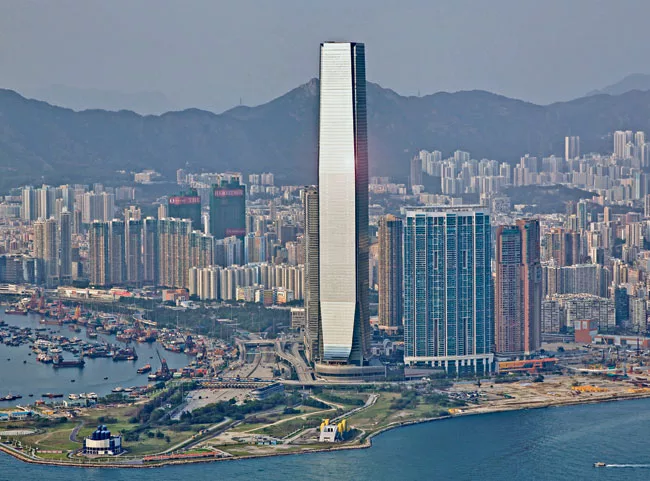
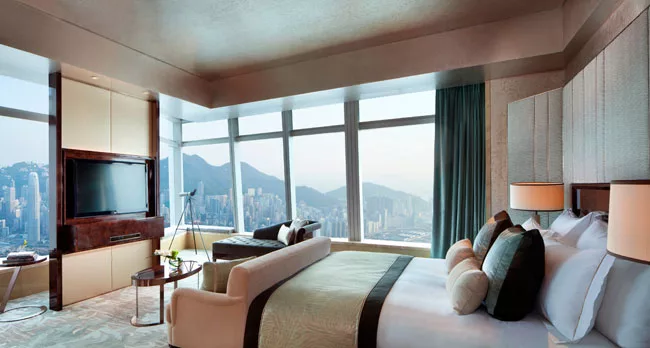
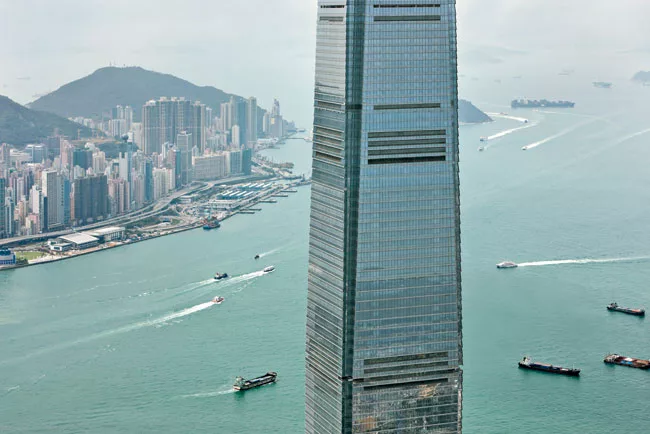
Harbor View The ICC looms above the West Kowloon Station's levels of retail and mass transit. Views from within the shaft overlooking Victoria Harbor are expansive, especially from the Ritz-Carlton Hotel rooms at the top.
 
Photo courtesy Ritz-Carlton Hotel, Hong Kong
International Commerce Center
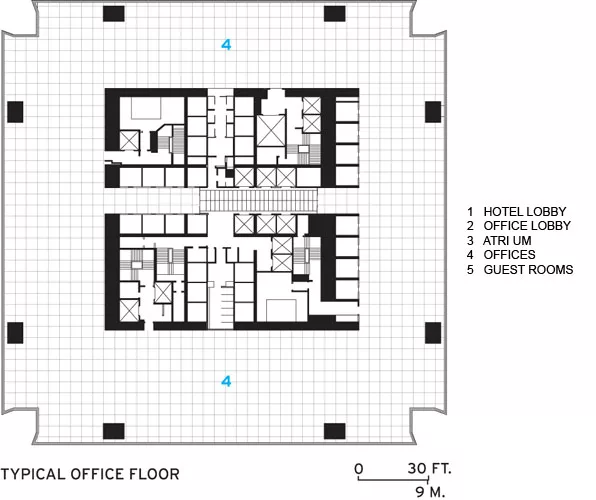
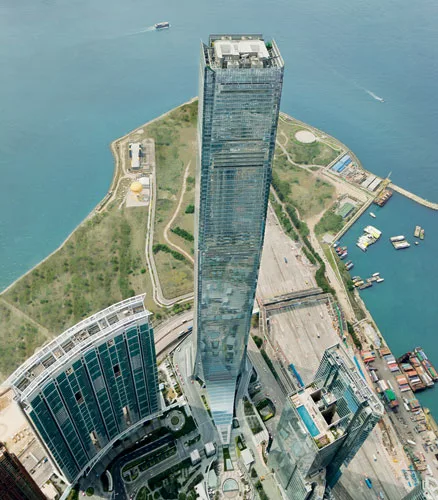
Tailored Tower The ICC’s elongated, glass-paneled shaft tapers gently toward the roof. Floors in the tower are typically 32,000 square feet, gradually shrinking to 29,000 square feet above the 78th floor. As the tower inclines inward 1 degree toward the top, the four glass facades seem to lift away from the shaft. In the crevasses, the reentrant corners gradually widen to mitigate wind turbulence, one of the major challenges for the supertall structure.
 
Photo courtesy Ritz-Carlton Hotel, Hong Kong
International Commerce Center
Tailored Tower The ICC’s elongated, glass-paneled shaft tapers gently toward the roof. Floors in the tower are typically 32,000 square feet, gradually shrinking to 29,000 square feet above the 78th floor. As the tower inclines inward 1 degree toward the top, the four glass facades seem to lift away from the shaft. In the crevasses, the reentrant corners gradually widen to mitigate wind turbulence, one of the major challenges for the supertall structure.
 
Photo © Grischa Rüschendorf
International Commerce Center
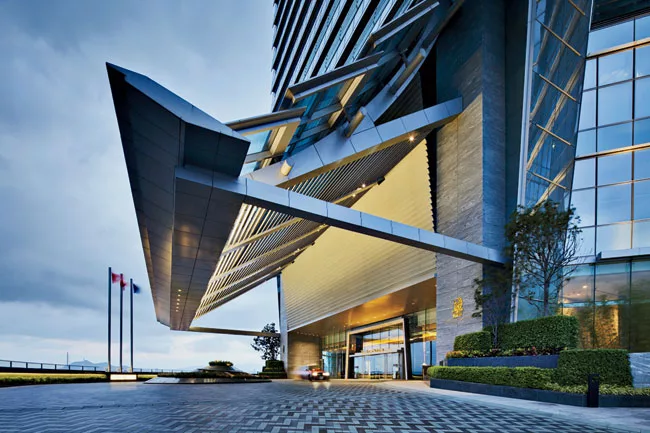
When the four facades reach the top, they form parapet walls at the roof level. At the base, angular glass-paneled canopies for offices and the hotel shelter visitors arriving by car on the top of the station roof.
 
Photo © Tim Griffith
International Commerce Center
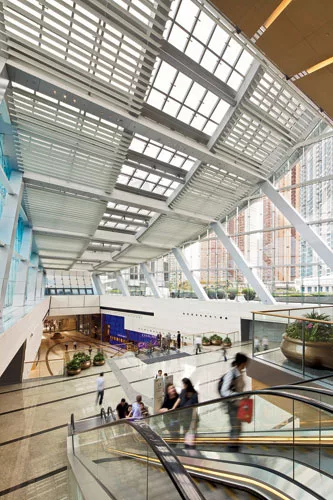
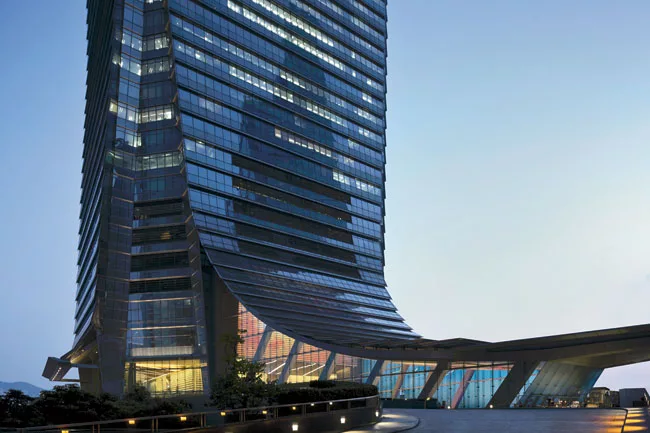
On the north side, the glass forms a scooped canopy over the atrium connecting the tower to retail and mass transit below.
 
Photo © Grischa Rüschendorf
International Commerce Center
On the north side, the glass forms a scooped canopy over the atrium connecting the tower to retail and mass transit below.
 
Photo © Takuya Watanabe
International Commerce Center
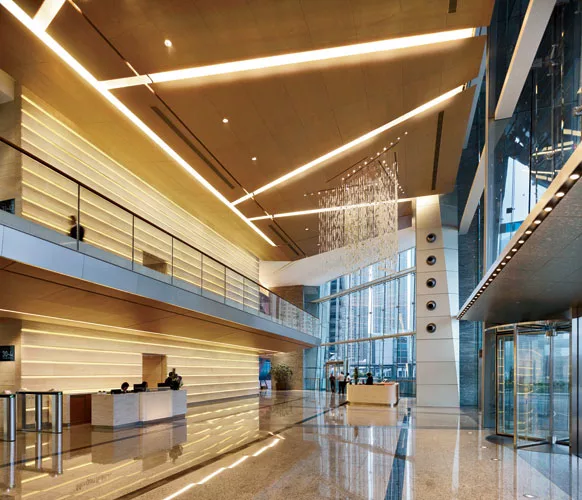
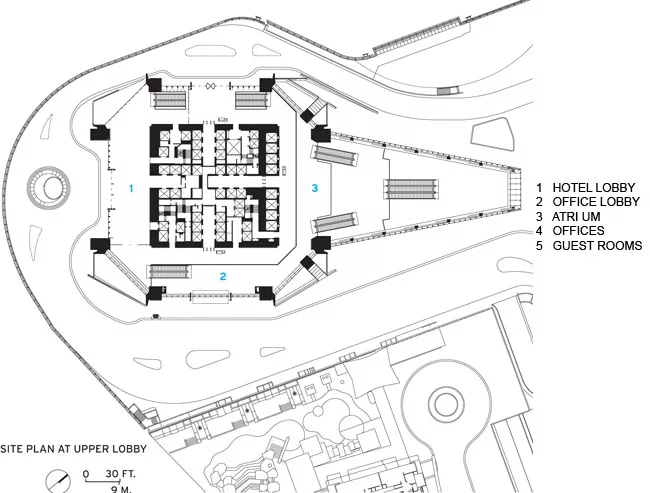
Sleek Surround KPF designed the public lobbies and circulation spaces for the tower’s offices, using a corporate-posh palette. Cove lighting articulates the horizontal strips of travertine marble cladding the walls. The Ritz-Carlton Hotel has two lobbies, with the main one on the 103rd floor.
 
Photo © Tim Griffith
International Commerce Center
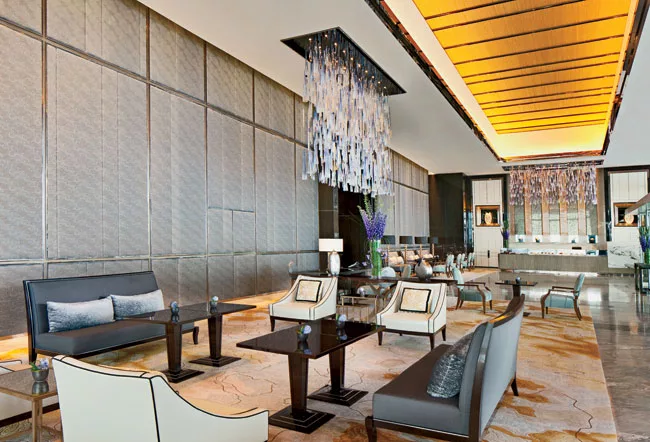
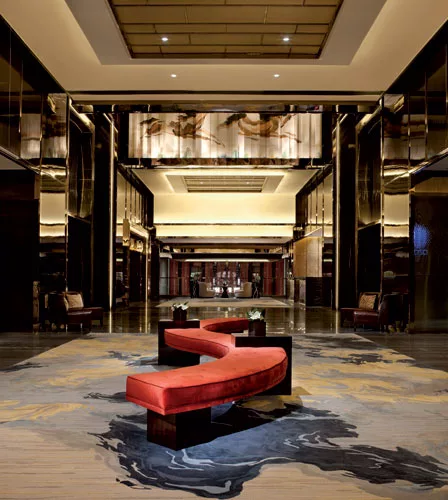
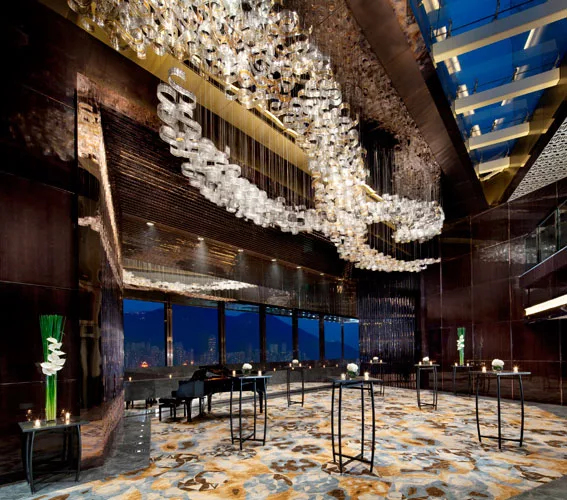
A smaller “street” lobby at “Level 9” is reached by driving up a curving road to the hotel entrance atop the station roof. The Singapore-based LTW Design Works designed the rectangular hotel lobby, which includes a pastry café, in a softly hued contemporary-luxe manner.
 
Photo © Chris Cypert
International Commerce Center
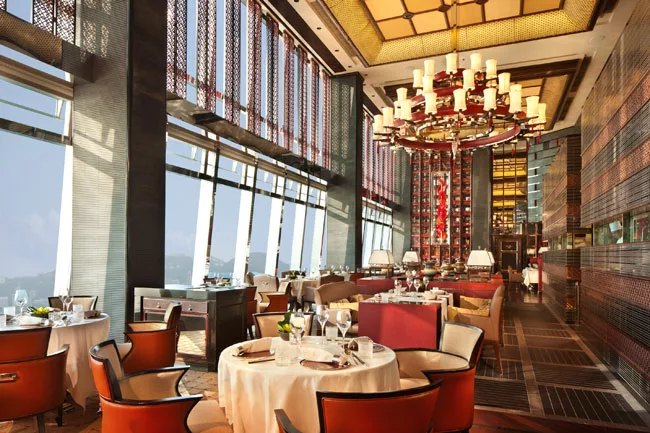
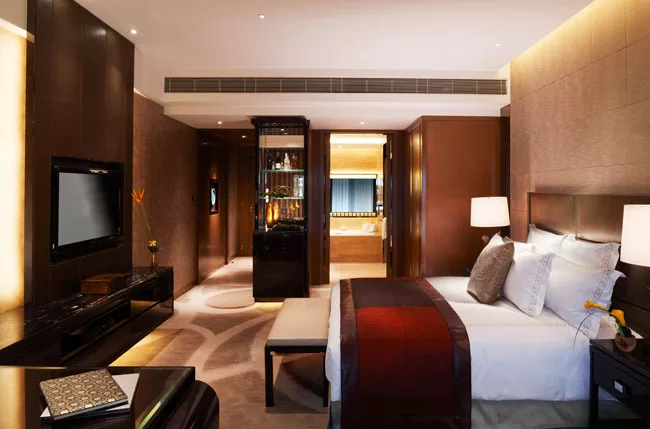
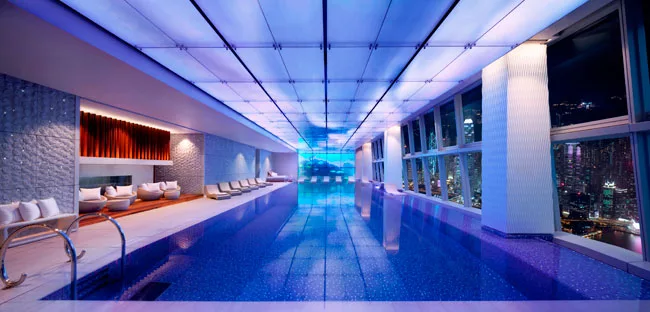
LTW Design Works (rooms, public spaces); Spin Design Studio (restaurants); Wonderwall (bar)
 
Image courtesy Ritz-Carlton
International Commerce Center
LTW Design Works (rooms, public spaces); Spin Design Studio (restaurants); Wonderwall (bar)
 
Image courtesy Ritz-Carlton
International Commerce Center
LTW Design Works (rooms, public spaces); Spin Design Studio (restaurants); Wonderwall (bar)
 
Image courtesy Ritz-Carlton
International Commerce Center
LTW Design Works (rooms, public spaces); Spin Design Studio (restaurants); Wonderwall (bar)
 
Image courtesy Ritz-Carlton
International Commerce Center
International Commerce Centre
LTW Design Works (rooms, public spaces); Spin Design Studio (restaurants); Wonderwall (bar)
 
Image courtesy Ritz-Carlton
International Commerce Center
International Commerce Centre
LTW Design Works (rooms, public spaces); Spin Design Studio (restaurants); Wonderwall (bar)
 
Image courtesy Ritz-Carlton
International Commerce Center
International Commerce Centre
LTW Design Works (rooms, public spaces); Spin Design Studio (restaurants); Wonderwall (bar)
 
Image courtesy Ritz-Carlton
International Commerce Center
International Commerce Centre
LTW Design Works (rooms, public spaces); Spin Design Studio (restaurants); Wonderwall (bar)
 
Image courtesy Ritz-Carlton
International Commerce Center
International Commerce Centre
 
Image courtesy Ritz-Carlton
International Commerce Center
International Commerce Centre
 
Image courtesy Ritz-Carlton
International Commerce Center
International Commerce Centre
 
Image courtesy Ritz-Carlton
International Commerce Center
International Commerce Centre
 
Image courtesy Ritz-Carlton
International Commerce Center
International Commerce Centre
 
Image courtesy Ritz-Carlton
International Commerce Center
International Commerce Centre
 
Image courtesy Kohn Pedersen Fox Architects
International Commerce Center
International Commerce Centre
 
Image courtesy Kohn Pedersen Fox Architects
International Commerce Center
International Commerce Centre
 
Image courtesy Kohn Pedersen Fox Architects
International Commerce Center
May 16, 2012

Architects & Firms

Kohn Pedersen Fox

Hong Kong, Kowloon

People/Products

American architects are exporting a luxury product of a dimension and scale few clients in the United States can afford at home: the supertall skyscraper—that is, a skyscraper over 1,250 feet tall (page 160). Kohn Pedersen Fox (KPF), the architect for the 1,588-foot-high International Commerce Centre (ICC) in Hong Kong, opened in 2011, ventured into Asia in the 1990s, and soon made its mark with towers in Shanghai and Tokyo. By the time the firm completed the tallest building in China in 2008—the 1,614-foot-tall Shanghai World Financial Center—it was at the center of an inner circle of (mostly American) architects designing supertall skyscrapers. Now KPF's roster of higher-than-high-rises in the works include five in China—in Shenzhen, Chongqing, Guangzhou, Shenyang, and Suzhou—one in Seoul, and another in Doha, Qatar.

William Pedersen, KPF design partner, credits America's edge in the global skyscraper boom to its historic role in inventing and advancing the tall-building type. And American architectural firms, says managing partner Paul Katz, are less hierarchical and more heterogeneous in their organization than many firms abroad. A “flatter” management structure allows U.S. architects to be “more inventive and motivated,” he says

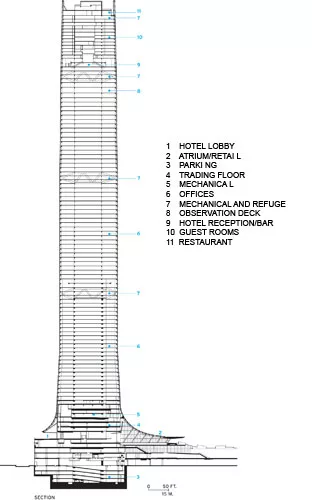
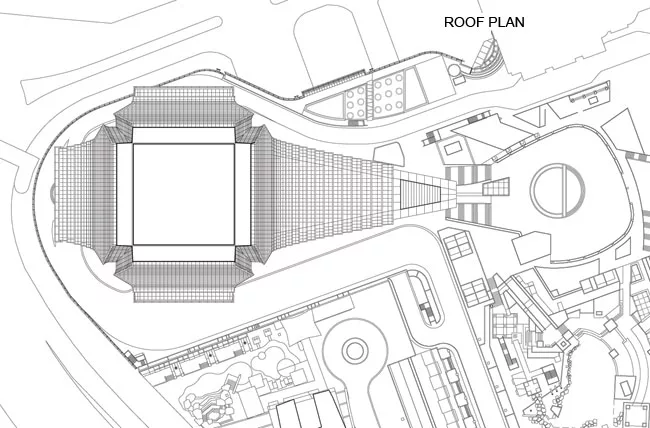
In 2000, KPF won the commission to design the 2.8 million-square-foot ICC that would loom up over the West Kowloon Station on the other side of Victoria Harbor from Hong Kong Island. The invited competition, which included Skidmore, Owings & Merrill (SOM), Pelli Clarke Pelli, and Kenzo Tange Associates, was initiated by developers Sun Hung Kai Properties, who had joined up with the Mass Transit Railway Corporation (MTR) to create an urban complex on 825 acres of reclaimed land. Residential high-rises, a W Hotel, restaurants, and cafés surround the signature tower planted atop a retail and mass-transit hub. In addition to spec office space, the ICC contains the super-luxe Ritz-Carlton Hotel within its upper reaches—for now the highest hotel in the world.

On the waterfront side of the tower to the east, construction of the Express Rail Link (ERL), a high-speed train to mainland China, is under way, and soon the much-touted West Kowloon Cultural District, planned by Foster + Partners as a series of low-rise museums and parks, will take shape to the south. Across the harbor rises the 1,335-foot-high Two International Finance Centre (2 IFC) in the Central District, also developed by Sun Hung Kai, and designed by Pelli Clarke Pelli in 2003. 2 IFC and ICC now form a totemic, monumental gateway to the city, each shooting up among an asparagus patch of Hong Kong's skyscrapers. If ICC's gleaming shaft lacks the instant recognition of Foster's much shorter HSBC (1986), its quiet comportment serves as a welcome antidote to the hurly-burly of most Hong Kong high-rises. Overlapping glass panels articulate the tapering elongated shaft, which terminates at the ground in a curved glass shed over the atrium. ICC's glass shingles and scooping canopy allude obliquely to the scales and tail of a dragon. “ 'Kowloon' means 'nine dragons,' ” says Pedersen of the place name that refers to the dragonlike form of Hong Kong's hills.

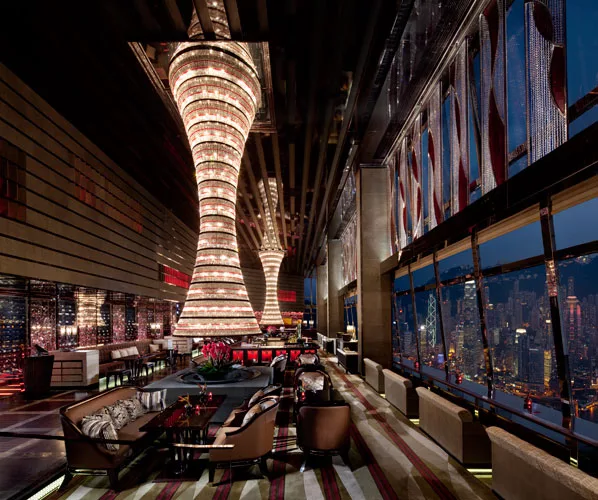
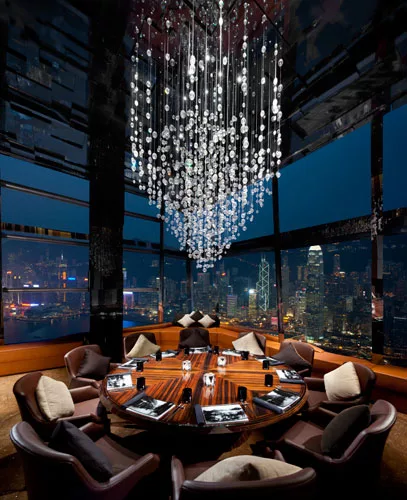
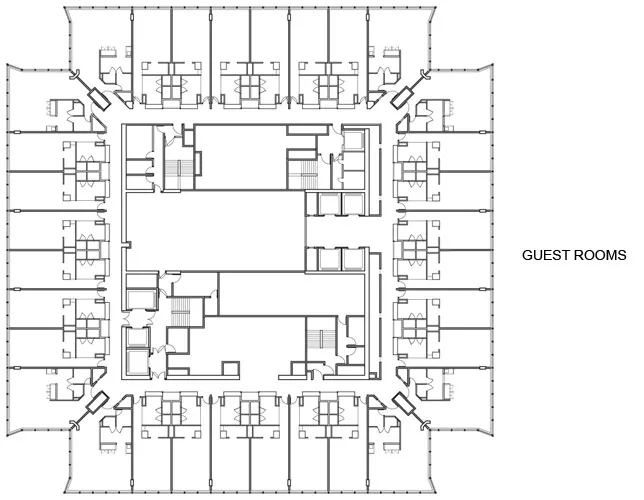
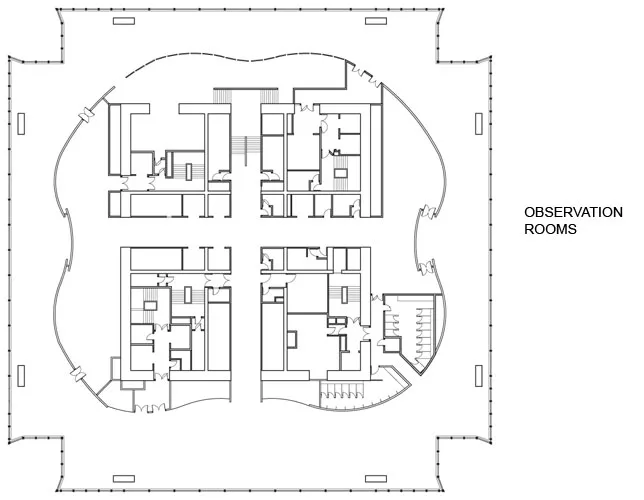
You arrive at the ICC by metro from the airport or Hong Kong Island—or by car on a curving road that leads to the hotel and office lobbies atop the station roof. From the car drop-off at Level 9, local and express elevators with requisite sky lobbies shoot up the tower: One stop away is the Ritz-Carlton reception area on the 103rd floor, where double-height restaurants overlook the city. On the uppermost (118th) floor you find the gym and pool, plus the over-the-top pulsating Ozone bar. It's all about the view, which sometimes the interior designers of the restaurants (Tokyo-based SPIN Design Studio) and the bar (the Japanese firm Wonderwall) forget in drowning the spaces in cocktail concoctions of splashy colors and frenetic motifs. LTW Design Works of Singapore gave the guest rooms a rich Buddhist-boudoir look.

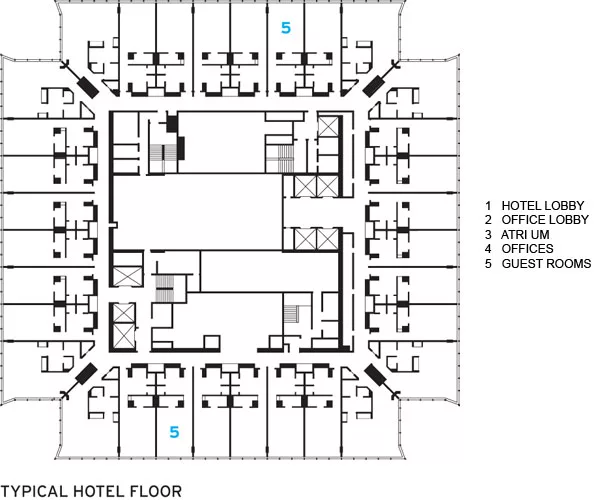
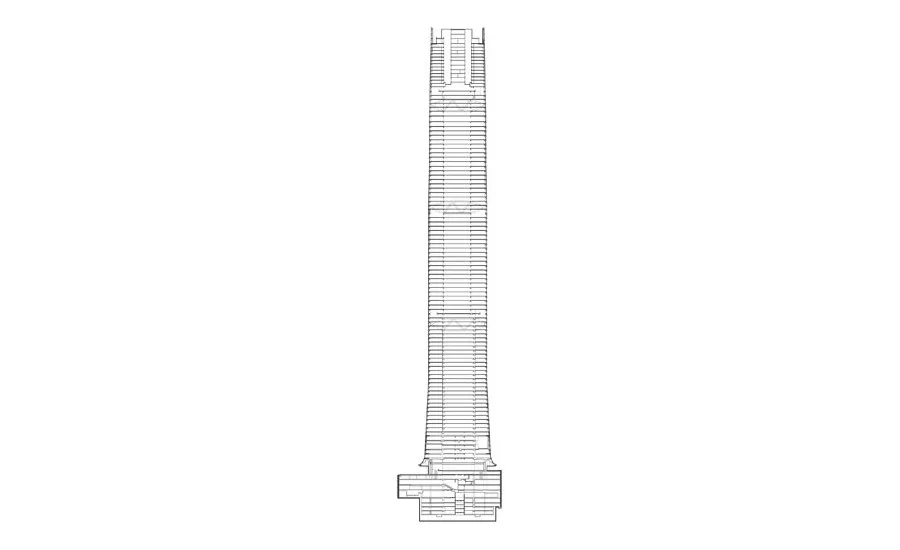
The ICC tower relies on a reinforced-concrete central core and an eight-mega-column structure for its square-donut plan, proposed by the structural engineer for the conceptual design, Leslie E. Robertson. Outrigger trusses couple the central core to the mega-columns on four different floors in the tower, with the lowest one made of prestressed concrete and the others constructed of structural steel. To deal with the soil and, below that, a clifflike bedrock, structural engineers for the execution of ICC, ARUP, turned to shaft-grouted friction barrettes for the foundation. As ARUP director Philip Lai explains, the barrettes—rectangular concrete piles, with an average depth of 230 feet—transfer loads on four sides to adjacent soil for stability (for more details see architecturalrecord.com).

Since the major problem confronting supertall towers is wind loads, Pedersen designed a reentrant (notched) corner to mitigate vortex shedding. Overlapping glass panels, each one-story high, spill down the facade, articulating the skin and creating canopies for the offices and hotel entrances. The flat, shingled panels lift up horizontally 5 degrees from the sloping wall; at the base, where the tower meets the atrium, the panels seem to slide into a catenary curve formed by three tangential arc segments.

The silver-coated, low-E glass shingles come in two types— one, a 10-foot-wide-by-5-foot-high glass-spandrel panel covering the slab edge and perimeter beam; the other, a 5-foot-wide and 10-foot-high vision panel. (At the reentrant corners, a striped, ceramic-frit spandrel panel helps cut glare.) The high-performance glass—and a system of sensors and monitors for HVAC use, which was developed with Hong Kong Polytechnic University—should reduce energy consumption by 15 percent, compared with an average office building.

Clearly, the cost of the supertall is not cheap. According to the architects, ICC's total budget was not made known even to the team. Katz maintains that the developers supervised costs and construction time quite closely on a need-to-know basis as the different parts of the building went out to bid.

Now, a year after this vast, vertical city opened, it is possible to stay in the Ritz-Carlton, do business with financial firms, such as Credit Suisse, Morgan Stanley, and Deutsche Bank ensconced below, shop in the mall, and take the metro to 2 IFC, where you can repeat this experience—without going outside. Soon you will be able to go directly from the ICC to Shenzhen or Guanzhou. Most of the time you'll occupy American export architecture, a fitting ambience for a monocultural luxury retail environment dominated by Armani, Chanel, and the like. It's almost like being in New York, but unlike Manhattan, it's a lot taller, denser, and harder to go outside and just take a walk around the block.


People

Architect:
Kohn Pedersen Fox Associates PC

Owner: Sun Hung Kai Properties

William Pedersen FAIA FAAR, Design Principal
Paul Katz FAIA HKIA, Managing Principal
Shawn Duffy AIA, Project Manager
David Malott, Senior Designer
Trent Tesch AIA, Senior Designer
Kar-hwa Ho AIA, Senior Designer (Interiors)

Associate architect: Wong & Ouyang

Interior designer(s): KPF (Office Public Areas), LTW Design Works (Hotel)

Engineer(s):
Structural & Civil, Fire Safety & Engineering: ARUP
MEP Engineer: J. Roger Preston Limited

Consultant(s):
Landscape: Belt Collins & Associates
Lighting: Lighting Planners Associates
Vertical Transport: Lerch Bates
Exterior Wall: ALT Cladding & Design Philippines, Inc.
Quantity Surveyor: WTP

General contractor: Sanfield

Renderer(s): AMD, Superview (3)

CAD system, project management, or other software used: Autocad, Rhino3D

Gross square footage:

2,822,136

Completion date:

May 2011


Products

Exterior cladding
Metal Panels: Permasteelisa
Metal/glass curtain wall: Permasteelisa; contact Stuart Orr (stuart.orr@permasteelisagroup.com)
Curtain wall: Permasteelisa

Glazing
Glass: Shanghai Yaohua Pilkington (SYP)
Skylights: Shanghai Yaohua Pilkington

Doors
Entrances: Dorma, Crane

Special interior finishes unique to this project: Specialty stone interior supply and fabrication: Mariotti Carlo & Figli, contact Primo Mariotti at primo@mariotticarlo.com

 
KEYWORDS: Hong Kong

Share This Story

Looking for a reprint of this article?
From high-res PDFs to custom plaques, order your copy today!

Stephens

Suzanne Stephens, a former deputy editor of Architectural Record, has been a writer, editor, and critic in the field of architecture for several decades. She has a Ph.D. in architectural history from Cornell University, and teaches a seminar in the history of architectural criticism in the architecture program of Barnard and Columbia colleges.

Post a comment to this article

Report Abusive Comment

Subscription Center
  • Create an Account
  • Start a Subscription
  • Manage My Account
  • Sign Up for Newsletters
  • Visit Customer Service
  • Update Preferences

More Videos

Sponsored Content

Sponsored Content is a special paid section where industry companies provide high quality, objective, non-commercial content around topics of interest to the Architectural Record audience. All Sponsored Content is supplied by the advertising company and any opinions expressed in this article are those of the author and not necessarily reflect the views of Architectural Record or its parent company, BNP Media. Interested in participating in our Sponsored Content section? Contact your local rep!

close
  • TAMLYN XtremeTrim Exterior Trim
    Sponsored byTamlyn

    Designing Cleaner Panel Facades: Why Exterior Trim Details Matter

  • Building with Vapor Barriers
    Sponsored byReef Industries, Inc.

    Vapor Barriers Help Control Moisture in Tighter Building Designs

  • Duct Interior with Prodeq System
    Sponsored byHenry, a Carlisle Company

    Designing Resilient Water Containment Systems

DESIGN:ED Podcast
Listen to Architectural Record’s DESIGN:ED Podcast

Events

June 11, 2026

Very Early Warning Fire Detection for Mission-Critical Facilities

Credits: 1 AIA LU/HSW; 1 AIBD P-CE; 0.1 ICC CEU

Examine advanced fire detection strategies that support uptime and enhance safety in data centers and other mission-critical facilities.

June 16, 2026

Focus on the Façade: Exploring Steel, Timber & Fire-Rated Curtain Walls and Channel Glass Systems

Credits: 1 AIA LU/HSW; 1 AIBD P-CE; 0.1 ICC CEU

Explore modern façade and glazing systems that enhance daylighting, fire safety, and thermal performance while expanding architectural design possibilities.

View All Submit An Event

Products

2026 Architect's Square Foot Costbook

2026 Architect's Square Foot Costbook

See More Products

Popular Stories

Practice Matters illustration

What’s in a (Firm’s) Name? Thinking About Succession and Legacy

Coronado Bridge

The Architect’s Guide to San Diego

Practice Matters illustration

By the Numbers: Counting America's Architects

Crane Cove, ONO

Design Vanguard 2026 Winners

House on a Hill

Design Vanguard 2026: Forma

Broader Sustainability of CMU - Free Webinar - May 21, 2026

Related Articles

  • South Shore International College Prep High School

    See More
  • Cathedral of the Light

    Cathedral of Christ the Light

    See More
  • BrillhartHouse_FT

    Brillhart House

    See More

Related Products

See More Products
  • ribbonarch.jpg

    Ribbon Architecture: Light, Shadow, and Reflection in Architecture

See More Products
×

The latest news and information

#1 Source for Architectural Design, News and Products

SUBSCRIBE
  • RESOURCES
    • Advertise
    • Contact Us
    • Submit
    • Store
  • ACCOUNT CENTER
    • Create an Account
    • Start a Subscription
    • Manage My Account
    • Sign Up for Newsletters
    • Visit Customer Service
    • Update Preferences
  • PRIVACY
    • PRIVACY POLICY
    • TERMS & CONDITIONS
    • DO NOT SELL MY PERSONAL INFORMATION
    • PRIVACY REQUEST
    • ACCESSIBILITY
  • SERVICES
    • Marketing Services
    • Reprints
    • Market Research
    • List Rental
    • Survey/Respondent Access
  • STAY CONNECTED
    • Linkedin
    • Facebook
    • Instagram
    • YouTube
    • X (Twitter)

Copyright ©2026. All Rights Reserved BNP Media, Inc. and BNP Media II, LLC.

Design, CMS, Hosting & Web Development :: ePublishing